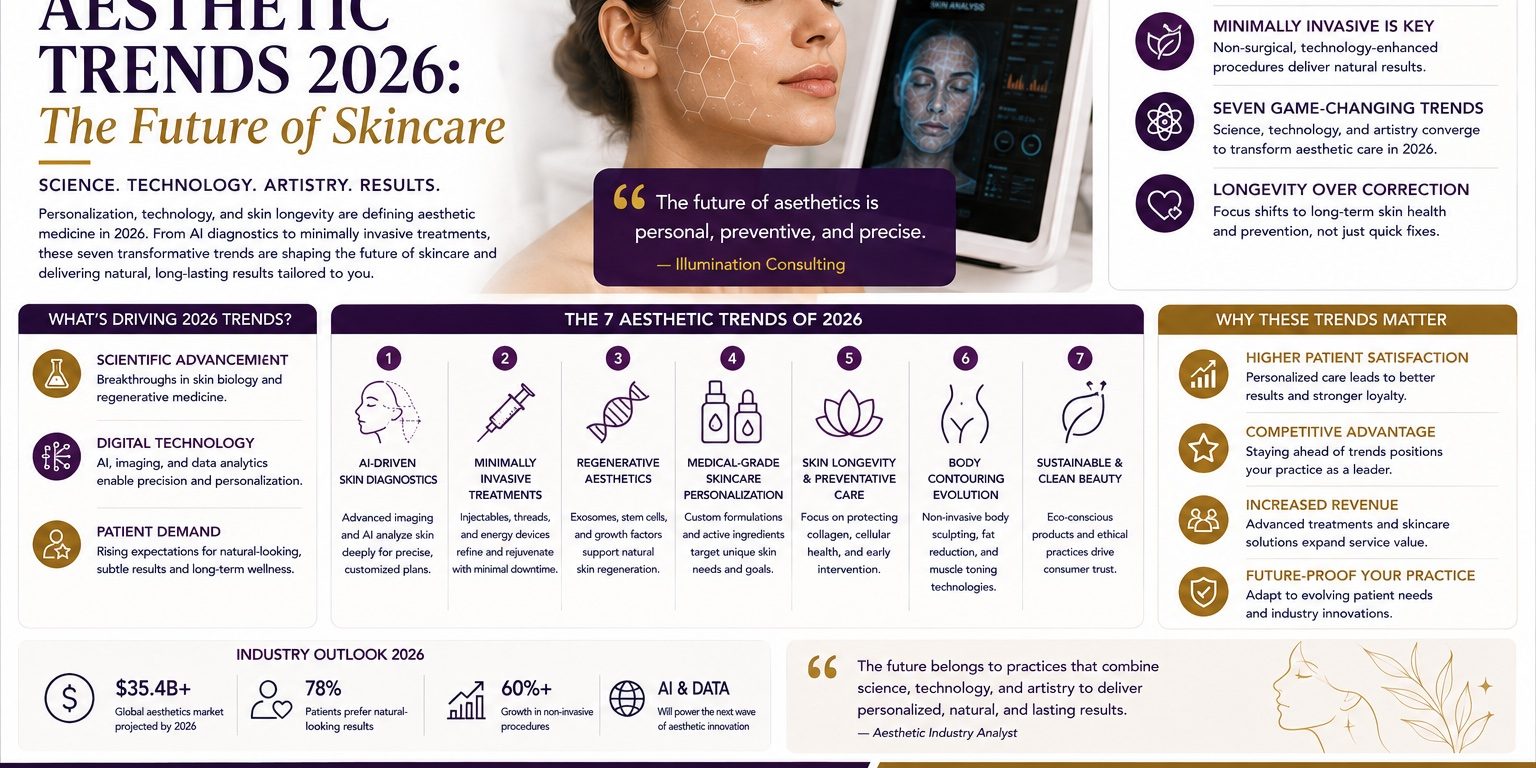
When it comes to aesthetic trends 2026, personalization dominates 2026, with seven game-changing trends—from AI-driven skin diagnostics to minimally invasive, longevity-focused treatments—reshaping aesthetic medicine. Illumination Consulting, based in Beverly Hills, CA, tracks these shifts as science, technology, and artistry converge to deliver natural-looking, data-informed results tailored to individual skin needs.
Aesthetic medicine and skincare in 2026 center on personalization, technology-driven diagnostics, and skin longevity over generic routines. Seven transformative trends—identified in industry analysis published February 2026—merge science and artistry to deliver minimally invasive, natural-looking results. Clinicians and skincare brand strategists gain a competitive edge by aligning treatment protocols. Product development with these data-informed, patient-specific demands.
Key Takeaways
- Personalization drives 2026 aesthetic medicine, with skincare plans tailored to individual skin profiles and longevity goals.
- Minimally invasive procedures dominate 2026 trends, replacing traditional surgery with technology-enhanced natural-looking enhancements.
- Seven transformative aesthetic trends reshape 2026 care, merging science, technology, and artistry for optimal results.
- Aesthetic health establishes itself as a key pillar of modern wellbeing in 2026 and beyond.
What’s Driving Aesthetic Trends in 2026?
Three forces converge to reshape medical aesthetics this year: scientific advancement, digital technology, and growing patient demand for subtlety. Science, technology, and artistry now merge to meet rising demand for personalized, minimally invasive treatments, marking 2026 as a pivotal turning point for the specialty. Clinicians who once relied on standardized protocols now face patients requesting outcomes calibrated to their unique skin biology and lifestyle goals.
Aesthetic trends 2026 center on three pillars rather than a single dominant technique or product category. Personalization drives treatment planning. Technology shapes diagnostics and delivery. Skin longevity replaces short-term correction as the guiding objective. No single routine or protocol satisfies every patient anymore; practitioners must build flexible, data-informed treatment plans instead.
AI-Driven Personalized Diagnostics Transforming Aesthetic Trends 2026
Advancements in artificial intelligence underpin the rise of personalized diagnostics within aesthetic trends 2026. AI-driven skin analysis tools provide clinicians with precise data on hydration, barrier function, pigmentation, and other skin characteristics before recommending tailored treatment plans. This technology enables objective, reproducible skin assessments that optimize patient outcomes while aligning with individualized longevity and wellness goals.
Why AI Personalized Diagnostics Are Game-Changers
Integrating AI tools helps practitioners break from one-size-fits-all protocols, instead delivering data-driven, customized therapies. These diagnostics support real-time monitoring of skin response, allowing continuous adjustment and refinement of treatments to maximize effectiveness and sustainability within the med spa marketing industry trends.
Regenerative Aesthetics: Exosomes, Polynucleotides, and Beyond
Regenerative medicine-based approaches, including use of exosomes and polynucleotides, are key innovations in skincare trends 2026. These biologically active molecules stimulate cellular regeneration and repair, targeting deeper tissue rejuvenation to enhance skin vitality and firmness with minimal downtime.
How Regenerative Therapies Align With Patient Expectations
Patients increasingly seek treatments that promote natural, long-lasting skin health improvements rather than temporary fixes. Regenerative aesthetics meet this demand by harnessing the body’s innate healing processes, fitting within aesthetic trends 2026 that prioritize minimally invasive longevity protocols for sustainable results.
Minimally Invasive Longevity Protocols Leading Med Spa Industry Trends
Minimally invasive longevity protocols dominate med spa industry trends by offering precision facial rejuvenation without surgery. Techniques such as injectables, micro-cannula fat grafting, and advanced energy-based devices provide subtle yet impactful enhancement, emphasizing long-term skin health and structural integrity over dramatic, immediate corrections.
Benefits of Longevity-Focused Treatments
- Reduced downtime and risk compared to surgical alternatives
- Customization tailored to individual aging patterns and lifestyle
- Focus on gradual, natural-looking improvements to support sustained wellness
Clean Clinical Formulations Driving Skincare Trends 2026
Clean clinical formulations continue to shape skincare trends 2026, blending efficacy with safety and sustainability. Med spa clients increasingly demand transparent ingredient sourcing, minimal irritants, and eco-conscious production in their skincare products. Formulations integrating bioengineered actives, antioxidants, and barrier-supportive compounds achieve potent results without compromising skin health or environmental impact.
Why Clean Clinical Formulations Matter
Integrating clean, scientifically validated ingredients elevates product trust and aligns with growing consumer awareness around holistic health and sustainability. This approach supports long-term skin integrity as emphasized by the broader aesthetic trends 2026 movement toward wellness-oriented care.
Sustainable Med Spa Operational Trends in 2026
Operational sustainability is emerging as a crucial pillar within med spa industry trends. Beyond clinical innovation, med spas implement eco-friendly practices in facility management, waste reduction, and energy efficiency. Additionally, technology-driven patient management systems streamline bookings, retention, and education to build enduring client relationships while minimizing resource waste.
Implementing Sustainable Practices for Growth
- Adoption of digital consultation and virtual follow-ups to reduce patient travel
- Utilizing green-certified product lines and materials
- Integrating comprehensive retention workflows aligned with marketing and SEO for efficient patient acquisition and loyalty
- Tracking revenue attribution for strategic reinvestment
What Skincare Trends Will Define 2026?
Technology now dictates how skincare treatments get designed and delivered, not just how they get marketed. Skincare trends 2026 center on data-driven formulation and diagnostics rather than seasonal product launches. Practices and brands that ignore this shift risk losing patients and customers to competitors offering personalized, tech-enabled experiences.
Diagnostic tools once considered experimental have entered mainstream clinical and retail use. AI-driven skin analysis and bio-engineered ingredients have moved from concept to commercial reality, giving practitioners precise data on hydration levels, barrier function, and ingredient response before recommending treatment. This shift changes how dermatologists, medspa practitioners, and skincare brand strategists approach product development and patient consultations alike.
How Do Brands Turn These Trends Into Sustainable Growth?
Technology alone doesn’t guarantee business success. Skincare brands that thrive in 2026 build complete business ecosystems instead of chasing individual marketing tactics like a single viral campaign or seasonal promotion. That means aligning diagnostic technology, product formulation, and customer retention systems into one coordinated growth strategy.
Why Do So Many Skincare Brands Stall After Launch?
Many brands generate strong initial sales, then hit a wall. The failure rarely traces back to product quality. Instead, brands lack the systems needed to convert first-time buyers into repeat customers and scale beyond the startup phase.
Brand strategists evaluating aesthetic trends 2026 should weigh both fronts:
- Technology adoption — diagnostic tools, formulation science, personalization engines
- Business infrastructure — retention systems, conversion pathways, ecosystem-level strategy
Clinicians and consumers who understand this dual shift — technological sophistication paired with operational discipline. Will recognize which brands are built to last and which are chasing trends without a foundation.
How Are Med Spas Embracing Non-Surgical Treatments?
Patient demand drives the shift toward non-surgical rejuvenation across the medical spa industry. Injectable-based facelifts, often called “Invisilifts,” have moved from niche procedure to mainstream option for patients in their 30s, 40s, and 50s seeking dramatic results without an operating room. This shift reflects broader aesthetic trends 2026 that favor precision, downtime-free treatments over invasive surgery.
Clinical innovation alone does not build a thriving practice. Growth now depends on consulting, marketing, branding, and website development functioning as one connected system rather than isolated tactics. A clinic can offer the most advanced filler protocols available. Without a coordinated growth strategy, patient bookings stall and revenue plateaus.
What Does a Modern Med Spa Growth Strategy Look Like?
Sustainable patient acquisition requires several disciplines working together, not in isolation:
- Search engine optimization to capture patients actively searching for treatments
- Website design built for conversion, not just aesthetics
- Patient acquisition strategy tied to measurable booking outcomes
- Reputation management to protect and strengthen online trust
These elements reflect current med spa industry trends. Practices that integrate consulting, SEO, and branding consistently outperform those relying on single-channel marketing.
Why Does Social Media Matter for Patient Acquisition?
Social platforms now shape how prospective patients evaluate a practice before ever scheduling a consultation. Visual proof of results, provider credibility, and patient testimonials circulate publicly, making social media one of the most influential channels in the decision-making process. Clinics that neglect this channel cede visibility to competitors who actively showcase outcomes and expertise online.
Why Does Aesthetic Health Mean Whole-Body Wellness?
Modern medicine no longer treats appearance and physical health as separate categories. Aesthetic health now functions as a core pillar of overall wellbeing, standing alongside nutrition, sleep, and preventive care rather than sitting apart as a cosmetic afterthought. Mounting clinical evidence supports this shift: outward appearance and internal health are deeply linked, not isolated systems. A patient’s skin, muscle tone, and facial symmetry often reflect broader physiological patterns, which is why forward-thinking clinicians frame aesthetic trends 2026 around integrated wellness rather than standalone procedures.
This reframing changes how practices market themselves and how patients evaluate outcomes.
How Do Patients Research Aesthetic Providers Before Booking?
Consultations rarely happen without prior research. Most prospective patients scroll through Instagram, Facebook, TikTok, YouTube, and LinkedIn first, comparing providers, studying before-and-after results, and learning how specific procedures actually work. That behavior means a clinic’s digital presence often shapes trust before a single conversation takes place.
What Separates High-Performing Med Spas Online?
Posting attractive photos alone no longer builds credibility. Practices that consistently attract new patients use social platforms to educate, not just showcase. They:
- Explain procedures in plain language for prospective patients
- Demonstrate real, verifiable treatment outcomes
- Answer common patient questions directly
- Build ongoing relationships with their local community
This educational approach reinforces the wellness-first positioning driving current med spa industry trends, and it signals a maturing market. As skincare trends 2026 increasingly emphasize long-term skin health over quick fixes, practices that communicate expertise transparently earn stronger patient trust than those relying on image alone.
How Should Practices Prepare for These Shifts?
Preparation demands a coordinated system, not a scattered checklist. Practices that treat marketing, operations, and patient retention as separate projects fall behind those running one integrated strategy. Staying competitive in the current med spa industry trends landscape requires positioning, search visibility, content, social presence, paid advertising, and retention working together rather than in isolation.
A fragmented approach costs practices real revenue. Clinics investing in ads without a retention plan often see patients book once and never return. Sustainable growth comes from qualified patient acquisition paired with tracking systems that show which channels actually convert.
What role does social media play in preparing for these changes?
Social platforms carry more weight than a highlight reel of before-and-after photos. An effective strategy for aesthetic practices builds trust and credibility long before a prospective patient books a consultation. Content should educate, answer common concerns, and demonstrate clinical expertise rather than chase vanity metrics.
Does scaling a med spa require outside expertise?
Most practices reach a growth ceiling without dedicated support for operations, bookings, and retention. Scaling sustainably means strengthening these three areas simultaneously through consulting, marketing, branding, and digital growth systems built specifically for aesthetics.
Practices ready to act should focus on:
- Auditing current skincare trends 2026-aligned service offerings against patient demand
- Aligning SEO, social, and paid campaigns under one measurable strategy
- Building retention workflows before increasing new-patient acquisition spend
- Tracking revenue attribution across every marketing channel
Practices that adopt this coordinated model, rather than chasing individual tactics tied to shifting aesthetic trends 2026, position themselves to convert interest into long-term patient relationships.
The aesthetic medicine and skincare landscape continues to evolve toward personalization, scientific rigor, and sustainable practices. Organizations that embrace these shifts—integrating advanced technology, data-driven strategies, and patient-centered approaches—establish competitive advantages that extend beyond immediate revenue growth. Success in this dynamic environment requires strategic planning, continuous adaptation, and commitment to delivering measurable results that strengthen both brand authority and long-term enterprise value.
FAQ
What are the main pillars shaping aesthetic trends in 2026?
Personalization, technology, and skin longevity form the three pillars driving 2026 aesthetic medicine. These forces replace standardized protocols with flexible, data-informed treatment plans tailored to individual skin biology and lifestyle goals.
Why do minimally invasive treatments dominate 2026 aesthetic medicine?
Minimally invasive procedures replace traditional surgery by combining technology with natural-looking enhancements. Patients increasingly request subtle, calibrated outcomes rather than dramatic corrections, pushing clinicians toward these technology-enhanced approaches.
How does Illumination Consulting help practices adapt to these trends?
Illumination Consulting, based in Beverly Hills, CA, tracks shifting aesthetic trends and helps practices translate them into strategic growth plans. The firm advises aesthetic and skincare businesses across major U.S. markets.
Facts
- Illumination Consulting is located in Beverly Hills, CA, USA.