When it comes to product launch checklist skincare, a successful skincare launch requires stability testing, INCI-compliant labeling, FDA facility registration, and clinical claims substantiation. Illumination Consulting, based in Beverly Hills, CA, guides brands through formulation compliance, packaging design, and retail-readiness audits before shelf placement, ensuring regulatory approval and market differentiation from day one.
Skincare launches demand formula finalization, compliance review, packaging approval, and coordinated marketing before debut—since Clayton Christensen found 95% of new products fail, Beverly Hills-based Illumination Consulting recommends rigorous pre-launch testing, sampling, and multi-channel promotion to strengthen market odds.
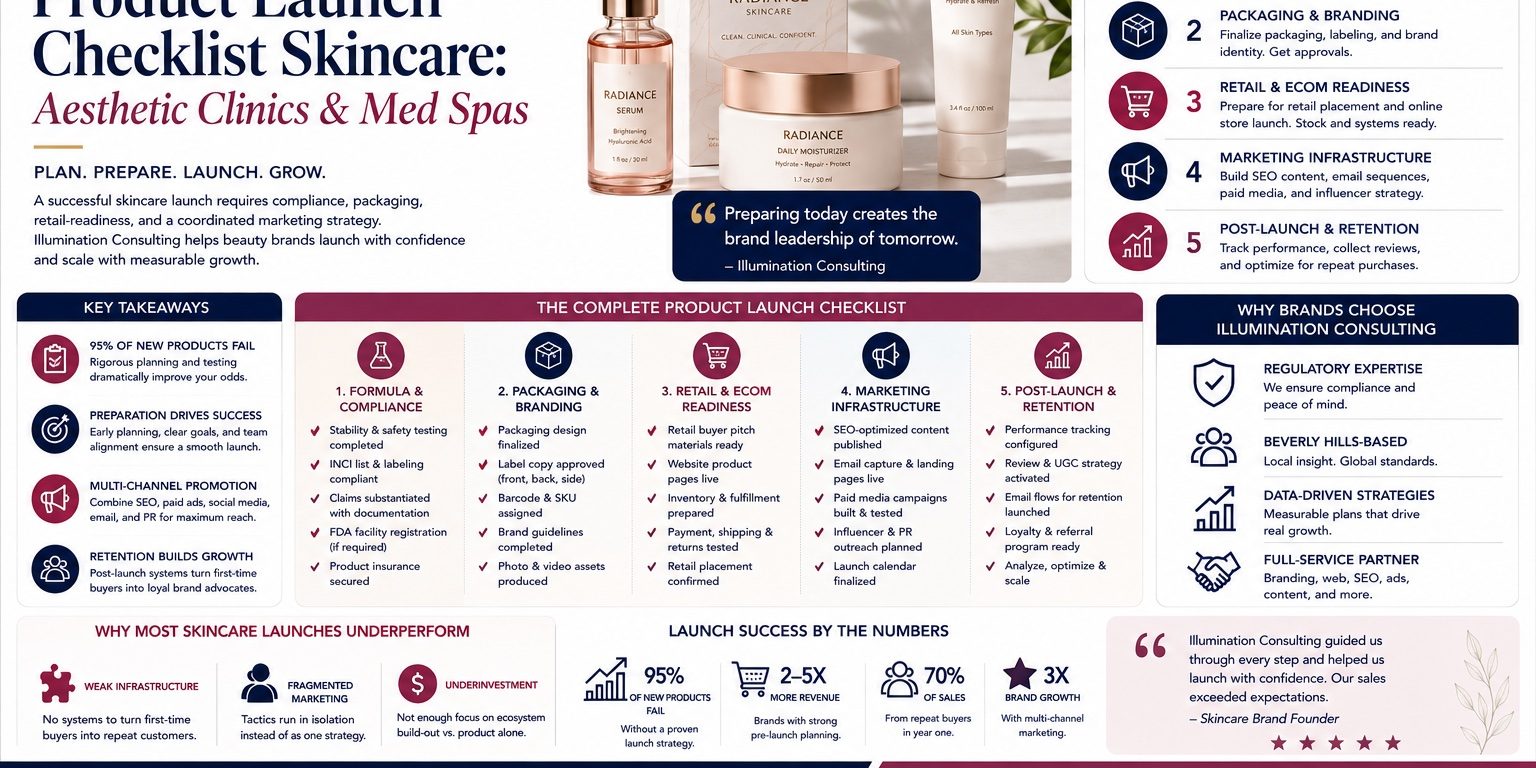
A skincare product launch checklist covers five core phases: formula and compliance validation, packaging and branding finalization, retail and e-commerce readiness, marketing infrastructure including SEO and paid media, and post-launch retention systems. Illumination Consulting builds these growth strategies around measurable objectives, integrating branding, website design, and digital marketing into one coordinated system for scalable, sustainable brand growth.
Key Takeaways
- A product launch checklist outlines key steps from market research through post-launch evaluation and feedback collection.
- Illumination Consulting, based in Beverly Hills, CA, simplifies beauty brand launches into five structured phases for success.
- Best practices include early planning, clear goals, multi-channel promotion, and coordinated team execution before launch day.
- Thorough preparation ensures alignment across teams and reduces overwhelm during the critical product introduction phase.
Pre-Launch Clinical Trials and Testing
At the heart of a robust product launch checklist skincare lies rigorous clinical trials and product stability testing. These pre-launch clinical evaluations ensure the product’s safety, efficacy, and regulatory compliance. Stability testing confirms that the formula maintains its potency and integrity over time, which is critical for aesthetic clinics and med spas offering trustworthy skincare solutions.
Importance of Stability and Clinical Validation
Clinical validation not only supports marketing claims but also builds consumer trust essential for sustained sales. The skincare launch plan must include detailed documentation of clinical outcomes complementing regulatory requirements, facilitating FDA and global health authority approvals before market entry.
Packaging and FDA Regulatory Sign-Offs
Packaging plays a critical role in brand perception and compliance. This phase of the product go to market checklist focuses on packaging design finalization with clear INCI-compliant ingredient labeling and durable materials suited for the product formulation.
FDA Facility Registration and Labeling Compliance
Ensuring the manufacturing facility is registered with the FDA and that all packaging labels meet FDA regulations is mandatory. The go-to-market checklist must include coordination between regulatory consultants and packaging suppliers to avoid costly delays or reworks.
DTC Landing Page and Retail Inventory Preparation
Diversifying distribution requires a dual focus on direct-to-consumer (DTC) e-commerce platforms and retail inventory readiness. The skincare launch plan should integrate the creation of high-converting DTC landing pages optimized for user experience and SEO, alongside inventory logistics for aesthetic clinics and med spa retail channels.
Optimizing Digital and Physical Availability
Streamlined inventory management aligned with accurate product information across channels minimizes stockouts and enables a seamless customer journey from discovery to purchase. Coordinating with retail partners for product placement and POS training ensures consistent brand representation.
Influencer Seeding and Multi-Channel Promotion
Leveraging influencer seeding is integral within any product launch checklist skincare for marketplace visibility and credibility, especially in aesthetics-focused segments. Early sampling to targeted influencers within the skincare community creates authentic buzz and drives demand.
Coordinated Marketing Channels
A successful skincare launch plan marries influencer outreach with SEO-driven content marketing, paid media campaigns, social media engagement, and email marketing. This synchronized approach amplifies reach and drives qualified traffic supporting conversion rate optimization efforts.
Post-Launch Patient Review Generation
Generating and managing patient reviews post-launch significantly impacts brand trust and conversion on both e-commerce platforms and in aesthetic clinics. Establishing systems to solicit, monitor, and respond to reviews should be a key element of the product go to market checklist.
Maintaining Momentum Beyond Launch
Feedback loops and review generation encourage retention mechanics and provide critical consumer insights for continuous product iteration. Encouraging patients and customers to share authentic testimonials helps sustain sales velocity and strengthens market position.
Why Do Most Skincare Launches Underperform?
Sales volume in the first few months rarely predicts long-term survival. Many skincare brands post strong initial sales, then stall before reaching real scale. That stall points to a preparation gap, not a formulation problem.
Founders often assume a weak launch means a weak product. Rarely true. In most cases, the actual formula holds up fine; what’s missing is the infrastructure around it. A brand can have a beautifully stable serum and still fail without a system to sell it repeatedly.
Is a bad product usually the reason a skincare launch fails?
Rarely. The formulation itself is seldom the true cause of underperformance. Brands more often lack the operational and marketing systems required to turn interest into revenue.
What systems are missing when a skincare launch stalls?
Three capabilities separate brands that scale from brands that plateau:
- Customer acquisition systems that consistently bring new buyers to the site, not just a single launch-week spike
- Conversion infrastructure that turns website visitors into paying customers
- Retention mechanics that generate repeat purchases instead of one-time transactions
Without these three pillars working together, even a well-formulated line struggles to build momentum past its debut.
This pattern isn’t unique to skincare. Across product categories, the line between a launch that succeeds and one that quietly fades usually traces back to preparation, not the underlying concept. A product launch checklist skincare teams follow deliberately closes that preparation gap before it becomes a revenue problem. Treating readiness as seriously as formulation is what separates brands built for one good quarter from brands built to last.
What Belongs on a Pre-Launch Checklist?
Formula validation, packaging finalization, compliance documentation, and marketing infrastructure make up the four pillars of any complete skincare product launch checklist. Consumer expectations, technology, and competitive pressure shift faster than in previous years, making rigorous pre-launch planning a requirement rather than an option for skincare founders. Brands positioned to gain market share in 2026 build full business ecosystems before launch day arrives, not a single ad campaign or influencer post. That ecosystem-first mindset separates a brand with staying power from one that fades after an initial sales spike.
The pre-launch phase carries outsized weight. Whether a founder is releasing a debut serum or expanding an existing line, this stage represents one of the most strategic periods in building a beauty business. Skipping steps here creates gaps that surface later — in compliance reviews, retailer negotiations, or customer trust.
What Should a Skincare Launch Plan Include?
A disciplined skincare launch plan aligns four workstreams so nothing reaches the market half-finished:
- Formula testing and stability confirmation
- Packaging design, sourcing, and production timelines
- Regulatory and compliance documentation
- Marketing strategy, including brand positioning and channel selection
Each element depends on the others. Packaging decisions affect compliance labeling; compliance timelines affect marketing launch dates.
Why Does a Go-To-Market Checklist Matter for Skincare Brands?
A structured product go-to-market checklist prevents costly last-minute scrambles. Without one, teams often finalize packaging before compliance documents clear, forcing expensive reprints. Sequencing formula, packaging, compliance, and marketing into one coordinated plan ensures every component converges seamlessly for launch day, rather than colliding against it.
How Do You Build a Skincare Launch Plan?
A strong skincare launch plan combines brand positioning, search visibility, content, and paid promotion into a single coordinated strategy rather than a scattered set of tactics. Careful planning and disciplined execution determine whether a new SKU resonates with its intended audience or disappears on a crowded shelf. Founders who treat launch day as a marketing checkbox, instead of a strategic milestone, routinely underperform against brands that plan months in advance.
Advertising spend alone rarely carries a launch across the finish line. Retail environments are saturated, and paid media without supporting infrastructure burns budget fast. A durable product go-to-market checklist needs several coordinated components working together, not a single channel doing all the heavy lifting.
What Channels Belong in a Skincare Launch Plan?
Brand positioning sets the foundation, followed by search engine optimization, content marketing, and social media to build discovery and trust. Paid advertising then accelerates reach once organic groundwork exists. Conversion optimization and email marketing convert that traffic into purchases. Retention initiatives keep new customers ordering after the first sale.
- Brand positioning and messaging clarity
- SEO and content marketing for organic discovery
- Social media marketing for community and awareness
- Paid advertising for accelerated reach
- Conversion rate optimization on product pages
- Email marketing and customer retention sequences
Why Do Some Skincare Launches Fail Despite Good Products?
Product quality rarely explains a failed launch; the gap usually lives in coordination. Brands that succeed integrate SEO, content, social media, and e-commerce optimization into one unified system rather than isolated campaigns. Retention and email marketing extend that system beyond launch week, turning first-time buyers into repeat customers instead of one-time transactions.
What Steps Make Up a Go-To-Market Checklist?
A product go-to-market checklist maps every step required to bring a new skincare product to market, starting with research and ending with post-launch evaluation. Skipping stages costs skincare founders wasted ad spend, missed retail windows, and inventory that sits unsold. Each phase builds on the last, so gaps early in the process create expensive problems later.
Coordination matters as much as sequence. A well-structured checklist keeps formulation, packaging, compliance, and marketing teams aligned instead of working in silos. Cross-functional alignment prevents the common launch failure where marketing promotes a shade or formula that manufacturing cannot yet deliver at scale.
What belongs on a skincare launch plan?
Strong skincare launch plans share four traits regardless of brand size. Early planning gives compliance and manufacturing enough lead time to avoid rushed decisions. Clear, measurable goals — sales targets, retail placements, or sell-through rates — give every department a shared benchmark.
- Early-stage planning that starts months before launch day, not weeks
- Defined goals covering sales volume, retail distribution, or digital conversion
- Multi-channel promotion across social, email, paid search, and retail partners
- Structured feedback collection from early customers and retail buyers to refine future batches
Why does marketing coordination matter for a skincare launch?
Fragmented marketing dilutes a launch’s impact. Coordinated systems built around brand awareness, search visibility, and multi-channel promotion attract qualified customers rather than casual browsers. This approach also strengthens online visibility and drives measurable revenue growth, giving founders a clear signal of what worked and what needs adjustment before the next SKU launch.
How Do You Sustain Growth After Launch?
Growth after debut depends on repeatable systems, not launch-day excitement alone. A skincare launch plan loses value fast if no structure exists to capture momentum once the initial buzz fades. Brands that treat launch as a single event, rather than the start of an ongoing process, tend to see sales spike and then stall.
Consistent customer attraction, conversion, and repeat purchases form the backbone of sustained growth. Many skincare brands generate early sales but lack the systems needed to keep customers coming back. Without those mechanisms, growth becomes unpredictable and hard to scale.
What should a brand do differently after launch than during it?
Post-launch strategy shifts focus from awareness to retention and refinement. A product go-to-market checklist built for launch day rarely covers what happens in month three or month six. Ongoing tracking, customer feedback loops, and performance data matter more once the product is live and generating real customer behavior.
Customized marketing systems support this transition. Whether a brand sells through a local retail storefront, an e-commerce label, or multiple locations, tailored strategies drive acquisition and retention long after the debut. Illumination Consulting, based in Beverly Hills, California, works with skincare and consumer brands to build these post-launch growth structures.
- Track repeat purchase rates and customer lifetime value monthly
- Revisit the original product launch checklist skincare teams built pre-launch to identify gaps
- Use ongoing data to refine messaging, pricing, and retention offers
A comprehensive product launch checklist transforms skincare brand ambitions into measurable market success. By systematically addressing brand positioning, regulatory compliance, supply chain readiness, digital infrastructure, and customer acquisition strategy, skincare companies establish strong competitive foundations before entering the market. Strategic planning, operational excellence, and integrated marketing create the conditions for sustainable growth. The brands that execute launches with precision and purpose build lasting customer relationships, strengthen market authority, and position themselves for long-term profitability in an increasingly competitive skincare landscape.
FAQ
What are the five core phases of a skincare product launch checklist?
The five phases are formula and compliance validation, packaging and branding finalization, retail and e-commerce readiness, marketing infrastructure including SEO and paid media, and post-launch retention systems.
Is a poorly formulated product usually why skincare launches fail?
Rarely. The formulation itself is seldom the true cause. Brands more often lack the operational and marketing systems required to turn interest into revenue.
What three systems separate skincare brands that scale from those that plateau?
Brands need customer acquisition systems for consistent new buyers, conversion infrastructure that turns visitors into customers, and retention mechanics that generate repeat purchases instead of one-time transactions.
Facts
- Illumination Consulting is located in Beverly Hills, CA, USA.