By Illumination Consulting Editorial Team · Updated 2026-08-05
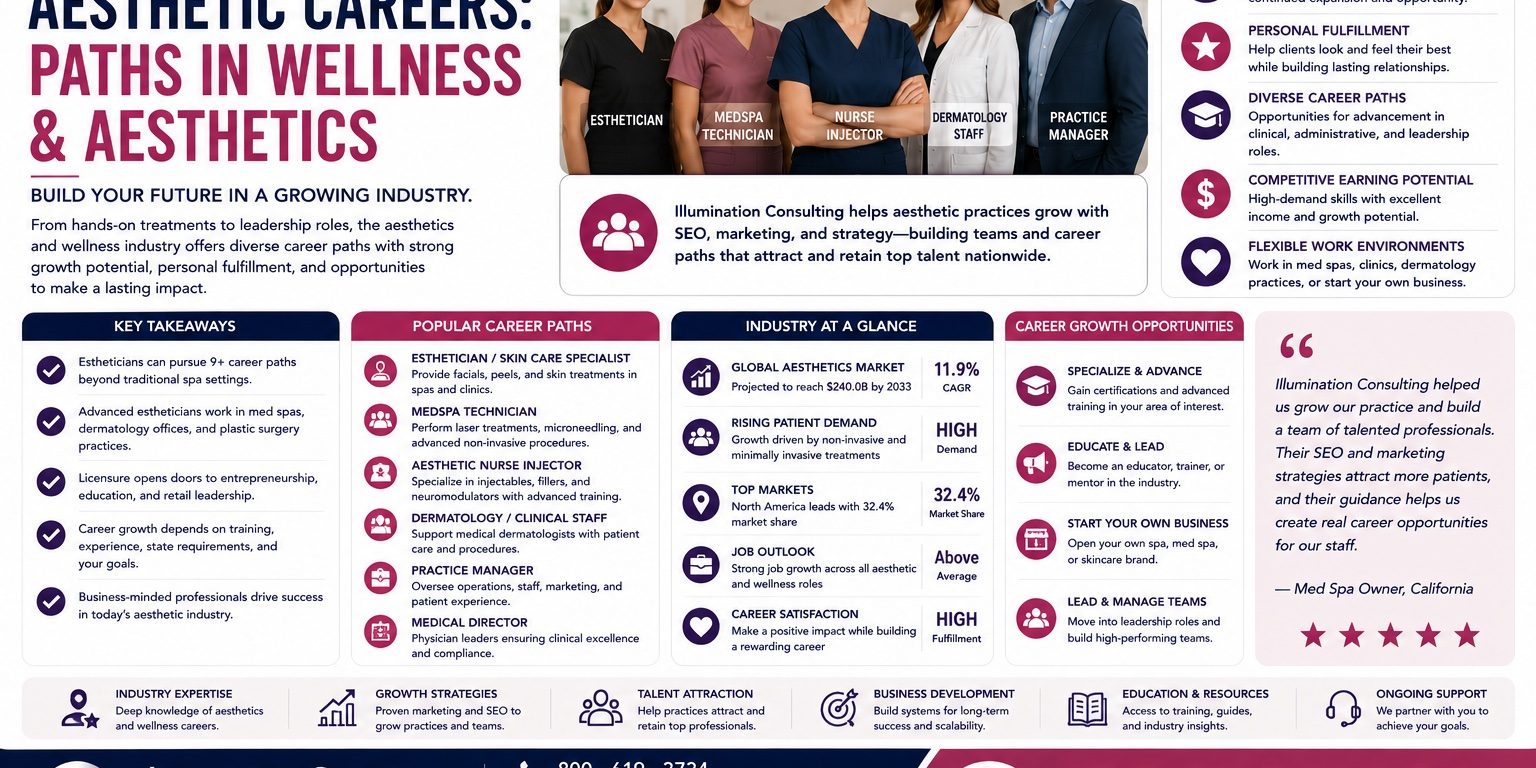
Career paths in aesthetics and wellness span estheticians, medspa technicians, aesthetic nurse injectors, dermatology staff, practice managers, and medical directors, spanning several distinct esthetician roles. Illumination Consulting, based in Beverly Hills, CA, supports professionals navigating these diverse, growing opportunities across spas, clinics, and medical practices.
Career paths in aesthetics and wellness span licensed esthetician roles, medical aesthetics nursing, spa management, and retail leadership within med spas and dermatology practices. Estheticians pursuing advancement often move into education, product specialization, or entrepreneurship. The field also rewards professionals who develop a business mindset alongside clinical skill, since medspas and dermatology practices increasingly look for staff who can contribute to patient retention, treatment sales, and brand reputation, not just service delivery. As the wellness and aesthetics industry expands, demand grows for practitioners who can move fluidly between hands-on treatment work and higher-level responsibilities like team training, protocol development, and client experience design. Illumination Consulting supports growing med spas and wellness brands with Aesthetic Clinic SEO: Attract More Patients, helping practices build teams and career tracks that attract skilled aesthetics professionals nationwide. That growth strategy work directly shapes the hiring pipeline: practices that market themselves effectively can recruit and retain stronger talent, which in turn creates more defined, better-supported career tracks for the professionals who join them.
Key Takeaways
- Estheticians work across nine or more distinct career paths beyond traditional spa settings.
- Advanced Practice Estheticians practice in medspas, dermatology offices, and plastic surgery practices nationwide.
- Esthetics licensure opens entrepreneurial opportunities including skincare business ownership and retail leadership roles.
- Career advancement depends on training, licensure, experience, state requirements, and professional goals alignment.
Licensed Aesthetician Certifications and Career Paths
One of the foundational elements for building strong career paths in the aesthetics sector is obtaining the correct licensed aesthetician certifications. These certifications vary by state but generally allow estheticians to perform skin care treatments such as facials, chemical peels, microdermabrasion, and laser hair removal where permitted. Many estheticians pursue additional certifications in advanced treatments, including advanced chemical peels, microneedling, and specialized modalities that enhance their clinic job prospects.
Holding a licensed aesthetician certification opens doors to various clinic jobs beyond traditional spa roles, including positions in dermatology clinics, med spas, and plastic surgery offices. It also provides a credential that supports entrepreneurial ventures such as skincare business ownership and retail leadership within aesthetic brands.
Nurse Injector Pathways (RN/NP/PA) in Aesthetic Careers
For registered nurses (RNs), nurse practitioners (NPs), and physician assistants (PAs), aesthetic careers often center on becoming nurse injectors. This role involves administering cosmetic injectables such as Botox, dermal fillers, and other neurotoxins, as well as performing patient consultations, treatment planning, and managing complication cases.
Pathways for nurse injectors typically require licensure as an RN, NP, or PA, followed by specialized training and certification in aesthetics and injection techniques. Continuing medical education (CME) is crucial to maintain certification and stay updated on evolving procedures and products. Nurse injectors are in high demand in med spas and dermatology clinics and often experience accelerated career advancement due to their combined clinical skill and patient relationship expertise.
Clinic Jobs Available for Nurse Injectors
- Med spa injector
- Dermatology cosmetic nurse
- Plastic surgery aesthetic injector
- Aesthetic education and training roles
Med Spa Practice Management Careers
Beyond clinical roles, med spa practice management represents a vital career path in the aesthetics sector. Practice managers oversee daily operations, including staffing, scheduling, compliance, budgeting, marketing, and revenue growth strategies. They serve as the bridge between clinical teams and business objectives to ensure both patient satisfaction and financial success.
Career paths here often begin with experience in spa or clinic operations and evolve into leadership roles through additional training in management, marketing, and business development. Illumination Consulting recognizes that med spa success depends heavily on hiring and retaining skilled professionals and building structured career tracks that offer advancement opportunities.
Key Responsibilities in Med Spa Practice Management
- Staff development and training coordination
- Compliance with healthcare regulations
- Financial oversight and budgeting
- Marketing and patient acquisition strategies
- Client experience design and retention initiatives
Continuing Medical Education (CME) in Aesthetic Careers
Continuing medical education (CME) plays a crucial role in career advancement and maintaining licensure within aesthetic careers. Med spas, clinics, and healthcare providers require practitioners to stay current with the latest treatment protocols, safety standards, and innovative technologies.
CME offerings in aesthetics often include workshops, certification renewals, advanced procedure training (e.g., new injectable products, laser treatments), and business skills workshops. Engaging in CME not only enhances clinical capabilities but also improves patient outcomes and clinic reputation, supporting stronger career paths and elevated roles.
Salary and Compensation Trends in the Aesthetics Sector
Salary and compensation trends vary widely across the spectrum of aesthetic careers and clinic jobs due to factors such as licensure level, geographic location, employer type, and experience. Entry-level spa estheticians typically earn a modest hourly wage which increases significantly with advanced certifications and clinical experience.
Nurse injectors (RN/NP/PA) generally command higher salaries reflecting their advanced clinical training and responsibilities, often supplemented by performance bonuses tied to treatment sales and patient retention. Med spa managers earn competitive salaries with additional incentives related to business growth metrics.
General salary ranges (approximate):
Overall, understanding salary trends helps aesthetic professionals strategize their career paths and negotiate compensation that reflects their skills and value to clinic jobs and aesthetic careers.
What Entry-Level Aesthetic Careers Can You Start With?
Spa esthetician work stands as the most accessible entry point into aesthetic careers. Newly licensed estheticians typically begin performing facials, exfoliation treatments, mask applications, and light chemical peels for clients seeking skin health and relaxation. This role builds hands-on technique, client communication skills, and product knowledge that carry into every advanced path that follows. Many spas also rotate new estheticians through retail consultation duties, giving them early exposure to product recommendation and sales conversations that later support higher-paying specialist and management roles.
Licensure opens doors well beyond the spa treatment room, though many aspiring professionals assume otherwise. Opportunities extend into luxury resorts, Startup Consulting Services: Aesthetic Clinics & Med Spas, education roles, and entrepreneurship for those ready to build their own client base. Aesthetics training functions less like a single fixed job description and more like a launchpad.
New estheticians benefit from treating their first one to two years as a skills-building phase rather than a permanent placement. Building a track record of client retention, mastering multiple treatment modalities, and picking up basic business fundamentals early positions a practitioner to move quickly once they decide which direction — clinical, educational, or entrepreneurial — best fits their long-term goals. Employers in this stage also value estheticians who ask questions about product formulation and treatment protocols, since that curiosity often signals readiness for more advanced certification down the road.
Is a spa job the only starting option for new estheticians?
No. While spa work remains the most common starting point, it represents just one of several available clinic jobs and service settings. Licensed estheticians also enter retail environments, resort spas, and education-focused positions right out of training.
Consider the breadth of starting points available:
- Spa esthetician — facials, exfoliation, peels
- Retail skincare consultant or department lead
- Resort or hospitality spa technician
- Esthetics instructor or trainer
Each entry point builds distinct skills, but all share one trait: they establish flexible career paths rather than locking graduates into one narrow specialty.
What Clinic Jobs Await Advanced Aesthetics Professionals?
Clinic doors open wide for advanced aesthetics professionals ready to move beyond entry-level treatment rooms. Medspas, dermatology offices, plastic surgery practices, and skincare clinics all recruit for these aesthetic careers, alongside roles in education, sales, consulting, and business ownership. Career changers weighing vocational paths in wellness gain a genuine advantage: the aesthetics field rewards clinical skill and business instinct equally.
Inside a clinical setting, staffing spans a wide professional spectrum. The medical aesthetics industry employs dermatologists, plastic surgeons, aesthetic nurse practitioners, physician assistants, registered nurses, medical estheticians, laser technicians, practice managers, and medical directors. Each role fills a distinct function within patient care and clinic operations.
Practice managers and medical directors, in particular, oversee the business side of clinical aesthetics — scheduling, compliance, staff development, and revenue growth — while clinical staff focus on patient care and treatment outcomes. Professionals who understand both sides of this equation, clinical delivery and business operations, tend to advance fastest into leadership roles. Clinics also increasingly value staff who can speak knowledgeably to patients about newer treatment categories, including combination therapies and maintenance protocols, since patient education has become a key driver of treatment adherence and repeat visits.
What Does an Aesthetic Nurse Injector Do?
Aesthetic nurse injectors handle cosmetic injectable treatments, including Botox, dermal fillers, and other neurotoxins. Daily responsibilities include patient consultations, aesthetic concern assessments, treatment planning, injections, complication management, and post-treatment care. Nurses transitioning from general medical settings find these clinic jobs demand both technical precision and strong relationship-building skills.
Can Medical Estheticians Perform Injectables?
No. Medical estheticians cannot legally perform injectable treatments. Their scope covers non-invasive services instead:
- Facials and skin treatments
- Chemical peels
- Microdermabrasion
- Laser hair removal, depending on state regulations
Understanding this distinction helps aspiring professionals map realistic career paths based on licensure and long-term clinical ambitions.
How Should You Plan Your Career Path Forward?
Training, licensure, experience, state requirements, and long-term professional goals determine the strongest career paths in aesthetics and wellness. No single formula fits every practitioner. A nurse transitioning into injectables faces different requirements than a spa-trained esthetician moving toward clinical work.
Clinical skincare interests and corrective treatment specialties often signal readiness for advanced roles. Professionals drawn to these areas typically find several directions open within medical aesthetics settings, from dermatology-adjacent practices to medspa treatment rooms.
Timing also matters. Practitioners who pursue advanced certification too early, before building a solid base of hands-on treatment hours, often find themselves underprepared for the complexity of clinical patient cases. Conversely, waiting too long to pursue advancement can mean missed opportunities as clinics fill specialist positions with candidates who already hold the required credentials. Regularly reassessing readiness against state scope-of-practice changes and emerging treatment technologies helps professionals time their next move well.
What Does Advanced Training Actually Add?
Advanced practice esthetics education builds on core skincare fundamentals rather than replacing them. Programs layer in deeper treatment knowledge, refined client consultation skills, and safety protocols specific to higher-level clinic environments. Coursework typically covers more advanced modalities such as chemical peel layering, microneedling, and pre- and post-procedure skin care for clients undergoing injectable or laser treatments elsewhere in the clinic, giving graduates a broader service menu and stronger footing to work alongside medical staff.
Where Should Career Planning Start?
Planning begins with an honest inventory, not a job title. Consider the following before choosing a direction:
- Current licensure status and any gaps toward advanced credentials
- Years of hands-on treatment experience
- State-specific scope-of-practice rules affecting eligible services
- Interest level in corrective or clinical work versus traditional spa services
- Long-term goals: staff role, specialist track, or eventual ownership
Aligning these factors reduces wasted training time. Clarity here shapes which clinic jobs become realistic near-term targets and which require additional certification first.
The aesthetic and wellness industry continues to evolve as a dynamic career landscape, offering professionals meaningful opportunities to drive business growth and client transformation. Whether you pursue clinical expertise, strategic business development, or digital innovation, success requires commitment to continuous learning and industry excellence. By aligning your career path with the sector’s expanding demands, you position yourself to build a rewarding professional trajectory that delivers measurable impact within this thriving field.
FAQ
What is the most accessible entry point into aesthetic careers?
Spa esthetician work is the most accessible entry point. New estheticians perform facials, exfoliation treatments, mask applications, and light chemical peels, building hands-on technique and client skills for advanced paths.
No, spa work is just one of several available settings. Licensed estheticians also enter retail environments, resort spas, and education-focused positions right after training.
What settings recruit advanced aesthetics professionals?
Medspas, dermatology offices, plastic surgery practices, and skincare clinics all recruit advanced professionals, alongside roles in education, sales, consulting, and business ownership within the aesthetics field.
Facts
- Illumination Consulting is located in Beverly Hills, CA, USA.