By Illumination Consulting Editorial Team · Updated 2026-08-05
The medical aesthetics market continues expanding rapidly worldwide, driven by rising demand for non-invasive treatments and advanced technologies. Illumination Consulting, headquartered in Beverly Hills, CA, t
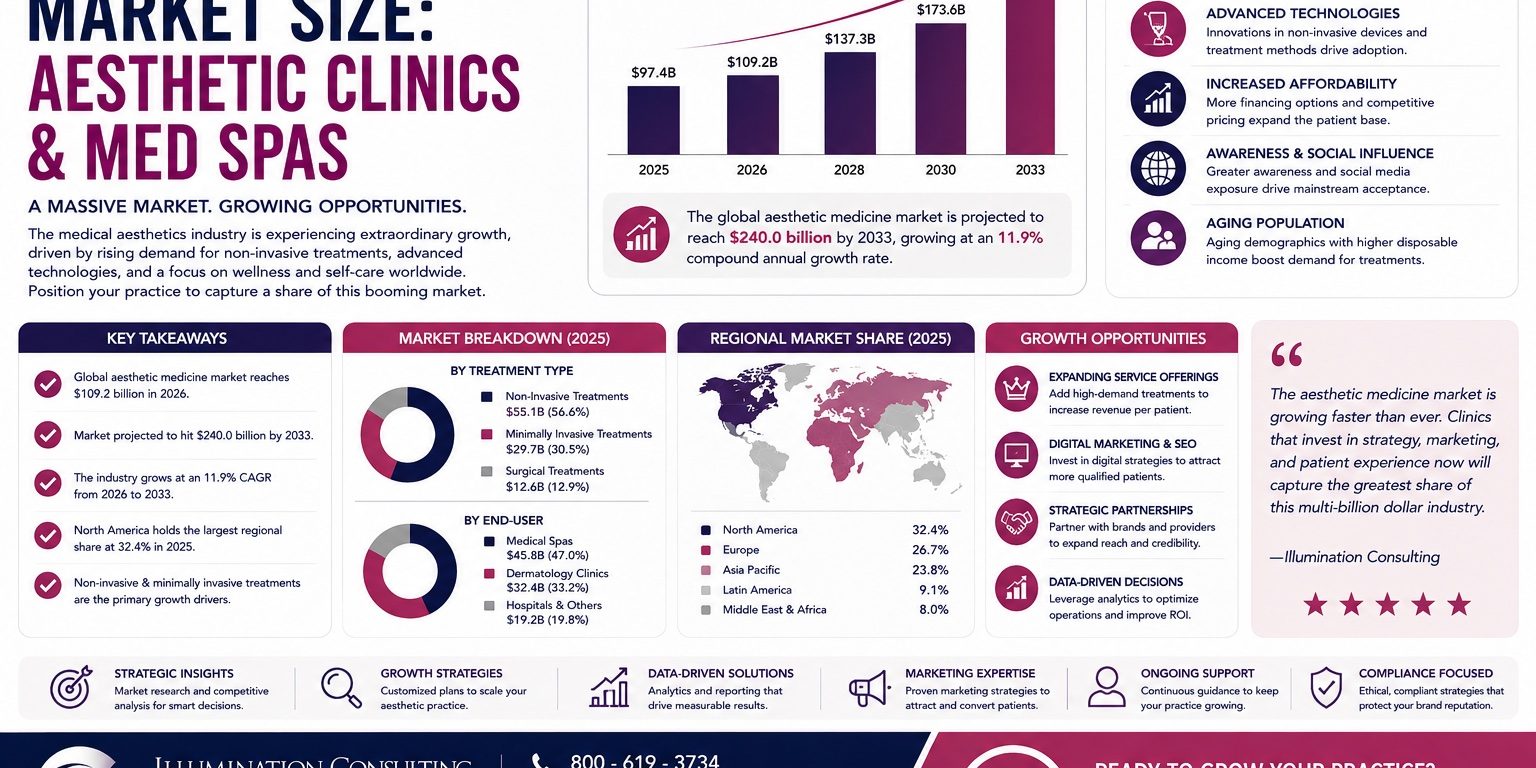
Aesthetic medicine reached pricing varies billion globally in 2025. Is projected to hit $240.0 billion by 2033, growing at an 11.9% CAGR, with North America commanding the largest regional share at 32.4% of the market.
Global Beverly Hills Business Growth: Aesthetic Clinics & Med Spas market size reached pricing varies billion in 2025, projected to hit $240.0 billion by 2033 at an 11.9% CAGR, per industry forecasts. North America held 32.4% market share in 2025. Growth stems from rising demand for minimally invasive and noninvasive procedures, creating substantial opportunity for MedSpa owners, device manufacturers, and investors positioning strategically now.
Key Takeaways
- Global aesthetic medicine market reaches $109.2 billion in 2026, expanding to $240.0 billion by 2033.
- Market grows at 11.9% compound annual growth rate from 2026 through 2033.
- Medical aesthetics market valued at $20.7 billion with 5.8% CAGR projected through 2029.
- North America holds the largest regional share of the global aesthetic medicine market.
Why Does the Aesthetic Market Size Matter Now?
Scale defines opportunity. Global valuation for aesthetic medicine reached pricing varies billion in 2025, with projections placing the market size at $240.0 billion by 2033. That trajectory reflects an 11.9% compound annual growth rate, a pace few adjacent healthcare categories can match. For executives and investors mapping five-year plans, that number changes the calculus on capital allocation, staffing, and technology investment.
Growth on this scale rarely arrives evenly. Consumer expectations shift fast, new technologies enter the clinic, and competitive pressure builds year over year. The aesthetic market of 2026 looks nothing like the one from a decade ago. Providers who plan around static assumptions risk falling behind rivals who don’t.
Does market growth guarantee business growth?
No. Many aesthetic and skincare businesses post strong early revenue, then stall before reaching real scale. The gap usually isn’t product quality — it’s the absence of systems built for patient acquisition, conversion, and retention. A rising industry growth curve rewards operators with infrastructure already in place, not those still building it after demand arrives.
Who benefits most from tracking this growth?
Device manufacturers, investors, and multi-location MedSpa groups benefit most, since forecasting decisions hinge directly on category trajectory. Three groups face the highest stakes:
- Device manufacturers calibrating production and R&D timelines against demand curves
- Investors evaluating entry points before valuations climb further
- MedSpa operators competing in one of the most crowded business environments in recent memory
Ignoring the trajectory doesn’t slow it down. It only widens the gap between prepared operators and everyone else.
What Do Competing Market Forecasts Reveal?
Two forecasts, two very different growth stories. One report projects the Startup Consulting Services: Aesthetic Clinics & Med Spas climbing from $22.59 billion in 2026 to $40.60 billion by 2031, a 12.4% compound annual growth rate (CAGR). The same report values 2025 at pricing varies billion, a narrower base that still points toward a steep climb ahead. A separate industry analysis lands on a far more conservative 5.8% CAGR from 2024 to 2029. Methodology, not market reality, drives most of that gap.
Why do market size estimates vary so much between reports?
Different research firms define product categories, geographic scope, and procedure types differently, which changes the denominator entirely. A forecast counting energy-based devices, injectables, and at-home tools together produces a larger market size than one isolated to clinical procedures. Executives comparing reports should check the underlying scope before treating any single CAGR as gospel.
Neither number tells the full story of the aesthetic market on its own. What matters more for operators and investors is the consistent upward trajectory across every model, even the conservative one. That signals durable industry growth, not a temporary spike.
What should executives take away from conflicting projections?
Opportunity sizing means little without a strategy built to capture it. Consumers now have more choices, more channels, and higher expectations than in previous market cycles, which raises the bar for competitive positioning. Advertising spend alone will not secure share in a market with this many entrants. Winning position within this growth window demands coordinated strategy across brand, digital presence, and patient acquisition systems working in tandem, not isolated tactics deployed one at a time.
Which Treatment Segments Are Driving Growth?
Invasive procedures lead the growth curve, claiming 59.7% of the aesthetic market in 2025. That figure surprises many industry strategists who assume noninvasive treatments dominate the conversation. Surgical and other invasive categories still command patient spending. Clinical revenue at scale, a reality that reshapes how device manufacturers and clinic operators should allocate resources.
Body contouring deserves particular attention from investors scanning for durable demand. The segment reached pricing varies billion in value as of 2023, confirming that body-focused treatments remain a core revenue driver rather than a passing trend. MedSpa owners weighing equipment purchases or service-line expansion should treat body contouring as a proven category, not a speculative bet.
Where Does Revenue Concentrate by Provider Type?
Clinics and dedicated aesthetic centers captured 48.1% of end-use revenue in 2025, outpacing hospitals and other provider settings. This concentration signals where market size growth actually lands: independent and specialized practices, not large hospital systems. Healthcare executives evaluating expansion strategies gain a clearer picture of where competitive pressure — and opportunity — will intensify.
Industry growth in aesthetics no longer rewards single-channel marketing efforts. Brands capturing share in these expanding segments integrate several disciplines at once:
- Search engine optimization for treatment-specific visibility
- Content marketing that educates prospective patients on invasive and noninvasive options
- Social media strategies that showcase outcomes and build trust
- E-commerce and booking optimization that converts interest into scheduled procedures
Treating these channels as isolated tactics leaves revenue on the table. Clinics and manufacturers that unify their growth strategy around the segments already proving demand. Invasive procedures, body contouring, and clinic-based care — position themselves to capture disproportionate share as the broader market expands.
How Are End-User Channels Shaping Demand?
Hospitals and clinics captured the largest revenue share among end users in 2023, outpacing medical spas and standalone aesthetic practices. This distribution matters for anyone tracking market size projections and allocating capital across provider types. Executives evaluating expansion targets or acquisition candidates need to understand which channels concentrate the strongest revenue base within the broader aesthetic market.
Social media now ranks among the most influential channels shaping how prospective patients discover and evaluate medical spas and clinics. Prior to booking a consultation, patients research providers on visual platforms, comparing results, credentials, and reputation. Channel strategy has become inseparable from patient acquisition.
Which end-user channel drives the most industry growth?
Hospitals and clinics led revenue generation in 2023, positioning that segment as the primary driver of measurable industry growth. Medical spas and standalone practices remain significant but trail behind in total share. Investors weighing channel-specific opportunities should treat hospital and clinic partnerships as a proven revenue anchor.
Do digital channels influence which providers patients choose?
Yes. High-performing practices use social platforms to educate prospective patients, showcase clinical expertise, and answer common procedure questions. These channels also demonstrate treatment outcomes visually. Strengthen relationships within the local community, reinforcing trust before a first appointment ever occurs.
For device manufacturers and clinic operators, the implication is direct:
- Hospital and clinic partnerships carry the largest revenue weight and deserve priority in channel investment.
- Social platforms function as a discovery and trust-building layer, not a secondary marketing tactic.
- Marketing programs built for this landscape help providers attract qualified patients, strengthen brand awareness, and generate measurable revenue growth across both channel types.
Executives who align investment with these channel realities capture disproportionate share as the sector expands.
Why Is Regional Growth So Uneven?
Geography determines opportunity in aesthetic medicine more than most executives realize. North America captured the largest regional share of the global aesthetic market, holding 32.4% in 2025, according to industry sizing data. Asia, meanwhile, posted the sharpest growth momentum, accounting for 27% growth during the same forecast period in a separate analysis. Those two facts tell different stories: one region dominates by volume and revenue, the other by velocity.
For device manufacturers and clinic groups, that split changes the calculus for expansion. A market leading in market size does not automatically lead in growth rate, and vice versa. Investment decisions built solely on today’s revenue share risk missing tomorrow’s demand curve.
Why does North America still dominate despite slower growth elsewhere?
Established infrastructure, higher consumer spending power, and mature provider networks keep North America ahead on raw market share. Illumination Consulting operates from Beverly Hills, California, placing the firm inside one of the most competitive aesthetic markets in North America. That proximity offers a direct view of how saturated, high-spend markets behave differently from emerging ones.
Does faster regional growth mean better investment opportunity?
Not automatically. Faster percentage growth in a smaller base can still trail the absolute revenue generated in a larger, slower-growing market. Strategists need both figures side by side before allocating budget or opening new locations.
Regional expansion plans succeed or fail based on local execution, not just macro trends. Consumers across every region now have more choices, more channels, and higher expectations than in prior years. Brands entering new territories without adapting to local consumer behavior. Digital habits often see industry growth projections fail to materialize on their own balance sheets.
What Risks Threaten Long-Term Industry Growth?
Weak internal systems pose the single greatest threat to long-term growth in aesthetic medicine. Practices and device manufacturers that lack repeatable processes for attracting customers, converting visitors, and generating repeat purchases put revenue at risk regardless of overall market size. A favorable market alone does not guarantee stability. Even in a sector expanding steadily, growth becomes unpredictable and hard to sustain without those systems in place.
Rising demand can mask operational gaps for a while. Eventually, the gaps surface as inconsistent bookings, patient churn, and stalled expansion.
Why does strong demand not guarantee business growth?
Demand and execution are separate variables. The broader aesthetic market can expand year over year while an individual clinic or brand stagnates because its acquisition and retention processes never matured. Growth depends on infrastructure, not just interest.
Is social media alone enough to protect market position?
No single tactic secures long-term positioning. Practices leaning on attractive visuals without a deeper strategy risk losing ground. Visual appeal alone does not sustain patient acquisition. Social platforms now enable ongoing relationship-building through education, transparency, and genuine engagement — something static advertising cannot replicate. Businesses still relying primarily on traditional advertising fall behind competitors building trust continuously online.
Executives and investors evaluating industry growth should treat these risks as structural, not seasonal. Key vulnerabilities include:
- Absence of conversion systems that turn website visitors into booked consultations
- Weak retention strategies that fail to generate repeat purchases
- Content strategies limited to imagery rather than education and transparency
- Overdependence on traditional advertising instead of ongoing digital relationship-building
Addressing these gaps determines which organizations capture disproportionate share as the market expands. Which ones watch competitors absorb the growth instead.
How Should Executives Build Growth Systems?
Executives build lasting growth by treating patient acquisition as a connected system, not a collection of separate tactics. Leadership teams that chase individual campaigns without a unifying strategy leave revenue on the table as the aesthetic market expands toward hundreds of billions in projected value. Businesses positioned to thrive going forward will construct complete operational ecosystems spanning branding, content, technology, and conversion. Rather than betting on one channel or campaign at a time.
That ecosystem mindset starts with visibility. Prospective patients research providers long before booking, scrolling through Instagram, Facebook, TikTok, YouTube, and LinkedIn to compare credentials, review outcomes, and gauge trustworthiness. A practice absent from those platforms effectively disappears from the decision-making process before a consultation ever gets scheduled.
What role does content play in a growth system?
Content acts as the connective tissue between visibility and conversion. Consistent publishing demonstrates clinical expertise, showcases real treatment outcomes, introduces provider teams, and answers the questions prospective patients ask most. Executives who treat content as a core operational function — not an afterthought. Build the credibility that separates market leaders from commoditized providers.
How do these touchpoints translate into bookings?
Each interaction functions as a step in a longer journey. Awareness builds into confidence, and confidence eventually converts into a scheduled consultation. Graphic Design for Clinics: Aesthetic Branding succeed when every touchpoint. Social proof, educational content, and website conversion paths — reinforces the next.
A well-built growth system typically includes:
- Brand positioning that differentiates the practice within a crowded, fast-growing field
- Content infrastructure publishing consistently across owned and social channels
- Conversion pathways connecting social engagement to booked consultations
- Retention mechanisms that increase lifetime patient value
As industry growth accelerates and competition intensifies, executives who invest in interconnected systems capture disproportionate share. Those relying on scattered tactics fall further behind each quarter.
What Should Stakeholders Do Next?
Stakeholders should treat the next twelve to eighteen months as a planning window, not a waiting period. Delayed action carries a real cost: the global aesthetic market is on pace to climb to $240.0 billion by 2033, and every quarter spent without a structured growth plan cedes ground to competitors already positioning for that expansion. Executives and device manufacturers who move early capture disproportionate share; those who wait inherit a more crowded, more expensive field.
What does a coordinated growth strategy actually include?
A single tactic rarely moves revenue on its own. Brand positioning, search engine optimization, content marketing, social media, paid advertising, conversion optimization, email marketing, and retention initiatives work best as one connected system rather than isolated efforts. Fragmented campaigns waste budget and produce inconsistent results; coordinated strategy compounds returns across channels.
Practical next steps for MedSpa owners, healthcare executives, and investors include:
- Auditing current marketing and booking systems for gaps in lead capture and follow-up.
- Aligning brand positioning with the specific patient segments driving demand growth.
- Building a content and SEO foundation before increasing paid ad spend.
- Establishing retention programs, since repeat and referral revenue stabilizes performance during market swings.
Who can help translate market growth into measurable revenue?
Growth-focused consulting services built for aesthetics and wellness brands help providers attract qualified customers, strengthen brand awareness, and generate measurable revenue growth rather than vanity metrics. Illumination Consulting, based in Beverly Hills, CA, works with aesthetic and wellness brands seeking a structured path through this expansion cycle. Stakeholders positioning now, ahead of continued industry growth, stand to capture a larger share of demand before the field tightens further.
FAQ
How big is the global aesthetic medicine market?
The global aesthetic medicine market reached pricing varies billion in 2025. Is projected to hit $240.0 billion by 2033, growing at an 11.9% compound annual growth rate.
Which region leads the aesthetic medicine market?
North America commands the largest regional share, holding 32.4% of the global aesthetic medicine market as of 2025.
Why do aesthetic market forecasts differ between reports?
Forecasts vary because of methodology differences, not market reality. One report projects 12.4% CAGR through 2031 while another lands on a more conservative 5.8% CAGR through 2029.
Facts
- Illumination Consulting is located in Beverly Hills, CA, USA.