The beauty industry has become one of the most competitive sectors in eCommerce. Every day, thousands of consumers search online for skincare products, cosmetics, makeup, haircare solutions, wellness products, and beauty advice before making a purchase. Whether they are researching ingredients, comparing brands, reading reviews, or looking for product recommendations, the buying journey almost always begins with a search engine.
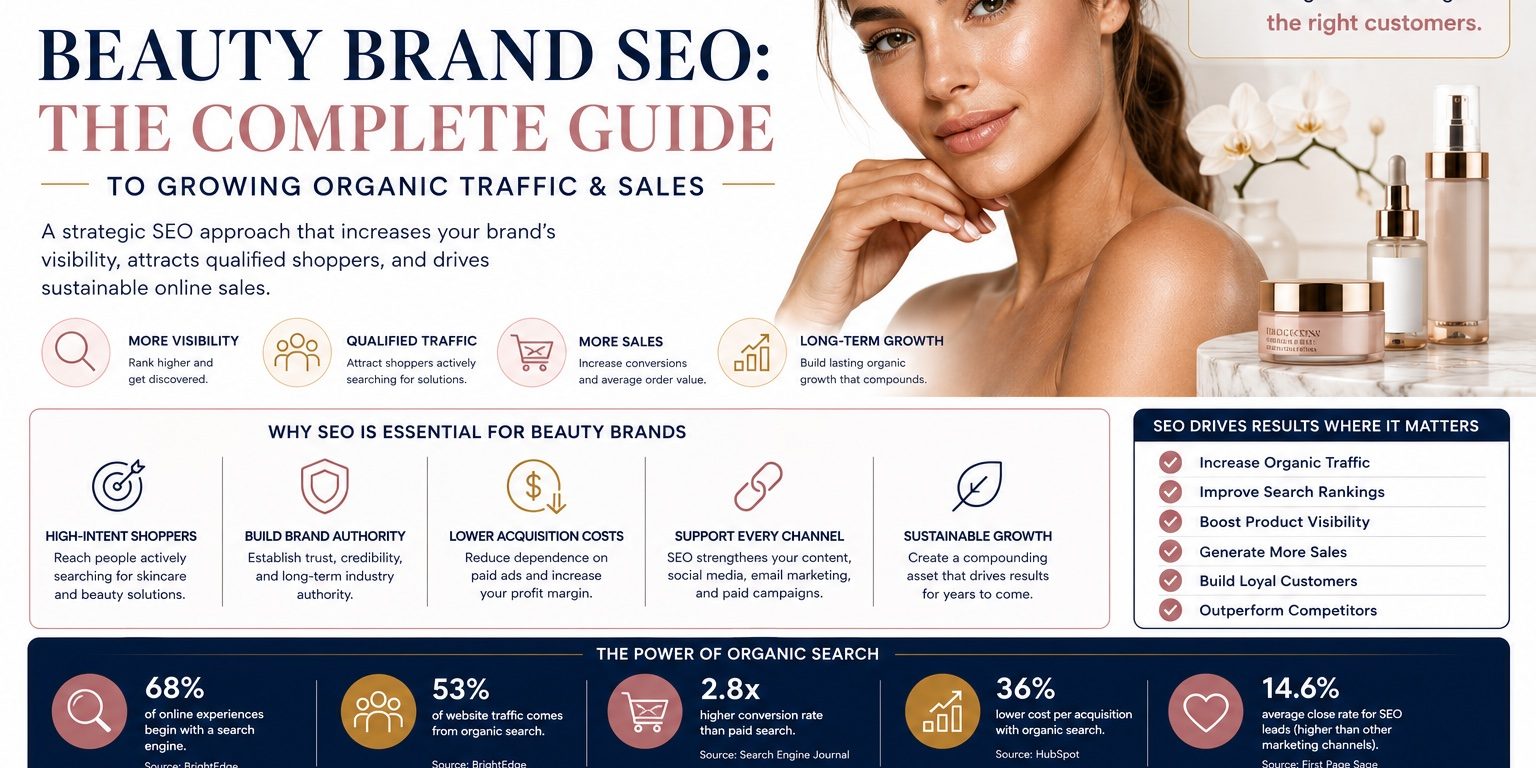
For beauty brands, this creates an enormous opportunity. Companies that invest in search engine optimization (SEO) position themselves in front of highly motivated shoppers precisely when they are actively searching for solutions. Unlike paid advertising, which stops generating traffic when the budget runs out, SEO creates a long-term marketing asset that continues driving qualified visitors and online sales for years.
Modern beauty SEO extends far beyond optimizing a handful of keywords. It involves developing a technically sound website, creating educational content, optimizing product and collection pages, improving site speed, strengthening internal linking, earning authoritative backlinks, and delivering an exceptional user experience across every device. Together, these elements help search engines understand your website while making it easier for customers to discover and purchase your products.
Consumer behavior has also evolved significantly. Today’s beauty shoppers conduct extensive research before purchasing. They compare ingredients, watch tutorials, read reviews, search for before-and-after results, and evaluate multiple brands before making a decision. Companies that consistently publish valuable educational content build trust, establish authority, and naturally attract more organic traffic.
Artificial intelligence is also reshaping SEO by helping businesses analyze search trends, identify keyword opportunities, optimize content, automate technical audits, and personalize customer experiences. When combined with expert SEO strategy, AI enables beauty brands to compete more effectively in increasingly crowded search results.
Whether you’re launching a new beauty startup, operating an established skincare company, selling cosmetics online, or managing a multi-brand eCommerce store, SEO provides one of the most sustainable methods for generating qualified traffic and increasing online revenue.
In this comprehensive guide, you’ll learn how beauty brand SEO works, why it matters, and how to build a long-term organic growth strategy that attracts more customers, increases product visibility, and drives sustainable online sales.
Why SEO Matters for Beauty Brands
Consumers rarely purchase beauty products immediately after discovering a brand.
Instead, they spend time researching products, comparing ingredients, evaluating reviews, and learning about potential solutions for their individual beauty concerns.
SEO ensures your brand appears throughout that research process.
Organic Search Captures High-Intent Buyers
Unlike interruption-based advertising, SEO reaches customers who are already looking for solutions.
Typical searches include:
- Best vitamin C serum
- Anti-aging skincare routine
- Moisturizer for sensitive skin
- Clean beauty products
- Cruelty-free skincare
- Organic face cleanser
- Acne treatment products
- Hyaluronic acid serum
- Best retinol cream
- Skincare routine for dry skin
These users are actively researching products and often have a strong intention to purchase.
SEO Builds Long-Term Brand Authority
High search rankings create more than website traffic.
They build:
- Brand awareness
- Consumer trust
- Industry authority
- Customer confidence
- Product credibility
- Long-term visibility
Consumers naturally associate top-ranking brands with expertise and quality.
SEO Reduces Customer Acquisition Costs
Paid advertising can generate immediate traffic, but every visitor comes at a cost.
SEO continues attracting qualified shoppers without paying for every click.
Over time, this lowers customer acquisition costs while increasing profitability.
SEO Supports Every Marketing Channel
A strong SEO strategy improves the performance of your entire digital marketing ecosystem.
Organic content supports:
- Social media marketing
- Email marketing
- Influencer campaigns
- Paid advertising
- Product launches
- Public relations
- Brand awareness
Instead of working independently, SEO strengthens every customer acquisition channel.
Building a Strong SEO Foundation for Your Beauty Brand
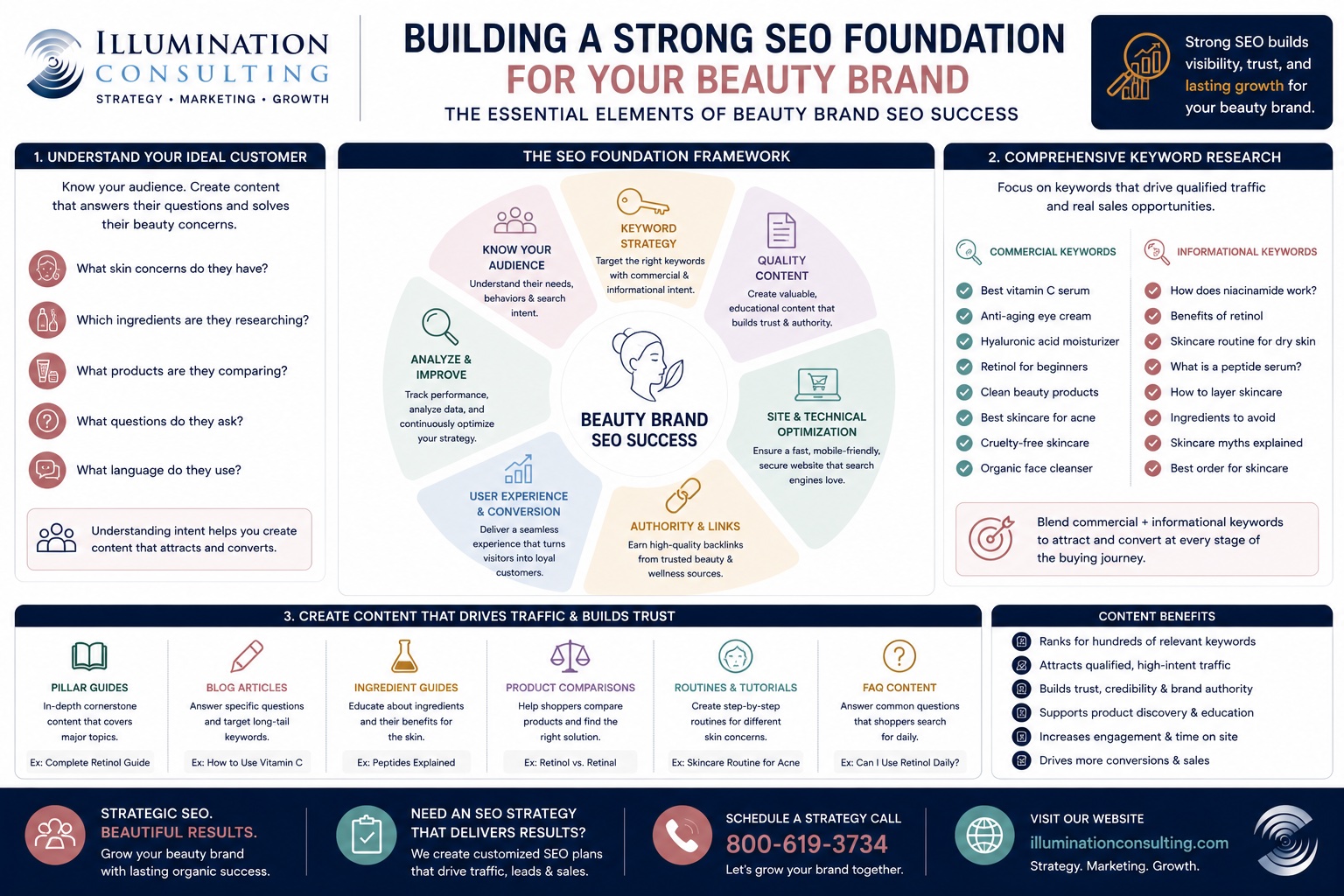
Many beauty brands approach SEO by focusing exclusively on keywords.
While keywords remain important, they represent only one component of a successful optimization strategy. Search engines evaluate hundreds of ranking factors, including website performance, content quality, user experience, technical optimization, internal linking, and overall site authority.
A comprehensive SEO strategy creates a strong foundation that supports long-term organic growth.
Understand Your Ideal Customer
Successful SEO begins with understanding the people you’re trying to reach.
Ask questions such as:
- What skincare or beauty concerns do they have?
- Which ingredients are they researching?
- What products are they comparing?
- What questions do they ask before purchasing?
- What language do they use during searches?
Understanding customer intent allows you to create content that aligns naturally with real search behavior.
Perform Comprehensive Keyword Research
Effective keyword research extends beyond identifying high-volume search terms.
Focus on keywords that demonstrate purchase intent and educational interest.
Examples include:
- Best peptide serum
- Vitamin C serum for dark spots
- Natural skincare routine
- Anti-aging eye cream
- Hyaluronic acid moisturizer
- Cruelty-free skincare brands
- Clean beauty products
- Best moisturizer for mature skin
- Brightening facial cleanser
- Retinol beginner guide
Combining commercial and educational keywords helps attract visitors throughout every stage of the buying journey.
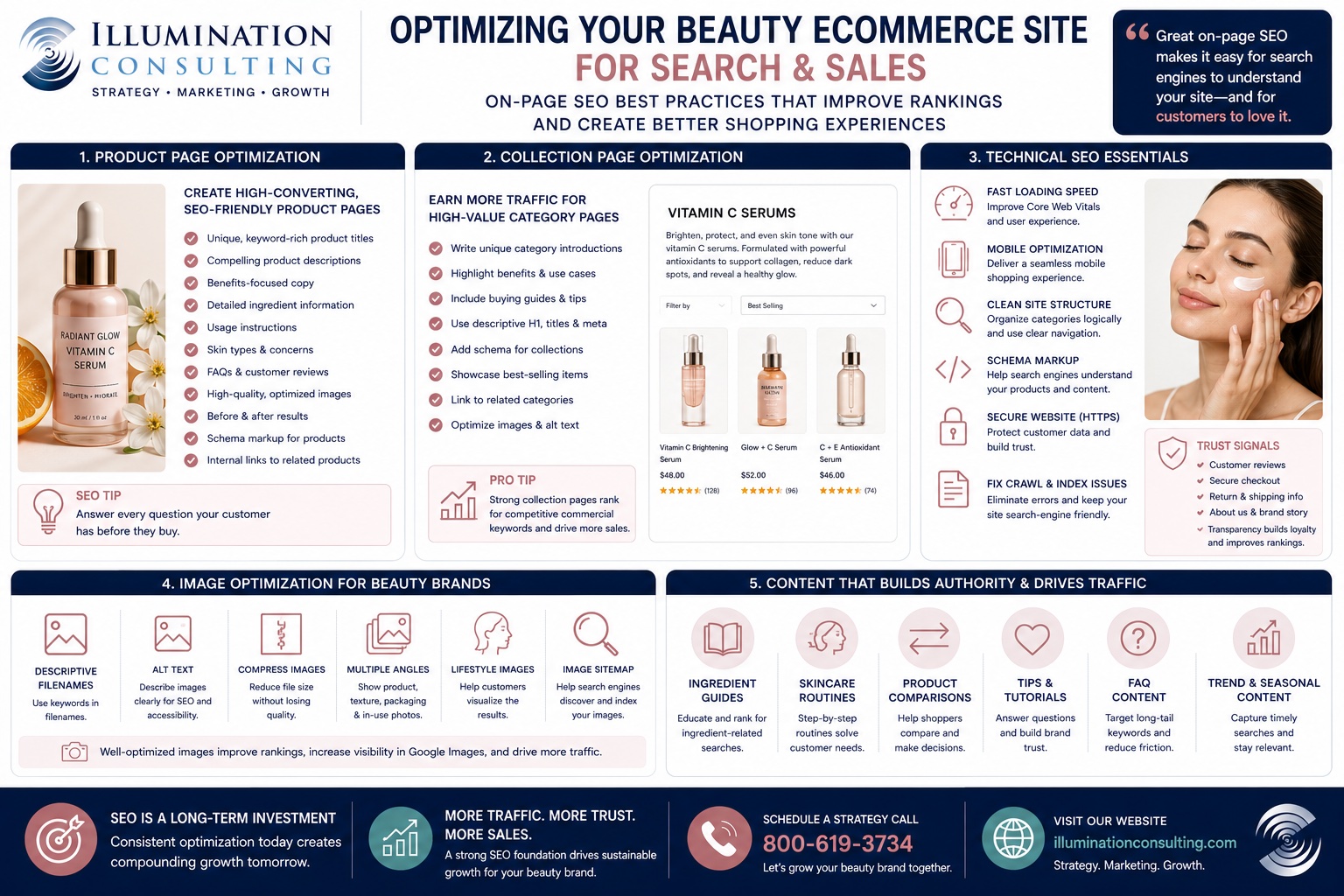
Optimizing Product Pages
Product pages often become the highest-converting pages on a beauty website.
Unfortunately, many brands use short manufacturer descriptions that offer little value for either customers or search engines.
Each product page should function as a comprehensive educational resource.
Include Detailed Product Information
High-performing product pages typically include:
- Product overview
- Key benefits
- Active ingredients
- Complete ingredient list
- Skin types
- Usage instructions
- Clinical results
- Frequently asked questions
- Customer reviews
- Before-and-after images
- Related products
Comprehensive content helps answer purchasing questions while improving keyword relevance.
Optimize Product Images
Images play a critical role in beauty eCommerce.
Optimize every image by:
- Compressing file sizes
- Using descriptive filenames
- Writing keyword-rich alt text
- Displaying multiple product angles
- Including lifestyle photography
- Showcasing texture shots
- Demonstrating application
Image optimization improves accessibility while increasing opportunities to appear in Google Images.
Collection Page Optimization
Collection pages frequently rank for broader commercial searches.
Examples include:
- Vitamin C Serums
- Cleansers
- Moisturizers
- Acne Treatments
- Anti-Aging Products
- Sensitive Skin Products
- Vegan Skincare
- Sunscreens
Rather than displaying only product grids, enhance these pages with educational introductions explaining:
- Product category benefits
- Ingredient recommendations
- Skin concerns addressed
- Product selection tips
This additional content improves both user experience and SEO.
Creating Educational Content That Drives Traffic
Content marketing remains one of the most effective SEO strategies for beauty brands.
Consumers actively search for educational information before purchasing skincare products.
Creating valuable resources allows your brand to appear during those research stages.
Publish Comprehensive Guides
Long-form educational articles establish authority while supporting internal linking.
Examples include:
- Complete Retinol Guide
- Vitamin C Benefits
- The Beginner’s Guide to Skincare Ingredients
- Building a Morning Skincare Routine
- How to Layer Skincare Products
- Understanding Sensitive Skin
- Anti-Aging Skincare Guide
- Sunscreen Explained
- Acne Skincare Guide
- Clean Beauty Guide
These cornerstone articles become valuable evergreen assets that continue generating traffic over time.
Supporting Blog Articles
Once pillar content is published, expand your content library with focused supporting articles.
Examples include:
- Retinol vs. Retinal: What’s the Difference?
- How Often Should You Use Vitamin C?
- Can You Combine Niacinamide and Retinol?
- The Best Ingredients for Dry Skin
- Understanding Peptides in Skincare
- How to Repair a Damaged Skin Barrier
- Choosing the Right Facial Cleanser
- Common Skincare Routine Mistakes
- Benefits of Double Cleansing
- Winter Skincare Tips
These supporting articles strengthen topical authority while expanding your keyword footprint across hundreds of relevant search queries.
Internal Linking Strengthens SEO
Every new article should connect readers to additional educational resources throughout your website.
For example, an article discussing retinol might naturally link to:
- Anti-Aging Products
- Vitamin C Guide
- Moisturizer Collection
- Sensitive Skin Guide
- Evening Skincare Routine
- Retinol Product Collection
- Sunscreen Education
Internal linking improves navigation, distributes authority across your website, and encourages visitors to explore additional content before making a purchase.
Technical SEO for Beauty eCommerce Websites
Outstanding content alone is not enough to achieve strong search rankings.
Search engines also evaluate the technical health of your website to determine how easily it can be crawled, indexed, and understood. Technical SEO ensures that every page is accessible, loads quickly, and provides an exceptional experience for shoppers across all devices.
For beauty brands with hundreds or even thousands of products, technical optimization becomes even more important as product catalogs expand.
Improve Website Speed
Website speed directly impacts both user experience and search rankings.
Consumers expect beauty websites to load almost instantly. Even small delays can increase bounce rates and reduce conversions.
Improve performance by:
- Compressing product images
- Using modern image formats
- Enabling browser caching
- Implementing lazy loading
- Utilizing a Content Delivery Network (CDN)
- Minimizing unnecessary JavaScript
- Optimizing CSS files
- Choosing high-performance hosting
A faster website creates a smoother shopping experience while supporting stronger organic visibility.
Mobile Optimization
Most beauty shoppers now discover products using smartphones.
Your website should provide an exceptional mobile experience by offering:
- Responsive layouts
- Fast loading pages
- Large touch-friendly buttons
- Simple navigation
- Mobile-friendly menus
- Readable typography
- Easy checkout
- Mobile search functionality
Google’s mobile-first indexing makes mobile optimization essential for long-term SEO success.
Optimize Core Web Vitals
Google uses Core Web Vitals to evaluate user experience.
Beauty brands should regularly monitor:
- Largest Contentful Paint (LCP)
- Interaction to Next Paint (INP)
- Cumulative Layout Shift (CLS)
Improving these performance metrics supports both higher search rankings and stronger conversion rates.
Building Website Authority Through Backlinks
Backlinks remain one of Google’s strongest ranking signals.
When reputable websites link to your content, search engines view your brand as more trustworthy and authoritative.
Rather than pursuing quantity, focus on earning high-quality backlinks from respected industry sources.
Content That Naturally Earns Links
Certain types of content are more likely to attract backlinks.
Examples include:
- Original research
- Ingredient guides
- Industry reports
- Beauty trend analyses
- Scientific resources
- Infographics
- Expert interviews
- Comprehensive tutorials
High-value educational resources often become reference material for bloggers, journalists, influencers, and other websites.
Collaborate with Industry Partners
Beauty brands can also strengthen authority through partnerships with:
- Beauty publications
- Industry magazines
- Dermatologists
- Medical professionals
- Estheticians
- Influencers
- Beauty bloggers
- Podcasts
- Educational websites
These collaborations increase exposure while generating valuable backlinks.
Leveraging AI for SEO
Artificial intelligence is transforming how beauty brands approach search engine optimization.
Rather than replacing SEO professionals, AI helps streamline research, improve efficiency, and uncover opportunities that may otherwise go unnoticed.
AI-Powered Keyword Research
Modern AI tools can identify:
- Emerging search trends
- Long-tail keyword opportunities
- Consumer intent
- Content gaps
- Seasonal demand
- Product opportunities
These insights help beauty brands prioritize topics with the greatest growth potential.
AI-Assisted Content Optimization
AI also supports:
- Topic clustering
- Content outlines
- Internal linking recommendations
- Meta descriptions
- Schema suggestions
- Readability improvements
- Search intent analysis
- Competitor comparisons
When paired with human expertise, AI accelerates content production while maintaining quality and relevance.
Local SEO for Beauty Brands with Physical Locations
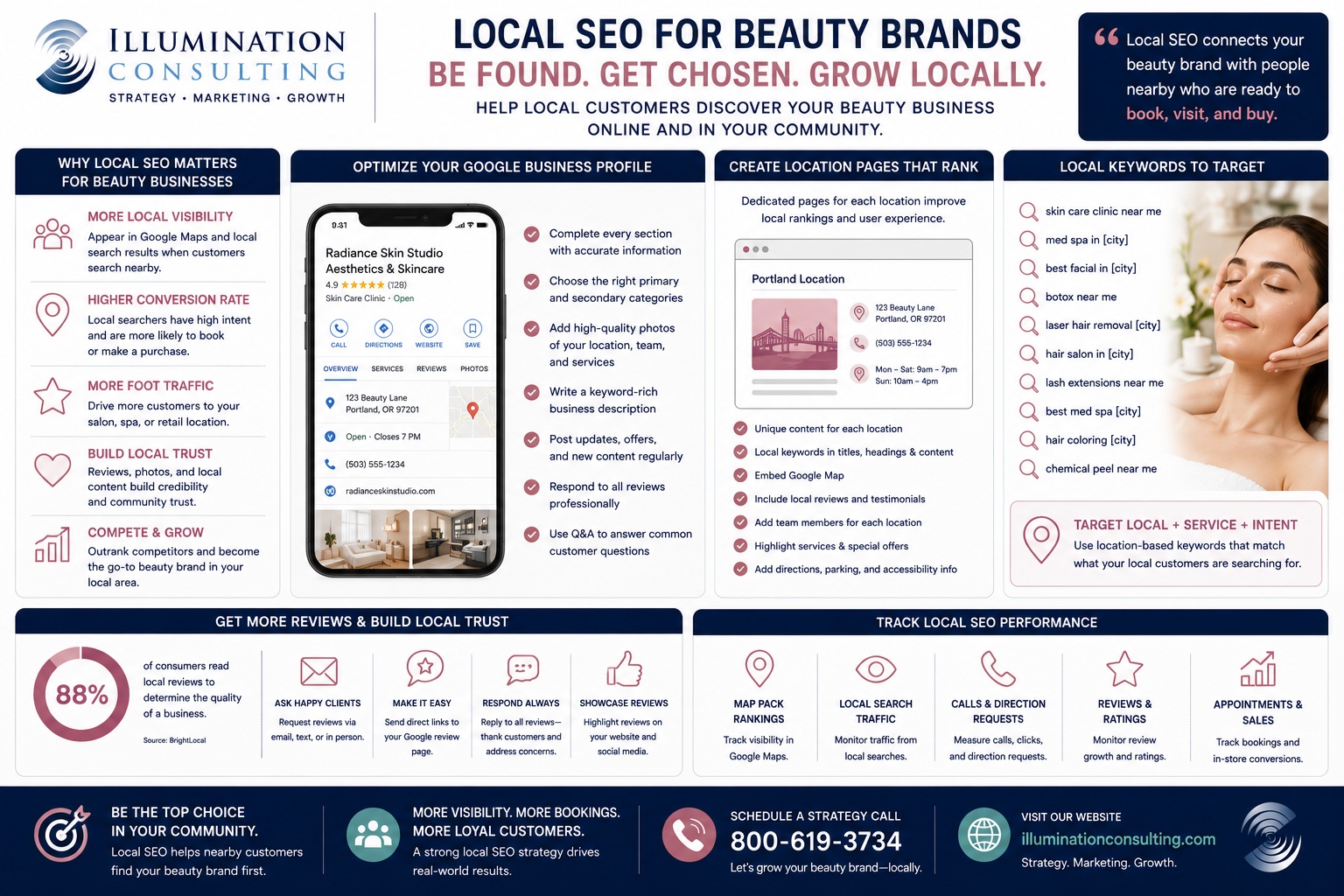
Many beauty companies operate both online stores and physical retail locations, spas, or flagship boutiques.
Local SEO helps nearby customers discover your business while supporting omnichannel growth.
Optimize Your Google Business Profile
Maintain an accurate and active profile by including:
- Business hours
- Contact information
- Website link
- Product categories
- Professional photography
- Customer reviews
- Regular business updates
- Frequently asked questions
An optimized profile increases visibility in local search results and Google Maps.
Create Location Pages
If your brand has multiple retail locations, develop dedicated pages for each location featuring:
- Address
- Contact information
- Store hours
- Available services
- Product offerings
- Team information
- Directions
- Local testimonials
These pages improve local rankings while making it easier for customers to find your stores.
Integrating SEO with Your Digital Marketing Strategy
SEO delivers the greatest results when integrated with every aspect of your marketing strategy.
Rather than treating search optimization as a separate initiative, successful beauty brands create a unified ecosystem where every marketing channel reinforces the others.
Content Marketing
Educational content fuels organic growth while supporting nearly every stage of the customer journey.
Examples include:
- Ingredient education
- Product comparisons
- Beauty routines
- Seasonal skincare advice
- Makeup tutorials
- Haircare guides
- Wellness content
- Beauty trend reports
Each article expands your keyword footprint while building trust with prospective customers.
Email Marketing
SEO attracts visitors.
Email marketing helps convert those visitors into long-term customers.
Encourage newsletter signups through:
- Educational resources
- Exclusive offers
- Beauty guides
- Product launch notifications
- VIP memberships
- Personalized skincare quizzes
This creates an owned audience that can be nurtured long after the initial website visit.
Social Media
Social media amplifies your SEO content by driving additional traffic and increasing brand awareness.
Repurpose blog articles into:
- Instagram carousels
- Pinterest graphics
- TikTok videos
- YouTube Shorts
- Facebook posts
- LinkedIn articles
- Infographics
- Email newsletters
This approach maximizes the value of every piece of content while strengthening your overall digital marketing strategy.
Measuring the Success of Your Beauty Brand SEO Strategy
SEO is a long-term investment that should be measured using meaningful business metrics rather than rankings alone.
While keyword positions are important, the ultimate objective is to attract qualified shoppers, increase online sales, and strengthen your brand’s visibility within the beauty industry.
Successful beauty brands regularly review performance data and adjust their strategy based on customer behavior and search trends.
Key SEO Metrics to Track
Monitor metrics including:
- Organic website traffic
- Keyword rankings
- Click-through rate (CTR)
- Product page traffic
- Collection page performance
- Conversion rate
- Average order value (AOV)
- Revenue from organic search
- Bounce rate
- Pages per session
- Returning visitors
- Customer lifetime value (LTV)
Together, these metrics provide a complete picture of how SEO contributes to business growth.
Evaluate Customer Behavior
SEO success isn’t measured solely by traffic volume.
Pay close attention to how visitors interact with your website.
Look for indicators such as:
- Time on page
- Product page engagement
- Internal link clicks
- Shopping cart additions
- Newsletter signups
- Product reviews
- Completed purchases
- Repeat customer visits
Understanding these behaviors helps identify opportunities to improve both SEO and conversion rates.
Common Beauty Brand SEO Mistakes
Many beauty companies struggle to achieve strong search rankings because they overlook fundamental SEO best practices.
Avoiding these common mistakes will help your brand build sustainable long-term visibility.
Duplicate Product Descriptions
Using manufacturer-supplied product descriptions is one of the most common SEO mistakes.
Instead, create unique descriptions that include:
- Product benefits
- Ingredient education
- Usage instructions
- Skin type recommendations
- Frequently asked questions
- Customer-focused messaging
Original content helps differentiate your products while improving search visibility.
Ignoring Educational Content
Many beauty brands focus exclusively on product pages.
Educational resources often generate significantly more organic traffic by answering questions consumers ask before purchasing.
Examples include:
- Ingredient guides
- Skincare routines
- Product comparisons
- Beauty tips
- Seasonal advice
- How-to tutorials
Educational content introduces potential customers to your brand earlier in the buying journey.
Poor Site Architecture
As product catalogs grow, navigation can become increasingly complex.
Your website should make it easy for both users and search engines to find information.
Organize products logically by:
- Category
- Skin concern
- Ingredient
- Product type
- Collection
- Routine
A clear site structure improves usability while strengthening SEO.
Neglecting Technical Maintenance
SEO requires ongoing attention.
Regularly review:
- Broken links
- Crawl errors
- Redirects
- Page speed
- Structured data
- Mobile usability
- XML sitemaps
- Indexing issues
Routine technical maintenance helps preserve rankings while preventing avoidable performance issues.
Frequently Asked Questions
What is beauty brand SEO?
Beauty brand SEO is the process of optimizing a beauty or skincare website to improve its visibility in search engines. It includes technical SEO, keyword research, product page optimization, content marketing, internal linking, website performance, and backlink development to attract qualified shoppers and increase online sales.
Why is SEO important for beauty brands?
SEO helps beauty brands reach consumers who are actively searching for skincare products, cosmetics, and beauty advice. Unlike paid advertising, organic search continues generating qualified traffic long after content is published, creating a sustainable source of leads and revenue.
How long does beauty SEO take to produce results?
SEO is a long-term strategy. Many brands begin seeing measurable improvements within three to six months, while highly competitive keywords often require six to twelve months or longer. Consistency, content quality, and technical optimization all influence the speed of results.
Can AI improve SEO performance?
Yes. AI can assist with keyword research, search intent analysis, content planning, topic clustering, technical audits, internal linking, and content optimization. When combined with experienced SEO strategy and human oversight, AI improves efficiency while helping beauty brands identify valuable growth opportunities.
What type of content performs best for beauty SEO?
Comprehensive educational resources consistently deliver the strongest long-term performance. Ingredient guides, skincare routines, product comparisons, beauty tutorials, seasonal advice, buying guides, frequently asked questions, and in-depth product pages all help attract qualified visitors while building topical authority.
Grow Your Beauty Brand with Strategic SEO
Search engine optimization is one of the most effective long-term investments a beauty brand can make. While paid advertising delivers immediate visibility, SEO creates a lasting digital asset that continually attracts qualified shoppers, strengthens brand authority, and increases online sales. By combining technical optimization, educational content, product page enhancements, AI-powered insights, and a superior user experience, beauty brands can build sustainable organic growth that compounds over time.
The most successful beauty companies understand that SEO is not a one-time project but an ongoing strategy. Every optimized product page, educational article, internal link, and technical improvement contributes to greater search visibility and stronger customer engagement. As your content library expands and your authority grows, your website becomes an increasingly valuable resource for both consumers and search engines.
At Illumination Consulting, we help beauty brands develop comprehensive SEO strategies that integrate with website design, AI-powered marketing, eCommerce optimization, content marketing, and digital growth initiatives. From technical SEO audits and keyword strategy to content development and conversion optimization, our customized solutions are designed to increase organic traffic, improve search rankings, and generate measurable business growth.
Get Your Growth Strategy today or Speak with a Growth Specialist to discover how a strategic beauty brand SEO campaign can help your business attract more qualified shoppers, increase online sales, and achieve sustainable long-term success.