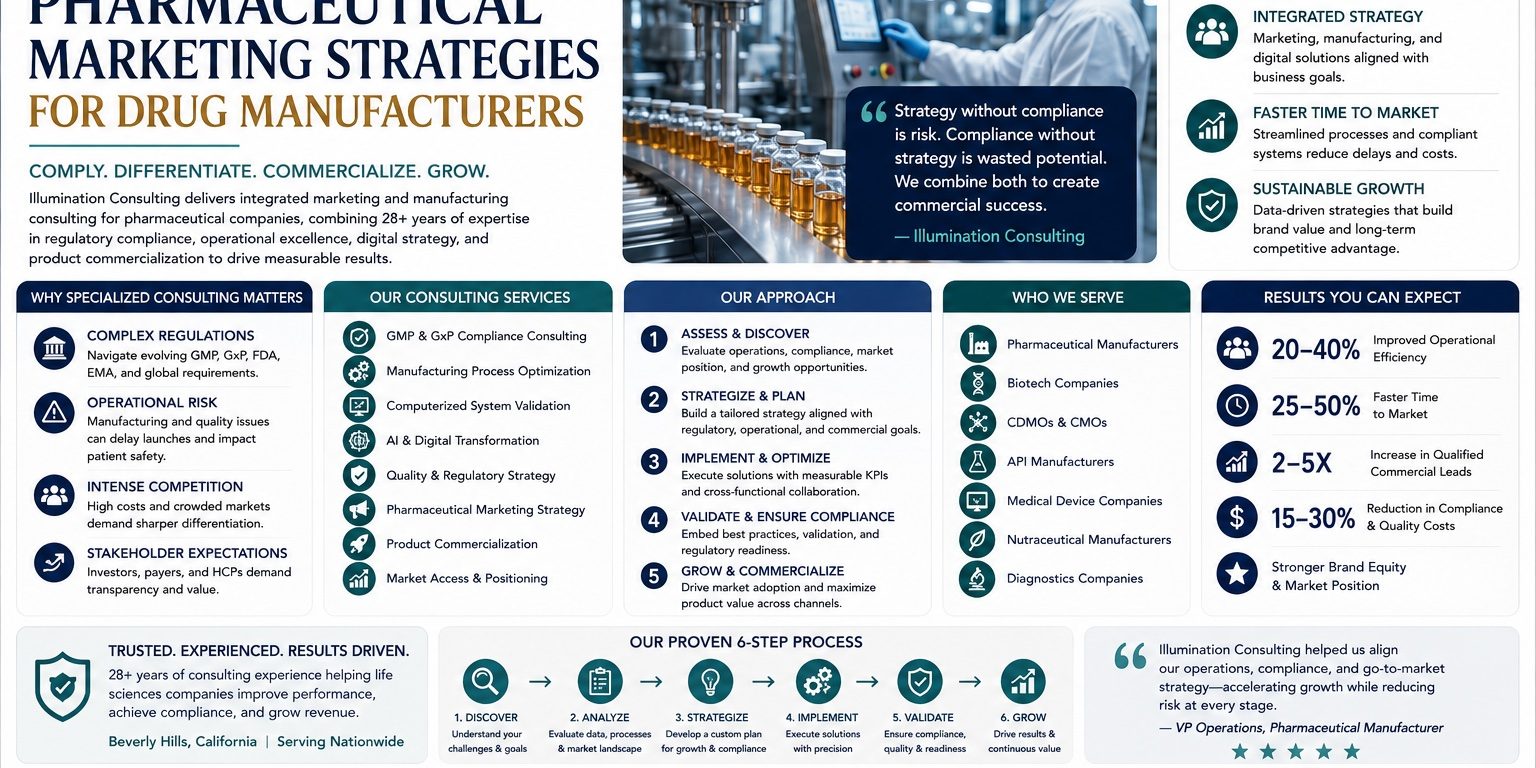
When it comes to pharmaceutical marketing, pharmaceutical manufacturing consulting services combine business strategy, operational improvement, and digital growth systems for regulated life sciences producers. Illumination Consulting brings over 28 years of consulting experience, guiding QA/QC Directors and Plant Managers through process optimization, technology modernization, AI implementation, and marketing strategies that aim to strengthen competitive positioning and enhance manufacturing performance.
Key Takeaways
- Illumination Consulting operates from Beverly Hills, CA, providing pharmaceutical manufacturing consulting services.
- Computerized system validation experts ensure compliance with national and international regulatory standards.
- Leading firms complete numerous engagements with a dedicated team of industry experts.
- Pharmaceutical consultants reduce time to market and embed lasting GxP compliance practices.
Why Does Pharma Manufacturing Need Specialized Consulting?
Pharmaceutical manufacturers answer to a regulatory standard that most industries never encounter. Good Manufacturing Practice (GMP) requirements govern nearly every process on the plant floor. Complex regulatory frameworks continue to expand as new modalities enter production. Scale-up from clinical to commercial volume introduces additional operational risk at each stage. A generalist consultant rarely grasps these constraints well enough to protect a manufacturer’s timeline or its compliance record.
Public scrutiny compounds the challenge. The pharmaceutical industry has faced heightened visibility. Intense competitive pressure since the Covid-19 pandemic pushed drug development and supply chains into daily headlines. Executives now manage reputational risk alongside operational risk, which often requires integrated strategies.
What Makes Illumination Consulting Different for Manufacturers?
Illumination Consulting brings almost three decades of business consulting experience into regulated manufacturing settings. That foundation pairs with current expertise in pharmaceutical marketing, manufacturing digital services, and product commercialization strategy — disciplines that rarely coexist under one advisory roof. The firm operates from Beverly Hills, California, serving manufacturers nationwide.
Why Not Just Hire a Generic Marketing Firm?
Generic agencies rarely account for GMP constraints, validation timelines, or regulatory review cycles. A specialized approach protects manufacturers from missteps in three areas:
- Compliance-aware messaging that avoids claims requiring regulatory substantiation
- Digital infrastructure built to support audit-ready documentation and traceability
- Commercialization timing aligned with clinical milestones rather than generic launch calendars
Plant managers and QA directors need partners who understand production risk, not just marketing metrics. That distinction separates specialized consulting from conventional agency work.
FDA Office of Prescription Drug Promotion (OPDP) Compliance
In pharmaceutical marketing, adherence to the FDA Office of Prescription Drug Promotion (OPDP) regulations is crucial to ensure promotional materials meet legal requirements and avoid enforcement actions. Messaging and marketing campaigns must undergo rigorous review to guarantee accuracy, balance, and substantiation, aligning with FDA guidelines.
Illumination Consulting integrates FDA OPDP compliance considerations throughout product commercialization and marketing strategy development, ensuring all content delivers transparent, credible information while remaining compliant with regulatory standards.
Health Care Professional (HCP) Omnichannel Engagement
Effective pharmaceutical marketing increasingly depends on omnichannel engagement strategies that connect with Health Care Professionals (HCPs) across digital, face-to-face, and virtual channels. This approach enables consistent messaging, seamless user experiences, and data-driven insights that enhance relationship building and influence prescribing behavior.
Leveraging manufacturing digital services, Illumination Consulting helps manufacturers design and implement HCP omnichannel campaigns that integrate CRM platforms, content delivery, and analytics, optimizing outreach to medical and commercial stakeholders while maintaining compliance.
Medical Affairs Content Distribution
Medical affairs teams require robust systems to distribute scientifically accurate, compliant content efficiently to HCPs and other stakeholders. This includes peer-reviewed publications, clinical study data, and educational materials tailored to diverse professional audiences.
Illumination Consulting supports the deployment of integrated content management systems and digital platforms as part of its manufacturing digital services to ensure timely, secure, and audit-ready distribution aligned with product commercialization timelines and regulatory expectations.
Patient Support Program Marketing
Patient support programs (PSPs) are vital components of product commercialization, helping improve adherence, access, and outcomes while fostering brand loyalty. Marketing strategies for PSPs must navigate regulatory constraints carefully while delivering clear, empathetic communication to patients.
Illumination Consulting advises on creating targeted PSP marketing initiatives that integrate with broader commercial and operational plans, leveraging digital tools to enhance patient engagement and support.
Digital Therapeutics Synergy
Digital therapeutics represent a growing nexus between pharmaceutical products and software-driven health interventions. Aligning pharmaceutical marketing strategies with digital therapeutics creates opportunities for improved patient outcomes and differentiated value propositions.
Illumination Consulting’s expertise in manufacturing digital services informs seamless integration of digital therapeutics within commercial models, ensuring compliance, scalability, and effective stakeholder communication throughout the product commercialization journey.
What Operational Risks Threaten Manufacturing Output?
Unstable processes, compliance gaps, and inefficient workflows create the greatest threat to pharmaceutical manufacturing output. Contract manufacturing organizations and biopharma producers face constant pressure to reduce operational risk while increasing efficiency across every production line. Without a structured strategy, small process deviations compound into missed batches, regulatory exposure, and costly downtime.
Regulated pharmaceutical and biotechnology companies carry a heavier burden than most industries. Product safety and stable manufacturing processes sit at the center of every operational decision. Minimizing business risk is not optional. Plant Managers and QA/QC Directors who treat risk reduction as a core discipline, rather than an afterthought, protect output and shareholder confidence simultaneously.
What causes the most operational disruption on the plant floor?
Disruption typically traces back to fragmented systems, manual workflows, and disconnected data across departments. Operations VPs often find that quality, supply chain, and manufacturing teams work from separate tools, creating blind spots that delay corrective action.
Illumination Consulting addresses these gaps through manufacturing digital services built on business analysis, competitive analysis, digital transformation, and workflow automation. Technology consulting rounds out the approach, giving leadership teams a clearer view of where risk originates and how to eliminate it before it reaches the production line.
How should leadership evaluate a consulting partner’s approach to risk?
Executives should look for consultants who tie efficiency directly to measurable performance rather than generic recommendations. Every implementation should target improved scalability, tighter compliance, and sustained quality standards over time. That measurable, long-term orientation separates a strategic growth partner from a short-term fix.
How Can Manufacturing Digital Services Improve Efficiency?
Manufacturing digital services cut wasted labor hours by automating repetitive administrative work across quality, production, and reporting functions. Plant Managers and QA/QC Directors lose measurable time each week to manual data entry, redundant approvals, and disconnected systems. Left unaddressed, these gaps compound into missed production targets and slower regulatory response times.
Workflow automation, business process automation, and CRM optimization form the core of Illumination Consulting’s approach to operational improvement. These AI-driven services reduce manual bottlenecks and free QA/QC and operations teams to focus on higher-value compliance and production decisions. Automation does not replace judgment; it removes friction from repeatable tasks.
Does AI Replace Human Decision-Making in Manufacturing?
No. Illumination Consulting maintains that artificial intelligence should support business strategy, not override the judgment of plant leadership. Manufacturing decisions involving compliance, safety, and product quality remain in human hands. AI tools exist to inform those decisions faster, not to make them independently.
What Role Does a Content Management System Play in Manufacturing Operations?
A modern content management system lets manufacturers publish documentation, update technical pages, and manage media without waiting on developer support for every change. This matters for QA/QC Directors who need to push updated SOPs, compliance notices, or product specifications quickly. A properly built system also gives operations teams flexibility to manage digital content as the organization scales into new product lines or facilities.
Executives evaluating digital investment should weigh three efficiency drivers together:
- Automation — reduces manual processing time across production and compliance workflows
- Content infrastructure — enables faster internal and external documentation updates
- Technology alignment — matches platforms and analytics tools to operational scale
Illumination Consulting applies established digital marketing platforms, AI solutions, and analytics tools to help manufacturers build efficiency systems that scale with production demands, supporting product commercialization timelines without adding unnecessary technical overhead.
Does Pharmaceutical Marketing Drive Commercial Success?
Coordinated pharmaceutical marketing directly shapes commercial outcomes for manufacturers, CMOs, and biopharma organizations competing in crowded therapeutic categories. Executives who treat marketing as a coordinated system, rather than scattered advertising spend, see stronger results. A unified strategy attracts qualified customers, builds brand awareness, and generates measurable revenue growth across both B2B and clinical-facing channels. Without that coordination, budget gets wasted on disconnected campaigns that never compound into market share.
Branding plays a central role in this outcome. Positioning, messaging, product branding, and packaging consultation help manufacturers differentiate regulated products in markets where compliance requirements limit obvious points of differentiation. For QA/QC directors and plant managers, the product itself may be technically similar to competitors. The brand narrative around quality, reliability, and process discipline becomes the differentiator that commercial teams actually sell against.
What role does the corporate website play in pharma commercialization?
The website functions as the most important sales and marketing asset a manufacturer owns. Procurement teams, regulatory partners, and B2B buyers research suppliers online before any sales conversation begins, making site credibility a direct input into deal flow.
Does SEO matter for regulated manufacturers?
Search engine optimization remains one of the most reliable growth disciplines available to manufacturers seeking sustained visibility. It supports long-term findability among buyers actively searching for capabilities, certifications, and compliance expertise.
Three commercial levers connect directly to product commercialization timelines:
- Coordinated marketing campaigns that generate qualified leads
- Branding that clarifies competitive positioning for regulated products
- A website built to convert technical buyers into commercial relationships
What Steps Speed Product Commercialization?
Speed comes from sequencing consulting support to match each stage of the value chain, not from adding more vendors. Manufacturers reduce delay by pairing regulatory expertise with product commercialization planning early, before scale-up decisions lock in costly rework. The right consulting partner shortens time to market. Embeds lasting GxP discipline, giving plant leadership confident, repeatable pathways from trial batch to full production.
Strong engagement models span the full value chain, from early-stage innovation through post-launch commercialization, rather than intervening only at the finish line. That continuity matters for QA/QC Directors managing compliance risk across multiple product transitions at once.
What does an integrated growth approach look like for manufacturers?
Isolated marketing projects rarely move the needle for regulated producers. An integrated model links business consulting, branding, manufacturing digital services, SEO, and automation into one coordinated system, aligning commercial goals with operational reality.
Which objectives should leadership prioritize first?
Growth-focused organizations typically prioritize:
- Launching new products efficiently
- Entering new markets with reduced risk
- Improving operational efficiency across plants
- Generating qualified commercial leads ahead of launch
Prioritizing these in parallel, rather than sequentially, compresses overall commercialization timelines and strengthens pharmaceutical marketing readiness before regulatory milestones close.
Pharmaceutical manufacturing consulting transforms operational challenges into competitive advantages through strategic planning, process optimization, and technology integration. By partnering with experienced consultants who understand regulatory requirements, supply chain complexity, and market dynamics, manufacturers strengthen efficiency, reduce costs, and accelerate growth. The right consulting engagement positions your organization to navigate industry evolution while building sustainable profitability and long-term enterprise value in an increasingly competitive marketplace.
FAQ
Why does pharmaceutical manufacturing require specialized consulting instead of generalist advisors?
GMP requirements govern nearly every process on the plant floor. Scale-up from clinical to commercial volume introduces operational risk at each stage. Generalist consultants rarely understand these constraints well enough to protect timelines or compliance records.
What sets Illumination Consulting apart from other manufacturing advisors?
Illumination Consulting combines almost three decades of business consulting experience with pharmaceutical marketing, manufacturing digital services, and product commercialization strategy under one advisory roof. ### What operational risks most threaten pharmaceutical manufacturing output?
Unstable processes, compliance gaps, and inefficient workflows pose the greatest threat to output. ## Facts
- Illumination Consulting is located in Beverly Hills, CA, USA.