By Illumination Consulting Editorial Team · Updated 2026-07-29
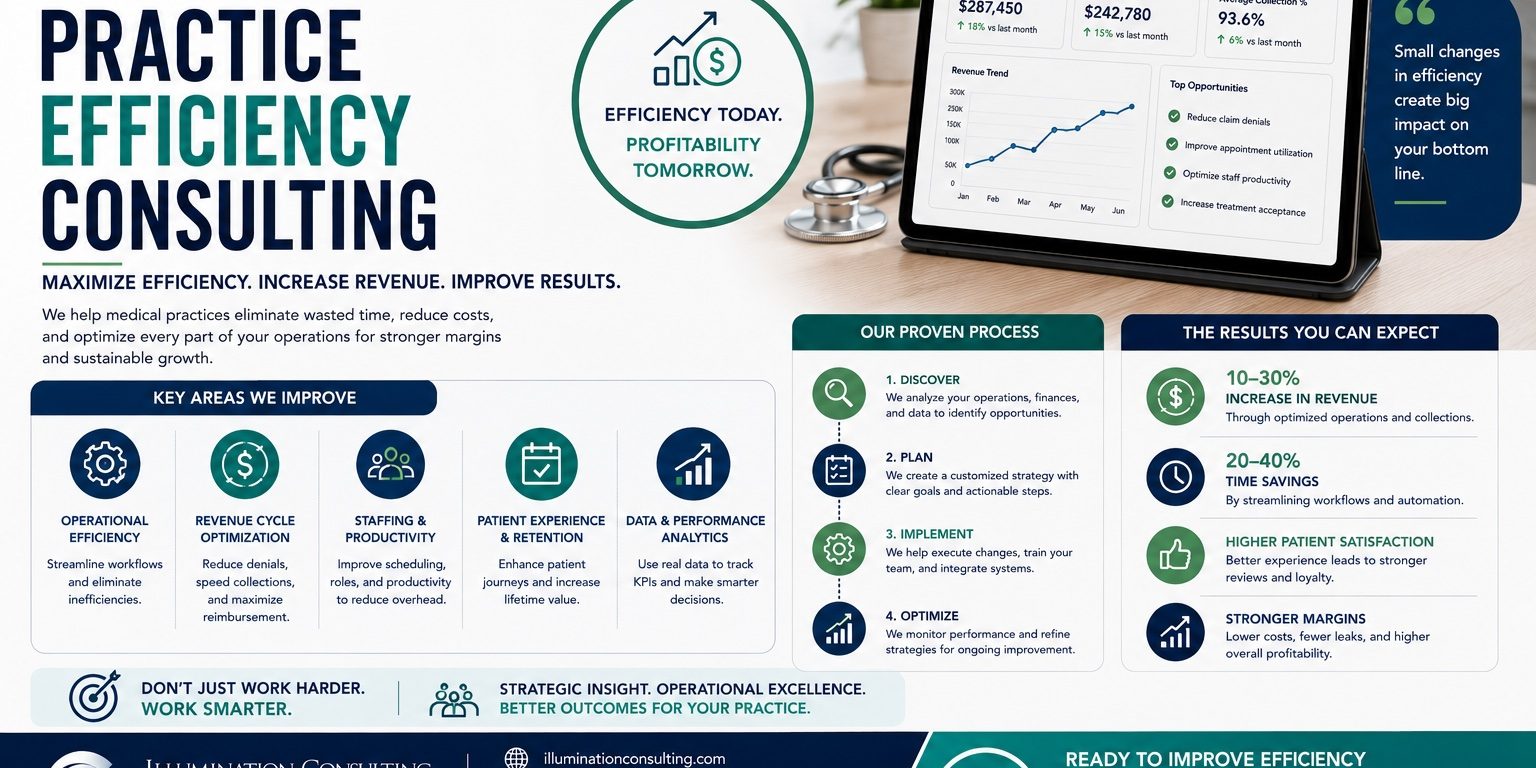
At Illumination Consulting, our premier practice efficiency consulting services are designed to pinpoint where your medical or aesthetic practice encounters financial losses—whether through billing inefficiencies, denied claims, or workflow slowdowns. We rigorously assess every stage of your revenue cycle, staff responsibilities, and patient scheduling systems to develop specifically tailored, measurable strategies that alleviate operational friction and plug revenue leaks. This comprehensive approach ensures a clear roadmap to enhanced margins and sustainable growth through expert clinic revenue optimization.
Key Takeaways
- Customized consulting services are essential to overcoming unique practice obstacles and achieving targeted performance objectives.
- Integrated revenue cycle management streamlines operations and maximizes financial returns in healthcare settings.
- Illumination Consulting operates from Beverly Hills, CA, delivering expert guidance on practice efficiency and revenue optimization.
- Physicians balancing clinical expertise with business management significantly benefit from dedicated practice efficiency consulting and administrative support systems.
Understanding Margin Loss: Operational Workflow or Financial Leak?
Margin erosion frequently arises simultaneously from operational inefficiencies and financial leakage. Staff burnout, scheduling inefficiencies, and sluggish patient intake subtly diminish profitability, while missed follow-ups and deficient conversion tracking cause more apparent revenue loss. Practice owners often mistakenly consider these problems in isolation; in reality, optimized medical practice efficiency requires addressing both together.
Practice efficiency consulting typically begins with a comprehensive evaluation of your operational framework, staffing structures, and technology ecosystem. The objective is to precisely identify where margin leakage happens — whether at the front desk, treatment areas, or during billing cycles. Our consultants specialize in enhancing clinical workflows and operational systems, beyond just projecting revenue outcomes.
Does Enhancing Operations Guarantee Revenue Growth?
While operational enhancements don’t automatically increase revenue, they create the essential foundation on which revenue growth depends. Improvements like optimized scheduling and decreased staff turnover directly enable increased bookings and patient retention, which marketing or pricing changes alone cannot achieve effectively without this solid base.
Key evaluation questions include:
- Are patient bookings and retention stable, declining, or failing to generate profit?
- Is staffing overhead disproportionate to patient volume?
- Are conversion rates and follow-up processes actively monitored and optimized?
Paired implementation of clinic revenue optimization with operational remedies ensures margin loss is addressed at its roots rather than just its symptoms.
What Issues Does Clinic Revenue Optimization Address?
Clinic revenue optimization uncovers hidden discrepancies between services provided and revenue collected. Contrary to assumptions centered solely on patient volume, much of the lost revenue stems from unbilled procedures, coding errors, and compliance challenges, which are often only identified through thorough audits.
Our approach begins with a detailed audit reviewing billing and scheduling workflows for inefficiencies and compliance risks that let revenue slip through unnoticed, which compounds significantly over time.
Is Revenue Leakage Always a Billing Problem?
Not exclusively. Increasingly, revenue leakage occurs even before patient visits, due to low online visibility and slow website performance, which divert potential patients to competitors. Strengthening local search authority and optimizing site performance converts more online search traffic into booked consultations, closing revenue gaps overlooked by billing audits.
Why Integrate Bookings, Retention, and Billing?
Because these elements form an interconnected system feeding overall practice growth. Improving one aspect while neglecting others results in ongoing margin loss. For example, optimizing billing without addressing patient retention yields limited benefits; likewise, enhancing marketing without resolving compliance issues can cause costly penalties.
Building Lasting Medical Practice Efficiency
Long-term medical practice efficiency arises from systematically addressing bottlenecks that consume physician and staff time daily; these include scheduling gaps, redundant paperwork, and manual follow-up tasks. Practices that treat consulting as a one-time remedy rarely maintain improvements. Success comes from implementing repeatable, sustainable systems.
Operational Changes with Greatest Impact
Workflow audits identifying inefficiencies in scheduling and staff hand-offs reveal key time loss points. Optimizing these processes frees physician hours without increasing staffing levels, enabling compounding efficiency gains rather than temporary plateaus.
Influence of the Practice Website on Efficiency
A conversion-optimized website minimizes administrative effort by reducing unqualified inquiries and streamlining patient intake procedures, complementing broader clinic revenue optimization strategies. Decreasing wasted administrative hours translates directly to more time for booked patients.
Our collaborative process with Illumination Consulting involves:
- Comprehensive mapping of current scheduling and workflow processes
- Identification of operational and revenue leakage points
- Redesigning digital intake workflows and website conversion paths
- Deploying sustainable systems that empower your team without dependence on continual external support
Our priority is building efficiency that endures, not short-term fixes.
Optimizing your practice requires an integrated methodology addressing operational workflows, patient experience, and financial performance together. By applying tailored systems and process improvements, your practice builds a foundation for measurable success and ongoing competitive advantage in today’s complex healthcare environment.
Clinical Workflow Diagnostic Checklists
To support your assessment and improvement efforts, we provide key diagnostic checklists identifying typical bottlenecks for immediate focus:
Patient Intake Bottlenecks
- Delays in check-in exceeding 5 minutes
- Frequent incomplete patient forms requiring staff follow-up
- Manual data entry prone to errors or duplication
- Low pre-registration use leading to crowded front desks
Room Turnover Latency
- Time between patient appointments exceeding target benchmarks (e.g., >10 minutes)
- Uncoordinated cleaning and preparation procedures
- Lack of standardized handoff protocols among staff and providers
Charting and Documentation Delays
- Excessive time providers spend charting post-appointment
- Redundant documentation requests across systems
- Delayed electronic health record (EHR) updates impairing billing timelines
Checkout Friction Points
- Slow payment processing and reconciliation
- Manual and error-prone commission and tip calculations
- Inconsistent patient checkout experiences impacting satisfaction
Operational KPI Benchmarks for Practice Efficiency
Measuring performance against key operational KPIs is critical. Benchmarks include:
Digital Paperless Intake Systems & Pre-Registration Workflows
Modern practices leverage digital intake automation to expedite patient onboarding while reducing paper usage and front desk bottlenecks. These solutions enable patients to complete registration, consents, and medical histories via mobile devices prior to arrival, synchronizing seamlessly with Electronic Medical Records like Nextech, Boulevard, and Symplast.
Automated data verification flags inconsistencies early, minimizing errors and ensuring compliance. Average front desk check-in time drops below 60 seconds, reducing labor expenses and enhancing patient satisfaction.
Pre-visit questionnaires with branching logic further customize data collection, improving clinical quality and adherence to protocols. Overall, these tools elevate operational efficiency, boost treatment room turnover rates, and foster patient-centered experiences.
Provider Schedule Density: Staggered Treatments with Four-Handed Workflows
Increasing provider schedule density exemplifies effective medical practice efficiency tactics. Utilizing staggered scheduling alongside four-handed workflows pairs physicians with medical assistants who prepare subsequent patients while treatments are in progress.
This method doubles provider injection capacity, enhances patient throughput, reduces overhead, and improves compliance and patient experience by ensuring consistent protocol application.
Applying Lean Healthcare Principles to Practice Operations
Adopting Lean methodologies systematically uncovers and eliminates operational wastes (Muda) including unnecessary waiting, overproduction, redundant processes, inefficient staff movements, excess inventory, and errors requiring rework.
Lean value stream mapping guides workflow redesigns optimizing patient flow, room layouts, documentation, and more, fostering agile, cost-effective clinics capable of sustained growth without proportional overhead increases.
Automated Billing Reconciliation, Contactless Checkout & POS Workflows
Advanced financial workflow automation prevents revenue leakage and reduces administrative burdens. Techniques involve card-on-file tokenization for secure payments, mobile POS for immediate chairside checkout, automated tip and commission calculations, and seamless daily reconciliation with accounting software like QuickBooks.
These systems reduce missed charges, quicken payment cycles, and streamline finances to complement enhanced clinical operations.
Clinical Workflow Diagnostic Checklists
Use these checklists to identify typical operational pain points:
Patient Intake Bottlenecks Checklist
- Average check-in time exceeds 5 minutes?
- Frequent incomplete or inaccurate patient forms?
- Manual data re-entry across systems?
- Low pre-registration completion rates?
Room Turnover Latency Checklist
- Inconsistent time between patients beyond 10 minutes?
- Uncoordinated cleaning or prep workflows?
- Undefined or inconsistent staff handoffs?
Charting Delays Checklist
- Extended charting time post-appointment?
- Duplicate documentation efforts?
- Billing delays due to late record entries?
Checkout Friction Checklist
- Manual or slow payment processing?
- Confusing tip and commission disbursement?
- Patient complaints regarding checkout experience?
Operational KPI Benchmarks Reference
FAQ
Is margin loss caused by operations or finances?
Margin loss results from intertwined operational inefficiencies and financial leakage. Optimizing both through integrated practice efficiency consulting produces the best outcomes.
Does improving operations guarantee higher revenue?
Operational improvements establish essential foundations that facilitate revenue growth, but without them, marketing and pricing initiatives often underperform.
What hidden issues does clinic revenue optimization uncover?
Optimization reveals unbilled procedures, coding errors, and compliance gaps contributing to revenue leakage, typically exposed through detailed billing and scheduling audits.
Facts
- Illumination Consulting is headquartered in Beverly Hills, CA, USA, specializing in comprehensive medical and aesthetic practice optimization.