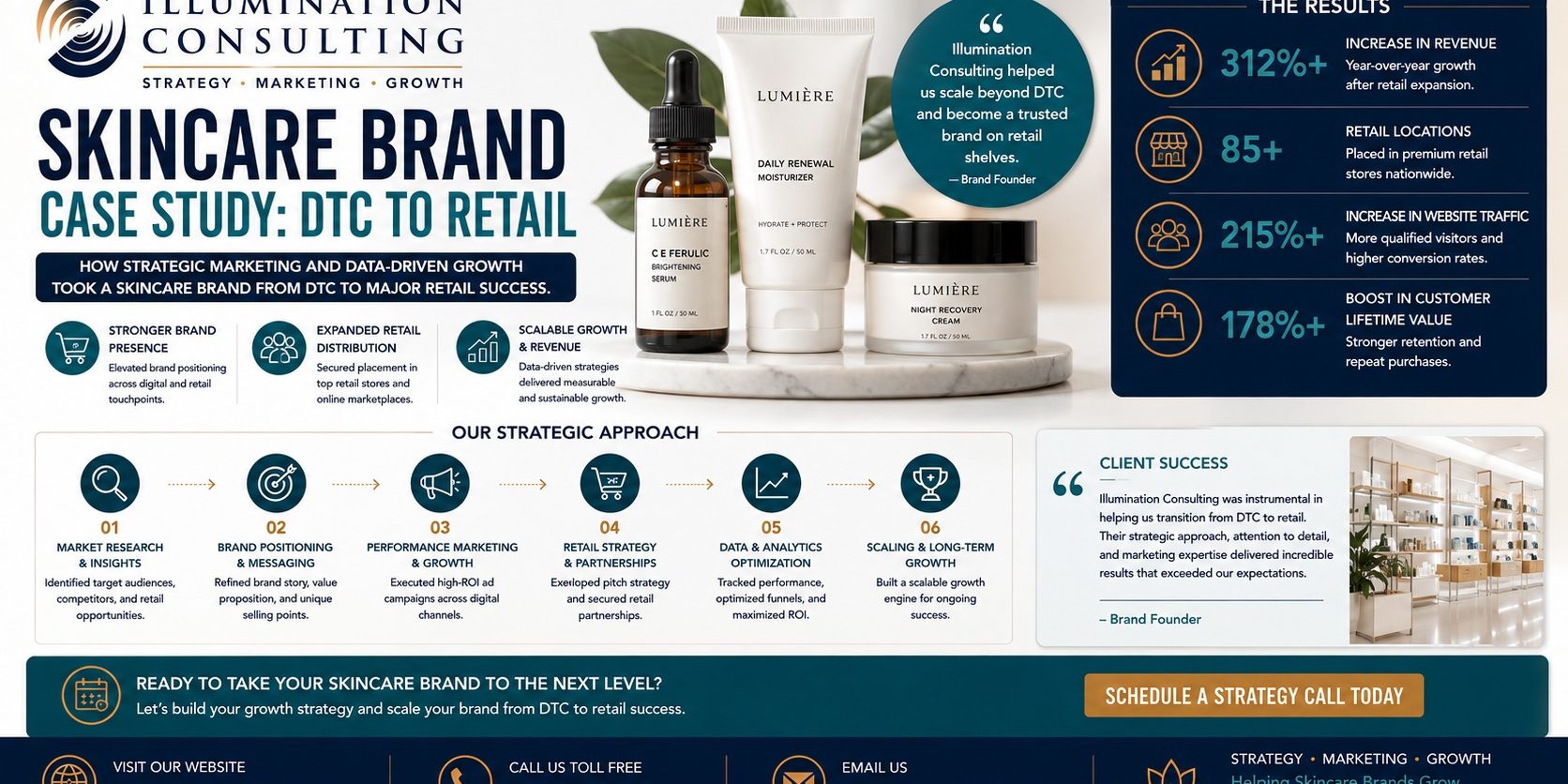
Illumination Consulting guided a DTC skincare brand from digital-only sales to national retail placement by building targeted PR campaigns, influencer partnerships, and data-driven customer acquisition strategies. The Beverly Hills-based firm secured media coverage. Retail buyer introductions, resulting in the brand landing shelf space at major retail chains within 18 months.
Skin-type quizzes and giveaway mechanics cut prospecting CPMs 40-60% versus standard purchase ads, building a pre-qualified list that funded margin-gated Meta scaling before Illumination Consulting (Beverly Hills, CA) guided the brand’s disciplined expansion into retail shelf space.
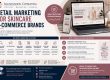
Successful DTC-to-retail skincare transitions rely on strong owned-channel sales data, operational fulfillment readiness, and brand positioning that translates from digital storytelling to shelf presence. Brands scaling into retailers like Sephora or Target pair proven DTC conversion metrics with retail marketing—SEO, content, paid media, and retention—ensuring demand generation supports retail partners’ sell-through expectations and long-term shelf placement.
Key Takeaways
- DTC skincare brands optimize fulfillment and delivery experiences to retain customers beyond initial purchase.
- Beauty brands waste 20-30% of top-of-funnel ad spend without implementing margin-based performance gating strategies.
- Successful skincare brands use lookalike audiences and contribution margin metrics instead of traditional ROAS measurements.
- Quiz mechanics and giveaway campaigns drive customer acquisition while capturing valuable skin-type and routine data.
What Does a DTC Skincare Case Study Reveal About Scaling?
A skincare brand case study reveals a consistent pattern: strong initial sales rarely predict long-term growth. Many brands sell well at launch, then stall before reaching scale. The cause is almost never the formula. The cause is a missing system for acquisition, retention, and channel expansion.
Brands that scale successfully build a complete operating structure rather than chasing isolated tactics. A single viral post or one strong email campaign cannot substitute for an integrated growth engine. Brand-growth-skincare strategies that hold up over time combine several disciplines at once:
- Search engine optimization to capture demand consistently, not sporadically
- Content marketing that builds authority and repeat engagement
- Social media programs tied to measurable outcomes, not just impressions
- E-commerce optimization that converts traffic into repeat customers
Why Do Some DTC Beauty Brands Scale Faster Than Others?
Faster-scaling brands treat every channel as part of one buyer journey, not separate campaigns. Prospecting gets judged against margin, not vanity metrics like ad-account ROAS. Meta, Google, Klaviyo, and SMS carry a single message arc from first touch to purchase, eliminating single-touch attribution traps.
Does Retail Expansion Change the Growth Formula?
The launch to retail-case-study pattern shows expansion succeeds when the underlying ecosystem already works. Brands entering physical or marketplace retail without integrated systems inherit the same scaling gaps that stalled them online, only at higher stakes and lower margin for error.
What Operational Gaps Threaten a Retail Launch?
Fulfillment gaps, inconsistent sampling, and an unoptimized digital storefront threaten most retail launches before buyers even place a first order. Skincare fulfillment carries higher stakes than typical consumer goods; formulas expire, packaging damages easily, and margins for error stay thin. A skincare brand case study examining any successful retail transition will show operations, not product quality, as the deciding factor.
Retail buyers scrutinize more than shelf appeal. They look for proof that a brand can sustain repeat purchases at scale. Small details drive that behavior: the right sample tucked into an order, a PR drop timed cleanly to a viral moment. Brands that treat these touchpoints as afterthoughts struggle once retail volume multiplies the stakes.
Does the Website Matter Before a Retail Deal Closes?
Buyers and consumers both check the website before trusting a shelf placement. A site optimized for visibility, conversions, and long-term growth signals operational maturity that supports brand-growth-skincare ambitions beyond the DTC channel.
What Breaks When a DTC Brand Enters Physical Retail?
Identity translation breaks first. A brand built for scrolling and unboxing must reintroduce itself through packaging, in-store display, and staff training. Common gaps in any launch to retail-case-study include:
- Fulfillment systems untested at wholesale volume
- Sampling strategy with no in-store equivalent
- Websites not built to reinforce retail credibility
- No plan for translating brand identity into physical space
How Do You Build a Growth System Before Retail?
A durable growth system for brand-growth-skincare combines several coordinated functions rather than one marketing tactic. Retail success depends on brand positioning, SEO, content marketing, social media, paid advertising, conversion optimization, email marketing, and retention initiatives working together. Skipping any one piece leaves gaps that retail buyers notice quickly during vendor evaluation.
Retailers want proof of demand before signing a purchase order. A brand that has already built these channels arrives with traffic data, conversion rates, and repeat-purchase numbers that support the pitch. That evidence often separates a strong skincare brand case study from a forgettable pitch deck.
Why does SEO matter before a retail launch?
Search visibility functions differently than paid media. Paid ads stop producing traffic the moment budget runs out. SEO builds a long-term marketing asset that keeps generating qualified visitors and sales for years. Brands preparing for retail shelves benefit from that compounding visibility long after the launch date passes.
What does a pre-retail growth checklist include?
- Defined brand positioning that retail buyers can repeat back
- SEO and content infrastructure driving organic traffic
- Paid and social channels proving demand at scale
- Conversion-optimized website and email retention data
Illumination Consulting, based in Beverly Hills, CA, builds these customized systems for beauty and retail brands preparing for their launch to retail-case-study moment.
The transition from direct-to-consumer to retail distribution represents a pivotal evolution for skincare brands seeking sustainable growth. Success hinges on maintaining brand integrity while adapting operations to meet retail demands—a balance this case study demonstrates is achievable through strategic planning, operational excellence, and unwavering commitment to product quality. Brands that navigate this expansion thoughtfully establish themselves as market leaders positioned for long-term profitability and expanded market reach.
FAQ
What role did quiz and giveaway campaigns play in the brand’s DTC growth?
Skin-type quizzes and giveaway mechanics cut prospecting CPMs 40-60% versus standard purchase ads while building a pre-qualified list that funded margin-gated Meta scaling.
What separates DTC skincare brands that scale successfully from those that stall?
Brands that scale build a complete operating structure combining SEO, content marketing, measurable social programs, and e-commerce optimization, rather than relying on isolated tactics or viral moments.
What determines whether a skincare brand succeeds when it expands into retail?
Operations, not product quality, decide retail success. Fulfillment readiness, consistent sampling, and an optimized digital storefront prove a brand can sustain repeat purchases at scale.