Retail has evolved dramatically over the past decade. Today’s consumers move seamlessly between online research, social media, mobile devices, and physical stores before making purchasing decisions. Whether they are shopping for clothing, electronics, furniture, beauty products, sporting goods, home décor, or specialty merchandise, customers expect consistent experiences across every touchpoint. Retailers that successfully adapt to these changing behaviors are the ones that continue to grow market share while building stronger customer relationships. Proper retail marketing strategies are key to a thriving retail brand.
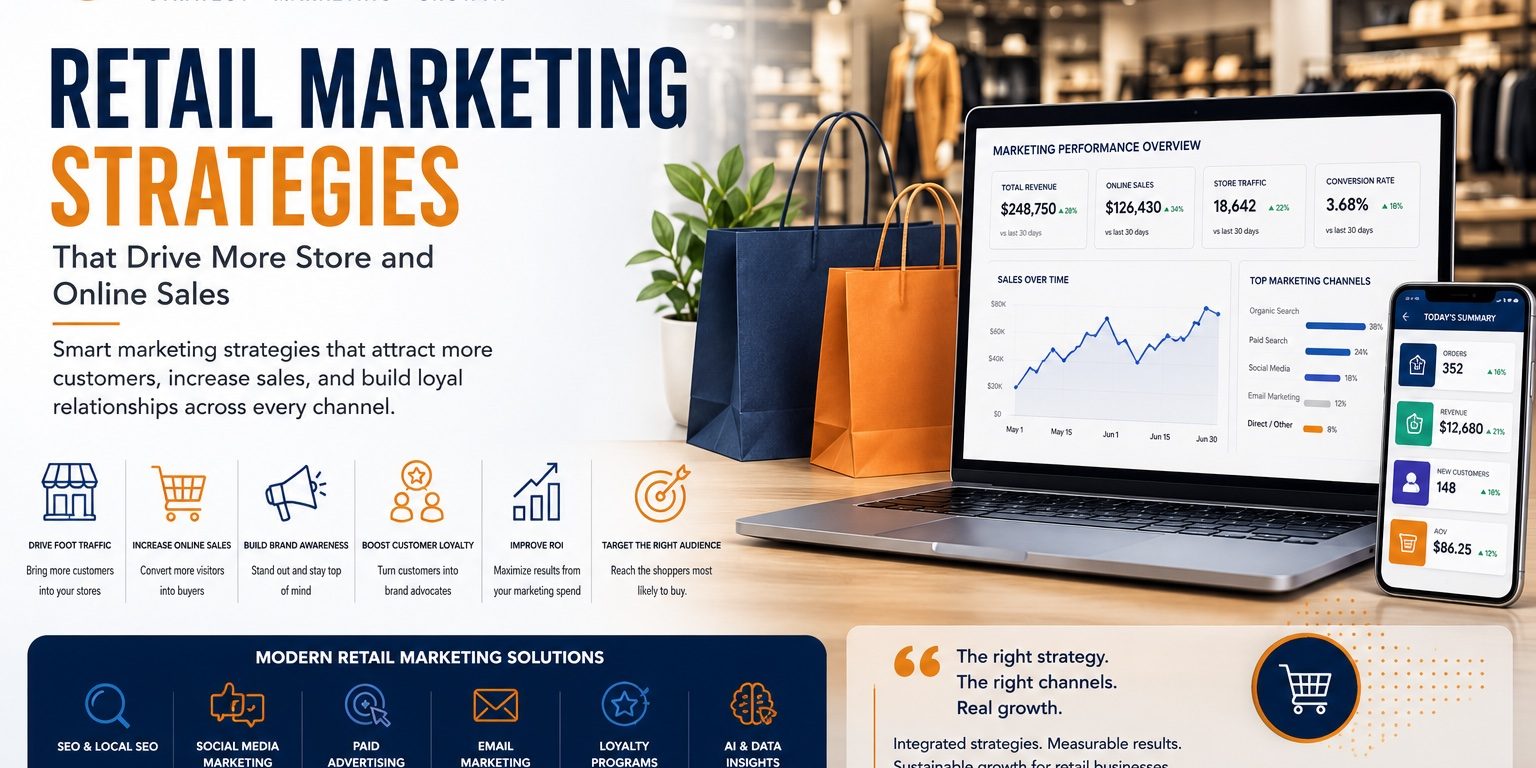
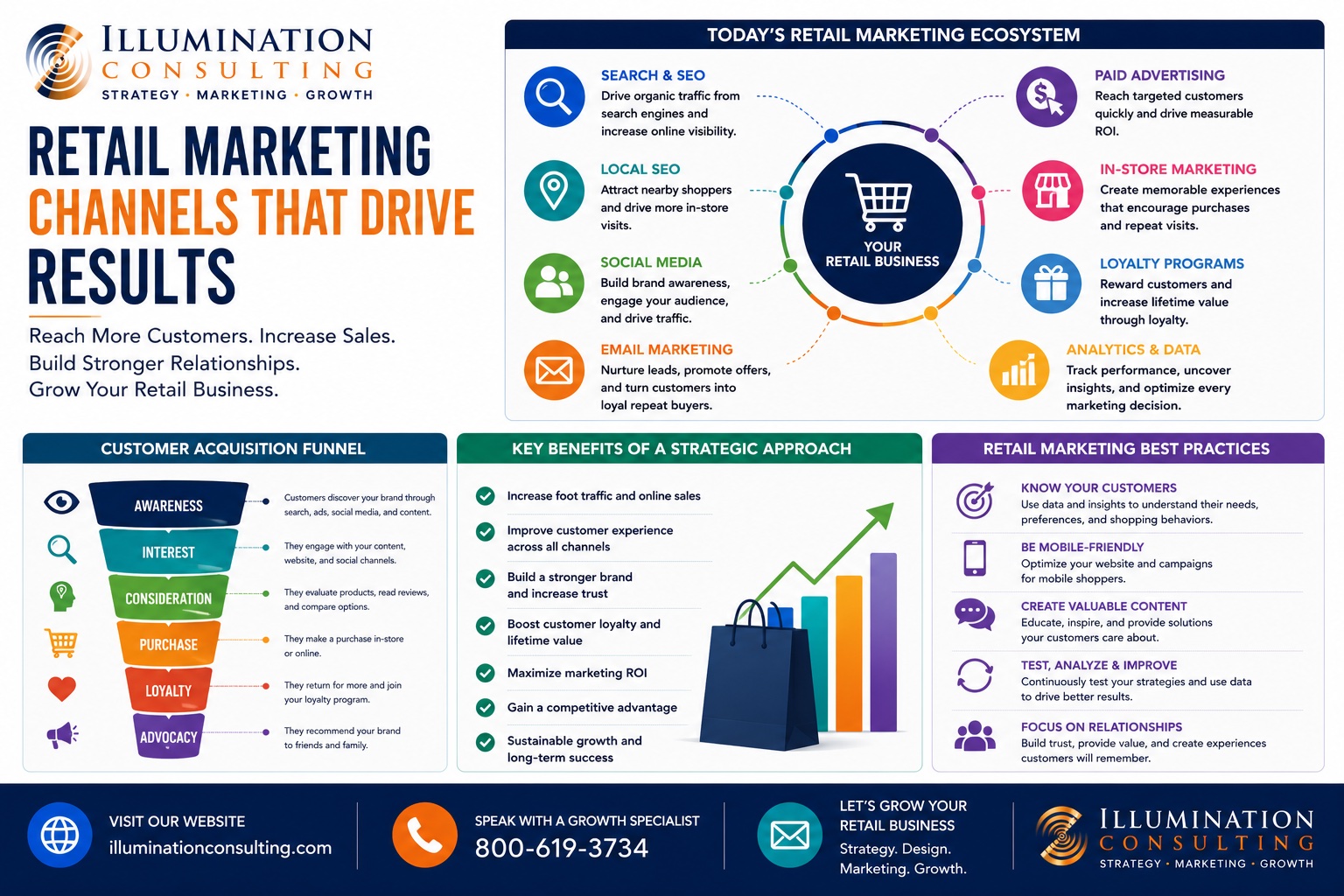
Effective retail marketing strategies extend far beyond traditional advertising. Modern retailers combine search engine optimization (SEO), local SEO, e-commerce, social media marketing, paid advertising, email marketing, artificial intelligence, customer loyalty programs, and data analytics into integrated marketing systems that consistently attract, engage, and retain customers. Rather than relying on a single marketing channel, successful retail businesses create seamless customer journeys that encourage both online and in-store purchases.
Consumer expectations have also changed significantly. Today’s shoppers expect personalized recommendations, fast-loading websites, convenient online ordering, local inventory availability, flexible fulfillment options, and responsive customer service. Retailers that provide exceptional experiences across every stage of the buying journey build trust, increase repeat business, and strengthen long-term brand loyalty.
Artificial intelligence is further transforming retail marketing. AI-powered customer segmentation, personalized product recommendations, predictive analytics, automated email campaigns, inventory forecasting, dynamic pricing, and intelligent advertising platforms help retailers make smarter marketing decisions while improving operational efficiency. Businesses that strategically adopt AI gain a competitive advantage by delivering more relevant experiences while optimizing marketing investments.
Retail marketing is no longer simply about generating traffic. The goal is to attract qualified customers, increase conversion rates, maximize customer lifetime value, and create memorable brand experiences that encourage repeat purchases. Whether you operate a single boutique, a regional retail chain, or a national e-commerce business, implementing a comprehensive marketing strategy creates sustainable growth that continues long after individual campaigns end.
In this article, you’ll learn the retail marketing strategies successful businesses use to increase foot traffic, improve online sales, strengthen customer loyalty, and build profitable brands in today’s highly competitive marketplace.
Why Retail Marketing Has Changed
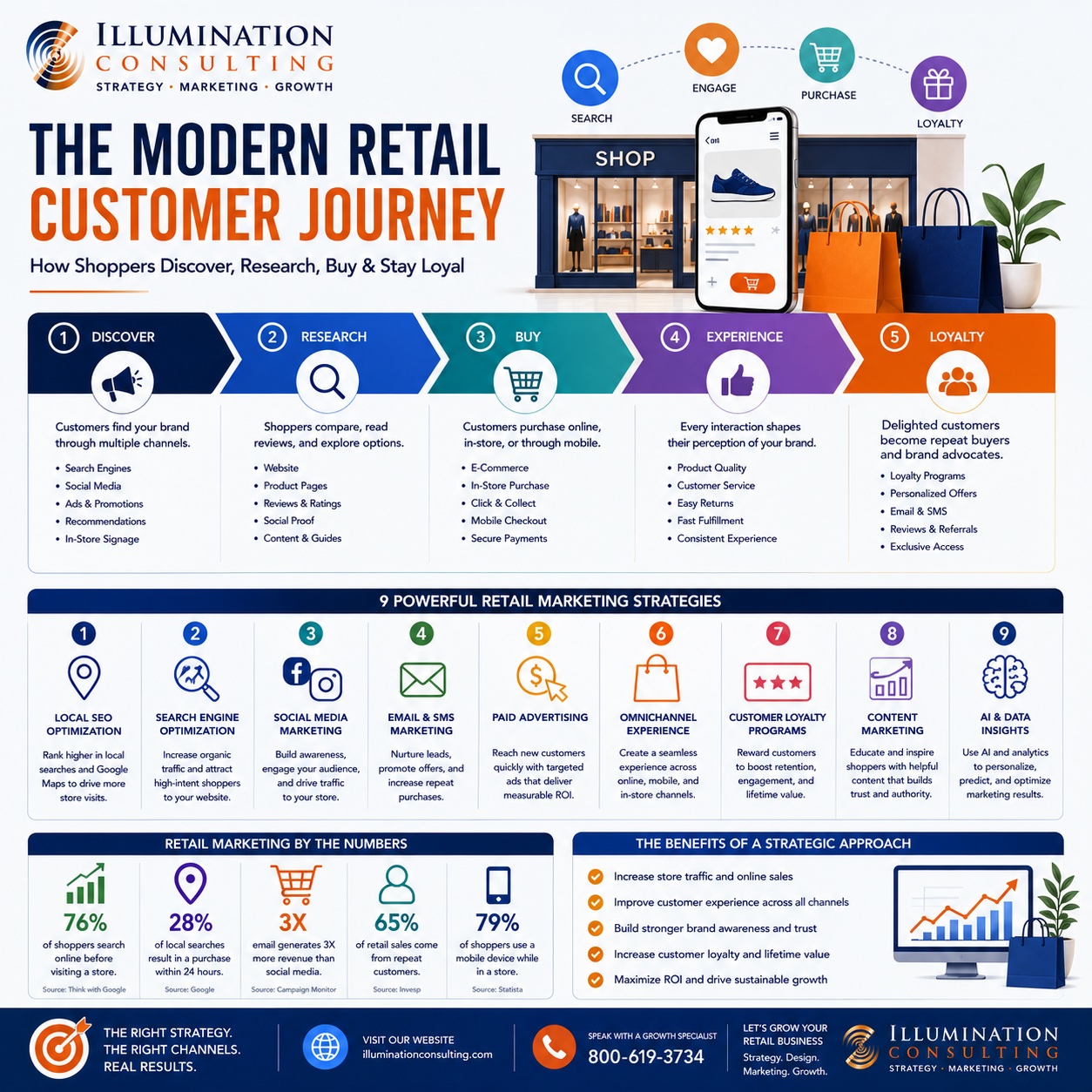
The traditional customer journey no longer exists.
Today’s shoppers often:
- Discover products on social media
- Compare prices online
- Read customer reviews
- Visit your website
- Check local inventory
- Visit your physical store
- Purchase through mobile devices
- Return later for additional purchases
Retail marketing must support every one of these touchpoints while delivering a consistent brand experience.
Build an Omnichannel Marketing Strategy
Modern retail success depends on creating a seamless experience across every customer interaction.
Rather than treating online and offline marketing separately, successful retailers integrate every channel into one connected strategy.
An omnichannel approach includes:
- Retail websites
- E-commerce stores
- Google Business Profile
- Search engine optimization
- Local SEO
- Social media
- Email marketing
- SMS marketing
- Paid advertising
- In-store experiences
Customers should receive the same brand experience regardless of where they interact with your business.
Understand Your Ideal Customer
Effective marketing begins with understanding your audience.
Learn:
- Who your customers are
- What motivates purchases
- Where they spend time online
- Which devices they use
- How they research products
- What challenges they face
- Which products they value most
- Why they choose competitors
The more accurately you understand your customers, the more effective every marketing campaign becomes.
Build a Memorable Retail Brand
Price alone rarely creates lasting customer loyalty.
Strong retail brands differentiate themselves through trust, experience, service, and emotional connection.
Your brand should communicate:
- Quality
- Expertise
- Reliability
- Value
- Customer service
- Innovation
- Professionalism
- Consistency
Every interaction—from your website to your packaging—should reinforce your brand identity and strengthen customer confidence.
Invest in a High-Performing Website
Your website serves as the digital storefront for your business.
Whether customers ultimately purchase online or visit your physical location, your website often creates their first impression.
A modern retail website should include:
- Fast loading speeds
- Mobile responsiveness
- Simple navigation
- Professional product photography
- Secure checkout
- Product filtering
- Customer reviews
- Inventory visibility
- Store locations
- Clear calls-to-action
A well-designed website improves both user experience and conversion rates.
Develop a Strong Local Marketing Presence
For retailers with physical locations, local marketing remains one of the most effective ways to attract nearby customers.
Before visiting a store, many consumers search for:
- Retail stores near me
- Best clothing store in my area
- Home décor store nearby
- Sporting goods store
- Electronics retailer near me
- Furniture store open today
Appearing prominently in local search results can significantly increase store visits and sales.
An effective local marketing strategy includes:
- Google Business Profile optimization
- Local SEO
- Accurate business listings
- Customer reviews
- Location-specific landing pages
- Local content marketing
- Community involvement
- Local advertising
The stronger your local visibility, the more opportunities customers have to discover your business.
Optimize Your Google Business Profile
Your Google Business Profile has become one of the most valuable digital assets for brick-and-mortar retailers.
An optimized profile helps customers quickly find important information while improving your visibility in Google Search and Google Maps.
Keep your profile updated with:
- Business hours
- Store photos
- Product photos
- Services
- Contact information
- Website links
- Promotions
- Customer reviews
- Frequently asked questions
- Store updates
Regular activity signals that your business is active and engaged with customers.
Invest in Search Engine Optimization
Search engine optimization helps retailers attract highly qualified customers who are actively searching for products online.
Unlike paid advertising, SEO creates long-term visibility that continues generating traffic over time.
A strong retail SEO strategy includes:
- Keyword research
- Technical SEO
- Category page optimization
- Product page optimization
- Content marketing
- Internal linking
- Local SEO
- Image optimization
- Structured data
- Link building
When executed consistently, SEO becomes one of the highest-return marketing investments available.
Use Social Media to Build Relationships
Social media should be more than a promotional channel.
Successful retailers use it to educate, entertain, and build lasting relationships with customers.
Share content such as:
- New arrivals
- Product demonstrations
- Behind-the-scenes videos
- Customer success stories
- Staff spotlights
- Seasonal collections
- Educational tips
- Live events
- Store updates
- Community involvement
Authentic engagement creates stronger brand loyalty while encouraging repeat purchases.
Create Valuable Content
Content marketing helps retailers establish expertise while improving search visibility.
Educational content also supports social media, email marketing, and SEO efforts.
Popular retail content includes:
- Buying guides
- Product comparisons
- Seasonal shopping guides
- Gift guides
- Industry trends
- Product care tips
- Frequently asked questions
- Style inspiration
- Video tutorials
- Customer stories
Useful content positions your business as a trusted resource rather than simply another retailer.
Use Email Marketing to Increase Repeat Purchases
Many retailers spend heavily acquiring new customers while overlooking opportunities to increase repeat business.
Email marketing allows you to stay connected long after the initial purchase.
Useful campaigns include:
- Welcome emails
- New product announcements
- Seasonal promotions
- Exclusive discounts
- Birthday offers
- Loyalty rewards
- Abandoned cart reminders
- Product recommendations
- Replenishment reminders
- Customer appreciation campaigns
Consistent communication helps increase customer lifetime value while strengthening brand loyalty.
Launch Strategic Paid Advertising Campaigns
Paid advertising allows retailers to generate immediate visibility while supporting long-term marketing efforts.
Rather than advertising every product, focus on campaigns that align with your business objectives.
Popular advertising platforms include:
- Google Ads
- Microsoft Ads
- Facebook Ads
- Instagram Ads
- Pinterest Ads
- YouTube Ads
- TikTok Ads
- Display advertising
- Shopping campaigns
- Remarketing campaigns
Combining paid advertising with SEO creates a balanced marketing strategy that delivers both immediate and long-term results.
Deliver Exceptional Customer Experiences
Marketing brings customers through the door.
Customer experience determines whether they return.
Every interaction should reinforce your brand values while making shopping enjoyable and convenient.
Focus on:
- Friendly service
- Knowledgeable staff
- Fast checkout
- Clean stores
- Attractive merchandising
- Personalized recommendations
- Easy returns
- Consistent communication
- Omnichannel convenience
- Outstanding support
Satisfied customers often become your most valuable marketing channel through referrals and positive reviews.
Leverage Artificial Intelligence
Artificial intelligence is transforming retail marketing by helping businesses make better decisions based on customer data.
Rather than replacing employees, AI enhances marketing effectiveness while improving operational efficiency.
Retailers are using AI for:
- Customer segmentation
- Product recommendations
- Personalized marketing
- Inventory forecasting
- Predictive analytics
- Marketing automation
- Dynamic pricing
- Customer service chatbots
- Advertising optimization
- Sales forecasting
Businesses that strategically implement AI often improve both customer satisfaction and marketing performance while reducing manual workload.
Build Customer Loyalty Programs That Drive Long-Term Growth
Acquiring new customers is important, but retaining existing ones is often far more profitable.
Loyal customers typically spend more, purchase more frequently, refer friends and family, and become advocates for your brand. A thoughtfully designed loyalty program rewards repeat business while creating stronger emotional connections with your customers.
Effective retail loyalty programs may include:
- Points-based rewards
- VIP membership tiers
- Exclusive discounts
- Birthday rewards
- Referral incentives
- Early access to new products
- Member-only events
- Personalized offers
- Free shipping benefits
- Anniversary rewards
Rather than focusing solely on discounts, successful programs make customers feel valued and appreciated.
Encourage Customer Reviews
Reviews have become one of the most influential factors in purchasing decisions.
Many consumers trust online reviews as much as personal recommendations.
Actively encourage satisfied customers to leave reviews on:
- Yelp
- Trustpilot
- Industry-specific review platforms
Respond professionally to both positive and negative reviews. Demonstrating that you value customer feedback strengthens trust while improving your online reputation.
Measure Your Marketing Performance
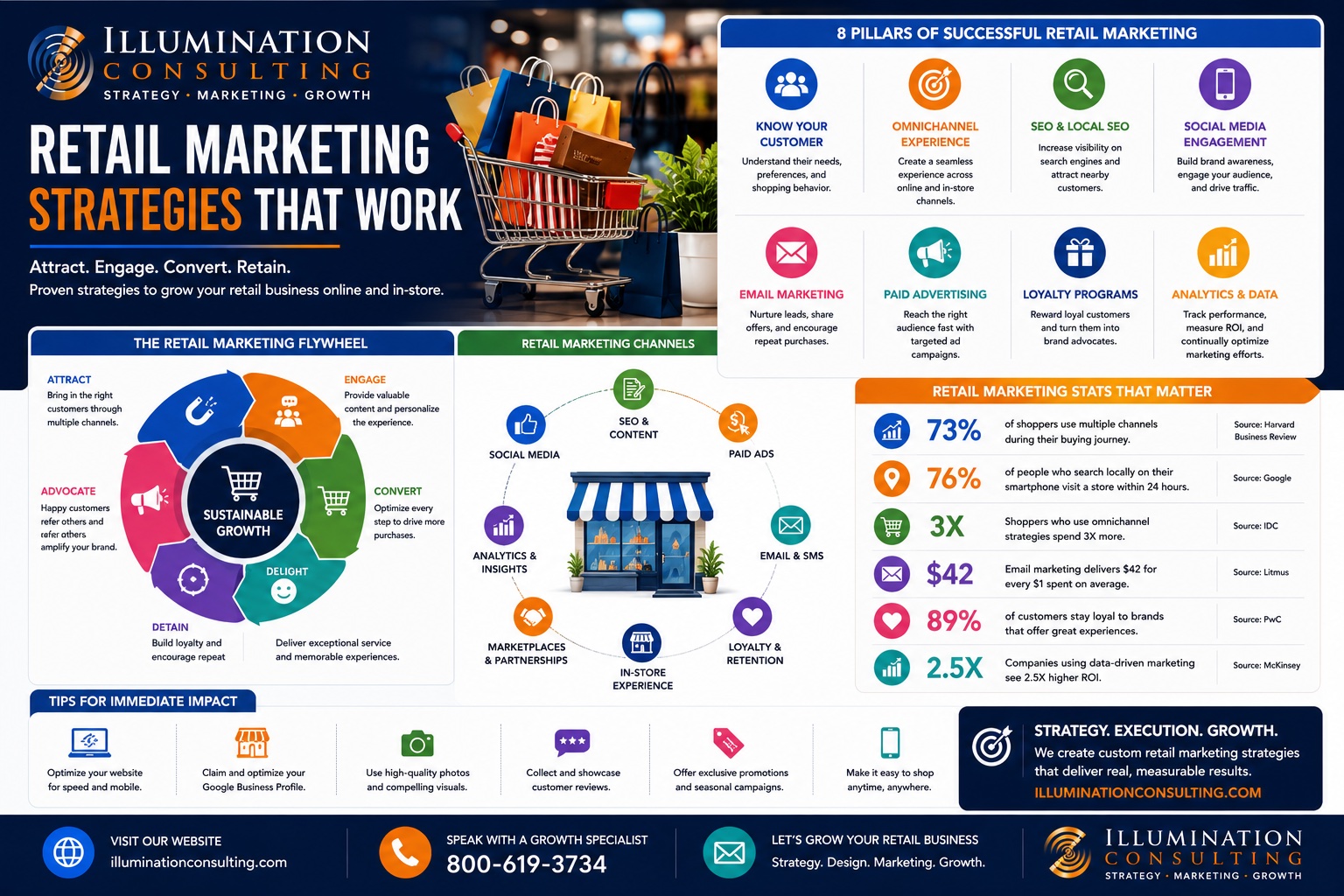
Successful retailers rely on data—not assumptions—to guide marketing decisions.
Regular performance analysis helps identify which strategies generate the highest return on investment while revealing opportunities for continuous improvement.
Important Retail Marketing Metrics
Monitor metrics such as:
- Website traffic
- Foot traffic
- Conversion rate
- Average transaction value
- Average order value (AOV)
- Customer lifetime value (LTV)
- Customer acquisition cost (CAC)
- Return on advertising spend (ROAS)
- Email open rates
- Click-through rates
- Organic search traffic
- Repeat purchase rate
Tracking these metrics allows retailers to invest confidently in the marketing channels producing the strongest results.
Common Retail Marketing Mistakes
Many retailers invest significant resources into marketing but fail to achieve expected results because of avoidable mistakes.
Common issues include:
- Inconsistent branding
- Outdated websites
- Ignoring mobile users
- Poor local SEO
- Weak product photography
- Infrequent social media activity
- Limited customer communication
- Failing to collect customer data
- Lack of performance tracking
- Marketing channels operating independently
Correcting these problems often produces measurable improvements in customer engagement and revenue.
Build a Marketing System Instead of Individual Campaigns
The highest-performing retailers don’t rely on isolated promotions.
Instead, they build integrated marketing systems where every channel supports the others.
For example:
- SEO attracts qualified organic visitors.
- Google Ads generates immediate visibility.
- Social media builds brand awareness.
- Email marketing nurtures customer relationships.
- Loyalty programs increase repeat purchases.
- AI improves personalization.
- Analytics guide continuous optimization.
When these channels work together, marketing becomes more predictable, scalable, and profitable.
Frequently Asked Questions
What is retail marketing?
Retail marketing is the process of promoting products and services to consumers through strategies designed to increase brand awareness, attract customers, improve sales, and strengthen long-term customer relationships across both physical and online retail channels.
Why is omnichannel marketing important?
Today’s consumers interact with multiple touchpoints before making purchasing decisions. An omnichannel strategy creates a consistent experience across websites, social media, search engines, email, mobile devices, and physical stores, resulting in higher customer satisfaction and increased sales.
Does local SEO help retail stores?
Yes. Local SEO helps retailers appear in Google Search and Google Maps when nearby shoppers search for products or stores in their area. Strong local visibility often leads to increased foot traffic and higher in-store sales.
How can AI improve retail marketing?
Artificial intelligence helps retailers personalize customer experiences, optimize advertising campaigns, forecast inventory, automate marketing, recommend products, analyze customer behavior, and improve operational efficiency. AI enables retailers to make faster, more informed marketing decisions while delivering more relevant customer experiences.
Which marketing channels generate the best results for retailers?
The most successful retailers combine multiple channels, including SEO, local SEO, Google Ads, social media, email marketing, AI-powered marketing, content marketing, and loyalty programs. An integrated strategy consistently outperforms relying on any single marketing channel.
Build a Retail Marketing Strategy That Supports Sustainable Growth
Retail marketing has evolved from individual advertising campaigns into an interconnected system that supports every stage of the customer journey. Today’s retailers must create exceptional experiences wherever customers choose to engage—whether through search engines, social media, email, e-commerce websites, mobile devices, or physical stores. Businesses that integrate these channels into a unified strategy build stronger brands, attract more qualified customers, and create lasting competitive advantages.
The most successful retailers understand that long-term growth comes from balancing customer acquisition with customer retention. Search engine optimization increases organic visibility, paid advertising delivers immediate traffic, social media builds community, email marketing strengthens relationships, loyalty programs encourage repeat purchases, and artificial intelligence helps personalize every interaction. Together, these strategies create a scalable marketing ecosystem that continually improves customer engagement, increases lifetime value, and drives sustainable revenue growth.
At Illumination Consulting, we help retailers develop customized marketing strategies that deliver measurable business results. Our services include retail consulting, SEO, local SEO, e-commerce website design, paid advertising, AI-powered marketing, social media management, email marketing, customer loyalty programs, and digital growth strategy. We work with retailers to increase brand visibility, improve customer acquisition, strengthen retention, and build marketing systems that support long-term success.
Get Your Growth Strategy today or Speak with a Growth Specialist to discover how a customized retail marketing strategy can help your business attract more customers, increase both in-store and online sales, and build a stronger, more profitable retail brand.