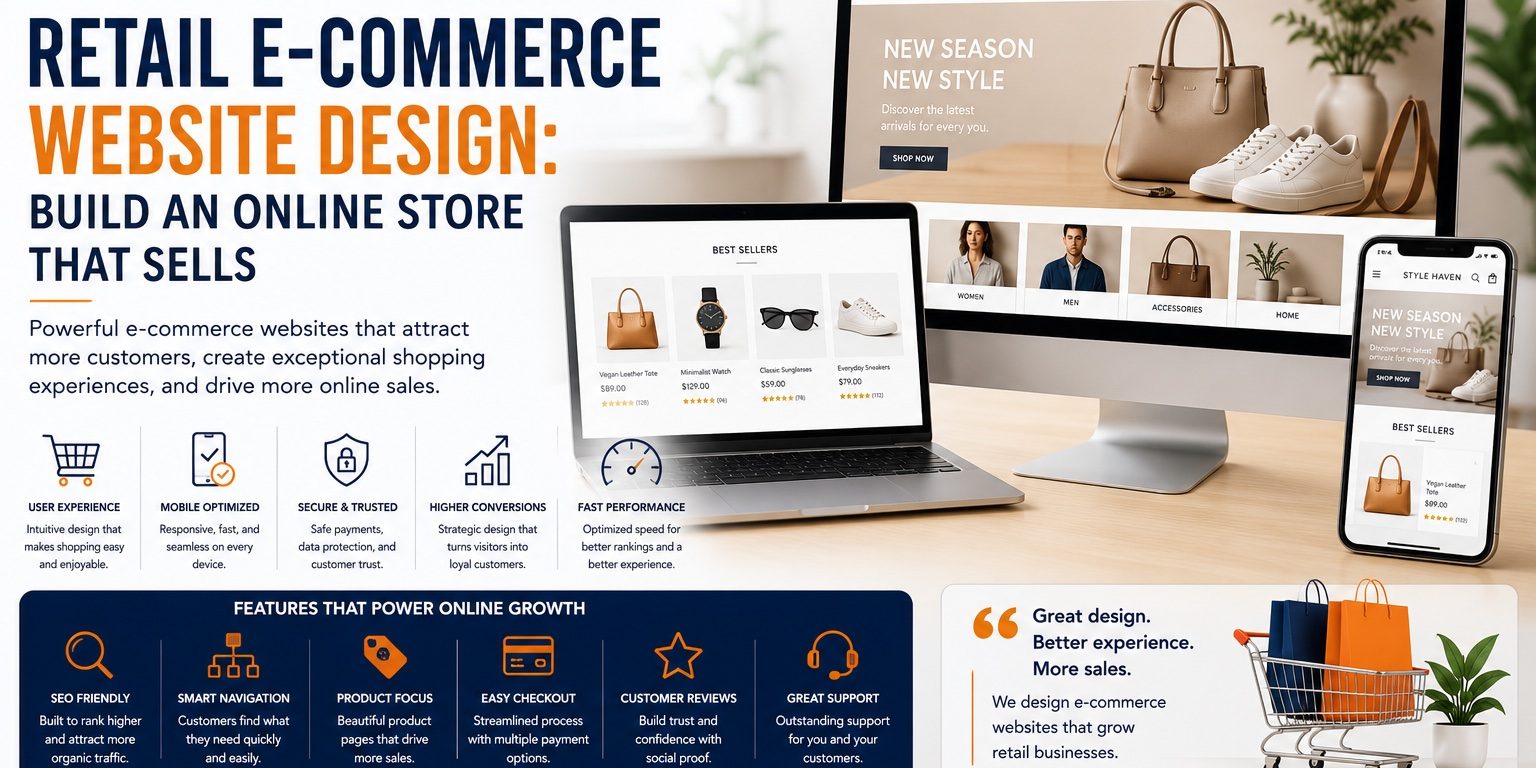
For today’s retailers, an e-commerce website is far more than an online catalog—it’s one of the most powerful revenue-generating assets a business can own. Whether customers discover your products through search engines, social media, email campaigns, or paid advertising, your website often determines whether they make a purchase or leave for a competitor. A professionally designed retail e-commerce website builds trust, creates exceptional shopping experiences, and transforms visitors into loyal customers.
Successful retail e-commerce website design combines visual appeal with strategic functionality. Every page should guide shoppers naturally through the buying journey while removing friction and building confidence. Fast loading speeds, intuitive navigation, mobile responsiveness, compelling product pages, secure checkout, and personalized shopping experiences all contribute to stronger conversion rates and higher customer satisfaction.
Consumer expectations continue to evolve. Shoppers expect seamless browsing across desktop and mobile devices, accurate inventory information, flexible payment options, personalized product recommendations, and convenient fulfillment methods such as home delivery, curbside pickup, and buy online, pick up in store (BOPIS). Retailers that deliver these experiences consistently outperform competitors while strengthening customer loyalty.
Artificial intelligence is also reshaping modern e-commerce. AI-powered search, product recommendations, predictive merchandising, customer segmentation, inventory forecasting, and marketing automation allow retailers to create highly personalized shopping experiences that increase engagement and maximize revenue. Rather than replacing human expertise, AI enhances every stage of the digital customer journey.
Website design also influences every other marketing initiative. Search engine optimization, Google Ads, email marketing, social media campaigns, influencer partnerships, and content marketing all become more effective when visitors land on an optimized website built to convert. Improving your website often generates a greater return on investment than simply increasing advertising budgets because it increases the value of every visitor you already attract.
Whether you’re launching a new online store or redesigning an established retail website, investing in professional e-commerce design creates a stronger digital foundation for long-term growth. The most successful retailers continually refine their websites based on customer behavior, performance data, and changing market expectations.
In this article, you’ll learn the website design strategies successful retailers use to improve user experience, increase conversions, strengthen customer loyalty, and generate more online sales.
Why Your Website Is Your Most Important Salesperson
Unlike a physical store that closes each evening, your e-commerce website is available around the clock.
It answers customer questions, showcases products, builds confidence, processes purchases, and supports your marketing campaigns 24 hours a day.
A high-performing retail website should:
- Build immediate trust
- Showcase products professionally
- Simplify navigation
- Educate shoppers
- Reduce buying hesitation
- Encourage larger purchases
- Capture leads
- Support customer service
- Increase repeat business
- Deliver a consistent brand experience
When designed strategically, your website becomes your most effective salesperson.
Create an Outstanding First Impression
Visitors form opinions about a website within seconds.
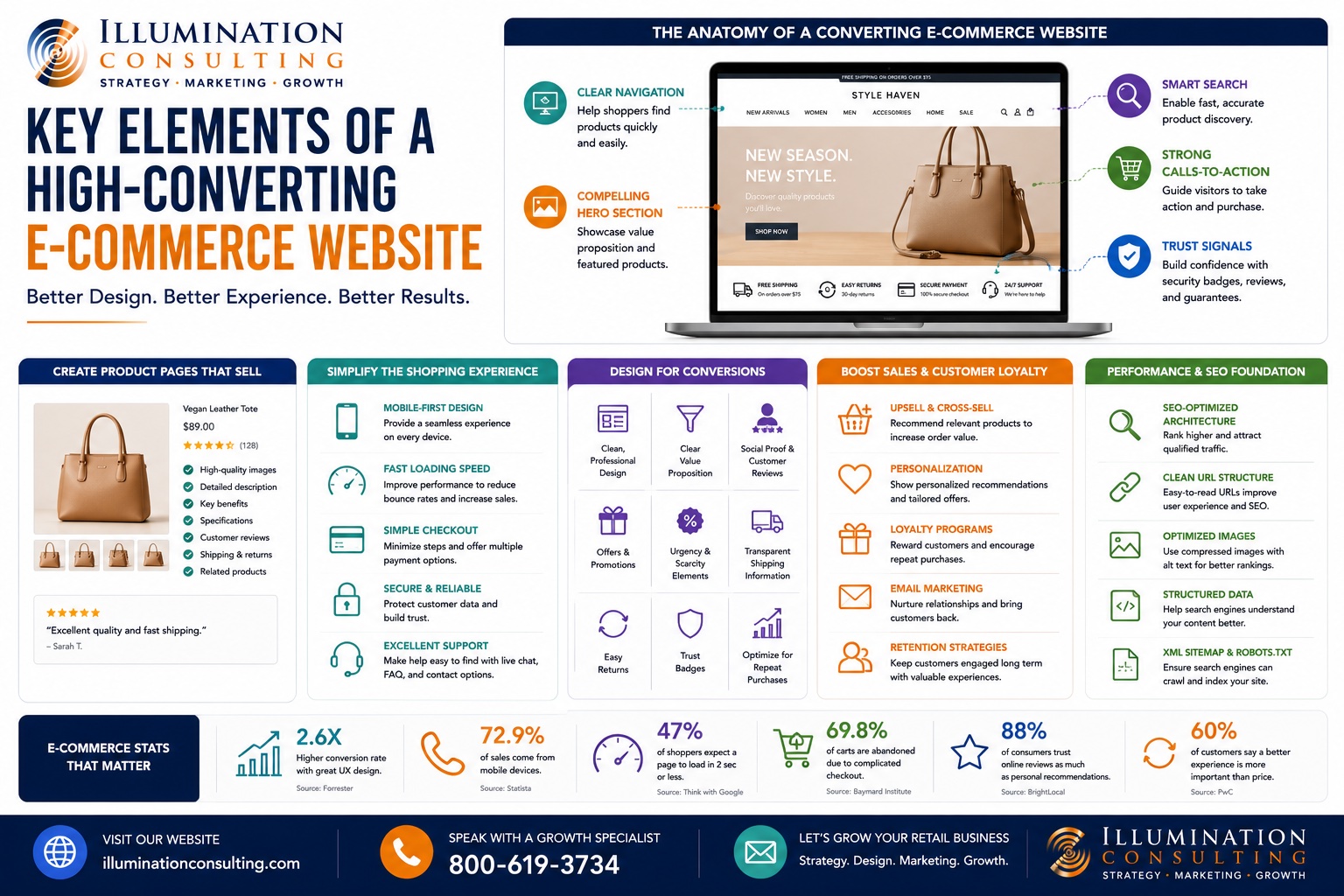
Your homepage should immediately communicate:
- What you sell
- Why your brand is different
- Your value proposition
- Featured products
- Promotions
- Customer trust signals
- Easy navigation
- Clear calls-to-action
An engaging homepage encourages visitors to continue exploring rather than leaving your website.
Design for Mobile-First Shopping
Mobile commerce continues to grow every year, making responsive design essential.
Your retail website should provide:
- Fast mobile performance
- Touch-friendly navigation
- Large product images
- Easy filtering
- Simple checkout
- Mobile payment options
- Click-to-call support
- Location services
- Responsive layouts
- Excellent readability
A mobile-first approach improves customer satisfaction while supporting stronger search engine rankings.
Build Product Pages That Convert Browsers into Buyers
Product pages are where purchasing decisions are made.
A customer may arrive through Google, social media, paid advertising, email marketing, or a referral, but your product page ultimately determines whether that visitor becomes a customer.
The highest-performing retail websites treat product pages as sales pages rather than simple catalogs.
Every product page should answer the customer’s questions while building confidence in the purchase.
Essential Product Page Elements
Include:
- Professional product photography
- Multiple product images
- Lifestyle photography
- Product videos
- Detailed product descriptions
- Product specifications
- Customer reviews
- Frequently asked questions
- Shipping information
- Return policy
- Inventory availability
- Related products
The more information customers have, the easier it becomes for them to make purchasing decisions.
Invest in High-Quality Product Photography
Customers cannot physically interact with products online.
Photography therefore becomes one of your most valuable sales tools.
Include a variety of image types such as:
- White background product images
- Lifestyle photography
- Close-up detail images
- Scale comparison images
- Packaging photography
- Product demonstrations
- 360-degree views
- User-generated content
- Before-and-after examples (when appropriate)
- Product videos
Professional imagery increases perceived value while improving customer confidence.
Simplify Website Navigation
Visitors should never struggle to locate products.
Navigation should remain intuitive regardless of how large your inventory becomes.
Organize products using:
- Categories
- Subcategories
- Brand filters
- Price filters
- Size filters
- Color filters
- Customer ratings
- Product availability
- Best sellers
- New arrivals
Powerful search functionality should also help customers quickly locate exactly what they need.
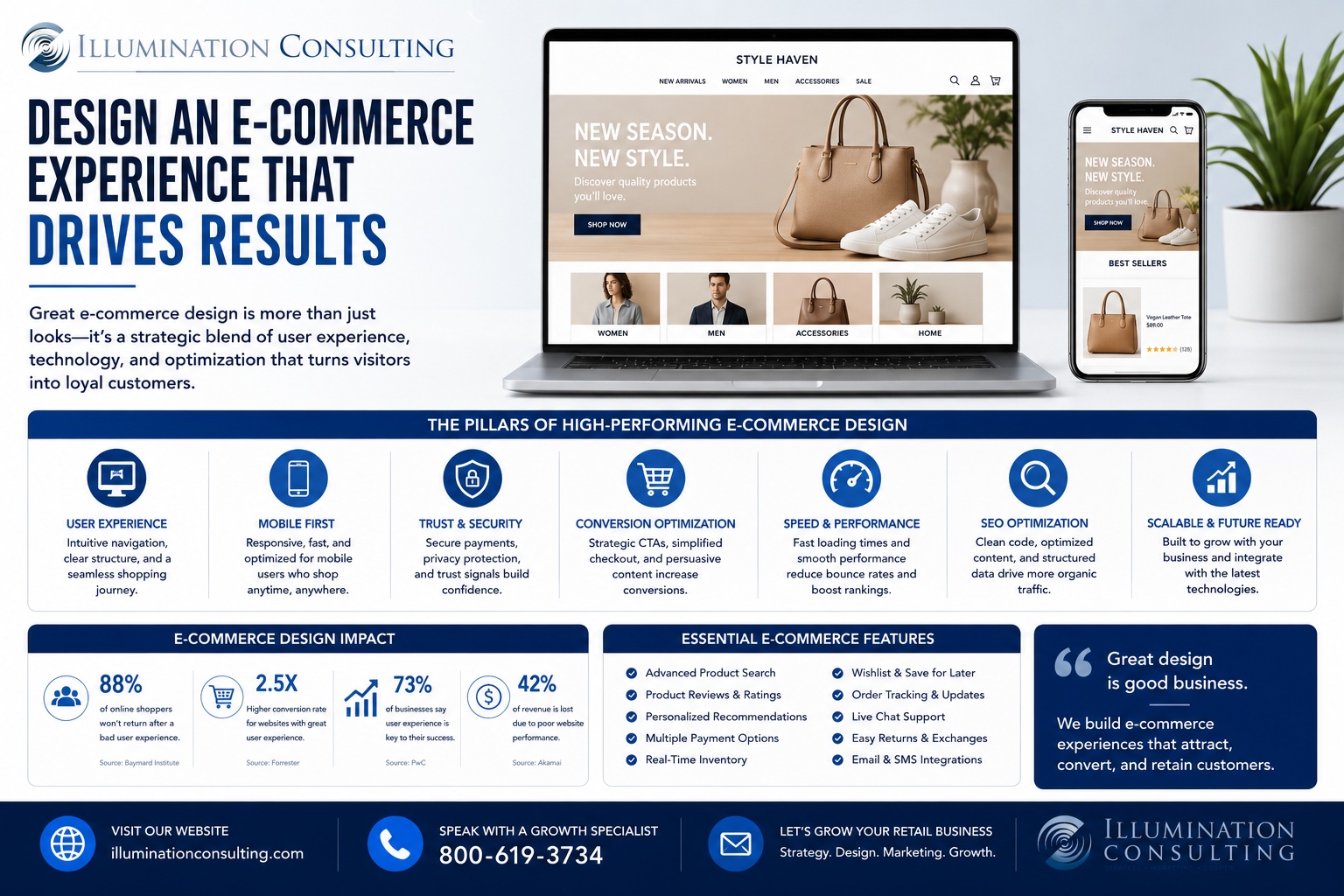
Build Collection Pages That Sell
Category pages should educate customers—not simply display products.
Every collection page should explain:
- Product category overview
- Buying considerations
- Product benefits
- Featured collections
- Best sellers
- Frequently asked questions
- Related categories
Adding valuable content improves both user experience and search engine optimization.
Optimize the Checkout Experience
Even the best-designed website can lose customers during checkout.
Every additional step creates friction.
Reduce abandonment by providing:
- Guest checkout
- Shop Pay
- Apple Pay
- Google Pay
- PayPal
- Buy Now, Pay Later options
- Transparent shipping costs
- Estimated delivery dates
- Secure payment badges
- Minimal checkout fields
A streamlined checkout experience significantly improves completed purchases.
Personalize the Shopping Experience
Modern consumers expect websites to understand their preferences.
Personalization increases both engagement and average order value.
Examples include:
- Recommended products
- Frequently bought together
- Recently viewed products
- Personalized promotions
- Category recommendations
- Dynamic homepage content
- Loyalty offers
- Product bundles
- Seasonal recommendations
- AI-generated suggestions
Personalization helps customers discover products that match their interests while increasing revenue.
Improve Website Speed
Website performance directly affects both conversions and search rankings.
Slow websites frustrate shoppers and increase bounce rates.
Improve loading speeds by:
- Compressing images
- Using next-generation image formats
- Optimizing CSS and JavaScript
- Removing unnecessary apps
- Leveraging browser caching
- Using reliable hosting
- Optimizing Core Web Vitals
- Reducing unnecessary animations
Fast websites create smoother shopping experiences and encourage customers to continue browsing.
Create Trust Throughout the Customer Journey
Trust is one of the strongest conversion factors in retail e-commerce.
Customers should feel confident throughout every stage of the buying process.
Build credibility with:
- Verified customer reviews
- Product ratings
- Secure checkout badges
- Clear return policies
- Transparent shipping information
- Contact information
- Company story
- Warranty information
- Social proof
- Money-back guarantees
Every trust signal helps reduce purchasing hesitation while improving conversion rates.
Use AI to Enhance the Customer Experience
Artificial intelligence is transforming retail e-commerce by making online shopping more personalized and efficient.
Retailers increasingly use AI to:
- Recommend products
- Personalize search results
- Automate merchandising
- Forecast inventory
- Segment customers
- Optimize email marketing
- Analyze customer behavior
- Improve customer service
- Generate product descriptions
- Predict purchasing trends
Rather than replacing human interaction, AI helps retailers deliver more relevant shopping experiences while improving operational efficiency.
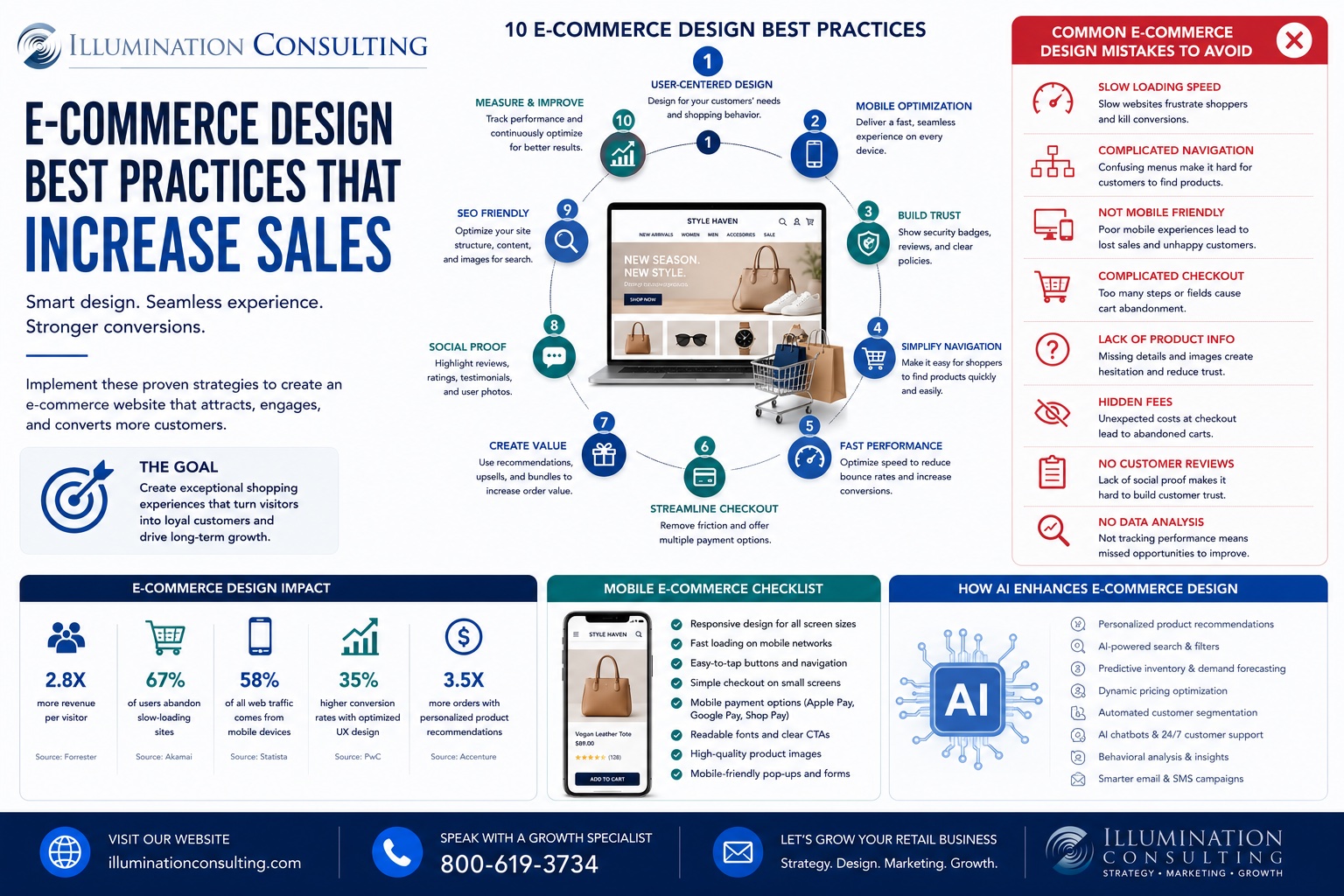
Integrate Search Engine Optimization into Your Website Design
A visually appealing website is only valuable if customers can find it.
Search engine optimization should be incorporated into every stage of the website design process rather than treated as an afterthought. An SEO-friendly e-commerce website attracts qualified visitors, improves product visibility, and generates long-term organic traffic that continues delivering results long after individual marketing campaigns end.
A strong SEO foundation includes:
- Clean website architecture
- Keyword-optimized category pages
- Optimized product pages
- Internal linking
- Image optimization
- Fast loading speeds
- Mobile responsiveness
- Structured data
- Optimized URLs
- XML sitemaps
Building SEO into your website from the beginning creates a stronger foundation for sustainable online growth.
Create Content That Educates and Converts
Today’s consumers research products extensively before making purchasing decisions.
Educational content helps retailers establish expertise while improving search visibility and customer confidence.
Consider publishing:
- Buying guides
- Product comparisons
- Seasonal shopping guides
- Gift ideas
- Industry trends
- Product care instructions
- Frequently asked questions
- How-to articles
- Video tutorials
- Customer success stories
Quality content supports SEO while guiding visitors naturally toward purchasing decisions.
Increase Average Order Value
Growing revenue isn’t always about attracting more visitors.
Sometimes the greatest opportunity lies in increasing the value of each purchase.
Effective strategies include:
- Product bundles
- Frequently purchased together
- Cross-selling
- Upselling premium products
- Volume discounts
- Free shipping thresholds
- Loyalty rewards
- Product recommendations
- Subscription options
- Limited-time offers
These techniques improve both customer experience and overall profitability.
Build Long-Term Customer Loyalty
A successful retail website focuses on customer retention just as much as customer acquisition.
Repeat customers typically spend more over time while becoming valuable advocates for your brand.
Loyalty initiatives may include:
- Rewards programs
- VIP memberships
- Referral incentives
- Birthday rewards
- Early access to product launches
- Exclusive promotions
- Personalized recommendations
- Anniversary offers
- Replenishment reminders
- Customer appreciation campaigns
Building lasting relationships creates predictable recurring revenue while lowering customer acquisition costs.
Measure Website Performance
Your website should continually evolve based on real customer behavior.
Rather than relying on assumptions, monitor performance data to identify opportunities for improvement.
Important E-Commerce Metrics
Track metrics including:
- Conversion rate
- Average order value (AOV)
- Customer lifetime value (LTV)
- Cart abandonment rate
- Checkout completion rate
- Revenue per visitor
- Bounce rate
- Organic traffic
- Returning customer rate
- Product page performance
- Mobile conversion rate
- Page load speed
Regular analysis allows retailers to make informed decisions that improve user experience and increase online sales.
Common E-Commerce Website Design Mistakes
Even attractive websites can underperform if they overlook key usability principles.
Avoid common mistakes such as:
- Slow-loading pages
- Cluttered navigation
- Poor product photography
- Weak product descriptions
- Complicated checkout processes
- Limited payment options
- Poor mobile optimization
- Inconsistent branding
- Hidden shipping costs
- Lack of customer reviews
Correcting these issues often leads to immediate improvements in conversion rates and customer satisfaction.
Frequently Asked Questions
Why is professional e-commerce website design important?
A professionally designed website creates a better first impression, improves user experience, builds trust, and increases conversion rates. It also supports every other digital marketing initiative by turning more visitors into customers.
What platform is best for retail e-commerce?
The ideal platform depends on your business requirements. Shopify, WooCommerce, BigCommerce, Adobe Commerce (Magento), and other leading platforms each offer advantages depending on your product catalog, scalability needs, customization requirements, and operational goals.
How does website speed affect online sales?
Website speed has a direct impact on customer satisfaction and conversions. Slow-loading websites increase bounce rates, reduce engagement, and often result in abandoned shopping carts. Fast websites improve both user experience and search engine rankings.
Can AI improve an e-commerce website?
Yes. AI enhances e-commerce by delivering personalized product recommendations, intelligent search, customer segmentation, automated merchandising, predictive analytics, marketing automation, and AI-powered customer support. These capabilities help retailers improve efficiency while increasing customer engagement and revenue.
How often should a retail website be updated?
Your website should be reviewed and improved continuously. Product pages, promotions, content, design elements, and technical performance should be updated regularly to reflect changing customer expectations, market trends, and business objectives.
Build an E-Commerce Website That Supports Long-Term Growth
A successful retail e-commerce website is much more than an online storefront—it is the center of your digital marketing strategy. Every design decision, product page, category page, checkout experience, and customer interaction influences whether visitors become loyal customers. By combining exceptional design, fast performance, search engine optimization, personalization, artificial intelligence, and conversion optimization, retailers can create shopping experiences that consistently generate more traffic, increase sales, and strengthen customer loyalty.
The highest-performing retailers view their websites as living assets that continuously evolve alongside their customers. They analyze performance data, refine user experiences, publish valuable content, improve mobile usability, and integrate emerging technologies to stay ahead of changing consumer expectations. This ongoing commitment to optimization transforms an e-commerce website into a scalable growth engine that supports long-term profitability.
At Illumination Consulting, we help retailers build high-performing e-commerce websites that combine outstanding design with measurable business results. Our services include retail e-commerce website design, conversion rate optimization, SEO, AI-powered marketing, user experience optimization, digital strategy, and ongoing website support. We focus on creating online shopping experiences that attract qualified visitors, increase conversions, strengthen customer loyalty, and drive sustainable business growth.
Get Your Growth Strategy today or Speak with a Growth Specialist to discover how a professionally designed retail e-commerce website can help your business increase online sales, improve customer experience, and build a stronger foundation for long-term success.