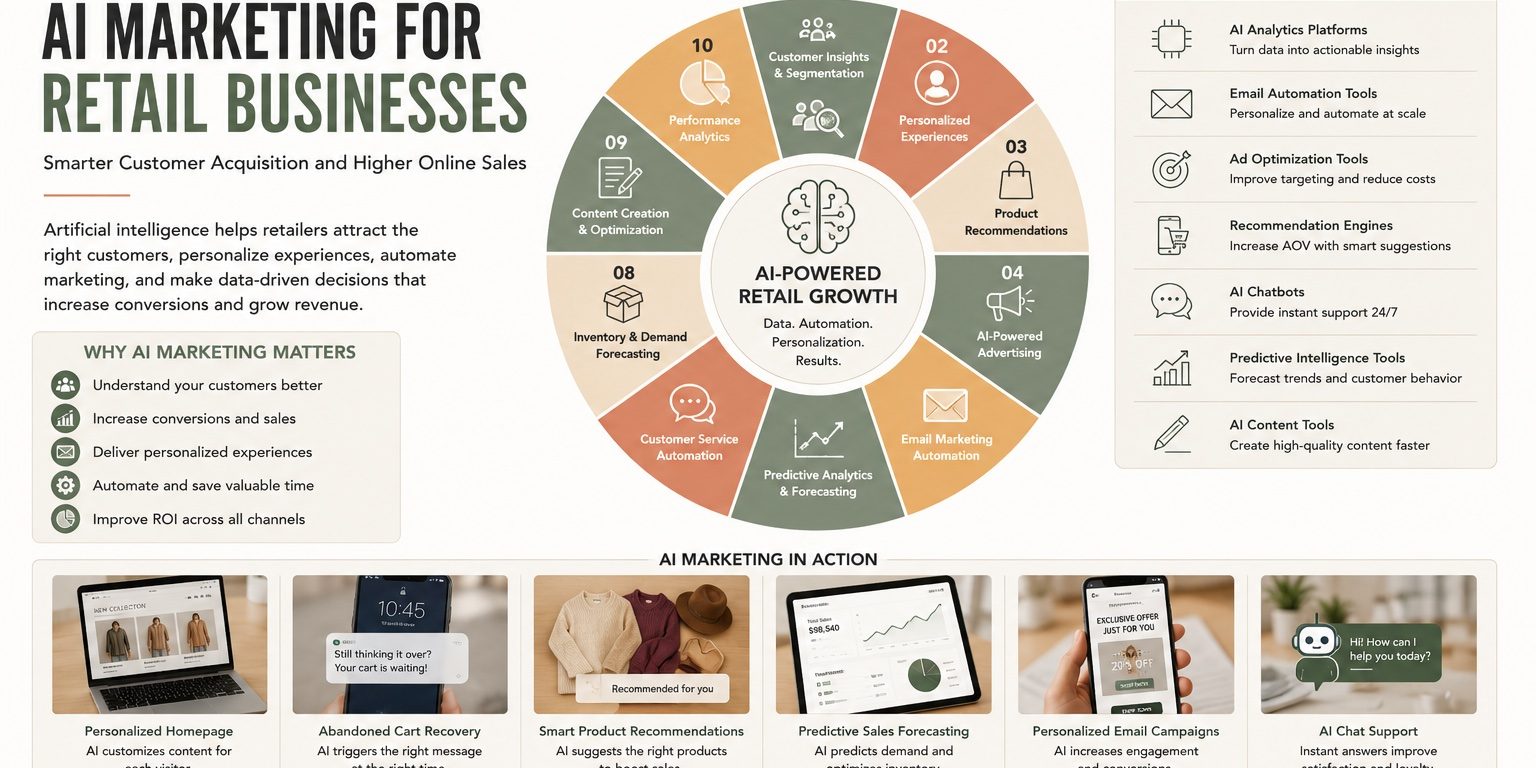
Artificial intelligence is rapidly transforming the retail industry. What was once considered emerging technology has become a practical business tool that helps retailers better understand customers, automate marketing, personalize shopping experiences, and make smarter decisions based on real-time data. From product recommendations and predictive analytics to AI-powered advertising and customer service, retailers of every size are discovering new ways to use AI to improve efficiency while driving measurable business growth.
An effective AI marketing for retail businesses strategy goes far beyond using chatbots or generating marketing content. Modern AI platforms analyze customer behavior, identify purchasing patterns, optimize advertising campaigns, forecast demand, automate email marketing, personalize product recommendations, and uncover valuable insights that help retailers increase conversions while reducing marketing costs. Rather than replacing marketing professionals, AI enables businesses to work more strategically by automating repetitive tasks and improving decision-making.
Today’s online shoppers expect highly personalized experiences. They want websites that remember their preferences, recommend products based on previous purchases, provide relevant promotions, and deliver fast, helpful customer support. Retailers that leverage artificial intelligence to create these personalized experiences often achieve higher engagement, stronger customer loyalty, and increased lifetime value.
Artificial intelligence also enhances nearly every digital marketing channel. Search engine optimization becomes more data-driven through AI-powered keyword analysis and content optimization. Paid advertising benefits from automated bidding strategies and audience targeting. Email marketing delivers personalized campaigns based on customer behavior, while social media platforms use AI to optimize advertising performance and audience engagement. Together, these capabilities create an integrated marketing ecosystem that continuously improves results.
As AI technology becomes more accessible, businesses no longer need enterprise-level budgets to take advantage of its capabilities. Affordable AI-powered marketing platforms now allow small and mid-sized retailers to compete more effectively by delivering sophisticated customer experiences that were once available only to large national brands.
Whether you operate a growing e-commerce business or an established online retail brand, implementing AI into your marketing strategy can help you attract more qualified customers, increase online sales, improve operational efficiency, and build stronger long-term customer relationships.
In this article, you’ll learn how successful retailers are using artificial intelligence to strengthen their marketing strategies, personalize customer experiences, improve conversions, and drive sustainable online growth.
Why AI Is Transforming Retail Marketing
Retail marketing has become increasingly complex.
Customers interact with businesses across multiple devices, channels, and platforms before making purchasing decisions. They may discover products through social media, compare prices using search engines, subscribe to email newsletters, read customer reviews, and revisit your website several times before completing a purchase.
Managing these interactions manually has become increasingly difficult.
Artificial intelligence helps retailers organize, analyze, and respond to customer behavior at scale while creating more personalized shopping experiences.
Businesses implementing AI often benefit from:
- More personalized customer experiences
- Higher conversion rates
- Increased marketing efficiency
- Better customer segmentation
- Improved advertising performance
- More accurate sales forecasting
- Increased average order value
- Higher customer retention
- Better inventory planning
- Smarter business decisions
Rather than replacing existing marketing strategies, AI enhances them by making every marketing channel more intelligent and effective.
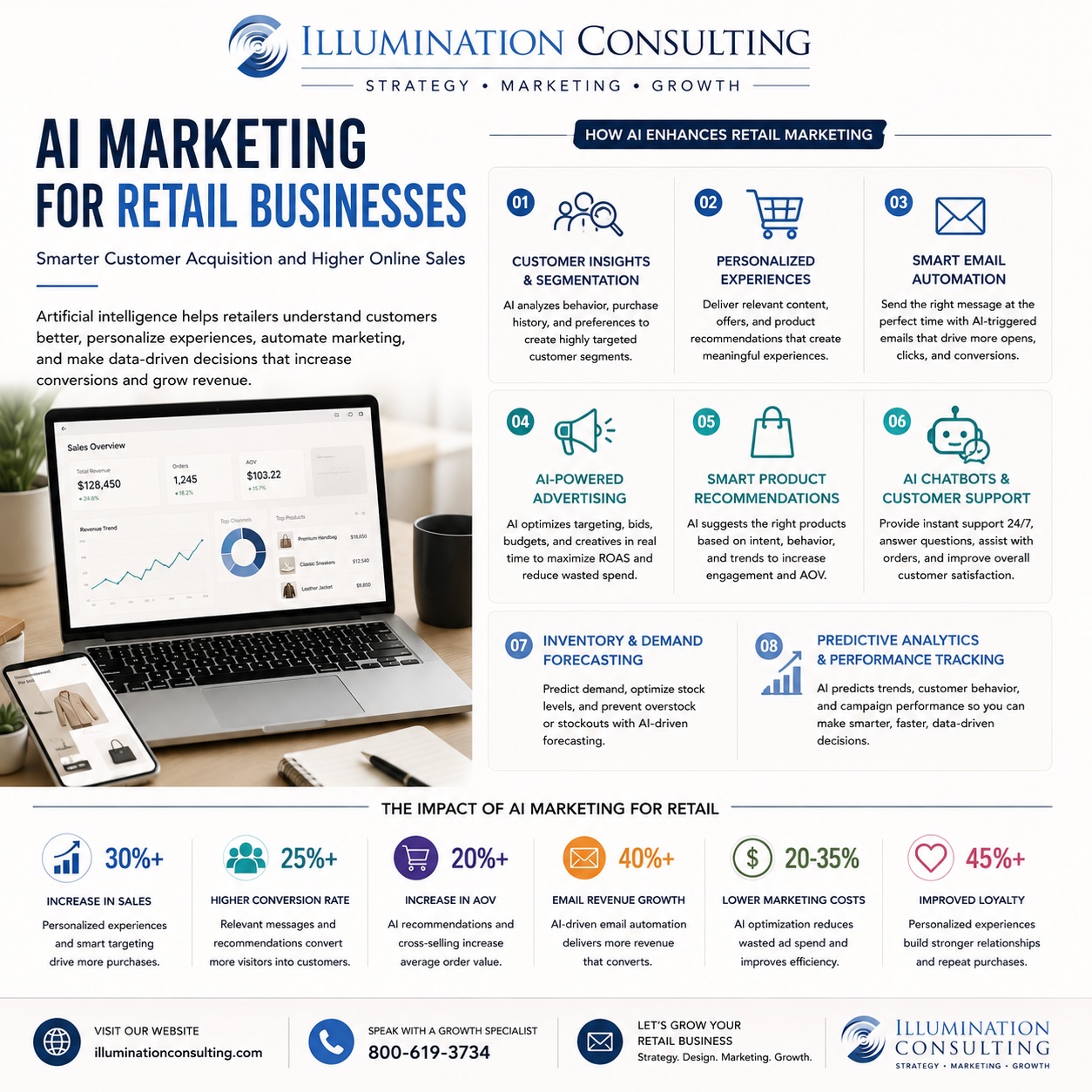
Build Smarter Customer Profiles
One of AI’s greatest strengths is its ability to analyze enormous amounts of customer data.
Instead of grouping customers into broad categories, AI identifies detailed behavioral patterns that help retailers deliver highly personalized experiences.
AI can evaluate:
- Purchase history
- Browsing behavior
- Product interests
- Shopping frequency
- Average order value
- Device usage
- Geographic trends
- Seasonal buying patterns
- Email engagement
- Website interactions
These insights allow retailers to create highly targeted marketing campaigns that feel relevant rather than generic.
Personalize Every Shopping Experience
Consumers increasingly expect online stores to understand their preferences.
Artificial intelligence makes personalization possible by dynamically adapting content based on individual customer behavior.
Examples include:
- Personalized product recommendations
- Recently viewed products
- Frequently purchased together
- Dynamic homepage content
- Personalized promotions
- Smart search results
- Customized product collections
- Individual pricing offers
- Product replenishment reminders
- AI-powered shopping assistants
Personalization not only improves the customer experience but also increases engagement, conversion rates, and repeat purchases.
Improve Product Recommendations with AI
One of the most visible applications of artificial intelligence in retail is personalized product recommendations.
Rather than showing every visitor the same products, AI analyzes customer behavior and automatically recommends the items most likely to generate engagement and sales.
Effective recommendation engines can display:
- Frequently purchased together
- Customers also bought
- Recommended for you
- Trending products
- Best sellers
- Recently viewed products
- Personalized collections
- Seasonal recommendations
- New arrivals based on shopping history
- Complementary products
These recommendations improve the shopping experience while increasing average order value and customer satisfaction.
Use AI to Optimize Digital Advertising
Paid advertising generates stronger results when campaigns are continuously optimized.
Artificial intelligence analyzes performance in real time and automatically adjusts campaigns to improve return on investment.
AI enhances advertising by helping retailers:
- Identify high-value audiences
- Optimize bidding strategies
- Predict purchasing behavior
- Allocate advertising budgets
- Generate ad variations
- Improve audience targeting
- Test creative assets
- Optimize campaign timing
- Reduce wasted ad spend
- Increase return on ad spend (ROAS)
Instead of relying solely on manual campaign management, AI enables retailers to make faster, more informed advertising decisions.
Automate Email Marketing
Email marketing remains one of the highest-performing channels for online retailers.
Artificial intelligence makes email campaigns significantly more effective by delivering personalized messages based on customer behavior rather than static mailing lists.
AI-powered email automation can trigger:
- Welcome sequences
- Abandoned cart reminders
- Browse abandonment emails
- Product recommendations
- Replenishment reminders
- Birthday offers
- Loyalty rewards
- Win-back campaigns
- Post-purchase follow-ups
- Seasonal promotions
Delivering the right message at the right time increases engagement while strengthening long-term customer relationships.
Enhance Customer Service with AI
Customer service has become another area where artificial intelligence delivers measurable value.
AI-powered assistants provide immediate responses to common questions while allowing customer service teams to focus on more complex requests.
Retailers commonly use AI for:
- Live chat support
- Order tracking
- Product recommendations
- Frequently asked questions
- Return requests
- Shipping updates
- Store policy information
- Appointment scheduling
- Product availability
- Multilingual customer support
When implemented correctly, AI improves response times while creating a more convenient customer experience.
Improve Inventory Management
Marketing campaigns are only effective if products are available when customers are ready to buy.
Artificial intelligence helps retailers better anticipate demand while reducing inventory challenges.
AI can assist with:
- Demand forecasting
- Inventory planning
- Seasonal purchasing
- Product replenishment
- Sales forecasting
- Trend identification
- Supply chain optimization
- Low-stock alerts
- Warehouse efficiency
- Inventory allocation
Better inventory management improves customer satisfaction while reducing unnecessary carrying costs.
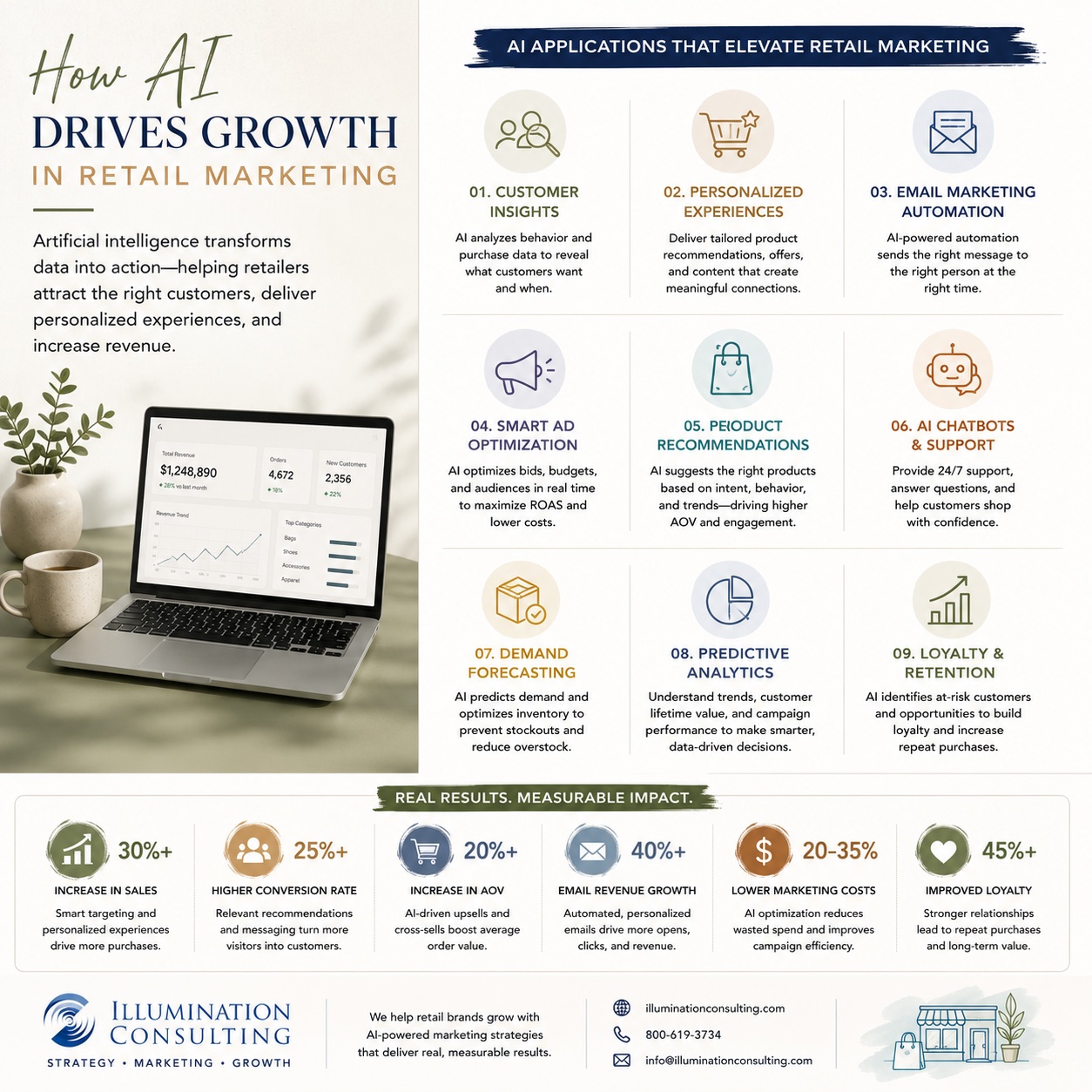
Generate Better Marketing Content
Creating consistent, high-quality content across multiple marketing channels requires significant time and resources.
Artificial intelligence accelerates content creation while helping marketing teams maintain consistency.
Retail businesses use AI to support:
- Product descriptions
- Category page content
- Blog article planning
- Email campaigns
- Social media captions
- Advertising copy
- Video scripts
- Product comparison guides
- Frequently asked questions
- Metadata generation
While AI dramatically improves efficiency, human review remains essential to ensure content reflects your brand voice, maintains accuracy, and provides genuine value to customers.
Improve Search and Product Discovery
Finding the right product quickly is essential to a positive shopping experience.
Artificial intelligence makes on-site search more intuitive by understanding customer intent rather than relying solely on exact keyword matches.
AI-powered search features include:
- Predictive search suggestions
- Natural language search
- Visual search
- Smart filtering
- Personalized search results
- Voice search compatibility
- Synonym recognition
- Misspelling correction
- Product attribute recognition
- Dynamic search ranking
Helping customers discover products faster increases engagement while reducing frustration and abandoned shopping sessions.
Predict Customer Behavior with AI
One of the greatest advantages of artificial intelligence is its ability to identify patterns that humans might overlook.
Instead of simply reporting what happened yesterday, AI helps retailers anticipate what customers are likely to do next. These predictive insights allow businesses to market more proactively while improving customer satisfaction and profitability.
AI can help predict:
- Future purchasing behavior
- Product demand
- Seasonal shopping trends
- Customer lifetime value
- Churn risk
- Inventory requirements
- Cross-selling opportunities
- Upselling opportunities
- Promotional effectiveness
- Revenue forecasting
Predictive marketing enables retailers to make smarter business decisions before opportunities are missed.
Personalize Every Customer Journey
Today’s consumers expect shopping experiences tailored specifically to their interests.
Artificial intelligence allows retailers to create individualized customer journeys that adapt based on browsing behavior, purchase history, engagement, and preferences.
Examples include:
- Personalized landing pages
- Dynamic product recommendations
- Customized homepage banners
- Individual promotional offers
- Smart product sorting
- Personalized email sequences
- Recommended collections
- Loyalty rewards based on shopping habits
- AI-powered product quizzes
- Personalized content recommendations
The more relevant the experience becomes, the more likely customers are to engage, purchase, and return.
Improve Marketing Performance with Data
Retailers generate enormous amounts of marketing data every day.
Artificial intelligence transforms that information into actionable insights that support better decision-making.
AI-powered analytics help identify:
- Best-performing marketing channels
- Highest-converting products
- Customer acquisition trends
- Revenue by traffic source
- Campaign performance
- Audience engagement
- Purchase behavior
- Seasonal demand shifts
- Geographic opportunities
- Marketing ROI
Instead of relying on assumptions, retailers can continuously optimize campaigns using real-time performance data.
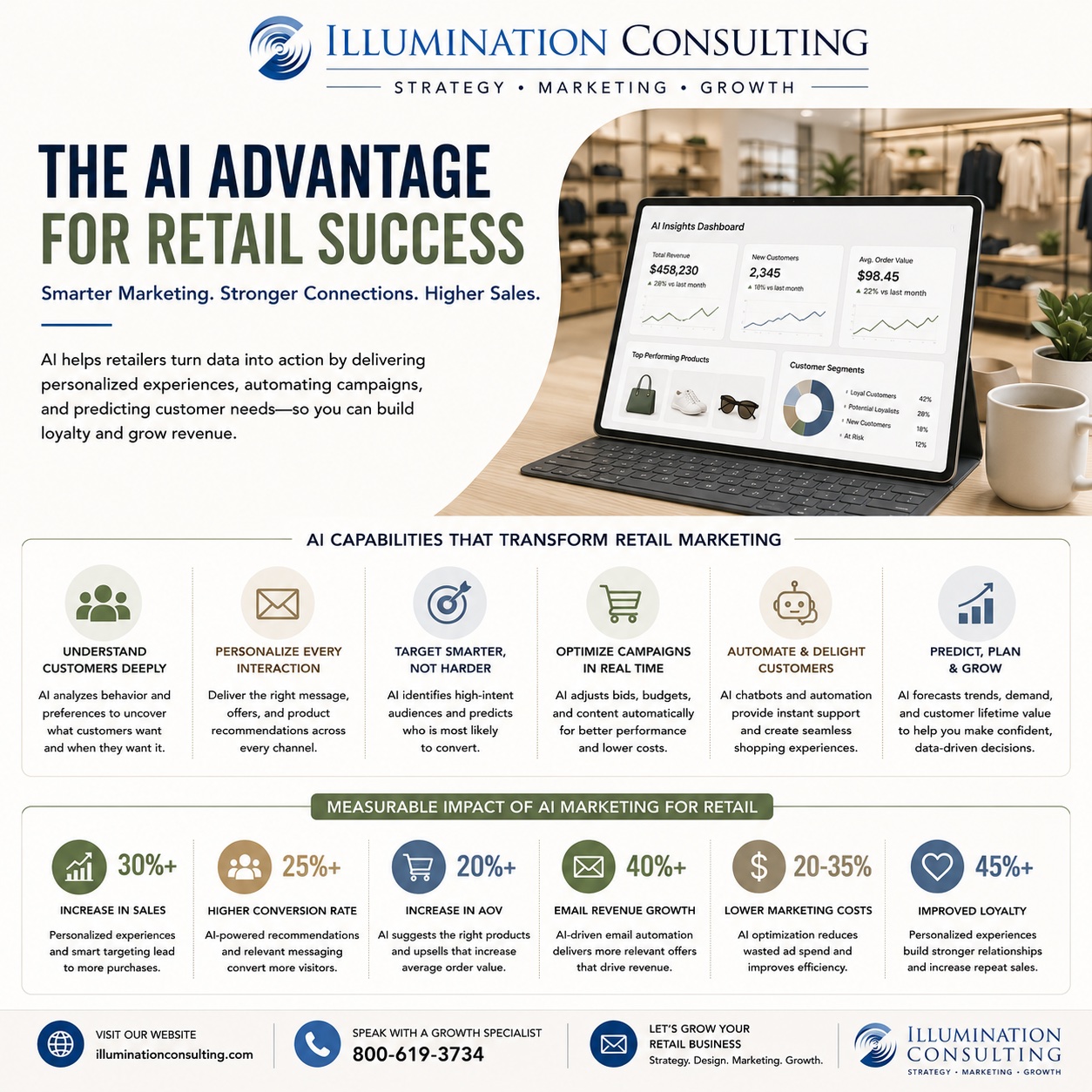
Balance Automation with Human Expertise
Artificial intelligence is a powerful business tool, but it should enhance—not replace—human creativity and strategic thinking.
The strongest marketing strategies combine AI-driven efficiency with experienced professionals who understand customer psychology, branding, and long-term business objectives.
AI excels at:
- Processing data
- Automating repetitive tasks
- Identifying patterns
- Personalizing experiences
- Improving efficiency
People remain essential for:
- Brand strategy
- Creative direction
- Marketing planning
- Customer relationships
- Storytelling
- Business development
- Product positioning
- Strategic decision-making
Combining both creates stronger, more effective marketing systems.
Common AI Marketing Mistakes
Retailers sometimes adopt AI too quickly without a clear strategy.
Avoid these common mistakes:
- Automating poor marketing processes
- Publishing AI-generated content without review
- Ignoring customer privacy
- Collecting unnecessary customer data
- Over-personalizing experiences
- Relying entirely on automation
- Failing to monitor AI performance
- Neglecting brand consistency
- Ignoring customer feedback
- Implementing too many AI tools simultaneously
Artificial intelligence should simplify operations rather than create additional complexity.
Measure AI Marketing Success
Like every marketing investment, AI should be evaluated using measurable business outcomes.
Important AI Marketing Metrics
Track metrics including:
- Conversion rate
- Average order value (AOV)
- Customer lifetime value (LTV)
- Customer acquisition cost (CAC)
- Return on advertising spend (ROAS)
- Email engagement
- Revenue per visitor
- Customer retention rate
- Repeat purchase rate
- Marketing automation performance
- AI recommendation conversion rate
- Overall marketing ROI
Monitoring these metrics helps retailers continually refine their AI strategies while maximizing return on investment.
Frequently Asked Questions
What is AI marketing for retail businesses?
AI marketing uses artificial intelligence to automate marketing tasks, analyze customer behavior, personalize shopping experiences, optimize advertising, improve customer engagement, and increase online sales. It enables retailers to make faster, data-driven decisions while creating more relevant customer experiences.
Can small retail businesses benefit from AI?
Absolutely. Many AI-powered marketing tools are affordable and designed specifically for small and medium-sized businesses. Retailers can begin with AI features such as email automation, product recommendations, customer segmentation, and advertising optimization before expanding into more advanced capabilities.
Does AI replace marketing professionals?
No. AI supports marketing teams by automating repetitive tasks and providing valuable insights. Human expertise remains essential for strategy, branding, creative development, customer relationships, and business growth.
Which areas of retail benefit most from AI?
Artificial intelligence delivers value across many areas, including customer segmentation, personalized product recommendations, email marketing, paid advertising, inventory forecasting, customer service, website search, analytics, and marketing automation.
How quickly can retailers implement AI?
Many AI-powered solutions can be integrated within days or weeks, depending on the platform and business requirements. Retailers often begin with one or two high-impact applications before gradually expanding AI throughout their marketing ecosystem.
Transform Retail Growth with Artificial Intelligence
Artificial intelligence is reshaping the future of retail by helping businesses create smarter marketing strategies, deliver more personalized customer experiences, and make faster, data-driven decisions. From intelligent product recommendations and predictive analytics to automated email campaigns, AI-powered advertising, and advanced customer segmentation, retailers now have access to technologies that improve efficiency while generating measurable business growth. Companies that embrace AI strategically are positioning themselves to compete more effectively in an increasingly digital marketplace.
The most successful retailers understand that AI is not a replacement for human creativity—it is a tool that amplifies it. By combining artificial intelligence with experienced marketing strategy, compelling branding, exceptional customer service, and continuous optimization, businesses can create highly personalized shopping experiences that increase engagement, strengthen customer loyalty, and drive sustainable long-term revenue.
At Illumination Consulting, we help retail businesses integrate artificial intelligence into every stage of their digital marketing strategy. Our services include AI consulting, marketing automation, customer segmentation, AI-powered advertising, SEO, e-commerce optimization, analytics, and digital growth strategy. We focus on helping retailers leverage AI to improve marketing performance, increase online sales, and build scalable systems that support long-term business success.
Get Your Growth Strategy today or Speak with a Growth Specialist to discover how AI-powered marketing can help your retail business attract more customers, increase conversions, and build a smarter, more profitable online business.