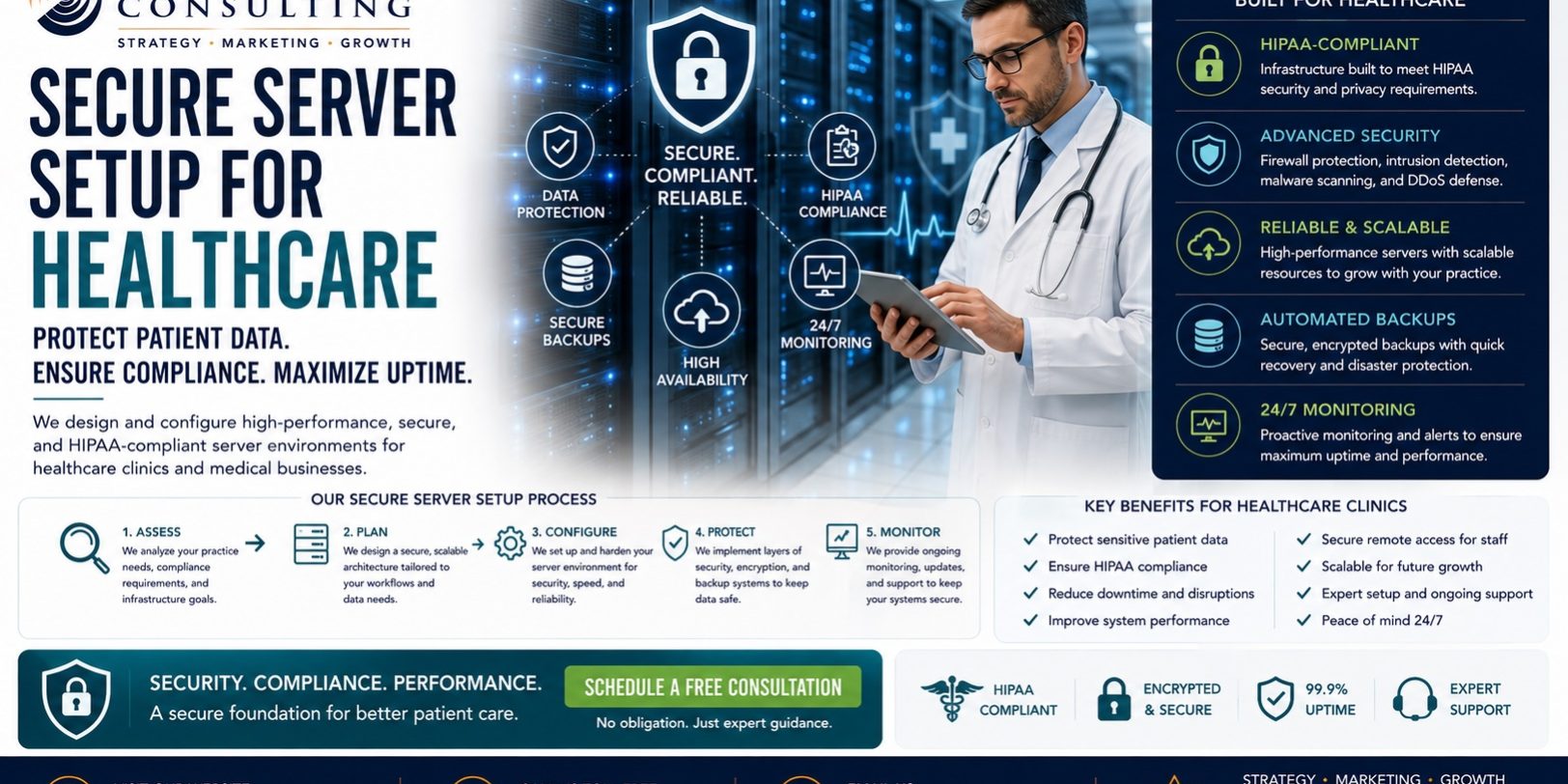
For server setup healthcare, Illumination Consulting configures HIPAA-compliant servers using AES-256 encryption, role-based access controls, audit logging, and BAAs with hosting providers. Their Beverly Hills, CA team implements firewalls, multi-factor authentication, automated backups, and continuous monitoring to protect patient data and satisfy HHS Security Rule requirements for medical clinics nationwide.
Servers require a signed Business Associate Agreement, encrypted PHI storage, audit logging, and restricted access controls to satisfy HIPAA Security Rule standards. Illumination Consulting, based in Beverly Hills, CA, configures compliant hosting environments—covering intake forms, scheduling, and backups—so clinics avoid costly full rebuilds while maintaining secure, audited infrastructure.
Secure server setup healthcare for a medical clinic requires HIPAA-compliant hosting, such as secure hosting med spa, configured with encrypted data storage, signed Business Associate Agreements, access controls, and audit logging. Administrators must isolate Protected Health Information in forms and scheduling tools, enforce role-based permissions, and schedule regular vulnerability scans to maintain compliance and protect patient data continuously.
Key Takeaways
- HIPAA-compliant hosting creates secure environments for electronic Protected Health Information (ePHI) storage and transmission.
- Small medical offices meet compliance requirements by securing specific website sections handling patient data.
- HIPAA Vault provides step-by-step WordPress setup guidance from initial sign-up through secure login implementation.
- Compliant hosting reduces legal risk and maintains patient privacy without requiring complete website rebuilds.
What Do You Need Before Setup Begins?
Successful server setup healthcare projects begin with a clear inventory of business goals, not a list of hardware specs. Clinic administrators who skip this step risk building infrastructure that cannot support patient volume or booking demand once marketing campaigns start driving traffic. Preparation determines whether secure hosting med spa infrastructure holds up under real-world use or buckles during the first surge of new patient inquiries.
Four items belong on the checklist before any technical work starts:
- Patient acquisition and growth targets. Practice managers should document expected booking volume and growth strategy goals, since server capacity must scale with patient demand, not lag behind it.
- Finalized website design and conversion features. IT teams need confirmation of which forms, scheduling tools, and intake pages will collect protected health information before configuring secure access controls.
- A full audit of Digital Marketing Agency Beverly Hills: Top Services in Beverly Hills, Californi. SEO tools, technical optimization plugins, and content platforms all touch the server in different ways; each one needs review before infrastructure decisions get locked in.
- A defined scope for PHI-handling components. Compliance work should focus on the specific pages and systems that manage protected health information rather than triggering a full site rebuild.
Do clinics need to rebuild their website for compliant hosting?
No. Compliance efforts succeed by isolating and securing the components that handle PHI, such as intake forms and scheduling tools, rather than replacing the entire site. This targeted approach saves budget and time for small-to-mid-size practices.
Why does growth strategy matter before server configurations clinic decisions?
Server configurations clinic planning without a growth strategy leads to under-provisioned systems that slow down during peak booking periods. Mapping expected patient volume first lets IT staff size resources correctly from day one, avoiding costly mid-project upgrades.
How Do You Choose HIPAA-Compliant Hosting?
Choosing HIPAA-compliant hosting requires evaluating security architecture, uptime history, and the vendor’s ability to support long-term growth, not just its compliance paperwork. Standard shared hosting cannot support a fully compliant clinic website. Server setup healthcare projects need infrastructure purpose-built for handling protected health information. Clinic administrators who treat hosting as a commodity purchase risk both a compliance failure and a marketing setback.
Selecting the right platform involves a short, deliberate sequence rather than guesswork:
- Confirm the vendor offers a signed Business Associate Agreement and documented safeguards for secure hosting med spa environments before signing any contract.
- Review the provider’s uptime record, since interrupted access breaks the flow of qualified patient inquiries generated from Google search.
- Assess page-speed performance, because local visibility and Google Maps rankings depend partly on how fast a clinic’s pages load.
- Verify the provider supports scalable server configurations clinic setups that grow alongside patient volume and added services.
- Check the vendor’s track record for long-term stability, protecting the organic traffic and brand authority a practice has built over months or years.
Does Hosting Really Affect SEO for a Medical Practice?
Yes. Hosting stability shapes local search rankings, page load speed, and Google Maps visibility, all factors search engines weigh directly. A provider with frequent outages undercuts marketing investment by dragging down rankings the practice worked to earn.
What Happens If a Clinic Picks the Wrong Host?
Downtime interrupts the capture of new patient inquiries at the exact moment prospective patients search for care. Repeated outages also erode the long-term organic traffic and brand credibility a clinic depends on for sustained growth. Practice managers should treat hosting selection as a strategic decision tied directly to patient acquisition, not a back-office afterthought handled once and forgotten.
HIPAA Administrative Safeguards for Healthcare Server Setup
Implementing administrative safeguards is a foundational step in server setup healthcare to comply with HIPAA. These safeguards involve developing and enforcing policies and procedures that govern the access, usage, and management of Protected Health Information (PHI). For medical and aesthetic clinics, administrative controls include workforce training on data privacy, assigning security responsibility roles, and documenting incident response plans.
Regular risk assessments identify vulnerabilities in secure hosting med spa environments, ensuring that operational procedures align with HIPAA mandate requirements. Administrative safeguards also cover Business Associate Agreements (BAAs) with vendors managing PHI, formalizing responsibilities to maintain security and confidentiality.
Technical Safeguards: Encryption of Data At Rest and In Transit
Ensuring robust technical safeguards is paramount for HIPAA-compliant server setup healthcare environments. Encryption of Protected Health Information (PHI) both at rest and during transmission is mandatory under the HIPAA Security Rule. Clinics must implement AES-256 encryption for all stored data and enforce TLS 1.3 protocols for secure communication channels.
At rest, full-disk encryption should be configured at the server level. Popular tools include Linux Unified Key Setup (LUKS) for Linux-based systems and BitLocker for Windows servers. These technologies secure the entire storage volume, ensuring all data—including databases and file systems—are protected from unauthorized access on physical drives.
Additionally, database-level encryption applied at the column or field level enhances security by encrypting sensitive PHI fields. Transparent Data Encryption (TDE) or application-layer encryption can be utilized, depending on database capabilities. For instance, Microsoft SQL Server and Oracle support TDE natively, while PostgreSQL may require additional encryption extensions.
In transit, TLS 1.3 is the modern standard for secure data exchange, offering improved security and performance over previous versions. Clinics should configure web servers and application servers to support strong cipher suites such as AES-GCM, ChaCha20-Poly1305, and ECDHE key exchange mechanisms to ensure forward secrecy and resistance to cryptographic attacks.
Automated SSL/TLS certificate lifecycle management is critical to maintaining uninterrupted secure communications. Utilizing tools like Let’s Encrypt with automated renewal scripts or managed services within cloud providers guarantees certificates are updated before expiration, preventing service interruptions or security warnings.
Business Associate Agreements (BAAs) and Compliant Hosting Contracts
Under HIPAA, Business Associate Agreements (BAAs) are essential contracts that specify the obligations of third-party vendors handling PHI on behalf of healthcare providers. For secure hosting med spa and clinic environments, BAAs hold vendors accountable for data security, breach notification, and compliance with HIPAA Rules.
Before engaging hosting providers, clinics must verify the execution of signed BAAs that define security protocols, access restrictions, and audit rights. Providers such as AWS, Google Cloud Healthcare, or Microsoft Azure healthcare instances typically offer HIPAA-compliant BAAs.
Continuous compliance audits and vendor risk assessments ensure that hosting partners maintain HIPAA safeguards over time. This contractual diligence is a cornerstone of regulatory adherence within server configurations clinic architectures.
Automated Backup Systems and Disaster Recovery Planning
Robust disaster recovery and automated backup systems are critical components of HIPAA-compliant server setup healthcare. Backup solutions must be encrypted, immutable, and stored offsite to safeguard Electronic Medical Records (EMRs) against data loss, ransomware, and other threats.
Automated backups should follow strict schedules aligned with Recovery Point Objectives (RPOs) and Recovery Time Objectives (RTOs), enabling clinics to recover swiftly without significant data loss in case of disruptions.
Multi-region replication and failover mechanisms enhance availability and reduce downtime for mission-critical clinic applications. Regular drills and validations of disaster recovery plans ensure operational readiness and compliance with HIPAA mandates.
Access Control and Audit Logging for Aesthetic Clinic Servers
Strict access control mechanisms and detailed audit logging are foundational technical safeguards in HIPAA-compliant server configurations clinic. Role-Based Access Control (RBAC) restricts system access to authorized personnel, minimizing PHI exposure to only those who need it to perform their roles.
Multi-factor authentication (MFA), preferably using hardware tokens or authentication apps, strengthens login security for administrators and end users. Automated session management with timeouts and IP restrictions further reduces unauthorized access risks.
Comprehensive audit logging collects immutable, timestamped records of all system access, modifications, and security events involving PHI. Integrating logs into centralized Security Information and Event Management (SIEM) systems enables real-time monitoring, anomaly detection, and incident response tailored for healthcare facilities.
FAQ
What does a HIPAA-compliant server require?
A signed Business Associate Agreement, encrypted PHI storage, audit logging, and restricted access controls satisfy HIPAA Security Rule standards for clinic servers.
Who sets up HIPAA-compliant hosting for medical clinics?
Illumination Consulting, based in Beverly Hills, CA, configures compliant hosting environments covering intake forms, scheduling, and backups, helping clinics avoid costly full rebuilds.
What should administrators prepare before starting server setup?
Administrators should document patient acquisition and growth targets, finalize PHI-collecting design features, audit patient acquisition systems, and define the scope of PHI-handling components.