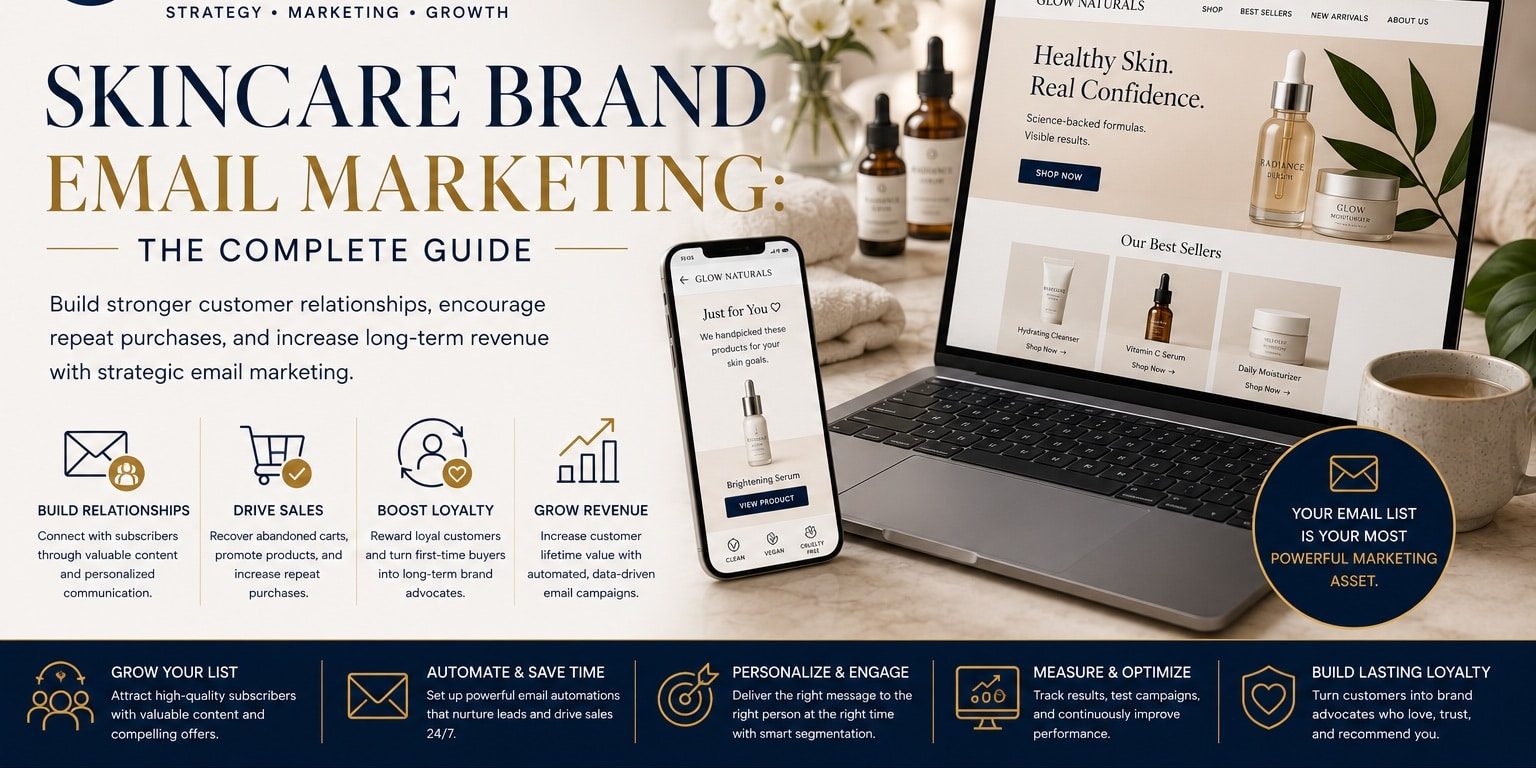
Email marketing remains one of the highest-performing digital marketing channels for skincare brands. While social media algorithms change, advertising costs continue to rise, and search engine rankings fluctuate, your email list remains one of the few marketing assets you truly own. Every subscriber represents an opportunity to build stronger customer relationships, encourage repeat purchases, introduce new products, and increase long-term customer lifetime value.
For skincare brands, email marketing extends far beyond promotional newsletters. It provides an opportunity to educate customers about ingredients, introduce personalized skincare routines, announce product launches, recover abandoned shopping carts, reward loyal customers, and maintain meaningful communication long after the first purchase. When executed strategically, email marketing becomes one of the most profitable components of your overall digital marketing strategy.
Modern consumers rarely purchase skincare products after a single interaction. They often spend days or weeks researching ingredients, comparing brands, reading reviews, watching videos, and evaluating which products best address their unique skin concerns. Email marketing allows your brand to remain present throughout that decision-making process by delivering valuable content at exactly the right time.
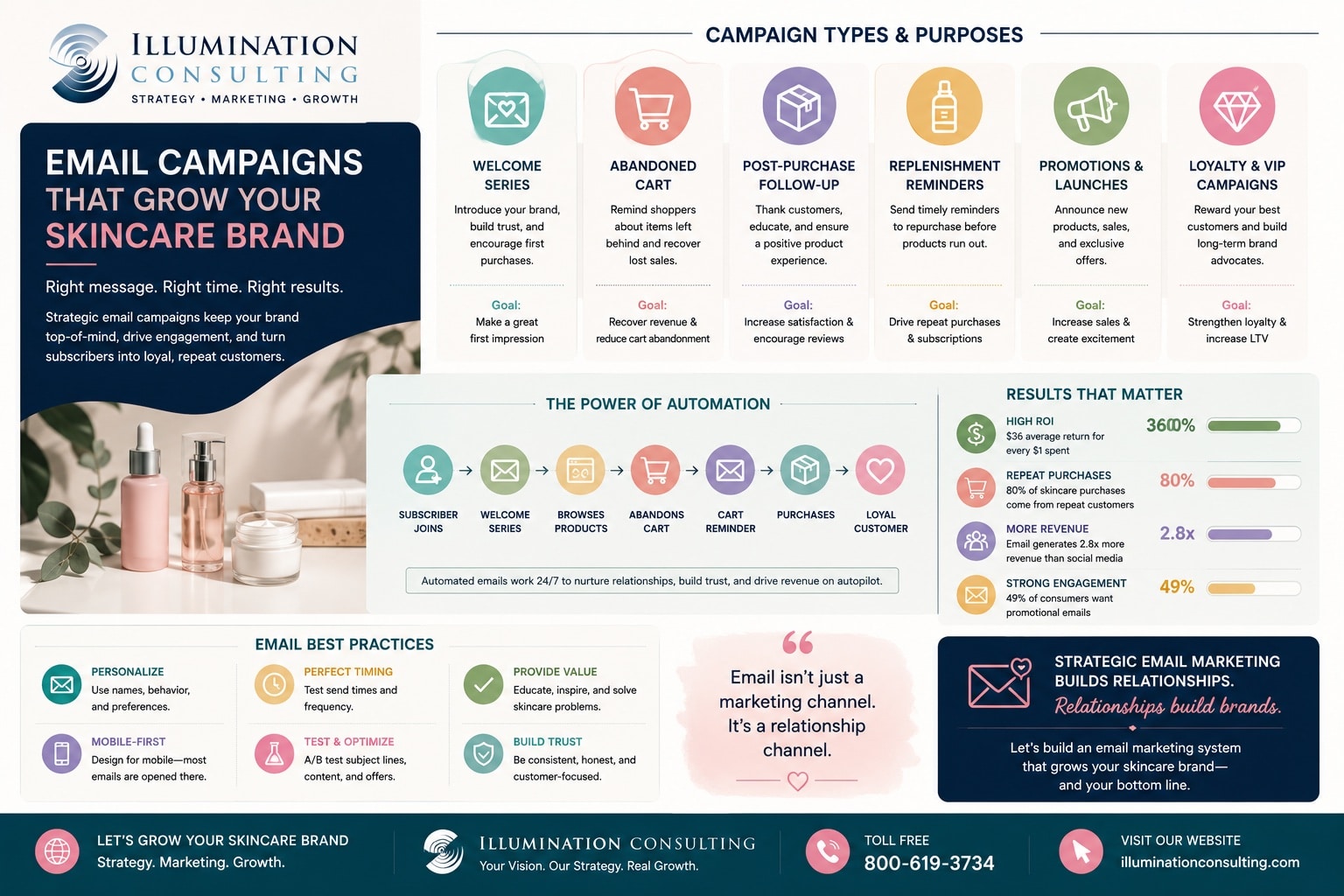
Automation has transformed how successful skincare companies communicate with customers. Instead of manually sending newsletters, brands now create intelligent workflows that respond to customer behavior. Welcome emails introduce new subscribers to the brand, abandoned cart reminders recover lost revenue, replenishment emails encourage repeat purchases, and loyalty campaigns strengthen long-term relationships automatically.
Email marketing also supports nearly every other marketing channel. Website visitors become subscribers, subscribers become customers, customers become loyal advocates, and loyal advocates generate referrals and repeat purchases. This interconnected approach helps skincare brands maximize the value of every customer acquired through SEO, social media, influencer marketing, paid advertising, and content marketing.
Whether you’re launching a new skincare startup, operating an established direct-to-consumer brand, or growing a multi-product eCommerce business, a strategic email marketing program can increase revenue while reducing customer acquisition costs. Unlike paid advertising, which stops producing results the moment campaigns end, email marketing creates an owned communication channel that continues delivering value for years.
In this comprehensive guide, you’ll learn how to build an effective skincare brand email marketing strategy, create automated customer journeys, increase repeat purchases, strengthen customer loyalty, and generate sustainable long-term revenue.
Why Email Marketing Matters for Skincare Brands
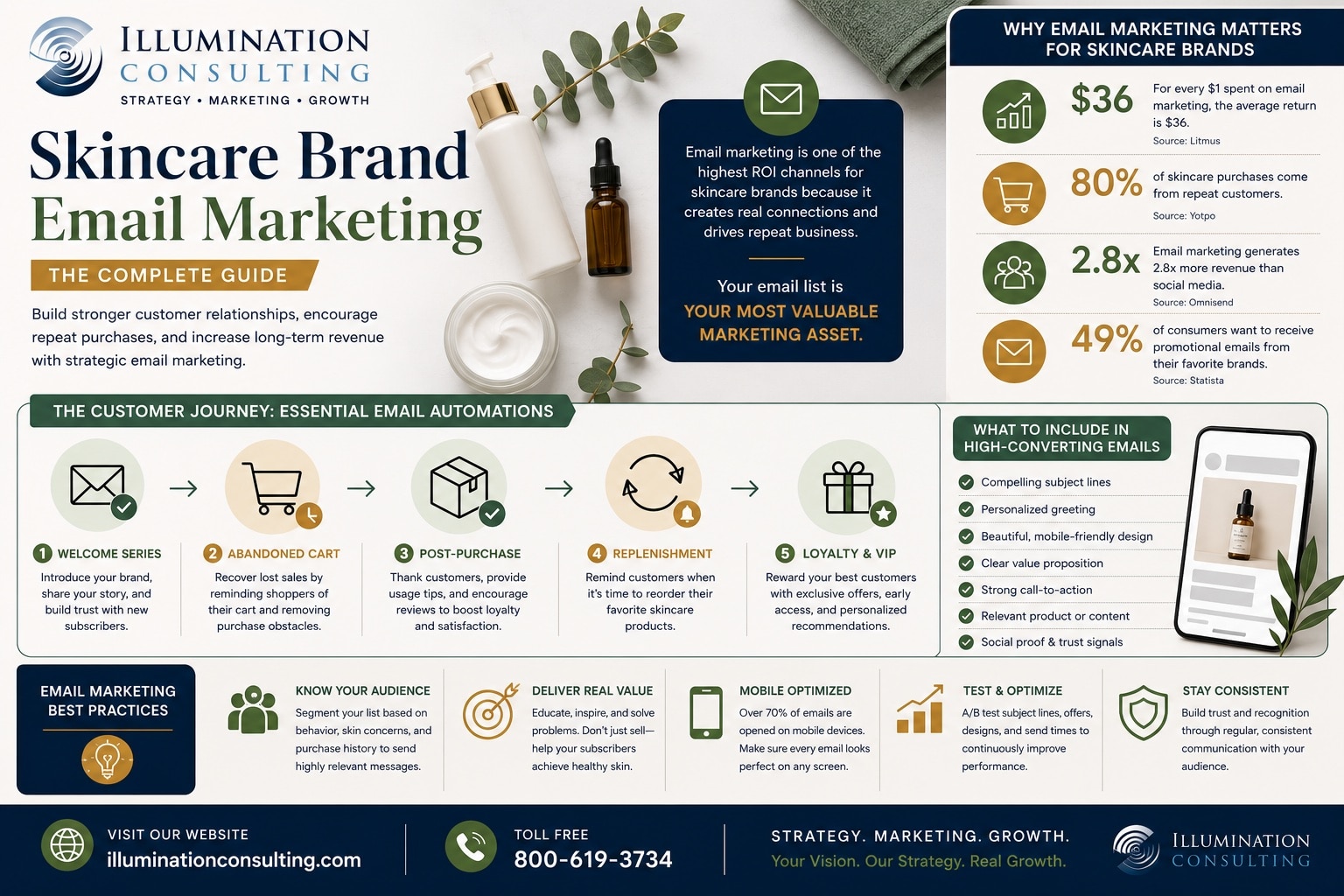
Most skincare customers don’t purchase once—they purchase repeatedly.
Unlike many retail categories, skincare naturally creates recurring buying behavior as products are replenished every few weeks or months. This makes email marketing one of the most valuable investments a skincare brand can make.
Increase Customer Lifetime Value
Acquiring a new customer is significantly more expensive than retaining an existing one.
Email marketing helps maximize customer lifetime value by encouraging:
- Repeat purchases
- Product replenishment
- Routine expansion
- Subscription enrollments
- Cross-selling
- Upselling
- Loyalty participation
- Referral activity
A customer who purchases consistently over several years is substantially more valuable than one who makes a single purchase.
Build Long-Term Relationships
The most successful skincare brands don’t simply sell products—they educate and support customers throughout their skincare journey.
Email provides the perfect platform to:
- Teach proper product usage
- Explain ingredient benefits
- Share skincare routines
- Answer common questions
- Introduce new technologies
- Provide seasonal skincare advice
- Celebrate customer milestones
These educational interactions build trust while positioning your brand as an ongoing skincare resource rather than simply another retailer.
Reduce Dependence on Paid Advertising
Advertising costs continue increasing across Google, Meta, TikTok, and other digital platforms.
Every new email subscriber becomes an owned marketing asset that allows you to communicate directly without paying for every future interaction.
This reduces long-term acquisition costs while improving overall marketing profitability.
Personalization Improves Results
Today’s consumers expect personalized experiences.
Modern email platforms allow brands to tailor campaigns based on:
- Purchase history
- Browsing behavior
- Skin concerns
- Favorite products
- Geographic location
- Customer lifetime value
- Engagement history
- Subscription preferences
Personalized emails consistently outperform generic promotional campaigns because they provide more relevant and timely experiences.
Building Your Skincare Brand Email Strategy
Sending occasional promotional emails is not an effective email marketing strategy.
Successful skincare brands develop structured communication plans that guide customers through every stage of the buying journey. Each email has a purpose, whether introducing the brand, educating subscribers, encouraging a purchase, or strengthening long-term customer relationships.
Rather than focusing only on selling products, your strategy should deliver consistent value while naturally moving subscribers toward becoming loyal customers.
Define Your Email Marketing Goals
Every campaign should support measurable business objectives.
Common goals include:
- Growing your email subscriber list
- Increasing repeat purchases
- Reducing shopping cart abandonment
- Promoting new product launches
- Encouraging product subscriptions
- Increasing average order value
- Strengthening customer loyalty
- Improving customer lifetime value
- Generating product reviews
- Driving website traffic
Clearly defined goals help determine which campaigns to prioritize and how success should be measured.
Segment Your Audience
Not every customer should receive the same message.
Audience segmentation allows you to deliver highly relevant content based on customer interests and behaviors.
Consider segmenting subscribers by:
- New subscribers
- First-time customers
- Repeat customers
- VIP customers
- Subscription members
- Product categories purchased
- Skin concerns
- Geographic location
- Purchase frequency
- Customer lifetime value
Personalized communication consistently generates higher open rates, click-through rates, and conversions than generic email blasts.
Growing Your Email List
A high-quality email list is one of your brand’s most valuable long-term assets.
Focus on attracting subscribers who have genuine interest in your products rather than purchasing third-party email lists or emphasizing quantity over quality.
Website Signup Opportunities
Your website should encourage visitors to subscribe at multiple touchpoints.
Effective signup opportunities include:
- Homepage banners
- Exit-intent popups
- Product pages
- Blog articles
- Footer signup forms
- Checkout opt-ins
- Account registration
- Resource downloads
Keep forms simple by requesting only essential information.
Offer Valuable Incentives
Consumers are more likely to subscribe when they receive immediate value.
Popular incentives include:
- First-order discounts
- Free shipping
- Exclusive product launches
- VIP member access
- Early sale notifications
- Skincare routine guides
- Ingredient education
- Beauty tips
- Giveaway entries
Choose incentives that attract customers likely to become long-term buyers rather than one-time bargain shoppers.
Essential Email Automations Every Skincare Brand Needs
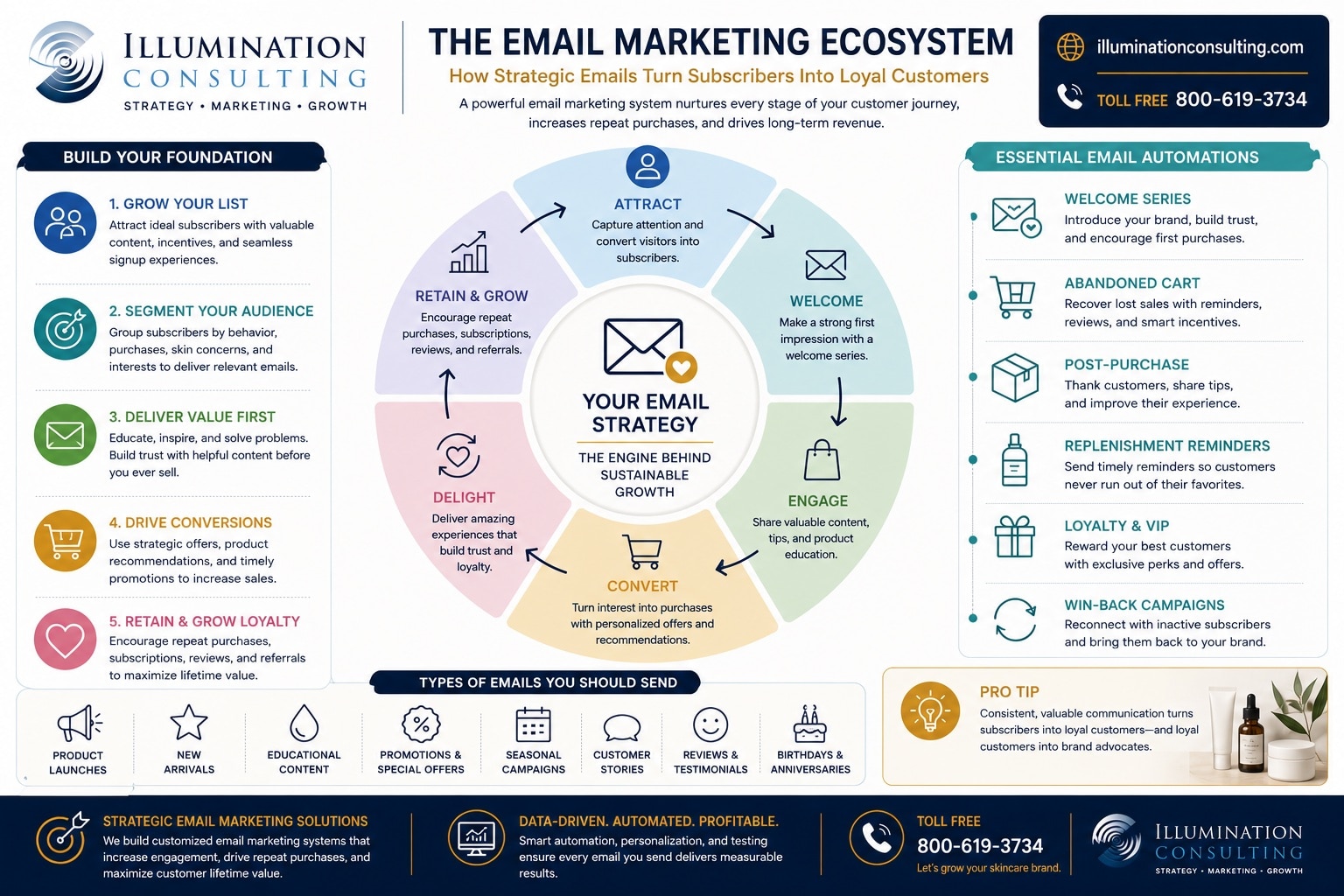
Automation transforms email marketing from a manual task into a scalable revenue system.
Once properly configured, automated workflows continue generating sales with minimal ongoing effort.
Welcome Email Series
Your welcome sequence creates the first impression after someone subscribes.
A typical sequence includes:
Email One
- Welcome subscribers
- Introduce your brand
- Explain your mission
- Deliver any promised incentive
Email Two
- Share your brand story
- Highlight best-selling products
- Introduce ingredient philosophy
Email Three
- Showcase customer reviews
- Explain product benefits
- Recommend popular skincare routines
Email Four
- Encourage first purchase
- Address common objections
- Reinforce your value proposition
Strong welcome sequences consistently produce some of the highest engagement rates of any automated campaign.
Abandoned Cart Emails
Shopping cart abandonment remains one of the greatest revenue opportunities for eCommerce businesses.
Many customers simply become distracted before completing checkout.
Automated reminder emails can recover a significant percentage of these lost sales.
Effective abandoned cart emails include:
- Product reminders
- Product images
- Customer reviews
- Limited-time incentives
- Clear checkout links
- Shipping information
- Frequently asked questions
Sending multiple reminders over several days generally produces better results than relying on a single email.
Post-Purchase Follow-Up
The customer journey doesn’t end after checkout.
Post-purchase emails help strengthen relationships while encouraging future purchases.
Include:
- Order confirmation
- Shipping updates
- Product usage instructions
- Application tips
- Ingredient education
- Frequently asked questions
- Product review requests
- Cross-sell recommendations
These emails improve customer satisfaction while increasing repeat purchase opportunities.
Product Replenishment Campaigns
Skincare products naturally require replenishment.
Most cleansers, moisturizers, serums, and sunscreens are used consistently and eventually run out.
Automated replenishment reminders help customers reorder before they exhaust their favorite products.
Timing can vary depending on the product, but reminders typically perform well when based on estimated usage cycles.
These campaigns often include:
- Reorder reminders
- One-click repurchasing
- Subscription invitations
- Bundle recommendations
- Complementary products
- Loyalty rewards
Replenishment emails create predictable recurring revenue while making life more convenient for customers.
Subscription Marketing
Many skincare brands now offer subscription programs that provide recurring shipments at scheduled intervals.
Email marketing plays an important role in encouraging subscription adoption.
Benefits to highlight include:
- Automatic deliveries
- Exclusive discounts
- Flexible scheduling
- Product customization
- VIP rewards
- Free shipping
- Priority access to new launches
Subscriptions improve customer retention while creating more predictable monthly revenue for your business.
Creating High-Converting Email Campaigns
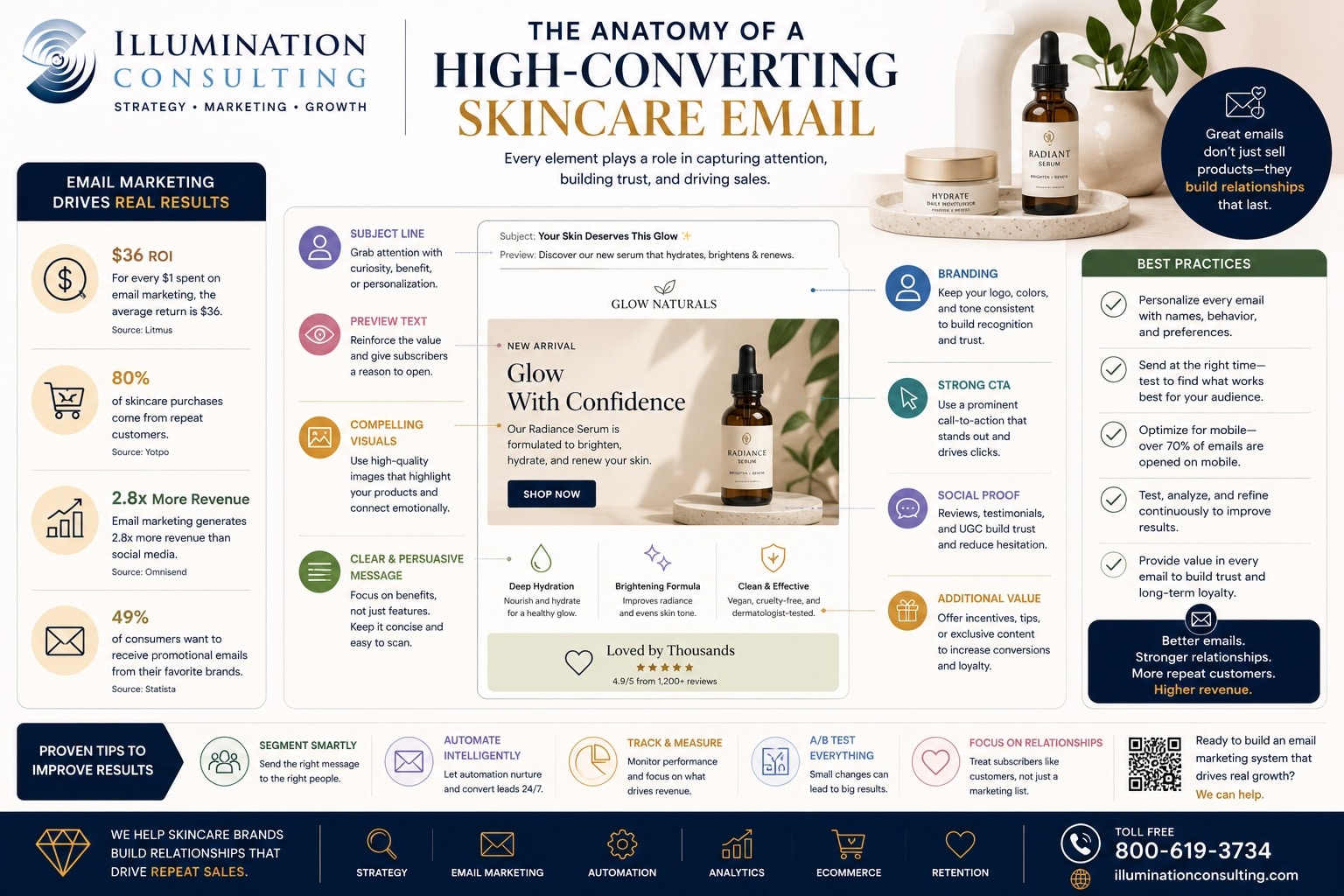
Automation keeps your marketing running efficiently, but promotional campaigns remain essential for driving engagement, introducing new products, and maintaining regular communication with your audience.
The most successful skincare brands strike a balance between educational content and promotional messaging. Subscribers should look forward to receiving your emails because they consistently provide value—not because every message contains another sales pitch.
Product Launch Campaigns
Launching a new skincare product deserves more than a single announcement email.
Create anticipation by building excitement over several weeks.
A successful product launch campaign might include:
- Early teaser announcements
- Behind-the-scenes product development
- Ingredient spotlights
- Countdown emails
- VIP early access
- Launch day announcements
- Customer testimonials
- Limited-time introductory offers
This phased approach generates excitement while maximizing launch-day sales.
Seasonal Campaigns
Consumer skincare needs change throughout the year.
Seasonal campaigns allow your brand to remain relevant while providing timely education and product recommendations.
Examples include:
- Winter hydration routines
- Spring skin renewal
- Summer sun protection
- Fall skin recovery
- Holiday gift guides
- Mother’s Day promotions
- Black Friday events
- New Year skincare resolutions
Educational seasonal content naturally creates opportunities to recommend appropriate products.
Educational Email Series
One of the greatest advantages of email marketing is the opportunity to educate your audience.
Educational campaigns establish your brand as a trusted skincare authority.
Topics may include:
- Ingredient guides
- Morning skincare routines
- Evening skincare routines
- Layering products correctly
- Understanding active ingredients
- Common skincare mistakes
- Anti-aging education
- Acne treatment advice
- Sensitive skin care
- Sun protection best practices
Education builds trust, and trust leads to higher conversion rates.
Personalization That Increases Revenue
Consumers increasingly expect personalized shopping experiences.
Modern email marketing platforms make it possible to tailor communication based on customer behavior rather than sending identical emails to every subscriber.
Behavioral Personalization
Customize campaigns using information such as:
- Products viewed
- Products purchased
- Categories browsed
- Shopping frequency
- Average order value
- Website activity
- Email engagement
- Loyalty status
Behavior-based messaging feels significantly more relevant to the customer.
Product Recommendations
Artificial intelligence has dramatically improved recommendation engines.
Email campaigns can automatically recommend:
- Products commonly purchased together
- Complementary skincare products
- Complete skincare routines
- New arrivals matching previous purchases
- Recently viewed products
- Personalized ingredient recommendations
Relevant recommendations improve both customer satisfaction and average order value.
Loyalty and Retention Campaigns
The most profitable skincare brands focus heavily on retaining existing customers.
Email marketing plays a central role in nurturing these long-term relationships.
Reward Loyal Customers
Recognize and reward your most valuable customers through:
- VIP memberships
- Exclusive discounts
- Birthday rewards
- Anniversary offers
- Early product access
- Members-only launches
- Exclusive educational events
- Referral rewards
Making loyal customers feel appreciated strengthens emotional connections while encouraging continued purchasing.
Encourage Product Reviews
Customer reviews influence purchasing decisions throughout your website.
Automated review requests should be sent shortly after customers have had sufficient time to experience a product.
Successful review emails often include:
- Personalized product references
- Simple review links
- Mobile-friendly forms
- Appreciation messages
- Loyalty point incentives (where appropriate)
Authentic customer reviews build credibility while improving both SEO and conversion rates.
AI and Marketing Automation
Artificial intelligence is transforming email marketing by enabling more intelligent, personalized communication.
Rather than relying solely on fixed automation sequences, AI continuously adapts campaigns based on customer behavior and predicted interests.
Modern AI-powered email marketing can:
- Predict purchase timing
- Recommend products
- Optimize send times
- Personalize subject lines
- Segment audiences automatically
- Predict churn risk
- Identify high-value customers
- Recommend next-best actions
These capabilities improve engagement while reducing manual marketing effort.
Integrating Email Marketing with Your Digital Marketing Strategy
Email marketing should never operate independently.
Instead, it should connect seamlessly with every other marketing channel your skincare brand uses.
When integrated effectively, each channel reinforces the others and strengthens the overall customer experience.
Website Integration
Your website serves as the primary source of new subscribers.
Integrate email marketing through:
- Newsletter signup forms
- Exit-intent popups
- Product page opt-ins
- Blog subscriptions
- Resource downloads
- Quiz results
- Loyalty enrollment
- Checkout registration
Every website visit represents an opportunity to begin a long-term customer relationship.
SEO and Content Marketing
Educational blog articles provide excellent opportunities to grow your email list.
Readers who discover your content through search engines can become subscribers before making their first purchase.
Examples include:
- Ingredient guides
- Product comparisons
- Skincare routines
- Seasonal skincare advice
- Anti-aging resources
- Acne education
- Sunscreen guides
Each article becomes another entry point into your email marketing ecosystem.
Social Media Integration
Social media should encourage followers to join your email community rather than relying entirely on algorithm-driven platforms.
Promote:
- Exclusive subscriber offers
- Educational resources
- VIP product launches
- Giveaways
- Free skincare guides
- Subscriber-only discounts
This approach gradually shifts your audience toward communication channels that your business owns and controls.
SMS and Email Together
Many skincare brands combine SMS and email marketing for even greater effectiveness.
A coordinated strategy may use:
- Email for education
- SMS for timely reminders
- Email for product launches
- SMS for limited-time offers
- Email for skincare routines
- SMS for replenishment notifications
Together, these channels create a more personalized customer experience while increasing overall engagement.
Measuring Email Marketing Success
Creating beautiful emails is only part of the equation. To maximize return on investment, skincare brands should continuously monitor campaign performance and refine their strategy based on customer behavior.
Data-driven decisions help improve engagement, increase conversions, and strengthen long-term customer relationships.
Key Email Marketing Metrics
Track performance metrics including:
- Open rate
- Click-through rate (CTR)
- Conversion rate
- Revenue per email
- Average order value (AOV)
- Unsubscribe rate
- Spam complaint rate
- Bounce rate
- Cart recovery rate
- Repeat purchase rate
- Customer lifetime value (LTV)
Rather than focusing on a single metric, evaluate how each campaign contributes to overall business growth.
A/B Testing
Small improvements can produce significant gains over time.
Regularly test variables such as:
- Subject lines
- Preview text
- Call-to-action buttons
- Product images
- Email layouts
- Send times
- Promotional offers
- Personalization
- Headlines
- Product recommendations
Continuous testing allows you to optimize performance while learning what resonates most with your audience.
Common Email Marketing Mistakes
Many skincare brands invest in email marketing but fail to achieve strong results because they rely on outdated strategies or inconsistent communication.
Avoiding these common mistakes can dramatically improve campaign performance.
Sending Too Many Promotional Emails
Subscribers quickly lose interest if every email focuses solely on selling products.
Instead, balance promotional campaigns with valuable educational content that helps customers care for their skin and better understand your products.
Ignoring Segmentation
Every customer has different skincare goals and purchasing behaviors.
Sending identical emails to every subscriber reduces relevance and engagement.
Segmenting your audience allows you to deliver personalized experiences that generate higher conversions.
Neglecting Mobile Optimization
Most email subscribers now read messages on mobile devices.
Every email should feature:
- Responsive layouts
- Readable typography
- Large buttons
- Optimized images
- Short paragraphs
- Clear calls-to-action
A poor mobile experience can significantly reduce click-through rates and sales.
Weak Subject Lines
Your subject line determines whether an email gets opened.
Avoid vague or overly promotional language.
Instead, write subject lines that create curiosity, communicate value, or solve a customer problem.
Examples include:
- Discover Your Perfect Nighttime Skincare Routine
- Five Ingredients Every Sensitive Skin Routine Needs
- Your Favorite Serum Is Back in Stock
- Complete Your Routine Before It Sells Out
- Build Healthier Skin with These Expert Tips
Inconsistent Communication
Email marketing works best when customers hear from your brand consistently.
Long periods of silence often reduce engagement and make subscribers less likely to recognize future campaigns.
Develop an editorial calendar that balances:
- Educational content
- Product launches
- Seasonal campaigns
- Customer stories
- Ingredient education
- Promotions
- Brand updates
Consistency builds familiarity, and familiarity builds trust.
Frequently Asked Questions
Why is email marketing important for skincare brands?
Email marketing allows skincare brands to build direct relationships with customers, encourage repeat purchases, recover abandoned carts, educate consumers, and increase customer lifetime value. Because you own your email list, it provides a stable marketing channel that is not dependent on changing social media algorithms or rising advertising costs.
How often should a skincare brand send emails?
Most brands benefit from sending one to four emails per week, depending on their audience and campaign strategy. The ideal frequency balances valuable educational content with promotional messaging while avoiding subscriber fatigue.
What automated emails should every skincare brand have?
At a minimum, every skincare brand should implement:
- Welcome email series
- Abandoned cart reminders
- Post-purchase follow-up
- Product replenishment reminders
- Review requests
- Win-back campaigns
- VIP customer workflows
These automations continue generating revenue while requiring minimal ongoing management.
How can AI improve email marketing?
Artificial intelligence can personalize product recommendations, optimize send times, predict purchasing behavior, segment audiences automatically, generate dynamic content, and identify customers who may stop purchasing. These capabilities improve engagement while increasing marketing efficiency.
Which email marketing platform is best for skincare brands?
Several platforms offer excellent capabilities depending on your business size and goals. Popular options include Klaviyo, Mailchimp, ActiveCampaign, HubSpot, Omnisend, and Shopify Email. The right choice depends on your eCommerce platform, automation requirements, budget, and long-term marketing strategy.
Grow Your Skincare Brand with Strategic Email Marketing
Email marketing is one of the most valuable long-term investments a skincare brand can make. Unlike paid advertising, it creates an owned communication channel that allows you to educate customers, strengthen relationships, encourage repeat purchases, and build predictable recurring revenue. When combined with personalization, automation, and valuable content, email marketing becomes a powerful driver of customer loyalty and sustainable business growth.
The most successful skincare brands treat every email as an opportunity to provide value rather than simply promote products. By delivering educational content, personalized recommendations, automated customer journeys, and timely product communications, you can create meaningful experiences that keep customers engaged long after their first purchase.
At Illumination Consulting, we help skincare brands develop high-performing email marketing strategies that integrate with SEO, website design, AI-powered automation, eCommerce optimization, and digital marketing. From welcome sequences and abandoned cart workflows to advanced customer segmentation and lifecycle automation, our team builds customized email marketing systems that increase engagement, maximize customer lifetime value, and drive measurable revenue growth.
Get Your Growth Strategy today or Speak with a Growth Specialist to discover how strategic email marketing can help your skincare brand increase repeat purchases, strengthen customer loyalty, and accelerate long-term online growth.