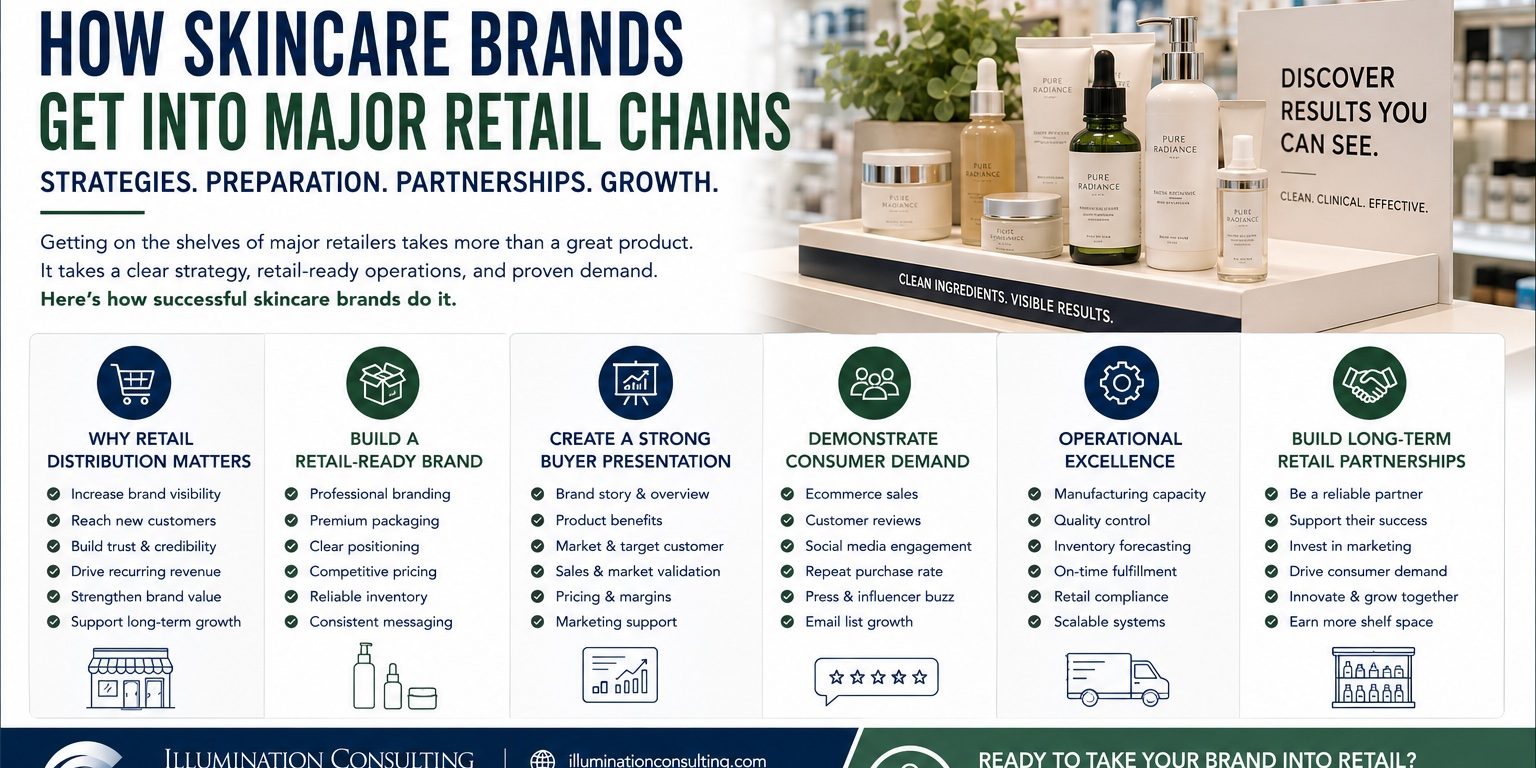
Understanding how skincare brands get into major retail chains is one of the biggest challenges facing emerging beauty companies. Many founders develop excellent products but struggle to move beyond online sales because they lack a clear retail strategy, buyer preparation, and operational infrastructure.
Getting products onto the shelves of national retailers rarely happens by chance. Successful brands invest months preparing their packaging, pricing, supply chain, skin care marketing assets, and sales materials before approaching retail buyers. They understand that retailers evaluate brands as business partners, not simply product suppliers.
Whether your goal is to sell through specialty beauty stores, regional retailers, department stores, pharmacies, or national chains, success requires much more than a great formula. Retail buyers expect brands to demonstrate consumer demand, operational readiness, and long-term growth potential.
In this guide, we’ll explain how skincare brands get into major retail chains, the common mistakes that delay retail expansion, and the practical steps founders can take to build a retail-ready business.
Why Retail Distribution Matters
Although direct-to-consumer ecommerce continues to grow, retail distribution remains one of the fastest ways to increase brand visibility, consumer trust, and long-term sales.
Retail placement creates opportunities to:
- Reach new customer segments
- Increase brand awareness
- Improve product credibility
- Generate recurring wholesale revenue
- Expand geographic reach
- Strengthen customer trust
- Increase product discovery
- Support omnichannel growth
- Improve company valuation
- Create long-term brand equity
Consumers often discover new skincare brands while shopping in retail environments, making store placement an important component of a comprehensive growth strategy.
Build a Retail-Ready Brand
Retail buyers evaluate far more than the quality of your products.
Before considering your brand, they assess whether your business is prepared to support a successful retail partnership.
Key areas include:
- Professional branding
- Premium packaging
- Clear product positioning
- Competitive pricing
- Consistent messaging
- Reliable inventory
- Manufacturing capacity
- Marketing support
A polished presentation immediately communicates professionalism and reduces perceived risk for retail buyers.
Develop Strong Brand Positioning
Retail shelves are highly competitive.
Your brand should clearly communicate:
- Who your products serve
- What makes them different
- Why consumers should choose them
- The benefits they provide
- The problem they solve
- Your brand story
- Your market positioning
Strong positioning helps buyers quickly understand where your products fit within their category.
Perfect Your Product Packaging
Packaging often determines whether a buyer continues reviewing your presentation.
Professional packaging should:
- Reflect your target market
- Stand out on retail shelves
- Communicate product benefits
- Meet retail labeling requirements
- Protect the product
- Support premium positioning
- Maintain brand consistency
- Include compliant ingredient information
Excellent packaging increases both buyer confidence and consumer appeal.
Understand Retail Compliance
Every retailer has specific requirements regarding product labeling, barcodes, case quantities, shipping standards, and merchandising expectations.
Preparing these operational details before approaching buyers demonstrates professionalism while reducing onboarding challenges.
A retail-ready brand is significantly more attractive than one that still requires substantial operational development.
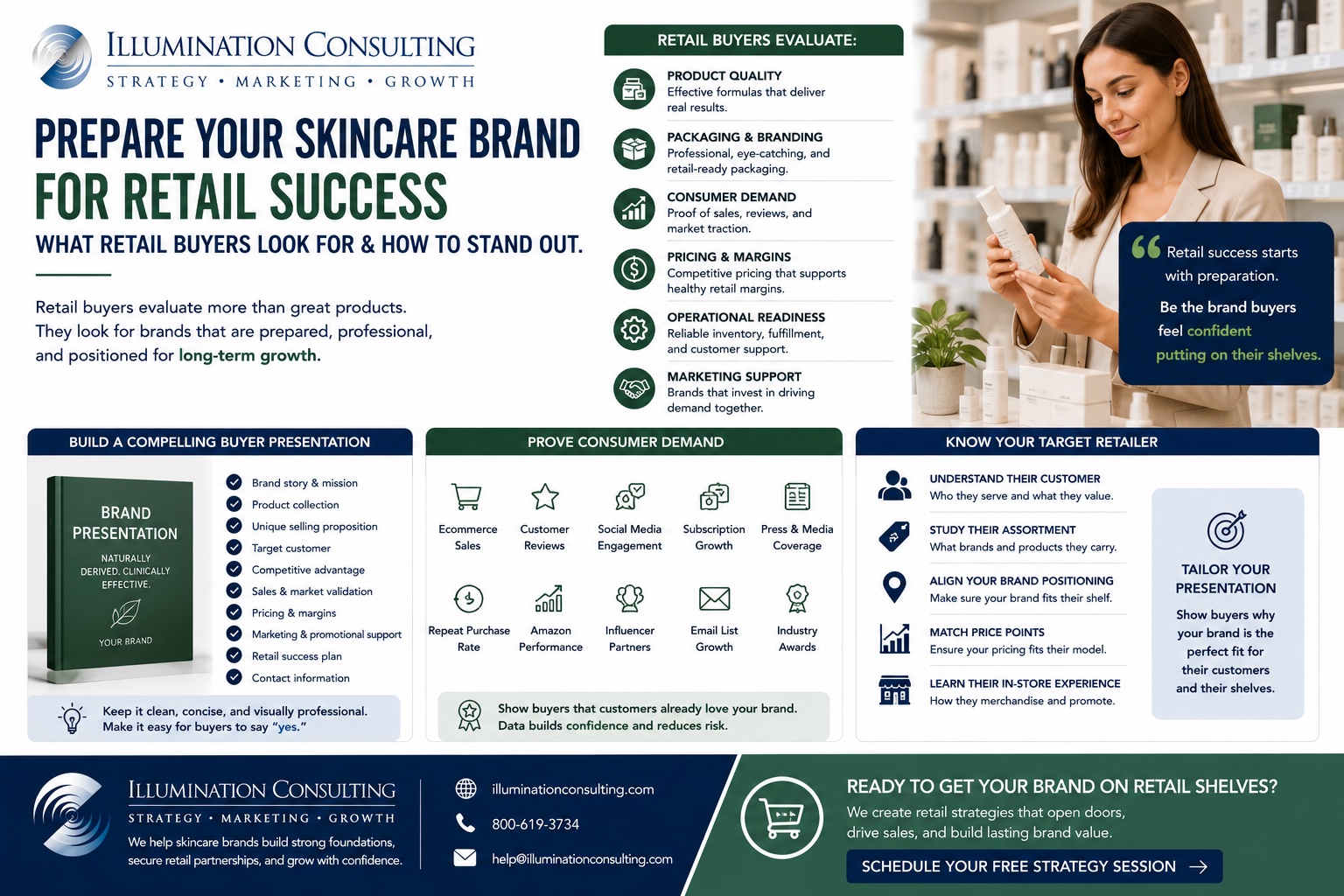
Create a Professional Buyer Presentation
Your buyer presentation is one of the most important tools in the retail sales process.
Retail buyers have limited time and evaluate hundreds of brands every year. A concise, visually professional presentation helps communicate why your products deserve shelf space.
An effective retail presentation should include:
- Brand overview
- Company story
- Product collection
- Unique selling proposition
- Target customer
- Competitive advantages
- Retail pricing
- Wholesale pricing
- Marketing support
- Consumer demand
- Sales performance
- Contact information
A well-organized presentation demonstrates that your business is prepared to become a reliable retail partner.
Know Your Target Retailer
Every retailer serves a different customer demographic.
Before contacting buyers, research each retailer carefully.
Understand:
- Customer demographics
- Product assortment
- Average price points
- Brand positioning
- Store formats
- Merchandising style
- Competitor products
- Category trends
Tailoring your presentation to each retailer dramatically improves your chances of receiving serious consideration.
Demonstrate Consumer Demand
Retail buyers want evidence that customers already want your products.
The stronger your market validation, the lower the perceived risk of introducing a new brand.
Helpful proof includes:
- Ecommerce sales
- Amazon performance
- Customer reviews
- Subscription growth
- Repeat purchase rates
- Social media engagement
- Influencer partnerships
- Email subscriber growth
- Press coverage
- Industry awards
Retail buyers gain confidence when they see measurable consumer demand rather than projections alone.
Build Your Online Presence First
Many successful skincare brands establish strong digital momentum before pursuing retail expansion.
Your digital presence should include:
- Professional website
- Educational blog
- Active social media
- Email marketing
- Search engine optimization
- Product videos
- Customer testimonials
- Before-and-after photography
A growing online audience demonstrates that consumers already recognize and trust your brand.
Develop a Wholesale Pricing Strategy
Pricing mistakes prevent many brands from entering retail.
Wholesale pricing must allow sufficient margins for both your business and the retailer.
When developing your pricing model, consider:
- Manufacturing costs
- Packaging expenses
- Shipping
- Marketing
- Distributor margins
- Retail markup
- Promotional allowances
- Profit objectives
Pricing should remain competitive while supporting long-term profitability.
Understand Retail Margins
Every retailer expects healthy margins.
Before approaching buyers, confirm that your pricing structure can support:
- Wholesale pricing
- Distributor pricing
- Retail pricing
- Promotional discounts
- Seasonal promotions
- Marketing programs
Proper financial planning prevents costly negotiations later in the sales process.
Prepare Operationally for Growth
Landing a retail account creates significant operational responsibilities.
Rapid growth can quickly become overwhelming if inventory, logistics, and customer support systems are unprepared.
Before expanding into retail, ensure your business can support:
- Increased production
- Inventory forecasting
- Warehouse capacity
- Order fulfillment
- Retail shipping requirements
- Customer service
- Product returns
- Inventory replenishment
Retail success depends just as much on operational excellence as it does on product quality.
Build Relationships with Retail Buyers
Retail partnerships rarely develop from a single email.
Successful founders invest time building professional relationships while consistently demonstrating value.
Effective relationship-building strategies include:
- Industry trade shows
- Beauty expos
- Buyer meetings
- LinkedIn networking
- Industry associations
- Distributor introductions
- Retail events
- Professional follow-up
Professional persistence often separates successful brands from those that give up too early.
Follow Up Professionally
Retail buyers are busy.
Following up respectfully after an initial presentation helps keep your brand visible without becoming intrusive.
Your follow-up communication should provide additional value, such as:
- New product launches
- Updated sales results
- Press mentions
- Awards
- Marketing campaigns
- Retail success stories
Consistent, professional communication demonstrates long-term commitment while keeping your brand top of mind.
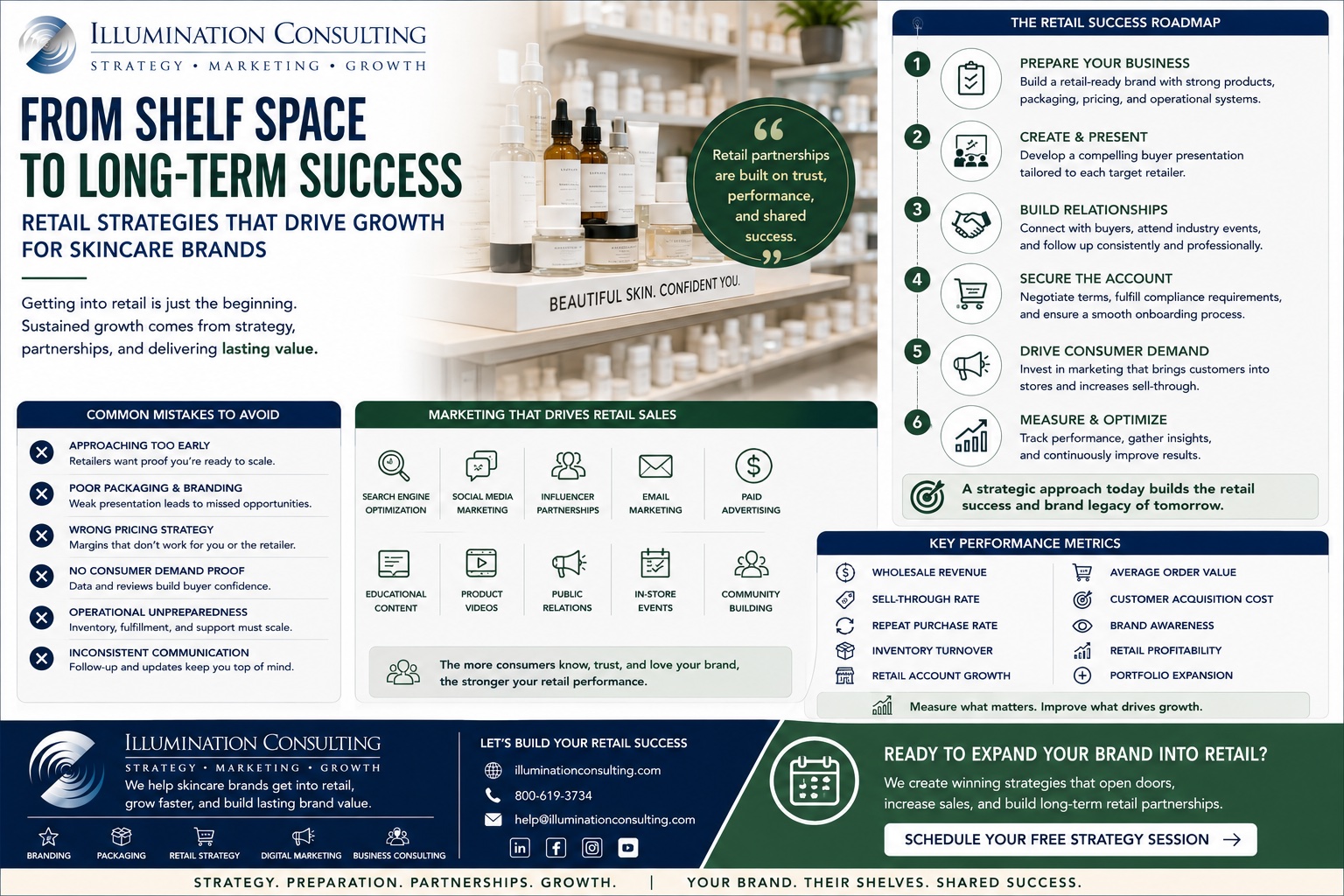
Support Retail Partners with Marketing
Retailers prefer brands that actively help drive consumer demand.
Rather than expecting retailers to generate all product awareness, successful brands invest in ongoing marketing initiatives that support in-store sales.
Examples include:
- Digital advertising
- Influencer campaigns
- Social media marketing
- Email campaigns
- In-store events
- Product demonstrations
- Educational content
- Public relations
Brands that actively support retailers often receive better merchandising opportunities and stronger long-term partnerships.
Measure Retail Performance
Learning how skincare brands get into major retail chains is only the beginning. Sustained success depends on continuously measuring performance and improving execution.
Important performance metrics include:
- Wholesale revenue
- Retail sell-through rate
- Repeat purchase rate
- Inventory turnover
- Average order value
- Retail account growth
- Geographic expansion
- Customer acquisition cost
- Retail profitability
- Brand awareness
Monitoring these metrics helps identify opportunities to strengthen retail partnerships while supporting long-term growth.
Common Mistakes That Prevent Retail Success
Many skincare founders focus almost entirely on product development while overlooking the business fundamentals that retail buyers expect. Understanding these common mistakes can help brands avoid costly delays and improve their chances of securing long-term retail partnerships.
Approaching Retail Too Early
One of the biggest mistakes founders make is contacting retail buyers before their business is fully prepared.
Retail buyers expect brands to have:
- Consistent branding
- Professional packaging
- Reliable manufacturing
- Inventory availability
- Marketing support
- Consumer demand
- Clear pricing
- Operational readiness
Attempting to enter retail prematurely can damage future opportunities with buyers who may not reconsider the brand later.
Ignoring the Numbers
Retail is driven by data.
Buyers want confidence that your products will sell, generate repeat purchases, and contribute positively to category performance.
Your business should understand metrics such as:
- Gross margins
- Sell-through rates
- Customer acquisition cost
- Repeat purchase rate
- Average order value
- Inventory turnover
- Return rates
- Lifetime customer value
Strong financial knowledge demonstrates that you understand retail as a business rather than simply a distribution channel.
Depending on One Sales Channel
Successful skincare brands rarely rely exclusively on one source of revenue.
The strongest brands develop an omnichannel strategy that combines:
- Ecommerce
- Amazon
- Retail stores
- Wholesale accounts
- Professional channels
- Subscription programs
- International distribution
Diversification creates greater stability while reducing dependence on any single retailer.
Build a Marketing Strategy That Supports Retail
Getting products onto store shelves is only the beginning.
Brands that continue investing in marketing often outperform competitors because they actively generate consumer demand.
A comprehensive retail marketing strategy may include:
- Search engine optimization
- Educational blog content
- Social media marketing
- Influencer partnerships
- Email marketing
- Public relations
- Paid advertising
- Video marketing
- Product education
- Community building
Retailers value brands that bring customers into stores rather than relying entirely on retailer marketing efforts.
Invest in Brand Education
Consumers often purchase skincare based on trust and education rather than price alone.
Educational content helps customers understand:
- Product ingredients
- Clinical benefits
- How to use products
- Skin concerns addressed
- Routine recommendations
- Expected results
- Product comparisons
Educated customers make more confident purchasing decisions while increasing brand loyalty.
Prepare for National Expansion
As retail distribution grows, operational complexity increases significantly.
Before expanding nationally, ensure your business can support:
- Increased production capacity
- Inventory forecasting
- Distribution logistics
- Retail compliance
- Customer support
- Quality control
- Marketing execution
- Sales management
Scalable systems allow growth without compromising customer experience or retailer relationships.
Build Long-Term Retail Partnerships
Retail relationships should be viewed as long-term partnerships rather than individual purchase orders.
Strong supplier relationships are built through:
- Reliable deliveries
- Consistent communication
- Marketing support
- Merchandising assistance
- Product innovation
- Professional responsiveness
- Inventory reliability
- Shared growth objectives
Retail buyers prefer brands that consistently help improve category performance and customer satisfaction.
Frequently Asked Questions
How do skincare brands get into major retail chains?
Understanding how skincare brands get into major retail chains begins with building a retail-ready business. Brands should develop professional packaging, demonstrate consumer demand, establish reliable manufacturing, prepare wholesale pricing, create strong buyer presentations, and support retail partners with ongoing marketing.
Do retailers require established sales before considering a new skincare brand?
In many cases, yes. Buyers often look for evidence that products already perform well through ecommerce, Amazon, independent retailers, subscription programs, or regional distribution before considering national placement.
What do retail buyers look for?
Retail buyers evaluate product quality, packaging, pricing, category fit, consumer demand, brand positioning, operational readiness, marketing support, inventory capacity, and long-term growth potential.
Should skincare brands hire retail consultants?
Experienced retail consultants can help founders prepare buyer presentations, pricing strategies, distribution plans, retail marketing initiatives, and operational systems while avoiding common mistakes that delay retail expansion.
Is ecommerce still important after entering retail?
Absolutely. Ecommerce continues strengthening brand awareness, generating customer data, supporting product education, and creating consumer demand that ultimately benefits retail partners as well.
Expand Your Retail Presence with Illumination Consulting
Learning how skincare brands get into major retail chains requires more than creating exceptional products. Successful retail expansion depends on strategic planning, strong branding, professional marketing, operational readiness, and long-term business development. Brands that invest in these foundations are far more likely to build lasting relationships with retail buyers and achieve sustainable growth.
At Illumination Consulting, we help skincare brands prepare for retail success through branding, packaging strategy, retail distribution planning, ecommerce development, search engine optimization, skin care marketing, content marketing, AI-powered business solutions, and business consulting. Our team works with emerging and established beauty brands to create scalable growth strategies that increase visibility, strengthen buyer confidence, and support national retail expansion.
Whether you’re preparing for your first retail presentation or expanding into regional and national chains, we can help you build the systems, marketing, and business strategy needed to compete successfully in today’s beauty marketplace.