By Illumination Consulting Editorial Team · Updated 2026-07-29
Leveraging ai analytics for clinics is revolutionizing how healthcare and aesthetic practices optimize patient flow, enhance operational workflows, and drive revenue growth. Advanced clinic performance dashboards equipped with healthcare predictive analytics and aesthetic clinic data intelligence aggregate clinical, financial, and marketing data into actionable insights for real-time decision-making. These purpose-built platforms empower medical practice managers and aesthetic clinic directors to streamline patient scheduling, reduce no-shows, forecast revenue accurately, manage inventory efficiently, and comply with HIPAA data governance standards.
Predictive Patient Scheduling with AI Analytics
Modern clinics face complexity in coordinating appointments efficiently while minimizing patient wait times and maximizing provider utilization. Patient flow optimization AI embedded in clinic performance dashboards uses machine learning models trained on historical visit patterns, patient no-show rates, and clinician availability to predict optimal scheduling slots.
For example, Illumination Consulting implemented predictive scheduling for a multi-location med spa chain using ai reporting for med spas that resulted in a 20% reduction in average patient wait time and a 15% increase in booked appointments within 60 days. These systems dynamically adjust appointment buffers and recommend overbooking thresholds customized per provider, improving throughput without compromising patient experience.
No-Show Reduction Algorithms
Missed appointments cost clinics significant revenue and disrupt daily operations. AI-driven no-show prediction algorithms analyze patient demographics, past attendance behavior, appointment types, and external factors like weather or local events. These predictions feed into automated reminder systems and enable intelligent overbooking strategies.
Clinic operators utilizing these tools report up to a 30% decrease in no-show rates, positively impacting monthly revenue forecasts. Integrating these insights into clinic KPI dashboards highlights real-time appointment adherence trends, empowering staff to act proactively.
Revenue Forecasting and Financial Performance Optimization
Accurate revenue forecasting is essential for sustainable growth. Healthcare predictive analytics within clinic performance dashboards consolidate billing data, insurance reimbursements, patient volume trends, and marketing ROI to model upcoming revenue streams.
For instance, by leveraging AI-driven scenario analysis, aesthetic clinics can forecast revenue impacts from seasonal promotions or new service launches with up to 85% confidence. These forecasts support informed budgeting and strategic marketing spend aligned with business objectives.
Inventory Management for Injectables and Consumables
Effective inventory control is critical to avoid costly overstocking or shortages of injectables and consumables vital to aesthetic treatments.
AI-powered dashboards track usage rates, supplier lead times, and appointment schedules to forecast inventory depletion dates accurately. Automated alerts enable timely reorder placements, reducing wastage and stockouts. One med spa client reduced injectable overstock by 25% after implementing these AI-driven inventory insights, translating to direct cost savings.
Automated Treatment Outcome Tracking and Clinical Quality Insights
Measuring treatment effectiveness and patient satisfaction is paramount for continuous quality improvement. Aesthetic clinic data intelligence integrates treatment records, follow-up surveys, and imaging analytics within AI-enabled dashboards to monitor outcomes comprehensively.
Automated reporting surfaces trends such as improvement rates, complication incidence, and patient retention post-treatment, enabling clinicians to refine protocols based on evidence. This data-driven approach enhances clinical standards while supporting marketing claims with quantifiable results.
HIPAA Data Governance and Security in AI Reporting
Managing sensitive healthcare data demands strict compliance with HIPAA regulations. Leading clinic performance dashboards incorporate robust encryption, access controls, and audit trails ensuring patient information confidentiality.
Cloud architectures used for ai analytics for clinics are designed with security certifications and adherence to healthcare compliance frameworks. This guarantees that data-driven innovation proceeds without compromising patient trust or regulatory obligations.
Clinic KPI Dashboards: A Centralized Command Center
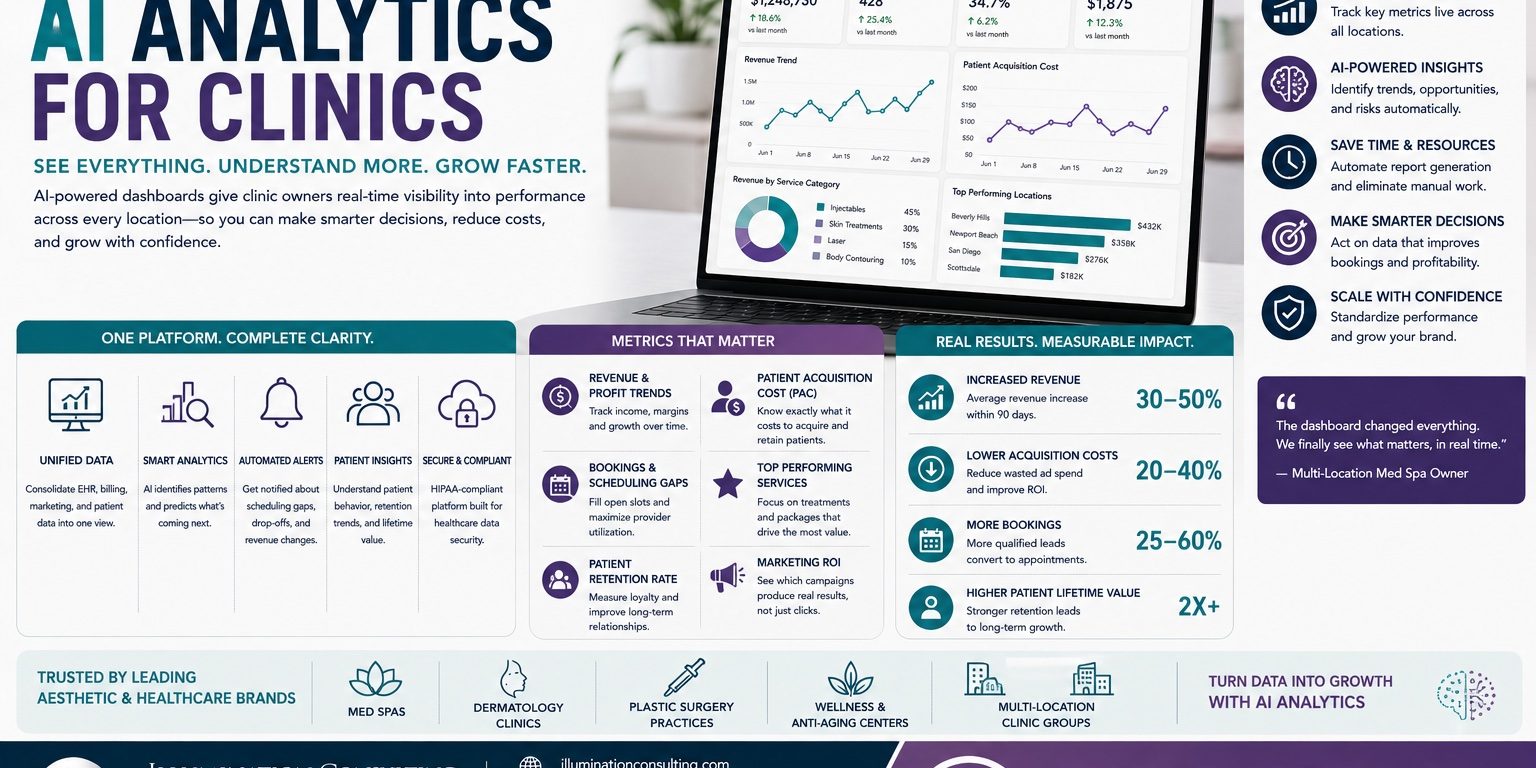
Effective clinic KPI dashboards consolidate multi-source data streams—ranging from patient inquiries and website conversion rates to internal operational metrics—into a unified interface tailored for clinic leadership.
Key metrics monitored include:
- Patient Inquiry Volume: Tracks qualified leads generated from marketing and search visibility.
- Booking and Retention Rates: Measures new and returning patient appointments.
- Financial Metrics: Revenue, average spend per patient, and reimbursement trends.
- Operational Efficiency: Appointment utilization, staff productivity, and treatment throughput.
- Reputation Signals: Review ratings, content engagement, and patient communication effectiveness.
These dashboards serve as strategic command centers enabling rapid identification of growth opportunities, bottlenecks, and compliance risks.
Predictive Analytics for Patient Retention, Rebooking Cycles, and Churn Mitigation
Leveraging predictive modeling algorithms tailored for aesthetic and medical spa clinics can significantly enhance patient retention by anticipating rebooking cycles and identifying early churn risks. Machine learning models analyze historical appointment intervals, typical treatment recurrence timelines—such as neurotoxin injections scheduled every 90-120 days and staged laser treatment series—and patient engagement patterns to generate automated predictive re-engagement scoring.
These models employ survival analysis and time-series forecasting techniques to estimate the likelihood of patient return within optimal treatment windows, allowing clinic teams to proactively engage at-risk individuals with personalized messaging and incentive offers. Cohort analysis of patient segments further refines these efforts by delineating behavior patterns linked to demographics, treatment types, and prior visit frequency.
Implementations that integrate such advanced predictive analytics have shown measurable improvements in patient lifetime value and decreased attrition rates by as much as 18%, reinforcing sustainable clinic growth.
Unified Business Intelligence: Integrating POS, EMR, and Multi-Touch Marketing Data
Developing robust data pipelines (ETL/ELT) is foundational to consolidating disparate clinic data sources—point-of-sale (POS) systems like Stripe, electronic medical records (EMR) platforms such as Nextech or Boulevard, and multi-channel marketing datasets from Google Ads, Meta Ads, and other platforms—into centralized Looker or PowerBI dashboards.
This integrated framework harmonizes transactional, clinical, and marketing attribution data, enabling executive leadership to visualize comprehensive operational and financial performance in real-time. Automated pipelines extract, transform, and load data regularly, ensuring accuracy and recency of information feeding into decision-support tools.
Such unified business intelligence supports finer-grained analysis of marketing ROI by linking spend to patient acquisition and revenue outcomes, while also correlating clinical throughput and provider productivity metrics. This end-to-end visibility empowers data-driven strategy formulation and rapid response to emerging market or operational trends.
AI-Powered Demand Forecasting for Inventory, Consumables, and Provider Scheduling
High-value consumables like neurotoxins, dermal fillers, and specialized aesthetic handpieces represent substantial cost centers for clinics. Employing predictive inventory modeling minimizes stockouts and overstock situations by forecasting demand based on appointment volumes, seasonal trends, and provider utilization metrics.
AI algorithms incorporate historical usage rates, supplier lead times, and real-time scheduling data to optimize reorder points and quantities. This precise demand forecasting supports efficient injector room scheduling, reducing idle provider hours and enhancing throughput without compromising care quality.
By integrating these forecasts within clinic dashboards, operations managers can balance inventory investments against capacity constraints, achieving lean operations with maximum patient delivery efficiency. Clinics leveraging this holistic approach report up to a 25% reduction in injectable inventory costs and significant improvements in injector efficiency metrics.
Patient Lifetime Value (LTV) Segmentation and Propensity-to-Buy Scoring
Applying advanced RFM segmentation (Recency, Frequency, Monetary value) models to patient data enables clinics to stratify their client base according to predicted patient lifetime value. Clustering algorithms dissect transactional and clinical interaction histories to classify patients into meaningful cohorts for targeted marketing, retention efforts, and personalized service delivery.
Complementarily, cross-sell propensity scoring harnesses machine learning to recommend complementary product and service offerings, such as pairing medical aesthetic treatments with retail skincare items, aligned with individual patient profiles and past purchase behaviors.
These algorithmic recommendations can be deployed within automated marketing workflows and point-of-sale systems to drive incremental revenue and enhance customer satisfaction. Incorporating such sophisticated business intelligence elevates a clinic’s ability to cultivate loyal patient relationships and maximize profitability.
Concrete Use Cases and Measurable Outcomes
By deploying ai analytics for clinics and targeted clinic performance dashboards, medical practices have achieved:
- Reducing patient no-shows by up to 30%, increasing monthly revenue by 12%
- Cutting injectable inventory costs by 25% via predictive usage modeling
- Shortening appointment wait times by 20% through AI-driven scheduling
- Improving patient retention metrics by integrating treatment outcome transparency
- Forecasting quarterly revenues with over 80% accuracy to optimize marketing spend
These quantifiable results highlight the transformative impact of embedding AI and healthcare predictive analytics within clinic operations.
FAQ
What are the core benefits of using AI analytics for clinics?
AI analytics transform fragmented clinical, financial, and marketing data into unified, actionable insights. This enables clinics to optimize scheduling, improve patient outcomes, enhance revenue cycles, and maintain compliance efficiently.
How do predictive patient scheduling and no-show reduction work?
Machine learning models analyze historical appointment and patient behavior data to forecast optimal slots and predict no-shows. This supports dynamic scheduling adjustments and targeted patient communications to maximize clinic utilization.
Why is inventory management crucial for med spas?
Proper inventory control prevents costly shortages or wastage of high-value injectables and consumables. AI-driven forecasting helps maintain optimal stock levels aligned with appointment demand.
How do clinic performance dashboards improve decision-making?
They centralize diverse data streams into intuitive visualizations and alerts that highlight trends and anomalies, enabling faster, evidence-based decisions rather than reactive management.
Facts
- Illumination Consulting is located in Beverly Hills, CA, USA.