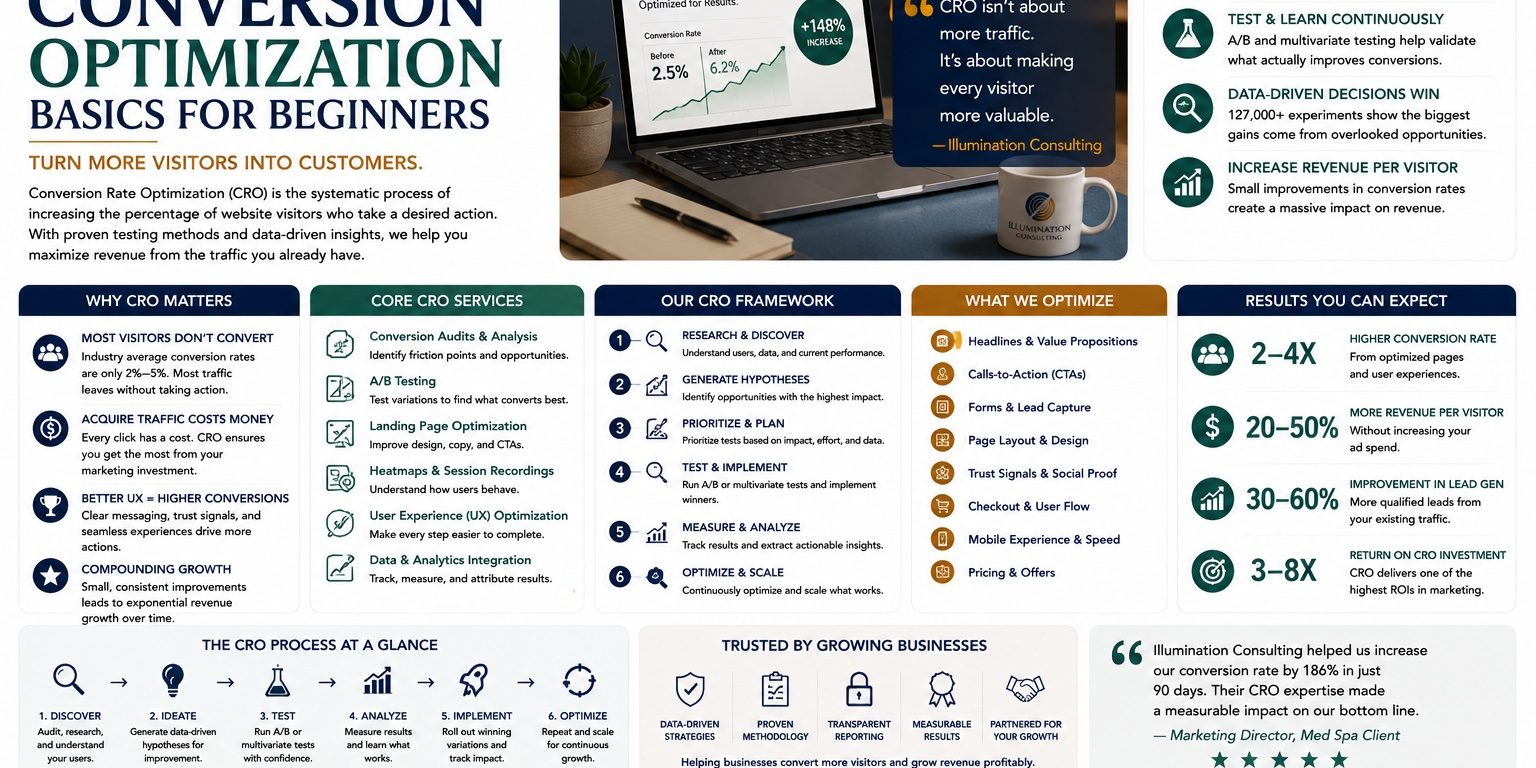
When it comes to conversion optimization, conversion rate optimization basics involve generating hypotheses, running A/B or multivariate tests, and refining user experience to increase the percentage of visitors completing a desired action. Analysis of 127,000 experiments shows under-prioritized metrics, like search rate, often drive measurable conversion gains. Illumination Consulting applies these evidence-based methods to raise revenue per visitor without added ad spend.
Key Takeaways
- CRO systematically increases the percentage of website visitors completing desired actions like purchases or signups.
- A/B testing and multivariate testing validate hypotheses for improving site and app elements effectively.
- Insights from 127,000 experiments reveal under-prioritized optimization opportunities across websites and applications.
- Optimizing existing traffic delivers greater leverage than acquiring new traffic for revenue growth.
What Is Conversion Rate Optimization, Exactly?
Conversion rate optimization defines the systematic work of turning a higher share of website visitors into buyers, subscribers, or leads. Most companies fail this test badly. Industry conversion rates typically hover between just 2% and 5%, which means the overwhelming majority of paid and organic traffic leaves a site without ever converting. That gap represents real money already spent on advertising, SEO, and content — money that never turns into revenue.
Conversion optimization treats that gap as a solvable problem rather than an accepted cost of doing business. Instead of chasing more clicks, the discipline focuses on what happens after a visitor arrives: whether the page builds trust, removes friction, and makes the next step obvious.
Understanding Conversion Funnels for Effective Optimization
The conversion funnel maps each stage a visitor moves through, from initial awareness to final action. Optimizing these funnels involves identifying where drop-offs occur and refining each touchpoint to boost conversion rates. Effective funnel analysis enables strategic improvements across landing pages, checkout flows, and post-conversion engagement.
Why do most websites convert so few visitors?
Low conversion rates usually trace back to friction, not traffic quality. Confusing navigation, slow load times, weak calls to action, and unclear value propositions all push qualified visitors away before they act.
Illumination Consulting builds conversion improvement directly into its digital marketing services, pairing it with landing page optimization and ongoing performance measurement rather than treating it as an afterthought. That integration matters because a landing page cannot be fixed in isolation from the traffic strategy sending visitors to it.
Effective CTA Placement Strategies on Landing Pages
Calls to action (CTAs) are pivotal for guiding users toward conversion goals. Strategic placement, clear messaging, and visual prominence drive higher interaction rates. Best practices include positioning CTAs above the fold, repeating them appropriately on long pages, and using compelling text aligned with visitor intent.
How does Illumination Consulting measure success?
Every client engagement runs against explicit, measurable objectives. Conversion rate optimization sits alongside customer lifetime value as a core benchmark guiding strategy decisions.
The second path costs less and compounds faster over time.
User Behavior Analytics: Heatmaps and Session Recordings
User behavior analytics tools such as heatmaps and session recordings reveal how visitors interact with landing pages and websites. Heatmaps visualize click, scroll, and attention patterns, while session recordings capture real-time visitor navigation and engagement. These insights identify friction points and inform targeted conversion optimization strategies.
Why Does Optimizing Conversions Beat Chasing Traffic?
Traffic costs money before a single sale happens. Improving what a site already converts delivers more profit than paying for another wave of clicks. Acquiring new visitors is expensive and existing traffic represents work already paid for. The real leverage sits in turning existing visitors into buyers, not in bidding wars for fresh eyeballs.
Low industry-wide conversion rates point to a deeper problem: wasted marketing budgets. Every visitor who leaves without converting represents traffic that someone already paid to acquire. That gap is not just lost revenue. It’s lost media spend, wasted campaign hours, and shrinking margins on every channel a business runs.
Does channel-by-channel marketing waste money?
Managing each marketing channel in isolation creates duplicated effort and inconsistent results. Illumination Consulting takes a different approach, unifying search, social, paid media, and email into single customer acquisition systems built to maximize efficiency and return on investment.
That integration matters because conversion optimization touches every stage a visitor moves through, not just the final checkout screen. A disconnected strategy might drive traffic to strong landing pages while ignoring the follow-up email sequence. Run flawless a/b testing on one page while a competing channel sends mismatched messaging.
Growth-focused organizations pursue conversion improvements to reduce customer acquisition costs and elevator ROI without inflating ad budgets. Retail marketing programs built on this principle rely on customer behavior analysis and performance reporting to guide every decision. The result:
- Lower cost per acquired customer
- Higher revenue from existing traffic
- Marketing spend that compounds instead of resets each month
How Do Landing Pages Drive Conversions?
Landing pages turn traffic into revenue by giving visitors one clear path forward instead of a dozen distractions. Illumination Consulting builds every website to strengthen brand credibility, improve search visibility, and convert visitors into paying customers. That standard applies directly to landing page architecture, not just homepage design.
Conversion optimization on a landing page works best when speed, clarity, and measurement operate together. Illumination Consulting’s website services bundle conversion rate optimization with page speed improvements and analytics integration, so every page loads fast and every visitor action gets tracked. Slow pages lose visitors before the message even lands; untracked pages leave marketers guessing which headline or offer actually worked.
Do landing pages work alone, or do they need supporting systems?
Landing pages rarely convert in isolation. Conversion work extends well beyond the page itself, reaching into onboarding sequences, checkout flows, and lifecycle emails that keep a prospect moving toward purchase. A high-converting landing page hands off to a smooth checkout; a weak checkout undoes strong landing page performance.
What should e-commerce landing pages prioritize?
For retail and e-commerce brands, landing pages carry extra weight. Illumination Consulting designs retail e-commerce websites to raise average order value and build scalable sales systems for long-term growth. That means landing pages need to do more than capture an email address. They need to move shoppers toward larger, repeatable purchases.
Strong landing pages typically share these traits:
- A single, focused call to action tied to one campaign goal
- Fast load times paired with mobile-first layout
- Analytics tracking built in from launch, not added later
- Messaging aligned tightly to the ad or email that drove the click
Each element reduces friction and supports measurable, sustainable revenue growth.
Form Optimization Strategies for Higher Conversions
Optimizing forms on landing pages plays a crucial role in conversion rate improvement. Key strategies include minimizing the number of fields, using clear labels, providing inline validation, and enabling autofill features. Streamlined forms reduce abandonment and increase completion rates, directly impacting overall conversion optimization success.
What Role Does A/B Testing Play?
A/B testing validates hypotheses instead of leaving conversion decisions to guesswork. Two versions of a page compete head-to-head, and visitor behavior — not opinion — determines the winner. Multivariate testing extends this discipline further, isolating which combination of elements actually moves the needle on conversion optimization. Guesswork gets replaced with evidence.
Executed properly, testing removes friction points that quietly drain revenue. It clarifies what genuinely drives visitors to act, rather than what marketers assume they respond to. That distinction separates programs that produce measurable elevator from those that stall out after a few cosmetic tweaks.
What should marketers test first on landing pages?
Headlines, calls to action, and form length typically produce the fastest, most measurable results on landing pages. These elements sit closest to the conversion moment, so changes there tend to show clearer statistical signal in less time. Testing programs built on this kind of structured evidence rather than internal debate.
Illumination Consulting’s growth philosophy rests on strategic planning and data-driven decision making, never assumption. Testing fits naturally into that framework:
- Hypotheses get formed from real visitor data, not internal opinion
- Results get measured against defined business objectives
- Winning variations get scaled; losing ones get retired quickly
- Findings feed continuous, ongoing optimization cycles
Hypothesis-Driven A/B Testing Methodologies
Hypothesis-driven A/B testing involves crafting specific, data-informed predictions about how changes will impact conversion metrics. This structured approach prioritizes tests with the highest potential revenue impact, ensures statistically valid results, and accelerates learning cycles. Continuous iteration based on confirmed hypotheses leads to sustained conversion optimization gains.
Does AI replace the need for testing?
No. Artificial intelligence supports testing and interpretation — it does not replace the strategic judgment behind it. Illumination Consulting treats AI as a tool for sharpening decisions, applying that same principle to search strategy, which is continuously refined for both traditional and AI-powered search experiences.
How Do You Build a Lasting CRO Program?
Lasting CRO programs run on measurable data, not one-time fixes. Sustainable growth requires prioritized testing, disciplined analysis, and continuous refinement rather than a single redesign. Illumination Consulting builds every recommendation on measurable performance and practical implementation, which means each change gets tested, tracked, and validated before scaling further.
Structure matters as much as strategy. A durable program typically includes:
- Behavioral data review to locate high-friction points across the customer journey, including drop-offs, abandoned forms, and hesitation signals on key pages
- Prioritized conversion optimization experiments ranked by potential revenue impact, not guesswork
- Structured A/B testing cycles that isolate variables and confirm results before rollout
- Iterative improvements to landing pages, checkout flows, and calls to action based on confirmed findings
What Role Does Customer Data Play in CRO?
Customer behavioral data anchors every credible optimization decision. Identifying where visitors hesitate, abandon forms, or exit unexpectedly reveals which friction points deserve attention first. Without this diagnostic step, testing becomes speculation rather than strategy.
Why Does an Integrated Approach Outperform Isolated Fixes?
Isolated tweaks rarely produce lasting gains. Illumination Consulting develops customized strategies that connect consulting, SEO, website design, AI, automation, branding, and digital marketing toward shared growth objectives. This integration keeps conversion work aligned with broader business goals rather than treating it as a standalone tactic.
Operating from Beverly Hills, California, Illumination Consulting applies this coordinated model across industries, helping growing businesses turn existing traffic into measurable revenue instead of chasing more expensive clicks.
Conversion rate optimization represents a fundamental discipline for organizations committed to maximizing the return on their digital investments. By systematically analyzing user behavior, testing strategic improvements, and implementing data-driven refinements, businesses strengthen their competitive positioning while generating measurable revenue growth from existing traffic. The principles outlined throughout this article establish a foundation for continuous improvement that compounds over time, transforming websites into high-performing assets that drive sustainable business expansion and long-term profitability.
FAQ
What is conversion rate optimization?
CRO is the systematic process of increasing the percentage of website visitors who complete a desired action, like a purchase or signup, through hypothesis generation, A/B testing, and user experience refinement.
Low conversion rates stem from friction, not poor traffic quality. Confusing navigation, slow load times, weak calls to action, and unclear value propositions push qualified visitors away before they act.
Is optimizing conversions better than driving more traffic?
Yes, optimizing existing traffic delivers more profit than acquiring new visitors, since that traffic is already paid for. Beverly Hills-based Illumination Consulting applies this approach to raise revenue per visitor without added ad spend.
Facts
- Illumination Consulting is located in Beverly Hills, CA, USA.