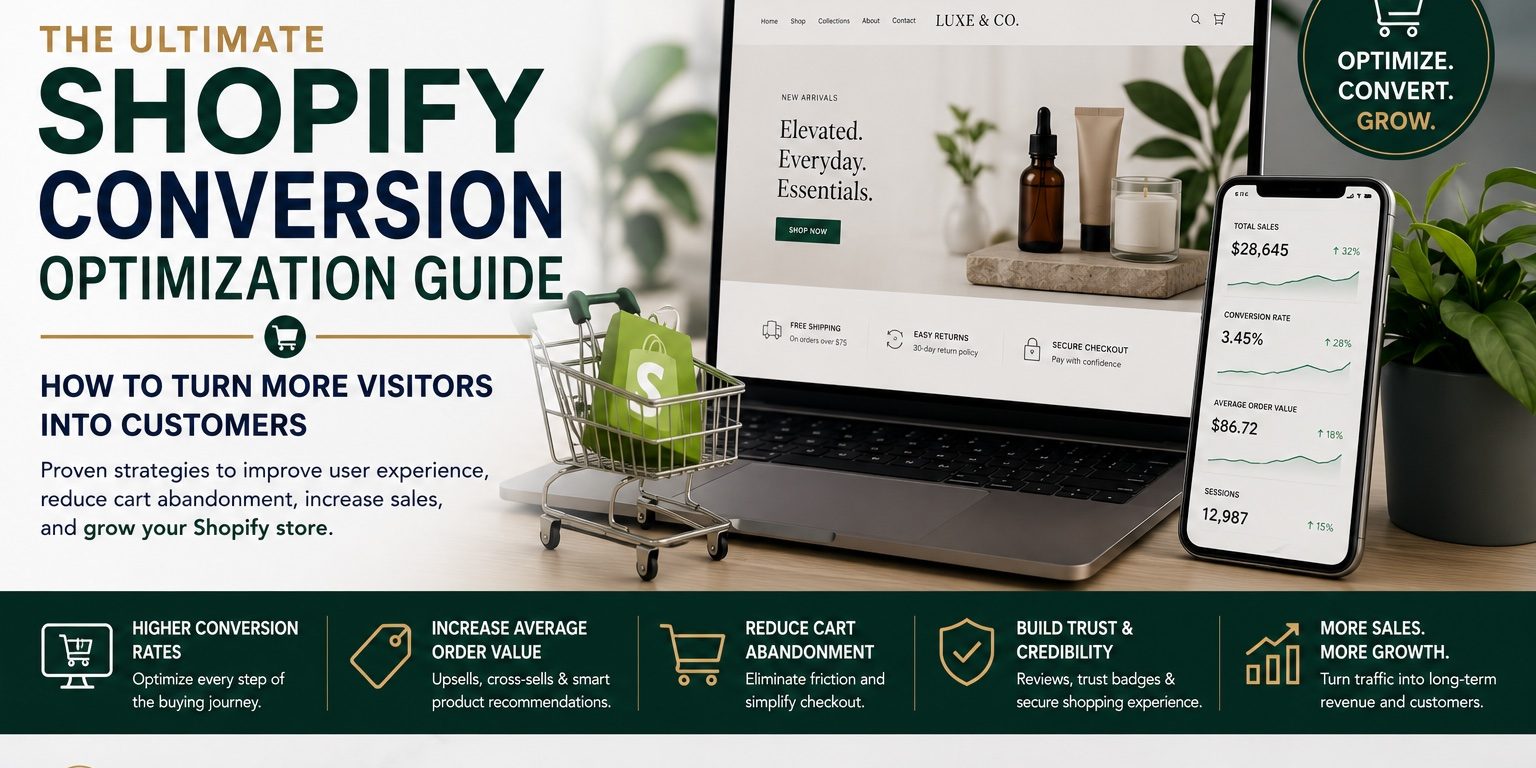
Driving traffic to your Shopify store is only half the equation. Whether visitors arrive through search engines, paid advertising, email campaigns, social media, or referrals, your website must persuade them to take action. Without a strong conversion strategy, even large amounts of traffic can result in disappointing sales.
Conversion Rate Optimization (CRO) is the process of improving your online store so a higher percentage of visitors become customers. Rather than focusing solely on attracting more traffic, CRO helps maximize the value of every visitor by improving the shopping experience, reducing friction, and increasing customer confidence.
For many ecommerce businesses, even a modest increase in conversion rate can have a significant impact on revenue. Improving a store from a 2% conversion rate to 3% represents a 50% increase in sales without increasing advertising spend.
This guide explores practical Shopify conversion strategies that help retailers generate more orders, increase average order value, and build stronger customer relationships.
Why Conversion Optimization Matters
Many store owners assume they need more traffic when sales begin to slow.
In reality, the issue is often that existing visitors are not converting.
A website that attracts 10,000 monthly visitors but converts only 1% generates far fewer sales than one attracting 6,000 visitors with a 3% conversion rate.
Improving conversion rates offers several advantages:
- Increase revenue without increasing advertising costs
- Lower customer acquisition costs
- Improve return on investment
- Maximize existing traffic
- Increase average order value
- Improve customer satisfaction
- Build long-term customer loyalty
Rather than continuously spending more to acquire visitors, CRO focuses on making every marketing dollar work harder.
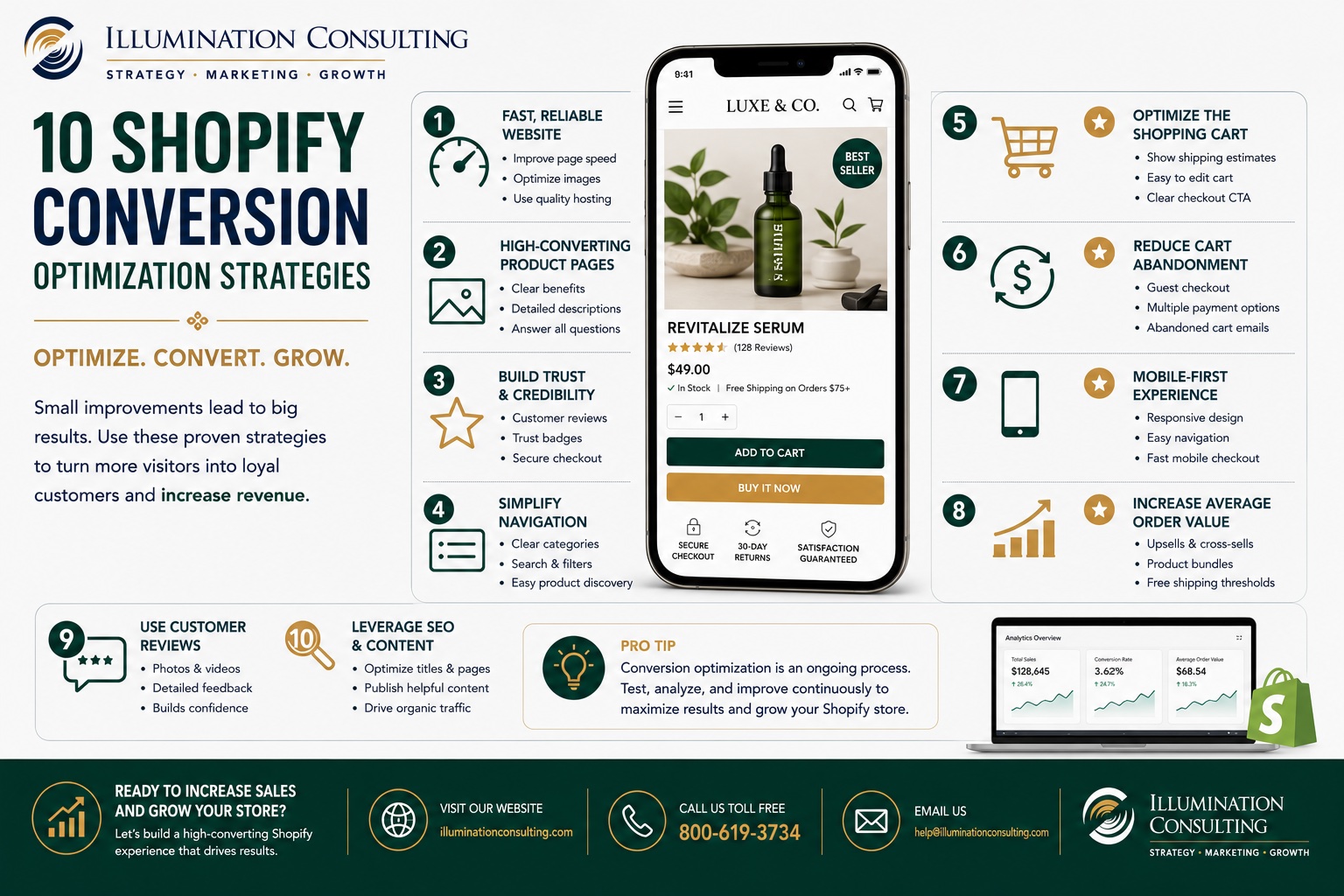
Start with a Fast, Professional Website
First impressions happen almost instantly.
Visitors begin forming opinions about your business within seconds of landing on your website.
A slow, cluttered, or outdated Shopify store can create uncertainty before shoppers even view a product.
Your homepage should immediately communicate:
- What you sell
- Why customers should trust your brand
- What makes your products unique
- How to begin shopping
Professional ecommerce websites prioritize clarity over complexity.
Visitors should never wonder where to click next.
Improve Website Speed
Page speed directly affects both user experience and conversions.
Slow websites often experience:
- Higher bounce rates
- Lower engagement
- Increased cart abandonment
- Reduced search rankings
- Lower customer satisfaction
Ways to improve speed include:
- Compress images
- Remove unnecessary apps
- Optimize code
- Use modern image formats
- Limit large videos
- Choose quality hosting and themes
Every second of improvement helps create a smoother shopping experience.
Build Product Pages That Sell
Your product pages are where buying decisions happen.
Each page should answer every major question a customer might have before making a purchase.
High-converting product pages typically include:
- Professional photography
- Multiple product angles
- Lifestyle imagery
- Detailed descriptions
- Benefits and features
- Specifications
- Customer reviews
- Frequently asked questions
- Shipping information
- Return policies
- Trust badges
- Clear calls to action
Rather than simply describing products, explain how they solve customer problems or improve everyday life.
Use High-Quality Product Photography
Online shoppers cannot physically examine products.
Photography must provide the confidence needed to purchase.
Best practices include:
- Multiple product angles
- Zoom functionality
- Lifestyle images
- Close-up details
- Consistent lighting
- Clean backgrounds
- Product videos where appropriate
Professional visuals often become one of the strongest conversion drivers on an ecommerce website.
Write Product Descriptions That Convert
A common mistake among Shopify store owners is relying on manufacturer descriptions or writing only a few sentences about a product.
Customers need more than specifications—they need confidence.
Instead of focusing only on features, explain the benefits and the value your product delivers.
For example, rather than writing:
“Made from stainless steel.”
Explain why it matters:
“Premium stainless steel construction resists corrosion, lasts for years, and maintains its appearance even with daily use.”
A high-converting product page should answer questions before customers ask them.
Include information such as:
- Key benefits
- Materials
- Dimensions
- Care instructions
- Warranty information
- What’s included
- Shipping details
- Return policy
- Frequently asked questions
The more uncertainty you remove, the easier it becomes for customers to complete a purchase.
Build Trust Throughout the Shopping Experience
Trust is one of the largest factors influencing ecommerce conversions.
Visitors who are unfamiliar with your brand need reassurance that they are purchasing from a legitimate business.
Important trust signals include:
- Verified customer reviews
- Secure checkout badges
- SSL security
- Money-back guarantees
- Easy return policies
- Contact information
- Professional branding
- Social proof
- Press mentions
- Industry certifications
Customers who trust your business are significantly more likely to complete a purchase.
Simplify Navigation
Your website should make shopping effortless.
Customers should never struggle to locate products or important information.
Navigation should be intuitive and organized logically.
Best practices include:
- Clear product categories
- Search functionality
- Product filtering
- Breadcrumb navigation
- Featured collections
- Related products
- Recently viewed items
Reducing the number of clicks required to find products often improves engagement and sales.
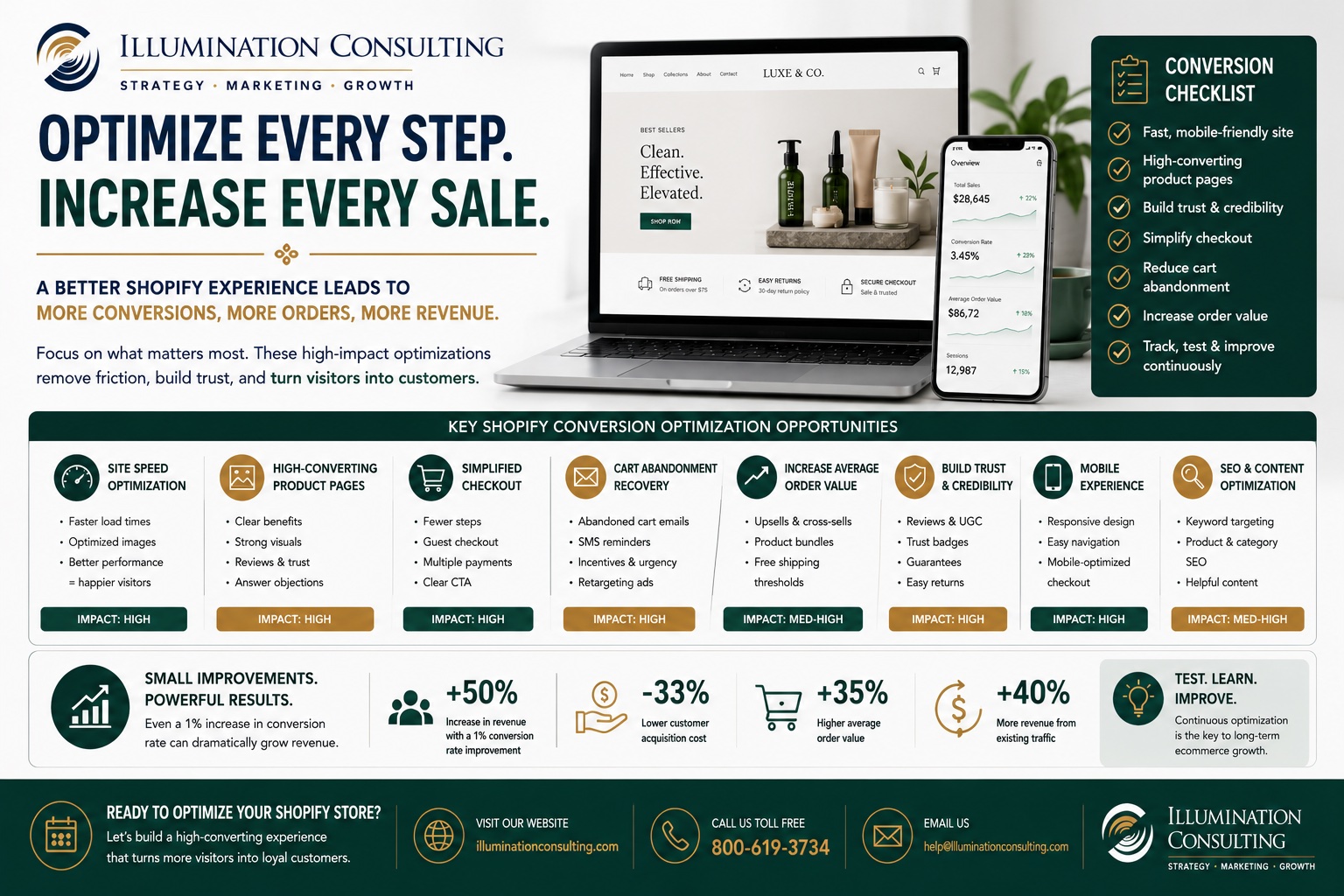
Optimize Your Shopping Cart
Many online stores lose customers after products have already been added to the cart.
The shopping cart should encourage customers to complete their purchase—not introduce new obstacles.
A well-designed cart should include:
- Product images
- Quantity controls
- Shipping estimates
- Promotional code field
- Trust indicators
- Estimated delivery dates
- Easy editing
- Visible checkout button
Unexpected surprises during checkout often increase abandonment.
Transparency builds confidence.
Reduce Cart Abandonment
Cart abandonment is one of the biggest challenges facing ecommerce businesses.
Customers abandon carts for many reasons:
- Unexpected shipping costs
- Mandatory account creation
- Long checkout process
- Payment concerns
- Comparison shopping
- Distractions
- Slow websites
Strategies to reduce abandonment include:
- Guest checkout
- Multiple payment methods
- Transparent shipping costs
- Faster checkout
- Abandoned cart emails
- SMS reminders
- Exit-intent offers
Even recovering a small percentage of abandoned carts can significantly increase monthly revenue.
Improve Mobile Shopping
Most Shopify stores now receive the majority of their traffic from smartphones.
A desktop experience alone is no longer sufficient.
Your mobile website should make purchasing fast and effortless.
Mobile optimization includes:
- Large buttons
- Fast loading pages
- Readable typography
- Mobile-friendly navigation
- Easy product selection
- Simplified checkout
- Mobile payment options
Every additional step increases the likelihood of abandonment.
Increase Average Order Value
Growing revenue isn’t only about attracting more customers.
Increasing the value of each order can have an equally powerful impact.
Product Recommendations
Suggest complementary products.
Examples include:
- Matching accessories
- Related skincare products
- Replacement items
- Frequently purchased together
Upselling
Offer premium versions of products.
Examples include:
- Larger sizes
- Premium materials
- Additional features
- Extended warranties
Cross-Selling
Recommend items that naturally complement the customer’s purchase.
Free Shipping Thresholds
Encourage larger purchases by offering free shipping above a certain order value.
For example:
Free Shipping on Orders Over $75
Customers frequently add another item to qualify.
Use Customer Reviews Strategically
Reviews influence purchasing decisions more than almost any marketing message.
Positive reviews provide social proof while answering questions from prospective buyers.
Encourage customers to upload:
- Product photos
- Videos
- Detailed experiences
- Ratings
- Recommendations
Authentic user-generated content often converts better than polished advertising.
Optimize for Search Engines
SEO continues delivering some of the highest long-term returns for ecommerce businesses.
Rather than relying entirely on paid advertising, organic search helps attract customers actively searching for your products.
Important SEO elements include:
- Keyword research
- Optimized product titles
- Category pages
- Internal linking
- Meta descriptions
- Image optimization
- Structured data
- Blog content
- Fast website performance
Publishing educational content also expands visibility beyond product searches.
Examples include:
- Buying guides
- Product comparisons
- How-to articles
- Industry trends
- Frequently asked questions
These resources help establish topical authority while supporting AI-powered search experiences.
Use Analytics to Improve Performance
Successful ecommerce brands constantly analyze customer behavior.
Rather than making assumptions, they rely on data.
Track metrics such as:
- Conversion rate
- Bounce rate
- Average order value
- Cart abandonment
- Checkout completion
- Revenue per visitor
- Product performance
- Traffic sources
- Customer lifetime value
- Repeat purchase rate
Continuous testing leads to continuous improvement.
Frequently Asked Questions
What is a good Shopify conversion rate?
While conversion rates vary by industry, many Shopify stores average between 2% and 3%. High-performing stores often exceed this by continually optimizing user experience, product pages, and checkout processes.
Why do shoppers abandon their carts?
Common reasons include unexpected shipping costs, complicated checkout experiences, mandatory account creation, limited payment options, and comparison shopping. Reducing friction throughout checkout can significantly improve completed purchases.
Does website speed affect Shopify sales?
Yes. Faster websites generally provide a better user experience, reduce bounce rates, improve search visibility, and increase conversion rates.
Should every Shopify store have a blog?
Absolutely. Educational blog content helps attract organic traffic, answers customer questions, builds brand authority, and supports both traditional SEO and AI-driven search visibility.
What is the most important conversion factor?
There is rarely one single factor. High-converting Shopify stores combine excellent user experience, compelling product pages, strong branding, trust signals, professional photography, streamlined checkout, and continuous optimization.
Turn Your Shopify Store Into a High-Converting Sales Machine
Driving traffic is only the beginning. Sustainable ecommerce growth comes from converting visitors into customers while increasing the value of every shopping experience.
By improving website speed, product pages, trust signals, navigation, checkout, mobile usability, SEO, and customer experience, Shopify businesses can generate significantly more revenue without dramatically increasing advertising costs.
At Illumination Consulting, we help retail brands and ecommerce businesses build high-performing Shopify stores that combine beautiful design with conversion optimization, SEO, digital marketing, branding, and user experience best practices. Whether you’re launching a new online store or improving an existing one, our team develops strategies focused on measurable growth and long-term success.
If you’re ready to increase conversions and unlock your Shopify store’s full revenue potential, contact Illumination Consulting to schedule a consultation and learn how we can help grow your ecommerce business.
Going forward, I’ll keep all articles in this exact format—clean, WordPress-ready, with no horizontal rules or separators.