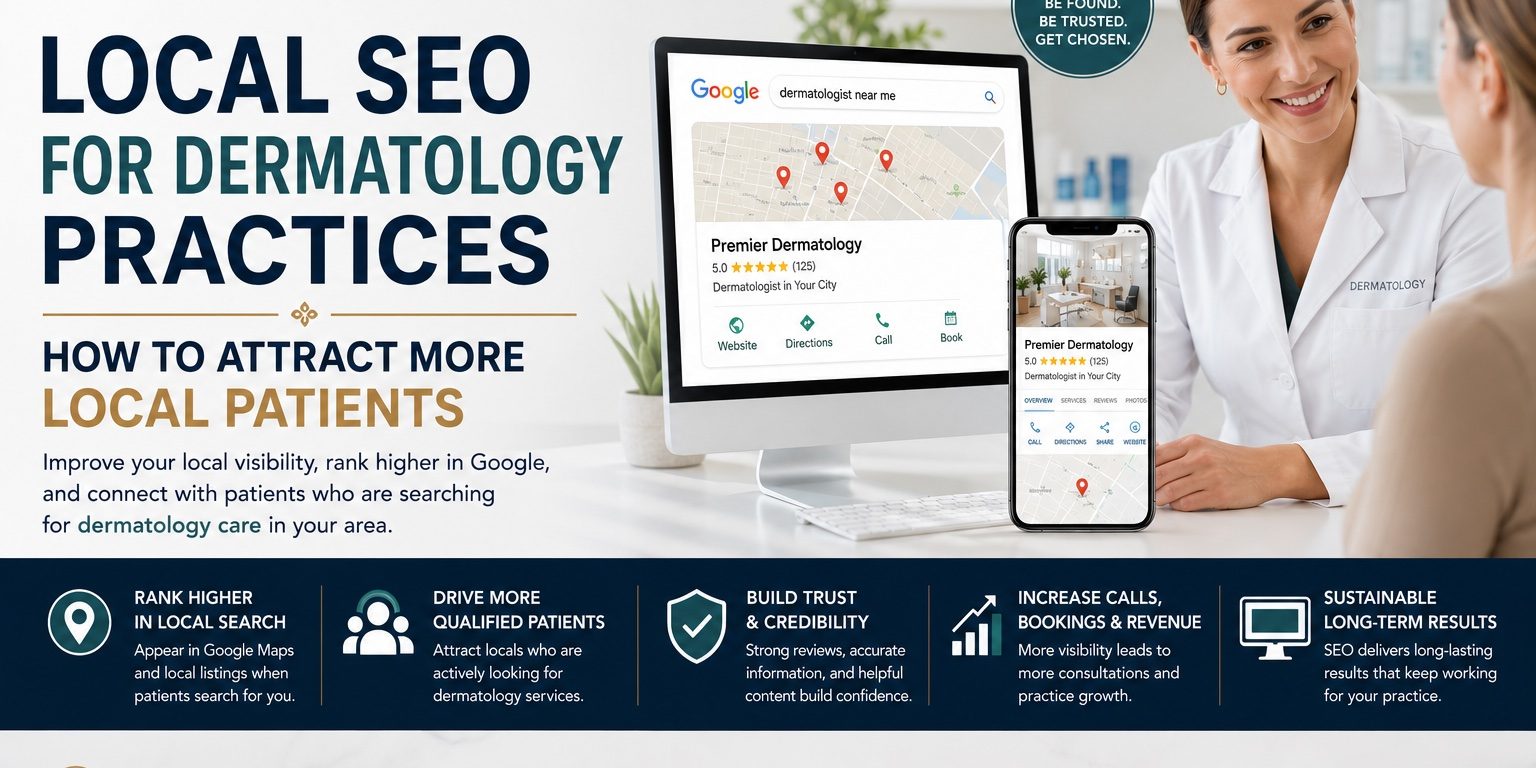
For most dermatology practices, growth begins with local visibility. When someone searches for a dermatologist, they are rarely looking across the country. Instead, they search for providers close to home using phrases such as “dermatologist near me,” “skin cancer screening nearby,” or “acne specialist in my area.” Appearing prominently in these search results can significantly influence patient acquisition. Practices that consistently rank well in local search often receive more phone calls, website visits, consultation requests, and appointment bookings than competitors with weaker online visibility. Local SEO for Dermatology practices is a critical marketing strategy to grow a clinic.
Local SEO is the process of improving a practice’s presence in geographically relevant search results. It combines website optimization, Google Business Profile management, authoritative content, online reviews, local citations, technical SEO, and ongoing digital marketing to help connect nearby patients with your practice.
Unlike paid advertising, local SEO continues generating value long after the initial optimization is complete. It helps practices build sustainable visibility while strengthening trust with both search engines and prospective patients.
Why Local SEO Matters for Dermatology Practices
Dermatology is one of the most competitive specialties within healthcare.
Patients often have numerous options within a relatively small geographic area, making online visibility increasingly important.
Before scheduling an appointment, prospective patients typically compare several providers by reviewing:
- Google search results
- Google Maps listings
- Practice websites
- Online reviews
- Provider credentials
- Services offered
- Before-and-after photos when applicable
- Insurance information
- Office location
- Appointment availability
If your practice is difficult to find online, many qualified patients may never discover your services.
Local SEO helps ensure your practice appears during these critical moments of decision-making.
Understanding How Patients Search
Today’s patients rarely search using only a provider’s name.
Instead, they search according to symptoms, treatments, conditions, procedures, and location.
Common examples include:
- Dermatologist near me
- Skin cancer screening
- Mole removal
- Acne treatment
- Psoriasis specialist
- Eczema doctor
- Cosmetic dermatologist
- Mohs surgeon
- Botox dermatologist
- Rosacea treatment
Each of these searches represents an opportunity for your practice to appear before highly qualified prospective patients.
A successful local SEO strategy aligns your website and online presence with these real-world search behaviors.
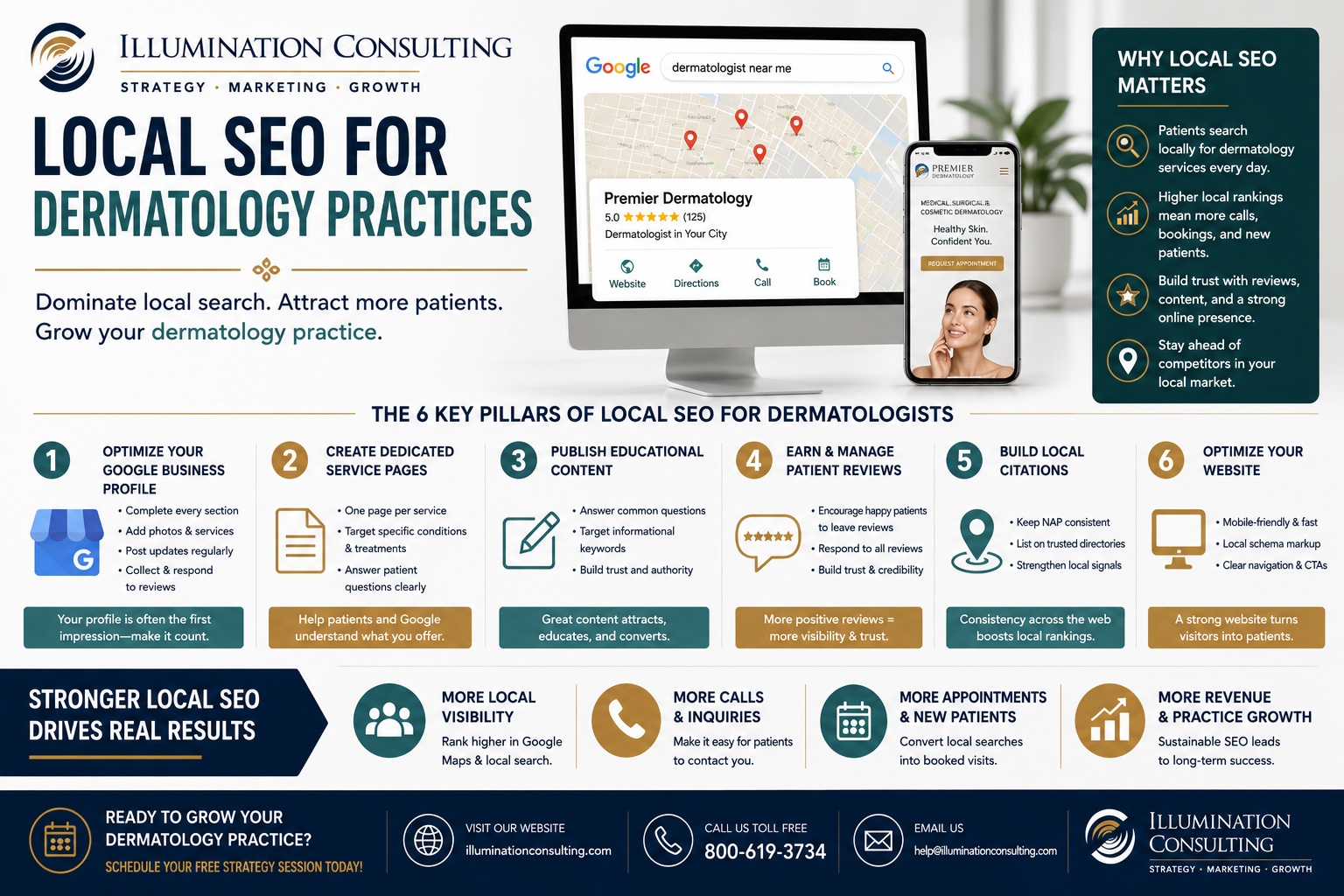
Optimize Your Google Business Profile
One of the most influential factors in local search is your Google Business Profile.
This listing often appears before a visitor even reaches your website and may determine whether they choose to call your office or continue searching elsewhere.
A complete profile should include:
- Accurate business name
- Correct address
- Phone number
- Website link
- Office hours
- Medical categories
- Professional photography
- Service descriptions
- Frequently asked questions
- Appointment links
- Regular updates
Google also considers profile activity.
Practices that routinely update their profile with educational content, photos, announcements, and patient-focused information often maintain stronger visibility than inactive listings.
Build Dedicated Service Pages
One common SEO mistake is placing every service onto a single page.
Instead, each major condition or treatment should have its own comprehensive page.
Examples include:
- Acne Treatment
- Skin Cancer Screenings
- Mohs Surgery
- Rosacea Treatment
- Psoriasis Treatment
- Eczema Treatment
- Mole Removal
- Cosmetic Dermatology
- Chemical Peels
- Botox
- Fillers
- Laser Treatments
Each page should answer patient questions while demonstrating the expertise of the practice.
Rather than publishing thin content, focus on creating helpful resources that explain:
- Who may benefit
- Symptoms
- Treatment options
- Recovery expectations
- Frequently asked questions
- Consultation process
These pages help improve both patient education and organic search visibility.
Create Educational Content That Builds Authority
Many dermatology websites focus almost exclusively on services.
Educational content expands visibility by answering the questions patients ask before scheduling an appointment.
Examples include:
- What causes acne?
- How often should I get a skin cancer screening?
- When should I worry about a changing mole?
- Does rosacea ever go away?
- What’s the difference between eczema and psoriasis?
- Are chemical peels safe?
Every educational article provides another opportunity to appear in search results while establishing trust before the patient ever contacts your office.
It also strengthens your website’s topical authority, making your service pages more competitive over time.
Earn More Visibility Through Patient Reviews
Online reviews influence both search rankings and patient decisions.
Even if two dermatology practices offer similar services, the practice with stronger reviews often receives more phone calls and appointment requests.
Reviews provide two important benefits:
- They help establish trust with prospective patients.
- They strengthen local search signals.
Encourage satisfied patients to leave reviews on your Google Business Profile after positive visits. The process should be simple, consistent, and incorporated into your normal patient communication workflow.
Best practices include:
- Send review requests shortly after appointments.
- Provide a direct review link.
- Thank patients for their feedback.
- Respond professionally to both positive and negative reviews.
- Never purchase reviews or post fake testimonials.
A steady flow of authentic reviews demonstrates that your practice is active, trusted, and engaged with patients.
Optimize Your Website for Local Search
Your website remains the foundation of your local SEO strategy.
Every page should reinforce where your practice is located and the services you provide.
Important optimization elements include:
- Fast page speed
- Mobile-friendly design
- Secure HTTPS connection
- Clear navigation
- Internal linking
- Optimized title tags
- Meta descriptions
- Structured headings
- Image optimization
- Schema markup
Patients should immediately understand:
- Where your office is located
- Which services you provide
- Who your physicians are
- How to schedule an appointment
A confusing website often causes visitors to leave before taking action.
Create Location-Specific Pages
If your practice serves multiple cities or has more than one office, each location should have its own dedicated landing page.
Instead of creating generic duplicate pages, each location page should include unique information such as:
- Office address
- Driving directions
- Parking information
- Office photography
- Physicians practicing at that location
- Services available
- Community information
- Frequently asked questions
- Nearby landmarks
These pages help search engines understand the geographic relevance of your practice while making it easier for patients to find the nearest office.
Build Consistent Local Citations
Search engines compare your business information across numerous online directories.
Your practice name, address, and phone number should remain consistent everywhere they appear.
Common citation sources include:
- Google Business Profile
- Apple Maps
- Bing Places
- Healthgrades
- Vitals
- WebMD
- Yelp
- Local chambers of commerce
- Medical association directories
Even small inconsistencies can create confusion and weaken local search signals.
Regular citation audits help maintain accuracy and improve trust with search engines.
Use High-Quality Photography
Patients want to see the people and environment behind the practice.
Professional photography helps establish credibility and creates a stronger emotional connection than generic stock images.
Consider including:
- Physician portraits
- Team photographs
- Reception area
- Treatment rooms
- Exterior building images
- Technology and equipment
- Community involvement
- Educational events
Authentic photography reinforces professionalism while improving both website engagement and Google Business Profile performance.
Make Your Website Mobile-First
Most local searches now occur on smartphones.
Patients may search while commuting, during lunch breaks, or immediately after receiving a referral.
A mobile-friendly dermatology website should make it easy to:
- Call the office
- Request an appointment
- Find directions
- Review physician biographies
- Read treatment information
- Complete contact forms
Common mobile mistakes include:
- Slow loading pages
- Tiny text
- Difficult navigation
- Pop-ups that block content
- Forms that require excessive typing
A smooth mobile experience improves both patient satisfaction and search performance.
Publish Content Consistently
Search engines favor websites that continue providing fresh, relevant information.
A consistent publishing schedule demonstrates that your practice remains active and authoritative.
Helpful topics include:
- Seasonal skin care advice
- Skin cancer awareness
- Common skin conditions
- Cosmetic dermatology
- Treatment comparisons
- Prevention tips
- Patient FAQs
- New technologies
- Office announcements
- Community education
Rather than writing for search engines, create content that genuinely helps patients make informed healthcare decisions.
High-quality educational resources also increase the likelihood of appearing in AI-powered search experiences.
Optimize for AI Search
Search behavior continues evolving.
Many consumers now use AI assistants to research symptoms, compare treatments, and identify local providers before visiting traditional search engines.
This shift makes authority and content quality more important than ever.
Dermatology practices should focus on publishing comprehensive, well-organized content that clearly answers patient questions.
Examples include:
- Detailed treatment guides
- Frequently asked questions
- Provider biographies
- Skin condition resources
- Preventive care information
- Procedure explanations
Clear structure, factual accuracy, and demonstrated expertise help both search engines and AI platforms understand and reference your content.
Measure Your SEO Performance
Local SEO should always be supported by data.
Tracking performance helps identify which strategies are producing meaningful business results.
Useful metrics include:
- Organic website traffic
- Google Business Profile views
- Phone calls
- Appointment requests
- Keyword rankings
- Local Map Pack visibility
- Conversion rate
- Click-through rate
- Review growth
- New patient inquiries
These insights help practices continuously improve their marketing while making informed investment decisions.
Frequently Asked Questions
How long does local SEO take to produce results?
Local SEO is a long-term strategy. Many practices begin seeing measurable improvements within several months, although highly competitive markets often require ongoing optimization and content development to achieve and maintain strong rankings.
Is Google Business Profile really that important?
Yes. For many dermatology practices, the Google Business Profile is one of the first things prospective patients see. A complete, accurate, and actively managed profile can significantly improve local visibility and increase phone calls, website visits, and appointment requests.
Should dermatologists create blog content?
Absolutely. Educational content helps answer patient questions, strengthens topical authority, improves search visibility, and supports both traditional SEO and AI-powered search experiences.
Does local SEO work for cosmetic dermatology?
Yes. Cosmetic dermatology services such as Botox, fillers, laser treatments, and chemical peels often generate significant local search activity. Optimized service pages and educational content can help practices attract highly qualified patients actively researching these procedures.
What is the biggest local SEO mistake?
One of the most common mistakes is treating SEO as a one-time project. Local search requires ongoing optimization, fresh content, review management, technical improvements, and continuous monitoring to remain competitive.
Grow Your Dermatology Practice with Local SEO
When prospective patients search for dermatology services, your online visibility can determine whether they contact your practice or choose a competitor. A strong local SEO strategy helps ensure your physicians, services, and expertise appear when nearby patients are actively looking for care.
Success requires more than simply ranking higher in search results. It involves building trust, providing valuable educational content, maintaining a high-performing website, optimizing your Google Business Profile, earning authentic patient reviews, and delivering an exceptional online experience that encourages visitors to schedule an appointment.
At Illumination Consulting, we help dermatology practices improve their online visibility through comprehensive local SEO, Agentic SEO, website optimization, content marketing, reputation management, and digital growth strategies designed specifically for healthcare providers.
If you’re ready to attract more qualified local patients and strengthen your practice’s online presence, contact Illumination Consulting to learn how a strategic local SEO program can support your long-term growth.