A plastic surgery website is often the first meaningful interaction a prospective patient has with a practice. Before scheduling a consultation, patients typically review the surgeon’s credentials, explore procedure pages, inspect before-and-after results, read reviews, compare financing options, and evaluate the professionalism of the practice.
The website must accomplish all of this while creating trust.
A visually attractive site is not enough. It must also communicate authority, answer patient questions, perform well on mobile devices, rank in search engines, and guide visitors toward taking action.
When these elements are missing, plastic surgeons can lose qualified patients without realizing it. The visitor may never call, complete a form, or explain why the website failed to build confidence. They simply leave and visit a competitor.
The following website mistakes frequently reduce consultation requests, weaken patient trust, and limit marketing performance.
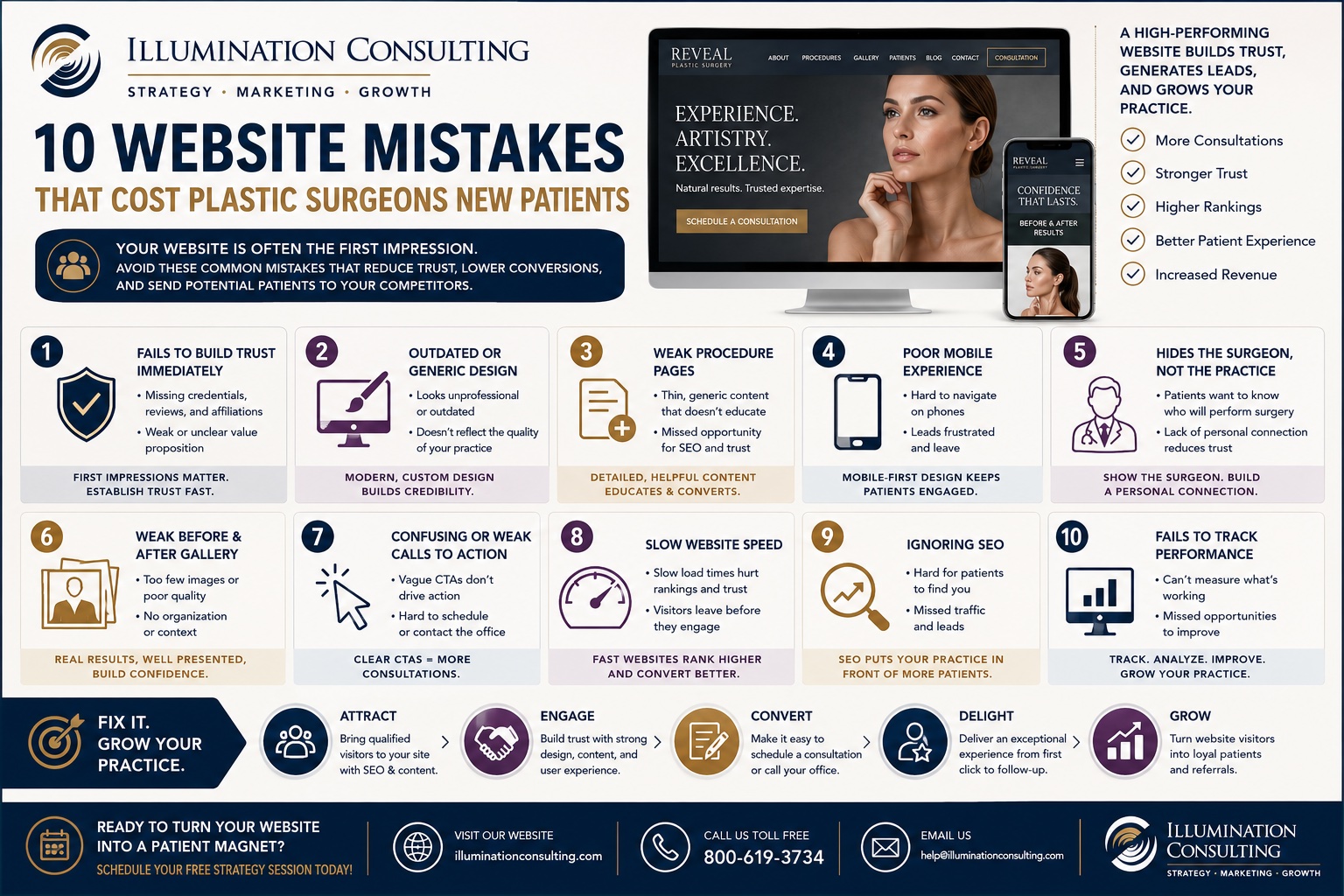
Failing to Establish Trust Immediately
Plastic surgery involves highly personal decisions, significant financial investment, and concerns about safety, recovery, and results. Patients need to feel confident in both the surgeon and the practice before they are willing to schedule a consultation.
A website that feels generic, outdated, impersonal, or poorly organized can create immediate doubt.
Visitors should quickly understand:
- Who the surgeon is
- What procedures the practice specializes in
- Where the practice is located
- Why patients should trust the provider
- What makes the practice different
- How to schedule a consultation
Trust-building elements should appear prominently throughout the site rather than being buried on an interior page.
Important trust signals include:
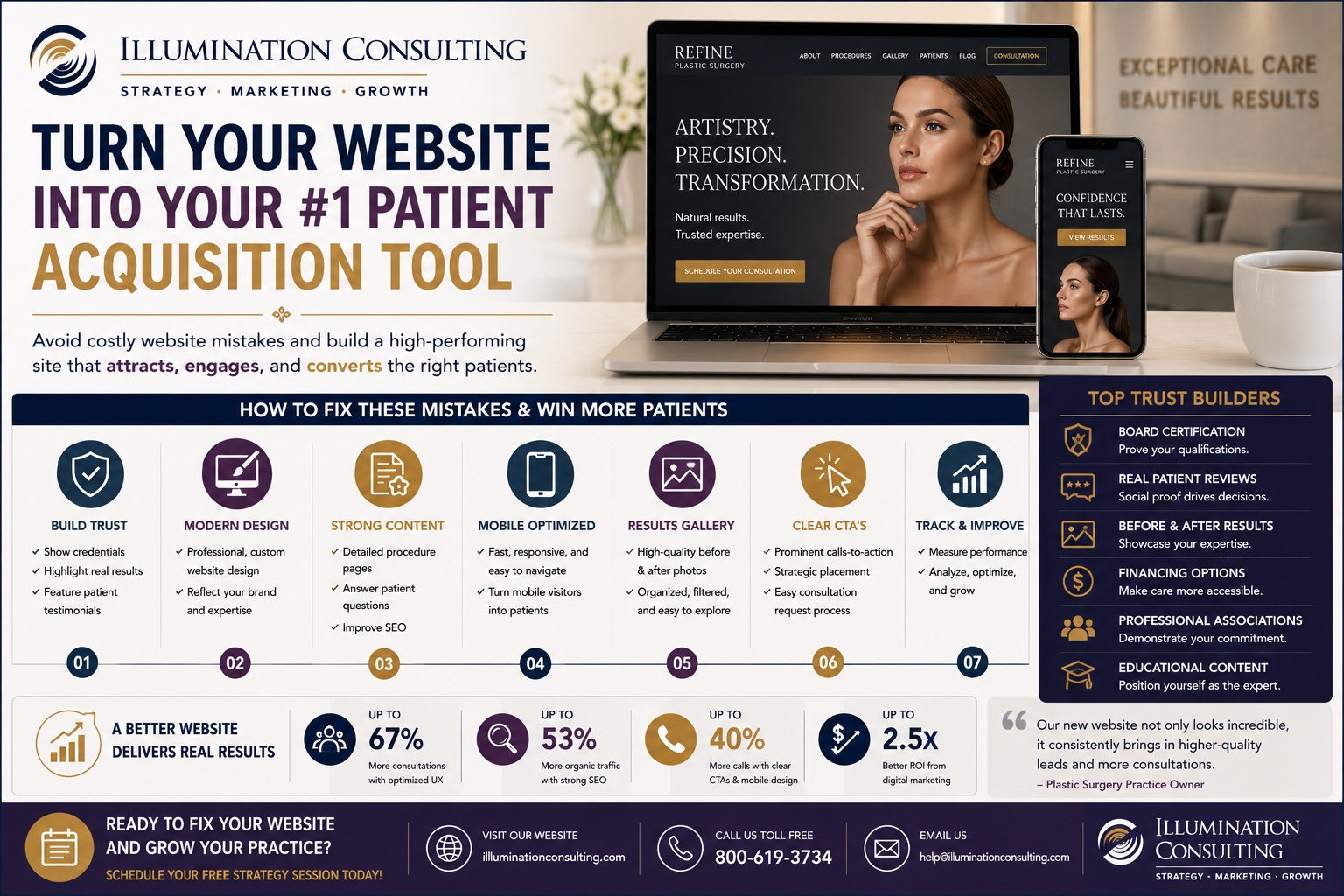
- Board certification
- Professional memberships
- Medical education and training
- Years of experience
- Hospital affiliations
- Awards and recognition
- Patient testimonials
- Before-and-after photographs
- Media appearances
- Published research or speaking credentials
The goal is not to overwhelm visitors with credentials. The goal is to clearly demonstrate expertise and reassure them that they are considering a reputable, qualified provider.
Using an Outdated or Generic Website Design
Consumers often associate the quality of a website with the quality of the practice.
This may not always be fair, but it is a common perception.
An outdated design can make a highly experienced surgeon appear less established, less current, or less attentive to detail. Generic template websites create a similar problem because they fail to communicate the distinctive identity of the surgeon and practice.
Plastic surgery websites should feel:
- Refined
- Modern
- Professional
- Patient-centered
- Visually polished
- Consistent with the practice’s positioning
A luxury practice should not look like a low-cost clinic. A highly specialized facial plastic surgeon should not look identical to a general cosmetic practice. The design, imagery, typography, messaging, and user experience should reinforce the desired market position.
Common design problems include:
- Cluttered layouts
- Low-quality stock photography
- Small or difficult-to-read text
- Inconsistent colors
- Excessive animation
- Poor spacing
- Confusing navigation
- Outdated design conventions
Good design should enhance credibility and guide the visitor. It should never distract from the surgeon, the procedures, or the patient journey.
Weak Procedure Pages
Procedure pages are among the most important sections of a plastic surgery website.
They attract search traffic, educate patients, demonstrate expertise, and help visitors determine whether they are ready to schedule a consultation. Unfortunately, many practices publish short, generic procedure descriptions that provide little value.
A weak procedure page may contain only a few paragraphs copied or lightly adapted from common medical information.
That does not adequately serve the patient.
A strong procedure page should explain:
- What the procedure is
- Who may be a good candidate
- What concerns it addresses
- How the surgery is performed
- What anesthesia may be used
- What recovery typically involves
- When results may become visible
- How long results may last
- Potential risks and considerations
- Related procedures
- Frequently asked questions
- How to schedule a consultation
The content should reflect the surgeon’s actual approach and experience rather than reading like generic medical copy.
Why detailed procedure pages matter
Comprehensive procedure pages support both patient education and search visibility.
Search engines favor content that meaningfully answers a user’s question. AI-powered search platforms also rely on clear, authoritative information when generating answers and recommendations.
Detailed pages can help a practice appear for searches involving:
- Procedure names
- Candidate questions
- Recovery timelines
- Cost-related questions
- Procedure comparisons
- Local surgical options
- Expected results
Every major procedure offered by the practice should have its own optimized page.
Poor Mobile Performance
Many prospective patients first visit a plastic surgery website from a smartphone.
They may discover the practice through Google, Instagram, YouTube, an online directory, or a referral link. If the mobile experience is slow or difficult to use, the practice can lose the visitor within seconds.
Common mobile problems include:
- Slow loading
- Text that is too small
- Buttons that are difficult to tap
- Images that do not scale properly
- Forms that are frustrating to complete
- Navigation menus that do not function correctly
- Pop-ups that block the screen
- Phone numbers that are not clickable
A mobile visitor should be able to easily review procedures, view the surgeon’s credentials, inspect results, call the office, and request a consultation.
Mobile design should prioritize action
The most important actions should remain accessible throughout the mobile experience.
These may include:
- Call the practice
- Request a consultation
- View before-and-after results
- Get directions
- Learn about financing
Mobile optimization is not simply a technical requirement. It directly affects lead generation and patient acquisition.
Hiding the Surgeon Behind the Brand
Branding is important, but patients are ultimately choosing a surgeon.
Some plastic surgery websites focus so heavily on the name, facility, or aesthetic concept of the practice that the surgeon becomes difficult to find. The site may feature attractive interiors, models, and treatment imagery while providing very little insight into the actual physician.
This weakens the personal connection.
Prospective patients want to understand:
- Who will perform the procedure
- What the surgeon believes
- How the surgeon communicates
- What specialties the surgeon has
- What kind of results the surgeon prioritizes
- Whether the surgeon feels trustworthy and approachable
The surgeon’s personality, philosophy, and expertise should be visible throughout the website.
A strong surgeon profile should include:
- Professional photography
- Education and credentials
- Surgical philosophy
- Areas of specialization
- Personal approach to patient care
- Professional memberships
- Awards and distinctions
- Video content
- Relevant personal background
Video is especially effective because it gives visitors an opportunity to hear the surgeon speak before scheduling an appointment.
A Weak Before-and-After Gallery
For many patients, the before-and-after gallery is one of the most influential sections of the website.
It allows visitors to evaluate the surgeon’s aesthetic judgment, consistency, technical skill, and experience with patients who have similar concerns.
A weak gallery can create uncertainty even when the surgeon produces excellent work.
Common gallery mistakes include:
- Too few cases
- Poor image quality
- Inconsistent lighting
- Inconsistent patient positioning
- No filtering by procedure
- Tiny images
- Missing case descriptions
- Difficult mobile navigation
- No explanation of individual treatment plans
A strong gallery should make it easy for visitors to find relevant cases.
For example, breast augmentation results may be filterable by implant type, incision method, body type, or patient goals. Facial procedure galleries may be organized by age range, technique, or treatment combination.
Add context without making unsupported claims
Case descriptions can help patients understand the treatment plan and individual nature of surgical outcomes.
A description may explain:
- The patient’s primary concern
- The procedure performed
- Relevant surgical approach
- Complementary treatments
- General recovery timing
- How long after surgery the photograph was taken
All galleries should use appropriate patient consent and should avoid implying that identical results can be guaranteed.
Confusing or Weak Calls to Action
A visitor may be interested in the practice but still fail to take the next step because the website does not clearly guide them.
Calls to action should be visible, specific, and easy to understand.
Weak calls to action include:
- Learn More
- Submit
- Click Here
- Contact Us
These phrases are not always wrong, but they are often too vague to motivate action.
Stronger calls to action may include:
- Schedule Your Consultation
- Request a Private Consultation
- Speak With Our Patient Coordinator
- Explore Financing Options
- View Patient Results
- Ask a Procedure Question
The website should provide multiple ways to connect while emphasizing the preferred conversion path.
Reduce friction in consultation forms
Long consultation forms can discourage qualified leads.
Initial forms generally need only enough information for the practice to respond appropriately. This may include:
- Name
- Phone number
- Email address
- Procedure of interest
- Preferred contact method
- Brief message
More sensitive medical information can be collected later through a secure and compliant patient intake process.
Slow Website Speed
Website speed has a direct impact on user experience.
Visitors who encounter slow-loading pages may leave before seeing the surgeon’s credentials, procedures, or results. This is especially problematic on mobile devices and for users with weaker internet connections.
Large images and video files are common causes of performance problems on plastic surgery websites.
Other causes include:
- Excessive plugins
- Poor-quality hosting
- Unoptimized code
- Too many tracking scripts
- Large animation files
- Outdated website platforms
- Poor caching configuration
Image optimization is especially important
Plastic surgery websites require high-quality photography, but image quality and performance must be balanced carefully.
Images should be:
- Properly sized
- Compressed
- Delivered in modern file formats
- Loaded efficiently
- Optimized for different screen sizes
A fast website feels more professional and makes it easier for prospective patients to explore multiple pages before taking action.
Ignoring Search Engine Optimization
A beautiful website has limited value if qualified patients cannot find it.
Plastic surgery SEO helps a practice appear when people search for procedures, providers, recovery information, and local surgical options.
Many practices make the mistake of launching a new website without a comprehensive search strategy.
Important SEO components include:
- Keyword research
- Procedure page optimization
- Local SEO
- Technical website optimization
- Internal linking
- Structured data
- Image optimization
- Authoritative content
- Google Business Profile optimization
- Online reputation development
The website should be designed around the way patients actually search.
A prospective patient may search for:
- Plastic surgeon near me
- Best facelift surgeon in the area
- Breast augmentation consultation
- Rhinoplasty recovery
- Mommy makeover cost
- Tummy tuck surgeon
- Facial plastic surgeon
- Natural-looking facelift results
The site should contain relevant, authoritative pages that align with these searches.
Optimize for AI-powered discovery
Search behavior is expanding beyond conventional search engines.
Consumers increasingly use AI platforms to research procedures, compare treatment options, and identify providers. This makes clear site structure, detailed educational content, provider authority, and consistent business information increasingly important.
Plastic surgery practices should develop content that can be easily understood, summarized, and cited by both traditional search engines and AI systems.
Failing to Track Website Performance
Without measurement, a practice cannot reliably determine whether its website is helping or hurting patient acquisition.
Website analytics should reveal more than total traffic.
Plastic surgeons and practice managers should understand:
- Which pages attract visitors
- Which procedures generate inquiries
- Where visitors leave
- Which marketing channels produce consultations
- Which geographic areas generate leads
- How mobile users behave
- Which calls to action receive engagement
- Which forms are completed
- Which pages contribute to conversions
Track meaningful business outcomes
Traffic alone does not equal success.
A website may receive thousands of visits but produce very few qualified consultation requests. Another site may attract less traffic but convert a much higher percentage of visitors.
Useful performance indicators include:
- Consultation form submissions
- Phone calls
- Online bookings
- Conversion rate
- Cost per lead
- Lead quality
- Procedure interest
- Organic search growth
- Landing page performance
- Patient acquisition cost
Call tracking, analytics platforms, form tracking, and customer relationship management systems can help connect marketing activity with actual business results.
Additional Website Issues That Can Reduce Patient Trust
The ten mistakes above are among the most damaging, but several additional issues can also affect website performance.
Missing or outdated information
Patients become frustrated when office hours, addresses, provider information, procedure availability, or contact details are inaccurate.
Inconsistent branding
Different logos, colors, messaging, or photography styles can make the practice appear disorganized.
Excessive stock photography
Stock images can support a design, but they should not replace authentic images of the surgeon, team, office, and patient experience.
Unclear financing information
Plastic surgery is often a substantial financial decision. Patients should be able to easily find information about accepted payment methods and available financing options.
Poor accessibility
Websites should be designed so people with disabilities can access and navigate the content. This includes readable contrast, keyboard navigation, alternative text, clear structure, and properly labeled forms.
Weak privacy and security practices
Consultation forms, patient inquiries, and website data should be handled responsibly. Medical practices must understand their privacy, security, and compliance obligations.
How to Evaluate a Plastic Surgery Website
Practice owners should review the website from the perspective of a first-time visitor.
Ask the following questions:
- Does the website immediately establish credibility?
- Is it clear which procedures the surgeon performs?
- Can visitors easily find the surgeon’s credentials?
- Does the site work well on a mobile phone?
- Are before-and-after results easy to explore?
- Can patients quickly request a consultation?
- Does the content answer meaningful patient questions?
- Does the site load quickly?
- Is the practice visible in local search?
- Are conversions and phone calls being tracked?
It is also useful to ask someone unfamiliar with the practice to test the site. Internal teams may overlook issues because they already know where information is located.
Frequently Asked Questions
How often should a plastic surgery website be redesigned?
There is no universal schedule. A website should be redesigned when it no longer reflects the brand, performs poorly on mobile devices, loads slowly, creates security concerns, or fails to support current marketing goals. Regular improvements may extend the life of a strong website without requiring a complete rebuild.
What pages should every plastic surgery website have?
At minimum, the website should include a home page, surgeon profile, individual procedure pages, before-and-after gallery, patient testimonials, financing information, consultation page, contact page, privacy information, and educational resources.
How many procedure pages should a plastic surgeon have?
Every major surgical and nonsurgical procedure offered by the practice should generally have a dedicated page. Closely related variations may also require separate content when patients search for them independently.
Do plastic surgery websites need professional photography?
Professional photography is strongly recommended. High-quality images of the surgeon, staff, office, and patient experience help establish authenticity and differentiate the practice from competitors using generic templates.
Can a new website improve patient consultations?
Yes, but only when the website is built around patient needs, conversion strategy, search visibility, brand positioning, and measurable business goals. A visual redesign alone may not improve results if deeper marketing and usability problems remain unresolved.
Why is mobile design so important for plastic surgeons?
A large percentage of prospective patients research providers from smartphones. A poor mobile experience can reduce engagement, increase abandonment, and prevent visitors from completing consultation forms or calling the practice.
Should procedure prices be listed on the website?
This depends on the procedure, practice strategy, and local market. Some practices publish starting prices or ranges, while others explain the factors that influence cost. The website should at least address cost concerns and provide a clear path for obtaining personalized information.
Turn Your Plastic Surgery Website Into a Patient Acquisition Asset
A plastic surgery website should do more than present information. It should establish trust, demonstrate expertise, educate prospective patients, support search visibility, and generate qualified consultation requests.
When the site is outdated, slow, difficult to navigate, or poorly optimized, the practice may lose patients before the team ever has an opportunity to speak with them.
Illumination Consulting helps plastic surgeons and aesthetic practices create high-performing websites supported by strategic branding, conversion optimization, search engine optimization, content development, and digital marketing.
Our approach combines visual presentation with patient psychology, technical performance, and measurable lead generation.
To strengthen your online presence and convert more website visitors into consultations, contact Illumination Consulting for a website and digital marketing strategy consultation.