The skincare industry continues to attract entrepreneurs because consumer demand remains strong across nearly every demographic. Consumers are spending more money on skincare than ever before, while social media, e-commerce, and digital marketing have made it easier to launch new brands. However, increased opportunity has also created increased competition. As a result, launching a skincare company today requires significantly more planning than it did just a few years ago.
Many entrepreneurs assume that creating a product is the hardest part of the process. In reality, product development is only one component of building a successful skincare business. Strong brands combine effective products with strategic positioning, professional branding, customer acquisition systems, and long-term growth planning. Furthermore, successful founders understand how to build trust, differentiate themselves from competitors, and create repeat customers.
Whether you are launching a new skincare company, expanding a med spa into retail products, creating a dermatologist-backed skincare line, or developing a luxury beauty brand, the principles remain largely the same. Therefore, understanding the business fundamentals behind successful skincare brands can dramatically improve your chances of long-term success.
Identify a Profitable Market Opportunity
Before developing products, founders should first understand who they intend to serve. Although many skincare brands begin with a product idea, the most successful companies usually begin with a customer problem.
Consumers purchase skincare products because they want specific outcomes. Consequently, brands that solve identifiable problems often gain traction faster than those offering generic solutions.
Potential market opportunities include:
- Anti-aging skincare
- Acne treatment solutions
- Sensitive skin products
- Hyperpigmentation correction
- Men’s skincare
- Luxury skincare
- Medical-grade skincare
- Clean beauty products
Once a target audience is identified, market research becomes significantly easier. Moreover, customer insights help shape future product development and marketing decisions.
As a result, founders avoid launching products that fail to meet actual market demand.
Create a Clear Brand Position
One of the biggest reasons skincare startups fail is a lack of differentiation. Consumers already have thousands of options available. Therefore, new brands must provide a compelling reason for customers to choose them.
A strong brand position should answer four critical questions:
- Who is the ideal customer?
- What makes the brand different?
- Why should customers trust it?
- What results should customers expect?
For example, some brands focus on luxury experiences while others emphasize clinical results. Similarly, some companies position themselves around clean ingredients while others focus on science-backed formulations.
Clear positioning improves marketing effectiveness because customers immediately understand what the brand represents.
Consequently, customer acquisition costs often decrease over time.
Develop Products That Solve Real Problems
Consumers rarely purchase products because of ingredient lists alone. Instead, they purchase products because they want to improve their skin.
Therefore, product development should focus on solving specific concerns.
Popular skincare objectives include:
- Reducing wrinkles
- Improving hydration
- Treating acne
- Brightening skin tone
- Reducing redness
- Improving skin texture
- Supporting healthy aging
In addition, products should provide realistic and measurable benefits. Although marketing can create initial interest, long-term success depends on customer satisfaction and repeat purchases.
As a result, product quality remains one of the most important drivers of sustainable growth.
Understand Regulatory and Compliance Requirements
Many new founders overlook regulatory considerations during the early stages of development. However, compliance issues can create significant challenges later.
Skincare brands must understand:
- Labeling requirements
- Ingredient regulations
- Product claims
- Manufacturing standards
- Packaging compliance
- Market-specific regulations
Furthermore, businesses selling internationally may face additional requirements depending on the countries involved.
Working with experienced manufacturers and industry professionals can help reduce compliance risks. Consequently, brands avoid costly delays and legal complications.
Select the Right Manufacturing Partner
Choosing the right manufacturing partner can significantly impact product quality, profitability, and scalability.
While some brands choose private-label products, others invest in custom formulations. Both approaches can be successful. However, each offers distinct advantages.
When evaluating manufacturers, consider:
- Product quality
- Ingredient sourcing
- Production capacity
- Minimum order quantities
- Lead times
- Quality control systems
- Packaging options
Additionally, manufacturers should demonstrate the ability to scale as demand grows.
As a result, brands can expand without constantly changing suppliers.
Develop Premium Packaging and Branding
Consumers often form opinions about products before they ever use them. Therefore, packaging plays a critical role in purchasing decisions.
Strong packaging communicates:
- Quality
- Trust
- Professionalism
- Brand identity
- Product value
In competitive markets, packaging often becomes a deciding factor. Moreover, premium packaging can support higher price points and stronger profit margins.
Although packaging should be visually appealing, it should also align with the brand’s positioning and target audience.
Consequently, every design decision should reinforce the overall brand message.
Build a High-Converting E-Commerce Website
A skincare website should function as a sales and marketing platform rather than simply an online catalog.
Unfortunately, many skincare brands invest heavily in product development but neglect website performance.
High-performing skincare websites include:
- Mobile optimization
- Fast loading speeds
- Product education
- Customer reviews
- Clear calls to action
- Professional photography
- Ingredient transparency
- Trust-building elements
Additionally, product pages should answer common customer questions before they arise.
As a result, visitors feel more confident and conversion rates improve.
Implement SEO From Day One
Search engine optimization remains one of the most effective long-term marketing strategies available to skincare brands.
Unlike advertising, SEO continues generating traffic long after content is published.
Therefore, skincare companies should build content around topics consumers actively search for.
Important SEO opportunities include:
- Ingredient guides
- Skincare routine articles
- Product comparisons
- Skin concern education
- Treatment explanations
- Frequently asked questions
- Product buying guides
Furthermore, educational content attracts consumers during the research phase of the buying journey.
Consequently, SEO helps brands build authority while generating qualified traffic.
Use Content Marketing to Establish Authority
Consumers increasingly want education before making purchasing decisions. Therefore, content marketing should become a core component of every skincare growth strategy.
Effective content topics include:
- Ingredient benefits
- Skincare routines
- Anti-aging recommendations
- Acne treatment advice
- Seasonal skincare tips
- Product usage guides
- Expert skincare insights
Moreover, educational content supports both SEO and customer trust.
Over time, content assets continue attracting visitors and supporting conversions.
As a result, content marketing often delivers compounding returns.
Build a Social Media Strategy That Supports Sales
Many skincare brands focus exclusively on follower counts. However, engagement and conversions matter far more than audience size.
Successful social media strategies combine education, entertainment, and promotion.
Effective content formats include:
- Product demonstrations
- Before-and-after results
- Customer testimonials
- Educational videos
- Founder stories
- Behind-the-scenes content
- Skincare tips
Additionally, short-form video continues to perform exceptionally well across most platforms.
Consequently, brands that invest in video content often experience stronger engagement and growth.
Create an Email Marketing System Early
Email marketing remains one of the highest ROI channels available to skincare brands.
Unfortunately, many companies delay implementation until later stages.
Instead, email systems should be established from the beginning.
Important campaigns include:
- Welcome sequences
- Educational series
- Abandoned cart recovery
- Product replenishment reminders
- New product announcements
- Customer retention campaigns
Furthermore, email marketing improves customer lifetime value while reducing reliance on paid advertising.
As a result, profitability often increases significantly.
Develop Customer Retention Programs
Acquiring customers is important. However, retaining customers is often even more valuable.
Repeat customers typically spend more, purchase more frequently, and generate referrals.
Therefore, retention strategies should receive substantial attention.
Effective retention programs include:
- Loyalty rewards
- Subscription services
- VIP memberships
- Product bundles
- Exclusive promotions
- Personalized recommendations
Additionally, strong retention programs improve profitability because customer acquisition costs are distributed across multiple purchases.
Consequently, businesses achieve healthier margins and more predictable revenue.
Expand Beyond Direct-to-Consumer Sales
Although direct-to-consumer sales provide an excellent starting point, additional distribution channels can accelerate growth.
Potential expansion opportunities include:
- Amazon
- Retail stores
- Med spas
- Dermatology practices
- Plastic surgery clinics
- Beauty boutiques
- Professional skincare providers
Diversification reduces dependence on a single revenue source. Furthermore, multiple channels increase brand exposure and customer reach.
As a result, businesses often scale more effectively.
Avoid Common Skincare Startup Mistakes
Many skincare companies encounter avoidable challenges during the launch phase.
Common mistakes include:
- Skipping market research
- Weak brand positioning
- Poor website design
- Inadequate marketing budgets
- Lack of customer retention planning
- Overcomplicated product lines
- Ignoring SEO
- Choosing the wrong manufacturer
Recognizing these risks early allows founders to make better decisions.
Consequently, businesses avoid unnecessary expenses and setbacks.
Build Systems That Support Long-Term Growth
As a skincare company grows, operational complexity increases. Therefore, systems become increasingly important.
Important growth systems include:
- Inventory management
- Marketing automation
- CRM platforms
- Reporting dashboards
- Customer service workflows
- Fulfillment processes
Additionally, automation improves efficiency and reduces operational bottlenecks.
As a result, businesses can scale more predictably while maintaining customer satisfaction.
Long-Term Benefits of Building a Strong Skincare Brand
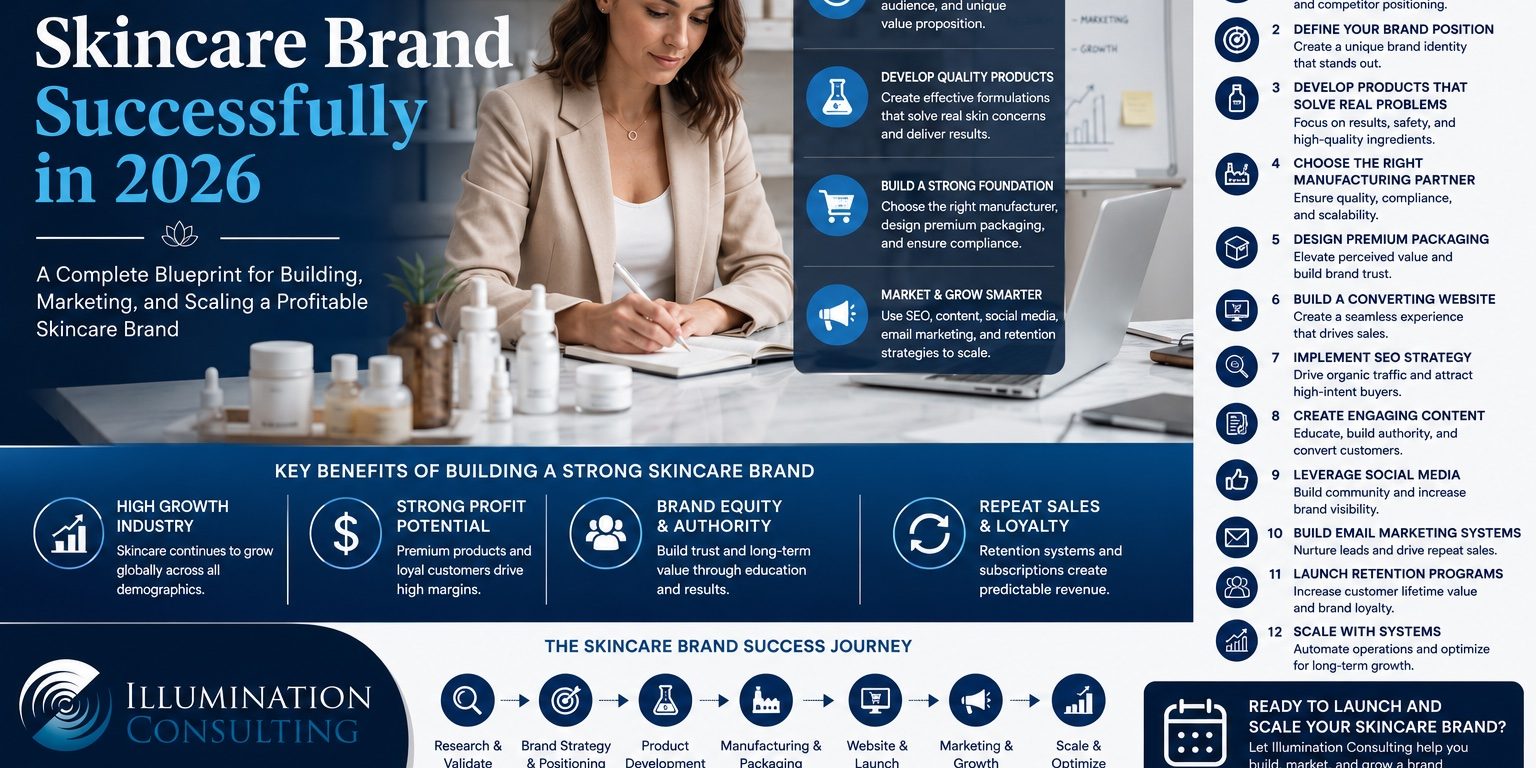
Understanding how to start a skincare brand successfully in 2026 involves much more than creating products. Successful brands combine market research, strategic positioning, quality products, effective marketing, and scalable operations.
Furthermore, brands that focus on customer outcomes often create stronger loyalty and retention. As trust grows, customer acquisition becomes easier and more efficient.
When branding, marketing, product development, and operational systems work together, businesses create sustainable competitive advantages. Consequently, they are better positioned to achieve long-term growth and profitability.
Key Takeaways
Key takeaways include:
- Start with market research
- Develop a clear brand position
- Create products that solve real problems
- Invest in SEO and content marketing
- Build customer retention systems
- Use multiple sales channels
- Avoid common startup mistakes
- Implement scalable growth systems
These strategies provide the strongest foundation for long-term success.
Q&A
| Question | Answer |
|---|---|
| Is 2026 a good time to start a skincare brand? | Yes. Consumer demand remains strong, although competition requires stronger positioning and marketing. |
| Should I choose private label or custom formulations? | Both approaches can work successfully depending on budget, timeline, and differentiation goals. |
| How important is SEO for skincare brands? | SEO is one of the most effective long-term channels for generating qualified traffic and sales. |
| What is the biggest mistake new skincare founders make? | Many founders launch products before validating market demand and building marketing systems. |
| How can skincare brands increase profitability? | Strong retention systems, SEO, email marketing, and customer loyalty programs often improve profitability significantly. |
How Illumination Consulting Helps Skincare Brands Grow
Illumination Consulting helps skincare brands launch, market, and scale through branding, website design, SEO, content marketing, e-commerce optimization, automation, and growth strategies designed to increase visibility, sales, customer retention, and long-term profitability.