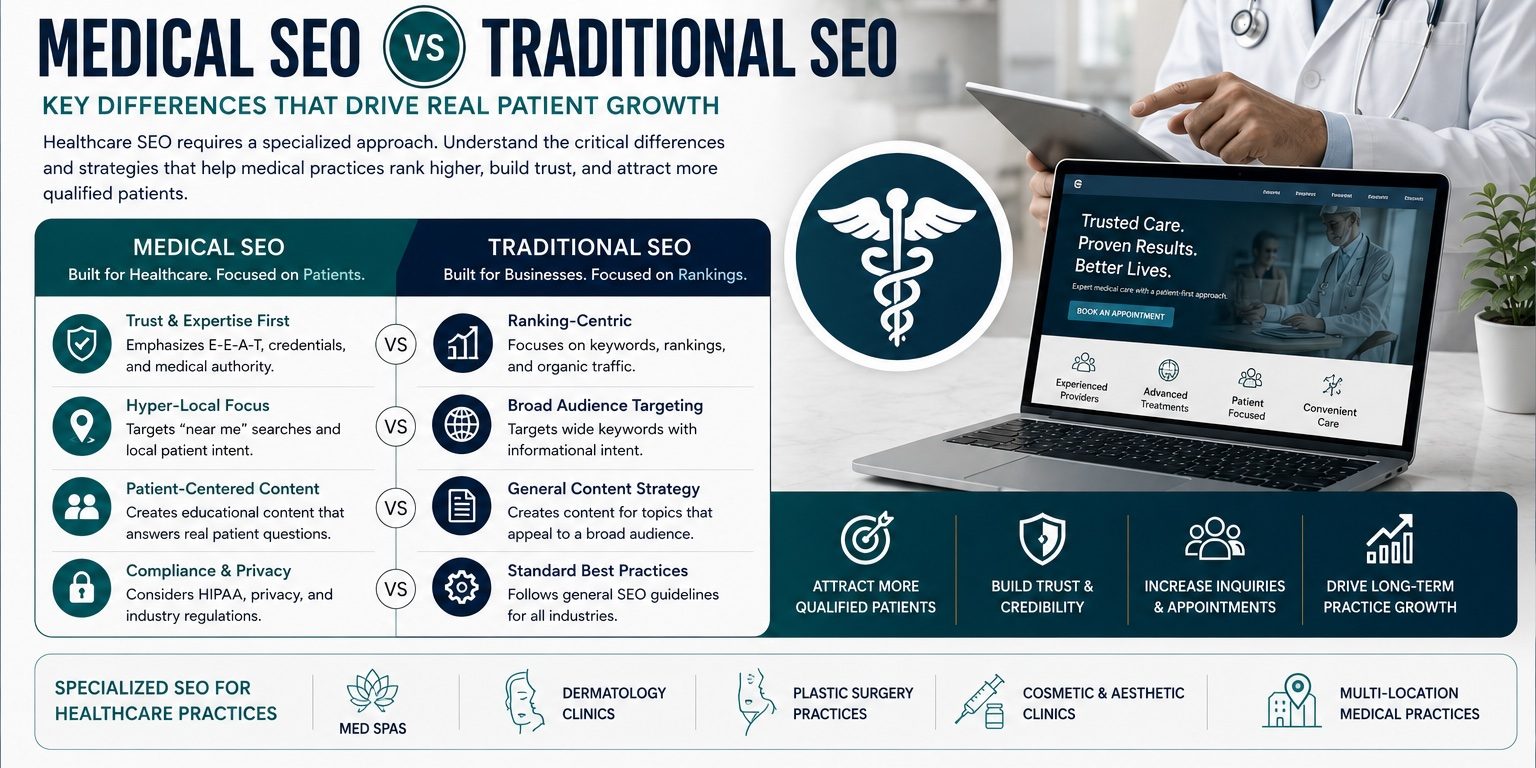
Every day, thousands of people turn to Google to search for healthcare providers, medical treatments, cosmetic procedures, and answers to important health questions. Whether someone is looking for a dermatologist to evaluate a suspicious mole, a plastic surgeon for a cosmetic procedure, or a med spa offering advanced skin rejuvenation treatments, their journey almost always begins with an online search. For healthcare organizations, this presents an incredible opportunity—but also a unique challenge. While many businesses can improve their visibility through standard search engine optimization strategies, healthcare practices operate in one of the most competitive and highly regulated industries online. Medical SEO vs traditional SEO. there is a difference. Search engines place significantly higher expectations on medical websites because inaccurate information can directly impact a person’s health, safety, and well-being.
This is where many healthcare organizations struggle. They invest in generic SEO campaigns that may work for restaurants, retail stores, law firms, or home service businesses, only to discover that the same tactics fail to generate meaningful patient growth. Ranking a medical website requires a different level of expertise, content quality, technical optimization, local search strategy, and trust-building than most other industries.
Medical SEO is designed specifically for healthcare providers. Rather than focusing solely on rankings and website traffic, it prioritizes patient trust, medical authority, compliance, local visibility, and high-quality educational content that aligns with Google’s increasingly sophisticated quality guidelines.
Understanding the difference between medical SEO and traditional SEO is essential for healthcare organizations that want to grow sustainably online. Whether you operate a dermatology clinic, plastic surgery practice, med spa, cosmetic surgery center, primary care office, dental practice, or multi-location healthcare organization, implementing an industry-specific SEO strategy can dramatically improve your ability to attract qualified patients while building long-term authority.
In this comprehensive guide, we’ll examine the key differences between medical SEO and traditional SEO, explain why healthcare websites require a specialized approach, and explore the strategies that help medical practices achieve stronger search visibility, increased patient inquiries, and sustainable business growth.
What Is Traditional SEO?
Traditional search engine optimization refers to the process of improving a website’s visibility within search engines such as Google and Bing. The primary objective is to increase organic traffic by helping webpages rank higher for relevant search queries.
Regardless of industry, traditional SEO typically focuses on three core pillars:
- Technical website optimization
- High-quality content creation
- Authority building through backlinks and online reputation
When these elements work together effectively, search engines gain confidence that a website deserves greater visibility for targeted keywords.
A traditional SEO campaign often includes activities such as:
- Comprehensive keyword research
- On-page optimization
- Meta title and description improvements
- Internal linking
- Content marketing
- Link building
- Technical SEO audits
- Website speed improvements
- Mobile optimization
- Conversion rate optimization
- User experience improvements
- Analytics reporting
For many industries, these strategies produce excellent results. An eCommerce retailer may focus on product category pages, a software company may publish educational resources, while a home services contractor might emphasize local service pages and customer reviews.
Although these businesses have different goals, the underlying SEO methodology remains largely consistent: create relevant content, optimize the website, earn authority, and provide a positive user experience.
Traditional SEO generally measures success using metrics such as:
- Organic website traffic
- Keyword rankings
- Backlink growth
- Click-through rates
- Time on site
- Lead generation
- Online sales
- Form submissions
- Revenue generated from organic search
These metrics remain valuable for healthcare organizations as well. However, healthcare providers face additional challenges that generic SEO strategies often fail to address.
Unlike many other industries, medical organizations must establish an exceptional level of credibility before Google is willing to reward them with strong rankings. A website discussing cosmetic procedures, dermatology treatments, prescription medications, or surgical options carries far greater responsibility than a website selling clothing or home décor. Search engines understand this distinction and evaluate healthcare websites using much stricter quality standards.
Traditional SEO provides an important foundation, but it is only the starting point. Healthcare organizations require a far more specialized strategy that accounts for patient safety, medical expertise, regulatory considerations, local intent, and Google’s emphasis on trustworthy health information.
That specialized strategy is known as medical SEO.
What Is Medical SEO?
Medical SEO is a specialized branch of search engine optimization designed specifically for healthcare organizations. While it incorporates many of the same technical and strategic principles as traditional SEO, it goes significantly further by addressing the unique challenges associated with medical information, patient trust, regulatory considerations, and Google’s higher quality standards for health-related content.
Healthcare organizations compete in an environment where trust is often the deciding factor. Before scheduling an appointment, patients want confidence that they are choosing a qualified provider who can safely address their medical concerns. As a result, every aspect of a healthcare website—from its content and technical performance to its online reputation and local visibility—contributes to both search engine rankings and patient decision-making.
Medical SEO focuses on improving a healthcare organization’s visibility for searches that are most likely to generate qualified patient inquiries, consultations, and appointments. Rather than simply increasing website traffic, the objective is to attract individuals who are actively searching for healthcare services and guide them through a trustworthy digital experience.
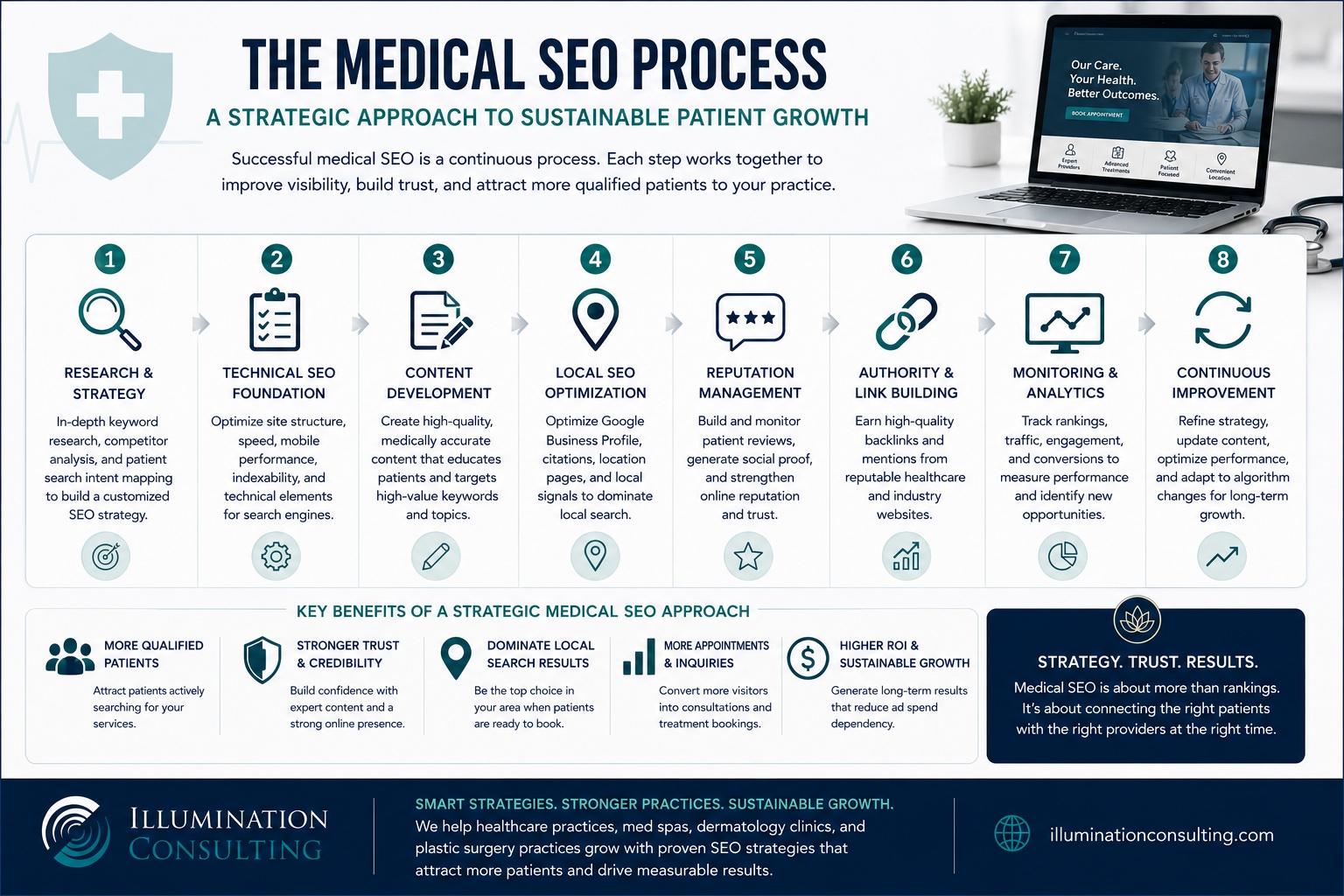
A comprehensive medical SEO strategy typically includes:
- Medical keyword research based on patient search behavior
- Optimization of service and treatment pages
- Educational blog content that answers common patient questions
- Local SEO for geographic searches
- Google Business Profile optimization
- Review and reputation management
- Technical website optimization
- Structured data implementation
- Internal linking between related services and educational resources
- High-quality backlink acquisition from authoritative sources
- Ongoing content updates to maintain medical accuracy
Successful medical SEO also recognizes that patients rarely search using complex medical terminology. Someone experiencing symptoms may search for “itchy rash treatment,” “Botox near me,” or “best dermatologist for acne” rather than the clinical terminology used within the medical profession.
Understanding patient language is essential when developing keyword strategies and educational content. By creating pages that answer real patient questions while maintaining medical accuracy, healthcare organizations can improve both search visibility and user engagement.
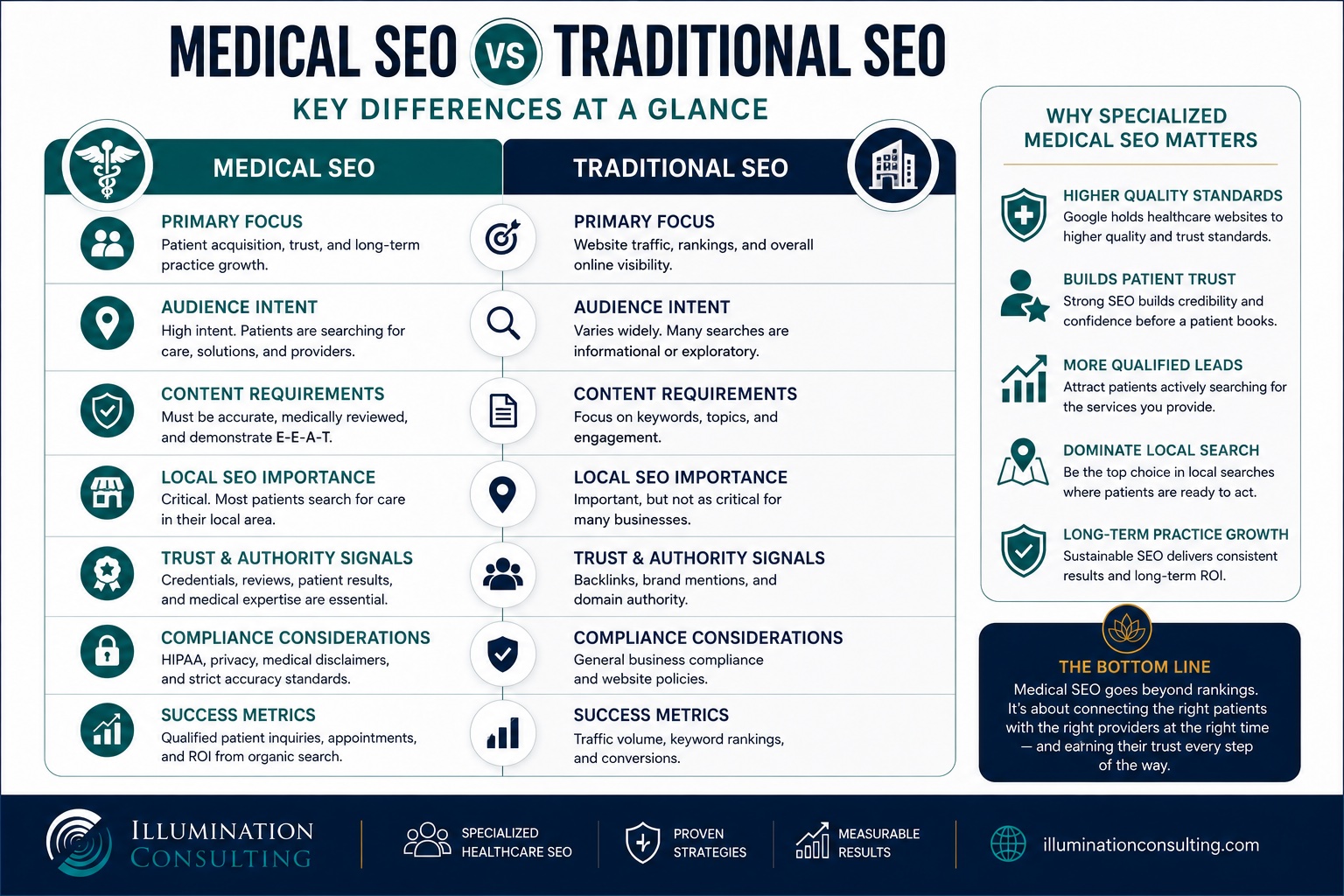
Unlike general business websites, healthcare websites often contain content related to diagnoses, treatments, medications, cosmetic procedures, surgical options, and preventive care. This places greater responsibility on website owners to ensure that information is accurate, current, professionally written, and aligned with accepted medical standards. Again, medical SEO vs traditional SEO, there is a difference.
Medical SEO therefore extends beyond technical optimization. It combines digital marketing expertise with a deep understanding of healthcare consumer behavior, search intent, content quality, local search, and Google’s evaluation of medically related information.
Why Healthcare SEO Requires a Different Strategy
Many business owners assume that SEO follows the same formula regardless of industry. While the foundational principles remain consistent, healthcare represents one of the most demanding categories in search engine optimization.
Google evaluates medical websites differently because health-related searches have the potential to influence important life decisions. Someone researching symptoms, selecting a surgeon, or comparing treatment options may make choices that directly affect their health and well-being. Because of this, search engines apply much stricter quality standards to healthcare content than they do to many other industries.
A generic SEO strategy may focus primarily on generating traffic, but healthcare SEO must balance visibility with credibility, authority, patient education, and trust.
Several factors make healthcare SEO uniquely challenging.
Patients Need Trust Before They Need Treatment
Healthcare decisions are highly personal. Patients are not simply purchasing a product—they are placing their health, appearance, or quality of life in the hands of a medical professional.
Before contacting a practice, prospective patients often evaluate:
- Physician credentials
- Years of experience
- Board certifications
- Patient testimonials
- Before-and-after galleries
- Awards and recognitions
- Hospital affiliations
- Professional memberships
- Online reviews
- Educational resources
A healthcare website must clearly communicate expertise and professionalism while making visitors feel confident in the quality of care they will receive.
Healthcare Searches Often Carry Higher Emotional Stakes
Someone searching for a new pair of shoes may compare prices and styles. Someone searching for a dermatologist after discovering an unusual skin lesion or researching reconstructive surgery is making a much more significant decision.
These users expect:
- Accurate information
- Compassionate communication
- Easy appointment scheduling
- Clear explanations of treatments
- Transparent provider information
- Secure online experiences
Healthcare SEO must therefore support the entire patient journey rather than focusing solely on keyword rankings.
Local Intent Is Stronger Than in Most Industries
Most healthcare providers serve patients within specific geographic regions. While some specialists attract patients nationally or internationally, the majority of searches include strong local intent.
Examples include:
- Dermatologist near me
- Best med spa in Portland
- Plastic surgeon in Los Angeles
- Botox clinic near me
- Cosmetic dermatologist in Seattle
This makes local SEO one of the most important components of a successful medical marketing strategy. Practices must optimize their website, business listings, reviews, maps presence, and location-specific pages to compete effectively within their service area.
Healthcare Competition Is Increasing
Over the past several years, healthcare organizations have significantly increased their investment in digital marketing. Independent practices now compete with:
- Large healthcare systems
- Hospital networks
- National medical brands
- Multi-location specialty groups
- Franchise medical clinics
- Private equity-backed organizations
- Well-funded cosmetic practices
These organizations often have dedicated marketing teams, substantial advertising budgets, and extensive content libraries.
A strategic medical SEO campaign helps independent practices compete by focusing on local authority, patient education, specialized expertise, and high-quality content that addresses the specific needs of their target audience.
Long-Term Authority Matters More Than Quick Wins
Some industries can achieve rapid improvements through aggressive SEO tactics. Healthcare websites benefit far more from consistent, long-term authority building.
Google rewards practices that continually publish accurate, helpful content, maintain technically sound websites, earn positive patient reviews, and demonstrate genuine expertise over time.
Rather than chasing short-term ranking gains, successful medical SEO emphasizes sustainable growth. Every optimized service page, educational article, local citation, patient review, and technical improvement contributes to building a stronger online presence that continues generating qualified patient inquiries for years to come.
This long-term approach not only improves search visibility but also strengthens a healthcare organization’s reputation, patient confidence, and competitive position within its local market.
Google’s Higher Standards for Healthcare Websites
Healthcare websites operate under some of the highest quality standards in Google’s search ecosystem. Unlike websites that sell products or provide entertainment, medical websites have the potential to influence decisions that directly affect a person’s health, financial well-being, and quality of life. Because of this, Google evaluates healthcare content with considerably greater scrutiny.
Understanding these standards is essential for any healthcare organization that wants to improve its organic visibility.
Many medical practices invest heavily in website design and traditional SEO tactics yet fail to achieve sustainable rankings because they overlook the quality signals Google expects from healthcare websites. Simply publishing service pages and blog articles is no longer enough. Search engines want evidence that medical information comes from trustworthy, qualified, and authoritative sources.
Understanding YMYL Content
Google classifies healthcare information as Your Money or Your Life (YMYL) content.
YMYL pages include information that could significantly affect a person’s:
- Health
- Safety
- Financial stability
- Overall well-being
Examples include:
- Medical treatments
- Surgical procedures
- Prescription medications
- Cosmetic procedures
- Dermatology advice
- Mental health information
- Nutrition guidance
- Disease prevention
- Diagnostic information
Because inaccurate medical information can have serious consequences, Google applies stricter quality evaluations to healthcare websites than it does for many other industries.
This means healthcare organizations must demonstrate significantly higher levels of expertise, transparency, and credibility throughout their websites.
The Importance of E-E-A-T
One of the most influential concepts in modern healthcare SEO is Google’s E-E-A-T framework:
- Experience
- Expertise
- Authoritativeness
- Trustworthiness
Although E-E-A-T is not a direct ranking factor, it represents many of the quality signals Google’s systems use to evaluate websites.
For healthcare organizations, these principles are particularly important.
Experience
Google values content created by individuals or organizations with genuine, real-world experience.
For healthcare practices, this may include:
- Years of clinical experience
- Patient care experience
- Case studies
- Before-and-after treatment examples
- Educational resources based on actual practice experience
Patients are far more likely to trust providers who demonstrate practical experience rather than simply repeating generic medical information.
Expertise
Healthcare content should reflect genuine medical knowledge.
Expertise can be demonstrated through:
- Board-certified physicians
- Licensed medical professionals
- Medical editors
- Evidence-based information
- Accurate explanations of conditions and treatments
- Regular content reviews and updates
Medical expertise reassures both search engines and prospective patients that the information provided is reliable and professionally developed.
Authoritativeness
Authority develops over time as a healthcare organization becomes recognized within its specialty.
Indicators of authority include:
- High-quality educational content
- Professional memberships
- Medical awards
- Conference participation
- Research publications
- Industry recognition
- High-quality backlinks
- Mentions from reputable healthcare organizations
Authority is not built overnight. It grows through consistent publication of valuable content and a strong professional reputation.
Trustworthiness
Trust is arguably the most important element of healthcare SEO.
Patients want confidence that they are receiving accurate information from legitimate providers.
Healthcare websites should clearly communicate:
- Practice contact information
- Provider biographies
- Professional credentials
- Privacy policies
- Secure HTTPS connections
- Transparent pricing when appropriate
- Authentic patient testimonials
- Clear appointment scheduling options
These trust signals help reduce uncertainty while encouraging visitors to take the next step toward becoming patients.
Demonstrating Medical Expertise Online
Medical expertise extends well beyond listing physician credentials on an About page.
Every page of a healthcare website should reinforce credibility through thoughtful design, accurate information, and transparent communication.
Examples include:
- Comprehensive provider biographies
- Individual physician profile pages
- Board certifications
- Educational background
- Medical associations
- Continuing education
- Published research
- Community involvement
- Media appearances
- Professional awards
These elements help differentiate healthcare organizations from competitors while strengthening patient confidence.
Educational content also plays a major role.
Rather than publishing thin articles designed only to rank for keywords, successful healthcare organizations create comprehensive resources that answer real patient questions.
Examples include:
- Treatment comparisons
- Recovery timelines
- Procedure expectations
- Frequently asked questions
- Risk factors
- Benefits and limitations
- Patient preparation guides
- Preventive care recommendations
Content that genuinely helps patients understand their healthcare options is more likely to earn backlinks, generate engagement, and establish long-term authority.
Accuracy Matters More Than Volume
One of the biggest misconceptions in content marketing is that publishing more articles automatically improves rankings.
For healthcare websites, quality almost always outweighs quantity.
An outdated article containing inaccurate information can damage both patient trust and search visibility.
Medical practices should regularly review existing content to ensure:
- Medical recommendations remain current.
- Statistics are updated.
- Provider information is accurate.
- Treatment options reflect current standards of care.
- Internal links remain functional.
- External references point to reputable sources.
Content maintenance should be considered an ongoing component of every healthcare SEO strategy rather than a one-time project.
Building Trust Through Transparency
Transparency is another distinguishing factor between successful medical SEO campaigns and generic optimization strategies.
Patients want to know exactly who they are trusting with their care.
Healthcare websites should clearly identify:
- Physicians
- Nurse practitioners
- Physician assistants
- Clinical specialties
- Office locations
- Contact information
- Accepted insurance plans where applicable
- Office hours
- Scheduling methods
Additional trust signals include:
- Patient success stories
- Verified online reviews
- Before-and-after treatment galleries
- Professional photography
- Secure patient communication
- HIPAA-conscious contact forms
- Clear calls to action
When these elements work together, visitors develop confidence in both the healthcare organization and its online presence.
Why Generic SEO Often Falls Short
Many general marketing agencies apply identical SEO strategies across every industry they serve. While this approach may produce acceptable results for retail businesses or service companies, healthcare requires considerably greater attention to detail.
Medical practices need content strategies that prioritize accuracy over volume, authority over shortcuts, and patient trust over simple keyword rankings.
Healthcare SEO succeeds when technical optimization, educational content, local visibility, reputation management, and medical credibility work together as a unified strategy.
Organizations that invest in this comprehensive approach position themselves to achieve stronger rankings, attract higher-quality patient inquiries, and build sustainable online authority that continues delivering value long after individual marketing campaigns have ended. Talk to an expert about medical SEO vs traditional SEO and get a consultation. Give us a call and speak to an aesthetic growth specialist at Illumination Consulting.