A first purchase can make a marketing campaign look successful. It does not necessarily make the customer profitable.That distinction matters enormously in skin care. Brands invest in skin care marketing campaigns, paid advertising, influencers, search engine optimization, social media, sampling, promotions, content, public relations, and retail distribution to acquire customers. Yet the financial return from those investments may unfold over months or years rather than during the initial transaction. This is why skin care customer lifetime value should become one of the central metrics behind sustainable brand growth.
Consider two customers.
The first spends $85 after clicking a paid advertisement and never purchases again.
The second places the same $85 initial order, replenishes two products three months later, adds a serum to the next purchase, joins the loyalty program, and remains a customer for several years.
Their first transactions look identical.
Their economic value to the brand is completely different.
Skin care companies have an unusual advantage because many products are naturally replenishable. Cleansers, moisturizers, serums, sunscreens, treatments, and other products are consumed and eventually need replacement.
The strategic objective is therefore not simply convincing someone to purchase once.
It is building a customer relationship that continues because the products deliver value, the experience earns trust, and the brand remains relevant to the customer’s evolving needs.
Revenue Is Not the Same as Customer Value
Marketing dashboards frequently emphasize immediate revenue.
That is understandable. Companies need sales.
However, first-order revenue provides only a partial view of customer economics.
A more useful framework considers:
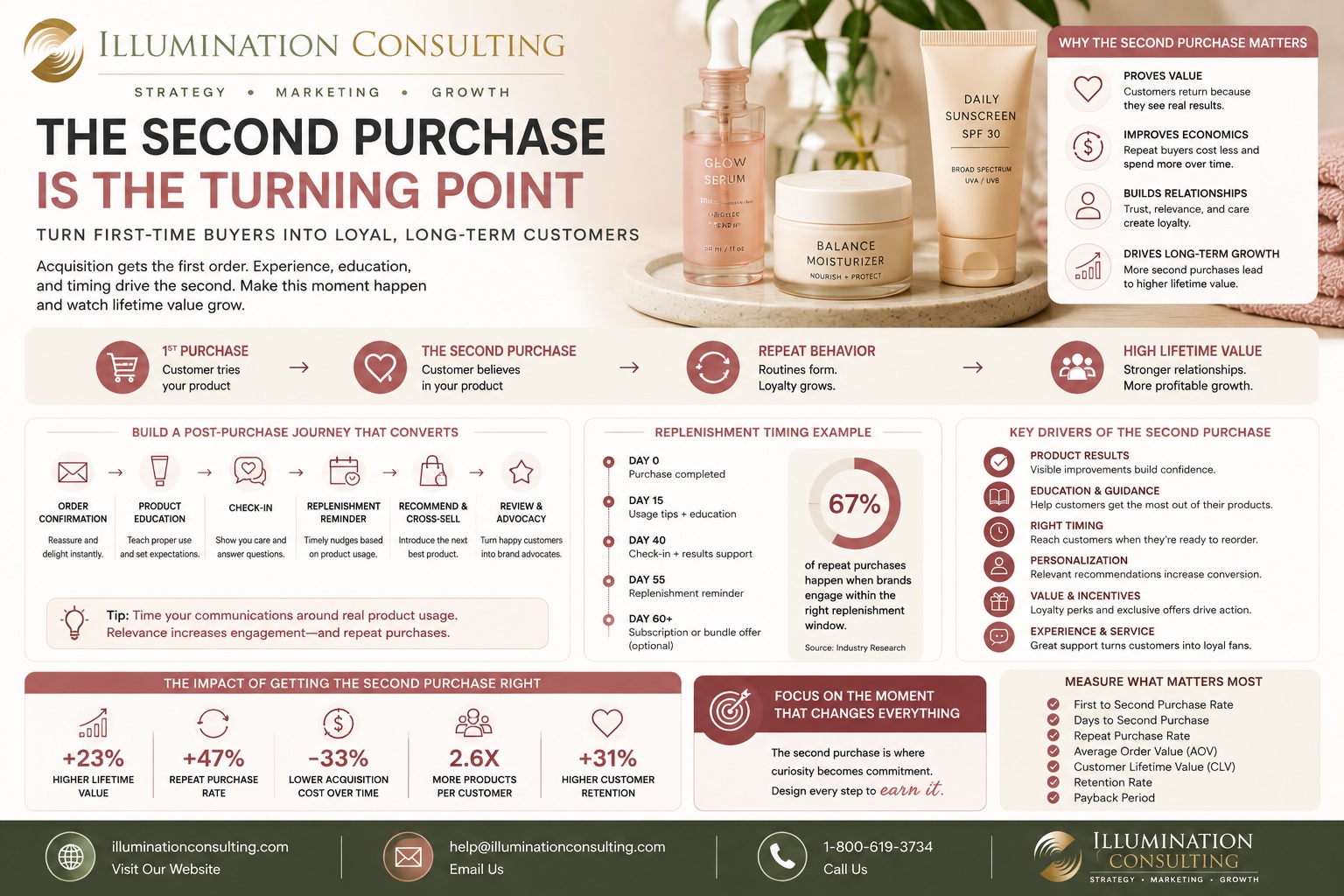
Acquisition → First Purchase → Repeat Purchase → Purchase Frequency → Retention → Lifetime Value
Each stage influences how much the brand can afford to spend acquiring customers.
If most customers disappear after one order, acquisition needs to become profitable very quickly.
If customers purchase repeatedly for several years, the brand can potentially tolerate a higher initial acquisition cost because additional profit arrives later.
This changes marketing strategy substantially.
Understand the Basic Lifetime Value Equation
Customer lifetime value can be calculated in several ways depending on the sophistication of the business.
A simplified model is:
Average Order Value × Purchase Frequency × Customer Lifespan = Customer Lifetime Revenue
Suppose the average customer spends $90 per order, purchases four times annually, and remains active for three years.
$90 × 4 × 3 = $1,080 in lifetime revenue
But revenue is not profit.
A more meaningful analysis also considers:
- Cost of goods
- Discounts
- Fulfillment
- Shipping subsidies
- Returns
- Payment processing
- Customer service
- Acquisition cost
A customer generating $1,080 in lifetime revenue may create significantly less contribution profit.
Brands should therefore avoid using inflated lifetime revenue numbers to justify unsustainable acquisition spending.
Start With Customer Acquisition Quality
Not every acquired customer is equally valuable.
Two marketing channels may generate the same number of first-time purchasers while producing very different long-term economics.
For example, customers acquired through a deep-discount campaign may purchase once and disappear.
Customers acquired through educational search content may arrive with a stronger understanding of the products and become repeat purchasers.
Brands should therefore measure customer acquisition beyond initial cost.
Useful questions include:
- Which channels produce the highest repeat purchase rates?
- Which channels generate the strongest average order values?
- Which customers buy at full price?
- Which acquisition sources produce the fewest returns?
- Which customers purchase across multiple categories?
- Which channels generate the highest lifetime value?
The cheapest customer is not necessarily the best customer.
Compare CAC With Customer Lifetime Value
Customer acquisition cost, or CAC, tells the company how much it spends to acquire a new customer.
If a campaign costs $20,000 and generates 400 new customers:
$20,000 ÷ 400 = $50 CAC
Whether $50 is attractive depends on what happens next.
If the average customer produces only $25 of contribution profit before disappearing, the economics are unsustainable.
If that customer produces $250 of contribution profit over several years, the acquisition cost may be highly attractive.
This is why CAC and lifetime value should be analyzed together.
First-Order Profitability Still Matters
Lifetime value should not become an excuse for reckless acquisition spending.
Forecasts can be wrong.
Retention can deteriorate.
Products can change.
Customers can behave differently from historical cohorts.
A company that loses substantial money on every first order while assuming customers will eventually become profitable creates significant cash-flow risk.
Skin care brands should understand:
- First-order revenue
- First-order gross margin
- Acquisition cost
- Fulfillment cost
- Discounts
- First-order contribution margin
Then they can determine how much future purchasing is required before the customer becomes profitable.
Calculate the Customer Payback Period
The payback period measures how long it takes to recover the cost of acquiring a customer.
Suppose a company spends $60 to acquire a customer but generates only $30 in contribution profit from the initial purchase.
The remaining $30 needs to be recovered through future purchases.
If the customer makes another profitable purchase 90 days later, the payback period may be reasonable.
If recovery takes two years, the company may require substantial working capital to continue scaling.
Fast-growing brands can experience severe cash pressure when acquisition spending occurs today while profitability arrives much later.
Customer lifetime value therefore needs to be evaluated alongside cash flow.
Improve the First Purchase Without Sacrificing Margin
The first transaction creates the foundation for lifetime value.
Skin care brands naturally want to reduce friction and encourage trial, but aggressive first-order discounts can create unintended consequences.
A large introductory discount may increase conversion while attracting customers who are primarily motivated by price. Those customers may become difficult to retain once products return to full price.
Brands can instead test acquisition offers such as:
- Product discovery sets
- Trial sizes
- Starter routines
- Gifts with purchase
- Free shipping thresholds
- Product bundles
- Samples
- Loyalty enrollment incentives
The objective is to make the first purchase compelling without teaching customers that the brand’s normal price is negotiable.
Use Starter Products Strategically
Some products naturally function as customer acquisition products.
A cleanser, moisturizer, sunscreen, or introductory set may have broader appeal than a specialized treatment.
Brands should identify which products most frequently appear in successful first orders and analyze what happens afterward.
Questions to examine include:
- Which first product produces the highest repeat rate?
- Which products lead customers into additional categories?
- Which introductory products produce the highest lifetime value?
- Which products generate high returns or dissatisfaction?
- Which products create the fastest second purchase?
This analysis can improve advertising, merchandising, sampling, and product-development decisions.
Make the Second Purchase a Strategic Priority
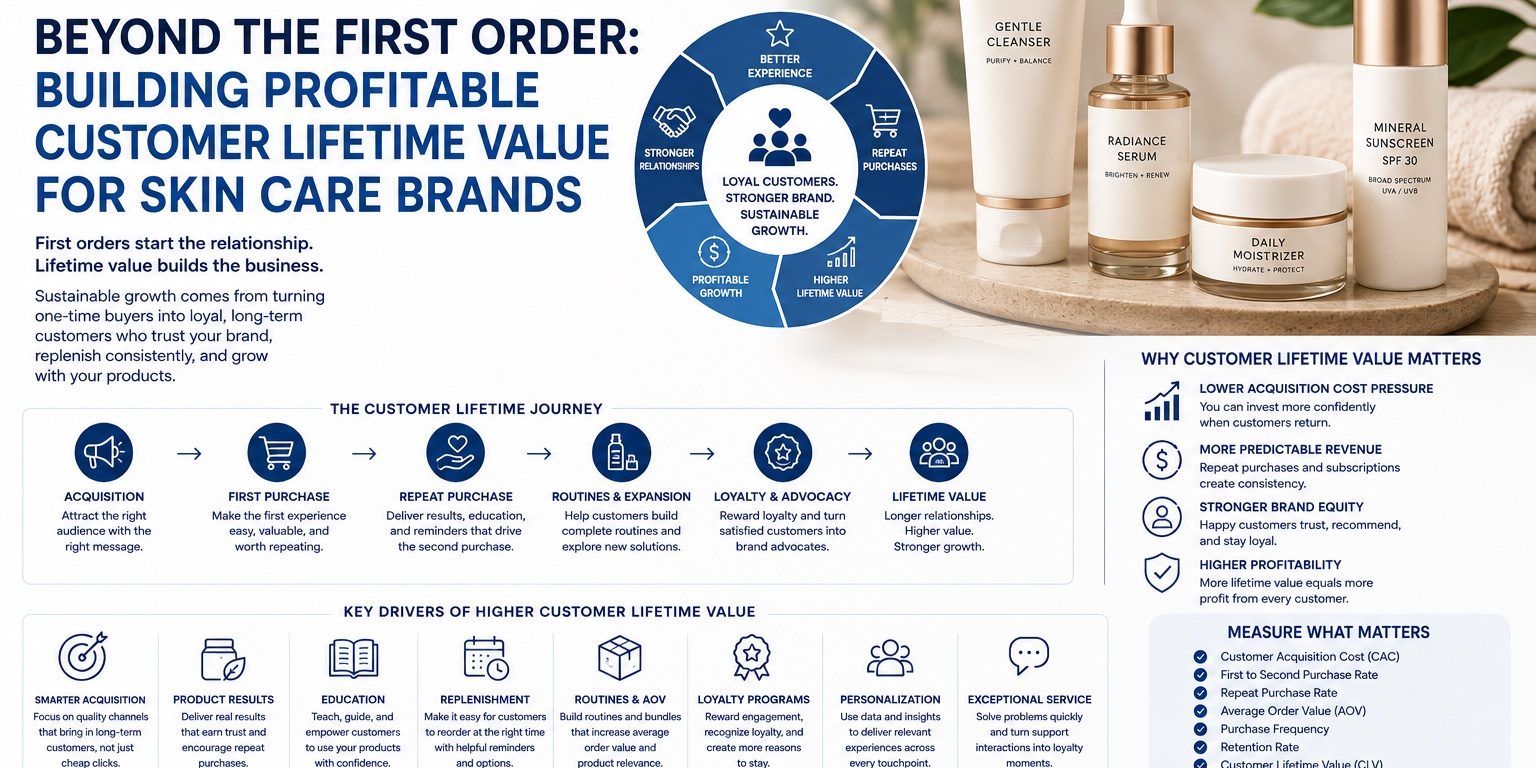
The transition from first purchase to second purchase is one of the most important moments in the customer lifecycle.
A second purchase provides evidence that the customer relationship may be developing beyond initial curiosity.
Brands should therefore measure:
First Purchase → Second Purchase Conversion Rate
They should also measure the average number of days between those purchases.
If a product normally lasts 60 days, communication can be structured around that expected replenishment window.
The company does not need to guess when customers might need more product.
Purchase history can guide the timing.
Build a Post-Purchase Journey
The period immediately following a purchase should not become a marketing silence.
A thoughtful post-purchase sequence can include:
Order Confirmation → Product Education → Usage Guidance → Check-In → Review Request → Replenishment → Related Product Recommendation
Each communication should have a purpose.
For example, educational content can help customers use products correctly. This may improve satisfaction and reduce the likelihood that someone abandons a product because they misunderstood how it should be incorporated into a routine.
Later communications can introduce complementary products or remind customers when replenishment is likely.
Product Results Drive Retention
Marketing can encourage repeat purchasing.
It cannot indefinitely compensate for disappointing products.
For skin care brands, retention ultimately depends heavily on whether customers believe the products provide sufficient value to continue using them.
This includes:
- Product performance
- Sensory experience
- Packaging
- Ease of use
- Perceived value
- Compatibility with routines
- Customer expectations
Brands should analyze repeat purchasing alongside product reviews, customer service inquiries, returns, and feedback.
If a particular product consistently generates weak retention, increasing replenishment emails may not solve the underlying problem.
The product itself may require attention.
Set Appropriate Customer Expectations
Skin care marketing can create significant expectations.
If advertising implies dramatic results that the typical customer does not experience, the initial conversion rate may improve while long-term retention suffers.
Sustainable customer relationships depend on trust.
Brands should communicate clearly:
- What the product is designed to do
- How it should be used
- How frequently it should be used
- Where it belongs within a routine
- What customers can reasonably expect
- How long certain results may take
Accurate education can improve both customer satisfaction and brand credibility.
The objective is not simply closing today’s transaction.
It is creating a customer who remains confident in the brand tomorrow.
Build Routines Instead of Selling Isolated Products
One of the strongest structural opportunities in skin care is that products often work within routines.
A customer purchasing a single product may eventually have legitimate needs across several categories.
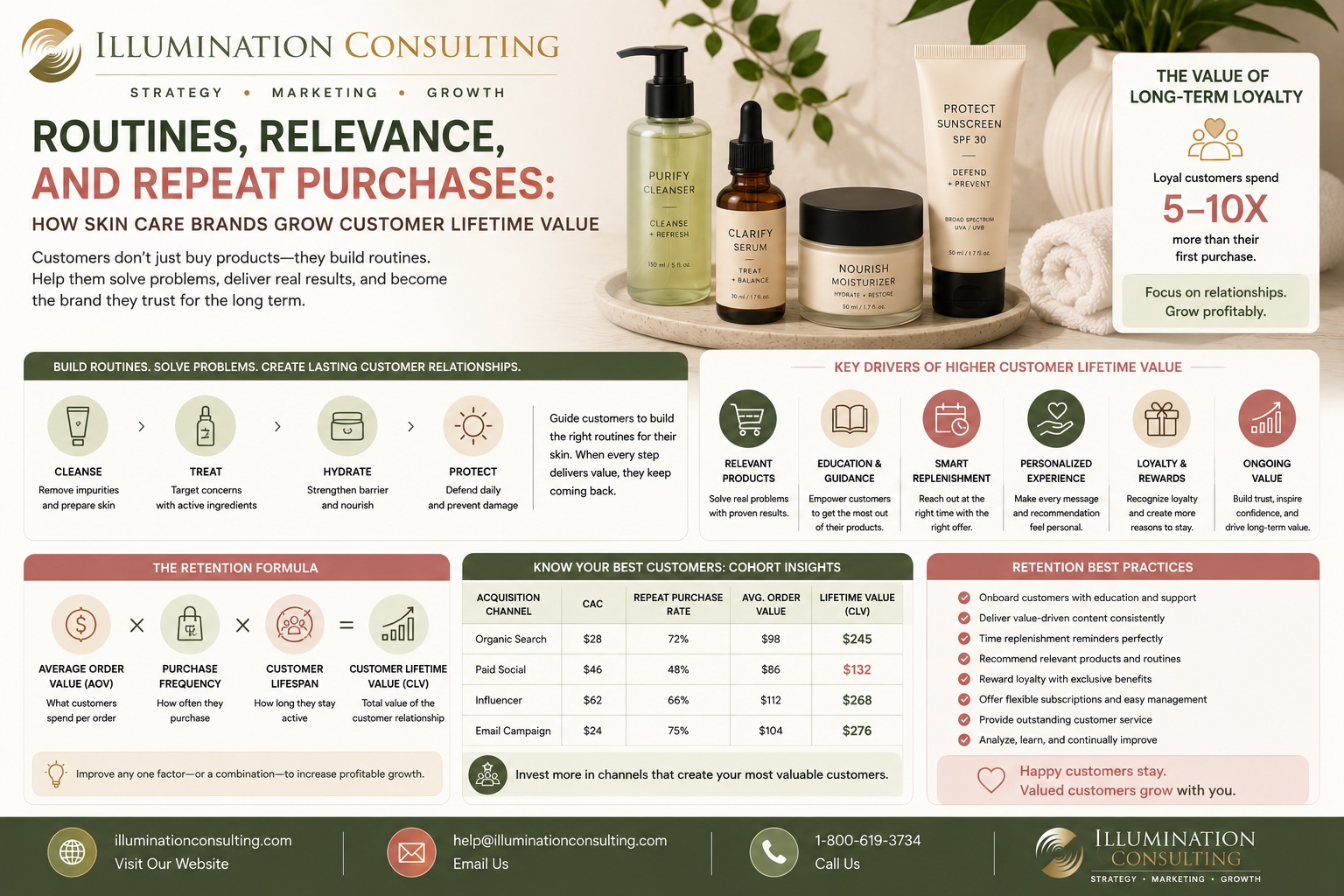
A basic routine might include:
Cleanse → Treat → Moisturize → Protect
More specialized routines can vary according to skin type, concerns, age, lifestyle, climate, and professional recommendations.
Helping customers construct appropriate routines can increase:
- Average order value
- Cross-category purchasing
- Product understanding
- Repeat purchasing
- Customer lifetime value
The important distinction is relevance.
Routine building should help customers solve problems rather than simply encourage them to purchase as many products as possible.
Use Product Education to Create Natural Cross-Selling
Cross-selling works best when customers understand why products belong together.
For example, a brand can explain:
- Which products complement one another
- Which products should be used morning versus evening
- How products should be layered
- Which combinations address specific concerns
- When a product should be introduced
Educational merchandising is generally more persuasive than simply displaying “You may also like” recommendations.
It turns cross-selling into guidance.
Increase Average Order Value Carefully
Average order value influences skin care customer lifetime value because larger transactions can improve customer economics.
Brands can increase AOV through:
- Product bundles
- Routine sets
- Free-shipping thresholds
- Complementary recommendations
- Premium sizes
- Gift sets
- Subscribe-and-save options
However, higher order value should not come at the expense of customer satisfaction.
A customer persuaded to buy five products they do not need may generate a larger first transaction but lower trust and retention.
The better objective is increasing the value of the relationship for both the customer and the company.
Use Replenishment as a Natural Retention Engine
Consumable products give skin care brands a built-in reason to reconnect with customers.
If a moisturizer typically lasts 60 days, the company can estimate when replenishment may become relevant.
This creates opportunities for:
- Email reminders
- SMS reminders
- Personalized recommendations
- Subscription offers
- Loyalty rewards
- Product bundles
Timing matters.
A replenishment message sent too early feels irrelevant.
A message sent too late may arrive after the customer has already purchased a competing product.
Brands should use actual purchase behavior to refine replenishment timing.
Measure Replenishment by Product
Different products have different consumption cycles.
A cleanser may last longer than a serum. A sunscreen may be consumed more quickly during summer. A treatment may be used only several times per week.
Brands should analyze reorder intervals by SKU rather than applying one generic schedule to every product.
This creates more relevant automation and better forecasting.
Decide Where Subscriptions Actually Make Sense
Subscriptions can create predictable recurring revenue, but not every skin care product or customer is suited to them.
Subscriptions work best when:
- Products are replenished predictably
- Usage frequency is relatively consistent
- Customers already demonstrate repeat behavior
- Managing the subscription is easy
- The value proposition is clear
Potential benefits include:
- Recurring revenue
- Higher retention
- Predictable demand
- Easier replenishment
- Stronger customer relationships
However, poorly designed programs can create cancellations, customer service problems, unwanted shipments, and frustration.
Make Subscription Flexibility Part of the Experience
Customers should be able to:
- Skip shipments
- Change frequency
- Swap products
- Pause
- Update quantities
- Cancel easily
Making cancellation intentionally difficult may reduce reported churn temporarily while damaging trust.
The objective is not trapping customers in subscriptions.
It is making continued purchasing sufficiently convenient and valuable that they choose to remain.
Build Loyalty Programs Around More Than Points
Loyalty programs can support retention, but points alone rarely create genuine loyalty.
Strong programs can combine economic incentives with recognition and access.
Potential benefits include:
- Points
- Member pricing
- Early product access
- Exclusive products
- Birthday benefits
- Samples
- Events
- Personalized recommendations
- Educational content
- VIP service
The program should reinforce the brand’s positioning.
A premium clinical skin care company may design loyalty very differently from a mass-market beauty brand.
The goal is to make the relationship increasingly valuable as customers remain with the company.
Segment Customers by Behavior
Sending identical communications to every customer wastes much of the value contained in customer data.
A first-time purchaser should not necessarily receive the same message as someone who has placed 15 orders.
Useful segments can include:
- First-time customers
- Second-time customers
- Repeat customers
- VIP customers
- Subscribers
- Lapsed customers
- Discount-driven customers
- Category-specific customers
- High-AOV customers
- High-lifetime-value customers
Each segment presents different opportunities.
First-time customers may need education.
Lapsed customers may need reactivation.
VIP customers may value recognition and early access more than another generic discount.
Segmentation makes retention marketing more relevant.
Use Email as a Retention System
Email remains one of the most valuable direct channels for skin care brands because it allows companies to communicate with customers throughout the lifecycle.
Effective email programs extend far beyond promotional newsletters.
Automated flows can include:
- Welcome sequences
- Post-purchase education
- Product usage guidance
- Replenishment reminders
- Review requests
- Cross-selling
- Subscription invitations
- Loyalty milestones
- Win-back campaigns
- Product launches
The strongest email programs respond to customer behavior rather than simply broadcasting the same promotion to everyone.
A customer who purchased a cleanser yesterday requires a different message from a loyal customer whose last purchase occurred nine months ago.
Balance Education and Promotion
Skin care provides substantial opportunities for educational communication.
Brands can teach customers about:
- Ingredients
- Skin concerns
- Product application
- Routine building
- Seasonal changes
- Product combinations
- New formulations
Educational content gives the company reasons to communicate without continuously discounting products.
This helps maintain engagement while reinforcing expertise and brand credibility.
Use SMS Selectively
SMS can produce strong engagement because messages reach customers directly.
That access should be treated carefully.
Useful SMS applications include:
- Replenishment reminders
- Back-in-stock alerts
- Product launches
- Time-sensitive promotions
- Loyalty notifications
- Subscription reminders
Sending too frequently can quickly become intrusive.
Brands should reserve SMS for communications where immediacy provides genuine value.
Personalize Based on Customer Behavior
Personalization should extend beyond inserting a customer’s first name into an email.
Useful personalization can reflect:
- Previous purchases
- Skin concerns
- Product categories
- Replenishment timing
- Browsing behavior
- Loyalty status
- Purchase frequency
- Geographic or seasonal factors
For example, a customer who repeatedly purchases products designed for dry skin should not continuously receive recommendations dominated by unrelated oily-skin solutions.
The more relevant the experience becomes, the easier it is for customers to navigate the brand.
Avoid Personalization That Feels Excessive
Brands should also respect the boundary between helpful personalization and uncomfortable surveillance.
Customers generally appreciate recommendations that logically follow from information they knowingly provided or purchases they made.
Personalization should improve convenience and relevance without making customers question how much information the company has collected.
Trust remains part of lifetime value.
Recover Customers Before They Become Completely Inactive
Customer churn is not always obvious.
Unlike subscription businesses, ecommerce brands may not receive a cancellation notice when a customer leaves.
The customer simply stops purchasing.
Brands should identify typical reorder patterns and establish definitions for declining engagement.
For example:
- Active customer
- At-risk customer
- Lapsed customer
- Inactive customer
The appropriate timeframes depend on normal product consumption.
A customer who has not reordered after 120 days may be highly unusual for one product and completely normal for another.
Build Win-Back Campaigns Around Relevance
Win-back campaigns can remind former customers why they purchased originally.
Messages can include:
- Replenishment reminders
- New product recommendations
- Product improvements
- Educational content
- Loyalty benefits
- Personalized offers
Discounts may sometimes be appropriate, but they should not automatically become the first response to inactivity.
The company should first consider why the customer may have stopped purchasing.
Learn From Customer Churn
Lost customers provide useful information.
Brands can analyze:
- Product reviews
- Returns
- Customer service interactions
- Subscription cancellations
- Surveys
- Purchase history
- Reorder behavior
Patterns may reveal problems with:
- Product performance
- Pricing
- Packaging
- Shipping
- Customer service
- Product availability
- Competitor alternatives
- Communication frequency
Reducing churn can sometimes produce greater financial returns than acquiring more customers.
A company should understand why customers leave before assuming the solution is another acquisition campaign.
Measure Retention by Customer Cohort
Overall retention metrics can hide important differences.
Cohort analysis groups customers based on when or how they were acquired and tracks their behavior over time.
A brand might compare customers acquired:
- During different months
- Through different advertising platforms
- Through influencers
- Through organic search
- During promotions
- Through retail sampling
- Through referrals
This can reveal significant differences in customer quality.
For example, one acquisition campaign may generate a large number of first purchases but poor six-month retention.
Another may produce fewer customers initially but significantly stronger repeat purchasing.
Without cohort analysis, the first campaign may incorrectly appear superior.
Measure Lifetime Value by Acquisition Channel
Channel-level lifetime value can materially change marketing investment decisions.
Imagine the following:
Paid Social Customer
- CAC: $45
- Lifetime contribution profit: $130
Organic Search Customer
- CAC allocation: $30
- Lifetime contribution profit: $220
Influencer Customer
- CAC: $65
- Lifetime contribution profit: $310
Looking only at acquisition cost would make the influencer channel appear least efficient.
Looking at lifetime economics tells a different story.
Brands should increasingly ask:
Which channels create our best customers?
Not simply:
Which channels create the cheapest first orders?
Measure Lifetime Value by First Product Purchased
The first product can also predict future customer behavior.
Brands should determine whether customers beginning with certain products demonstrate:
- Higher repeat purchase rates
- Greater cross-category purchasing
- Higher average order values
- Faster second purchases
- Longer retention
A hero product may be valuable not simply because it sells well but because it introduces customers who later develop much broader relationships with the brand.
This information can influence:
- Advertising
- Sampling
- Website merchandising
- Retail strategy
- Product development
- Bundling
Customer lifetime value can therefore become a merchandising metric as well as a marketing metric.
Understand the Relationship Between Returns and Lifetime Value
Returns and refunds reduce immediate profitability, but they can also reveal customer experience problems that affect retention.
Brands should monitor return reasons such as:
- Product dissatisfaction
- Skin reactions
- Packaging damage
- Incorrect expectations
- Shipping problems
- Accidental purchases
High return rates associated with a particular campaign or product may indicate that marketing is attracting the wrong customers or creating unrealistic expectations.
Reducing preventable returns can improve both contribution margin and customer satisfaction.
Protect Margin While Increasing Lifetime Value
Lifetime value should not be increased through revenue alone.
A customer who repeatedly purchases only during 40% discount events may generate substantial lifetime revenue but relatively weak lifetime profit.
Brands should monitor:
- Full-price purchasing
- Discount frequency
- Gross margin
- Promotional dependency
- Shipping subsidies
- Loyalty costs
- Subscription discounts
The objective is profitable customer longevity.
A smaller group of loyal, full-price customers may be economically more valuable than a much larger group that purchases only during aggressive promotions.
Use Customer Service as a Retention Channel
Customer service is often treated as a cost center.
For skin care companies, it can also become a retention mechanism.
Customers may need assistance with:
- Product selection
- Application
- Routines
- Orders
- Returns
- Subscriptions
- Product compatibility
Helpful support can rescue relationships that might otherwise end.
It can also generate valuable insights into recurring customer confusion.
If hundreds of customers ask the same question, the problem may not be the customers.
The website, packaging, instructions, or marketing may need improvement.
Turn Customer Questions Into Better Marketing
Common customer questions can inform:
- Product pages
- FAQs
- Email content
- Videos
- Social media
- Product inserts
- Advertising
- Educational articles
This reduces future friction while improving the customer experience.
Customer service data should therefore flow back into marketing and merchandising rather than remaining isolated within a support department.
Create Referral and Advocacy Opportunities
Highly satisfied customers can generate additional value beyond their own purchases.
They can introduce other customers.
Referral programs can encourage advocacy through:
- Referral credits
- Loyalty rewards
- Gifts
- Exclusive benefits
- Early access
However, genuine advocacy begins with customer satisfaction.
No referral incentive can sustainably compensate for a product or experience customers would not naturally recommend.
Brands should first create something worth discussing.
Use Community to Deepen the Relationship
Some skin care brands can extend customer relationships beyond transactions by building communities around education, routines, wellness, ingredients, or shared values.
Community can exist through:
- Social media
- Private groups
- Events
- Livestreams
- Educational programs
- Loyalty communities
- Professional partnerships
This can increase brand engagement even during periods when customers are not actively purchasing.
The strongest communities create genuine value rather than functioning as continuous promotional channels.
Connect Retail Customers to the Brand Relationship
Lifetime value becomes more difficult to measure when customers purchase through retailers.
The brand may not own the transaction data.
However, retail customers can still become part of the broader brand ecosystem.
Companies can encourage voluntary relationships through:
- Social media
- Email subscriptions
- Loyalty programs
- QR codes
- Product education
- Samples
- Events
- Product registration
- Communities
The objective is not taking customers away from retail partners.
It is strengthening the consumer’s relationship with the brand regardless of where future purchases occur.
Use AI to Improve Retention Decisions
Artificial intelligence can help skin care brands analyze increasingly complex customer data.
Potential applications include:
- Churn prediction
- Customer segmentation
- Replenishment prediction
- Product recommendations
- Lifetime value forecasting
- Review analysis
- Customer service
- Marketing personalization
- Cohort analysis
AI can help identify patterns that would be difficult to recognize manually across thousands or millions of customer interactions.
However, technology should support the customer strategy rather than define it.
The fundamental questions remain human:
Why do customers stay?
Why do they leave?
What creates additional value for them?
Build a Customer Lifetime Value Dashboard
Leadership should be able to monitor the health of customer relationships without navigating dozens of disconnected reports.
A useful dashboard can include:
- Customer acquisition cost
- First-order value
- First-order contribution margin
- Second-purchase rate
- Repeat purchase rate
- Purchase frequency
- Average order value
- Reorder interval
- Subscription retention
- Customer lifetime value
- Lifetime contribution profit
- Payback period
These metrics should also be segmented when possible by:
- Acquisition channel
- Customer cohort
- Product
- Promotion
- Geography
The objective is understanding what creates valuable customers and then investing accordingly.
Frequently Asked Questions
What is customer lifetime value for a skin care brand?
Skin care customer lifetime value estimates the total economic value a customer generates throughout their relationship with the brand. A useful calculation considers purchase frequency, average order value, retention, margins, and associated costs rather than revenue alone.
How can skin care brands increase customer lifetime value?
Brands can improve lifetime value through stronger products, better onboarding, replenishment programs, relevant cross-selling, routines, subscriptions, loyalty programs, personalization, excellent customer service, and improved retention.
Why are repeat purchases important for skin care companies?
Many skin care products are consumable, which creates natural replenishment opportunities. Repeat purchasing allows brands to generate additional revenue from existing customers and reduces dependence on continually acquiring new buyers.
Should skin care brands offer subscriptions?
Subscriptions can work well for products with predictable replenishment cycles and established repeat demand. Brands should provide flexible shipment timing, skipping, swapping, pausing, and cancellation to maintain customer trust.
What is a good relationship between customer acquisition cost and lifetime value?
There is no universal ratio appropriate for every skin care company. Brands should evaluate lifetime contribution profit, cash flow, payback period, margins, retention, and operating expenses when determining how much they can sustainably spend on customer acquisition.
Build Customers, Not Just Orders
A skin care company can generate impressive first-order revenue while quietly building an expensive acquisition machine.
The stronger model looks beyond the first transaction.
Acquisition brings customers into the brand. Product performance earns trust. Education improves the experience. Replenishment creates repeat purchasing. Routines expand relationships. Loyalty and personalization strengthen retention. Customer data improves every subsequent decision.
Together, these elements increase skin care customer lifetime value.
At Illumination Consulting, we help skin care companies improve growth across business strategy, skin care marketing, ecommerce website design, search engine optimization, customer acquisition, conversion optimization, retention, digital advertising, AI-powered solutions, and retail expansion.
The objective is not simply getting more people to place an order.
It is acquiring the right customers, creating enough value for them to stay, and building profitable relationships that become more valuable over time.