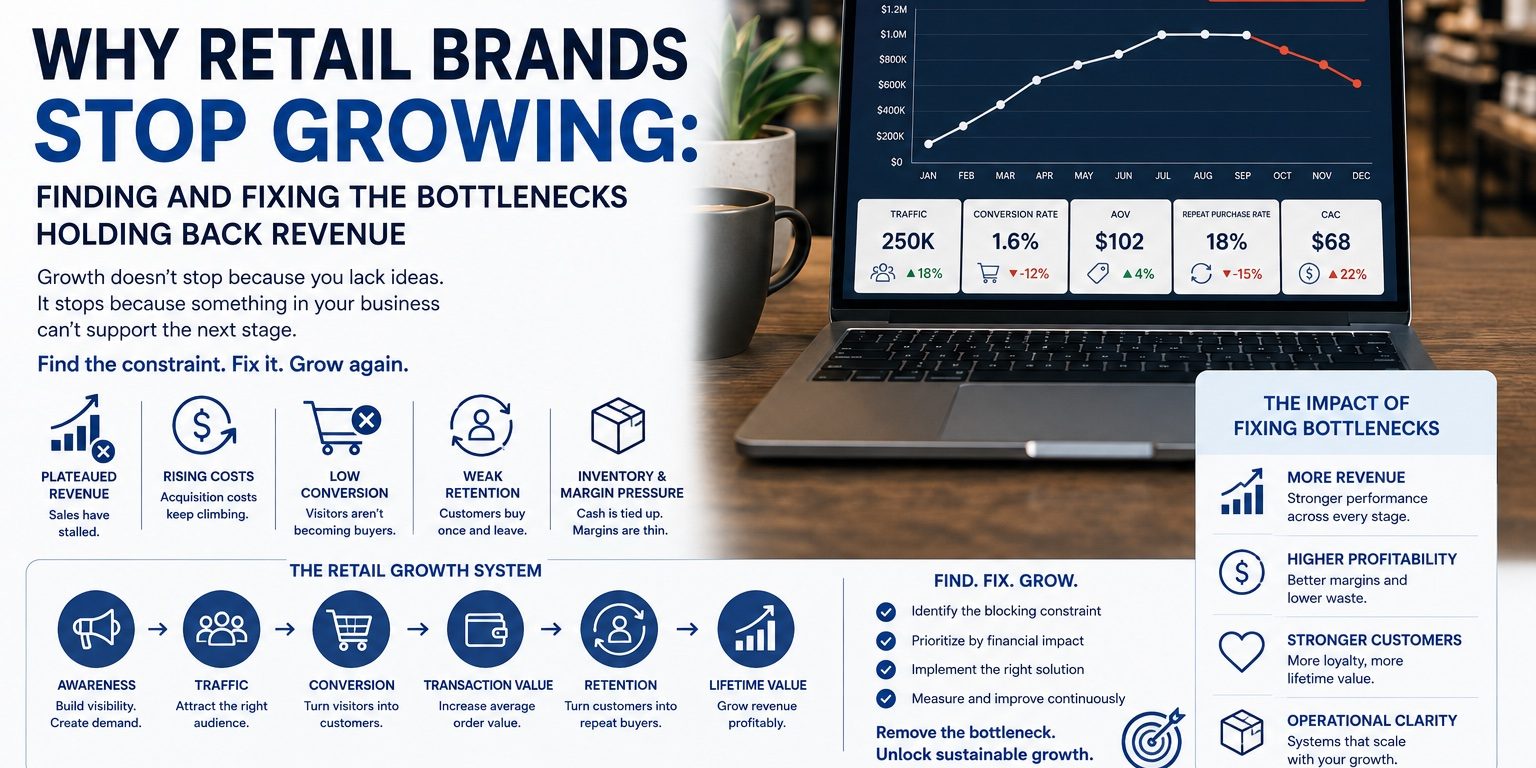
Retail businesses rarely stop growing because they suddenly run out of marketing ideas. More often, growth slows because one part of the business can no longer support the next stage. Traffic increases, but conversion does not. Advertising generates customers, but acquisition costs become too expensive. Ecommerce website sales improve, but repeat purchases remain weak. New products launch, but inventory becomes increasingly difficult to manage. Revenue grows while margins decline.
Eventually, leadership recognizes a frustrating pattern:
The company is working harder without growing proportionately.
This is one of the most important transitions in retail business growth. Retail marketing has to evolve alongside the retail business.
Early growth can often be achieved through entrepreneurial energy, successful products, aggressive marketing, founder involvement, and relatively simple operating systems. As the company becomes larger, those same methods may no longer produce the same results.
The business needs to identify what is actually limiting growth.
That constraint may exist within marketing, customer acquisition, conversion, merchandising, retention, inventory, operations, profitability, or organizational capacity.
Increasing activity without identifying the bottleneck can make matters worse.
More advertising directed toward a poorly converting website wastes money. More customers entering a business with weak retention increases acquisition dependency. More retail locations added to an inefficient operating model magnify expenses.
Sustainable growth therefore begins with diagnosis.
Growth Problems Are Usually System Problems
Retail businesses consist of interconnected systems.
A simplified revenue model might look like this:
Awareness → Traffic → Conversion → Transaction Value → Retention → Lifetime Value
Behind that customer journey are additional systems involving:
- Products
- Merchandising
- Inventory
- Marketing
- Technology
- Fulfillment
- Customer service
- Finance
- Operations
Weakness anywhere within the system can restrict growth.
For example, a retailer may believe it has a traffic problem because sales have plateaued.
Traffic might actually be increasing.
The real problem could be that mobile conversion has declined because the website has become slower. Or customers may be purchasing once but failing to return. Alternatively, revenue may be growing while margins deteriorate because advertising and discounts have become too expensive.
Each situation requires a completely different solution.
This is why retailers should diagnose the constraint before prescribing another marketing tactic.
Start With the Retail Revenue Equation
One useful way to understand growth is to break revenue into its primary components.
For ecommerce, a simplified equation is:
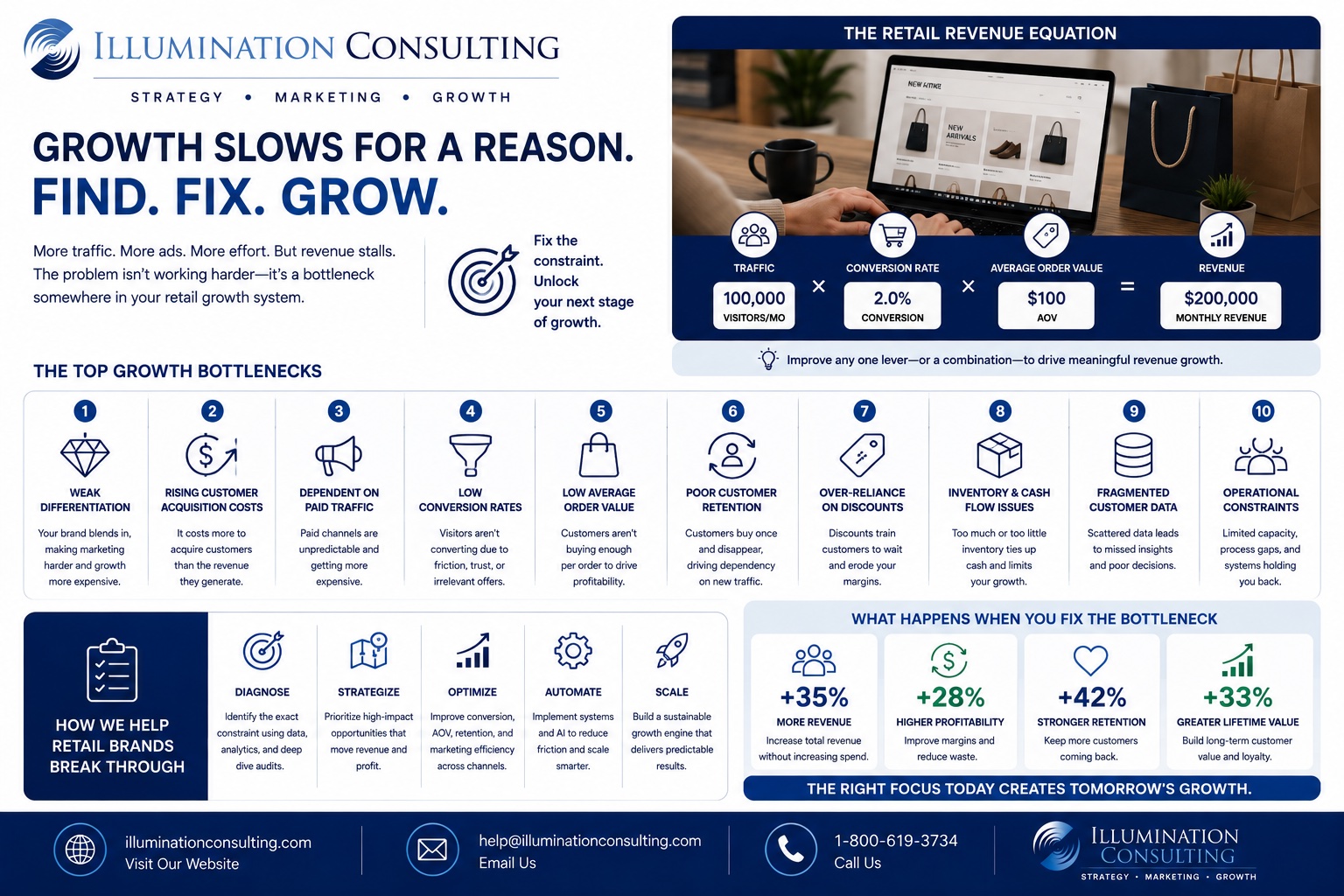
Traffic × Conversion Rate × Average Order Value = Revenue
Suppose a retailer generates:
100,000 monthly visitors × 2% conversion × $100 average order value = $200,000 monthly revenue
There are several ways to grow.
Increase traffic to 125,000 while everything else remains constant:
125,000 × 2% × $100 = $250,000
Or improve conversion:
100,000 × 2.5% × $100 = $250,000
Or increase average order value:
100,000 × 2% × $125 = $250,000
Each produces the same immediate revenue result through a different lever.
However, the long-term economics become even more interesting when retention is included.
If more first-time buyers return for additional purchases, the company can increase revenue without continually replacing every customer through new acquisition.
This is why retail growth should be evaluated as a system rather than a single marketing metric.
Bottleneck #1: The Brand Is No Longer Differentiated Enough
Many retail businesses begin with a relatively distinctive proposition.
Over time, competitors enter the category. Products become easier to replicate. Trends change. Consumers gain more alternatives.
The company’s original differentiation gradually weakens.
Marketing then becomes more difficult because customers have fewer reasons to choose one retailer over another.
Symptoms can include:
- Declining advertising performance
- Increasing price sensitivity
- Greater reliance on promotions
- Weak organic engagement
- Low branded search demand
- Difficulty explaining the company’s advantage
- Competitors appearing increasingly interchangeable
The instinctive response is often to increase marketing.
But if the positioning has weakened, more exposure does not necessarily solve the problem.
Revisit the Customer Value Proposition
Retailers should periodically reassess why customers choose them.
Differentiation can come from:
- Exclusive products
- Product quality
- Expertise
- Convenience
- Brand identity
- Customer experience
- Community
- Selection
- Service
- Innovation
- Personalization
- Speed
The strongest advantage is one that matters to customers and cannot be easily duplicated by competitors.
A retailer does not need to be completely unique.
It needs to provide a sufficiently compelling reason for its target customer to choose it.
Bottleneck #2: Customer Acquisition Has Become Too Expensive
Customer acquisition channels frequently become less efficient as businesses scale.
A retailer may initially find a profitable advertising audience and increase spending successfully. Eventually, the highest-intent prospects become saturated and incremental customers become more expensive.
This can happen across:
- Paid social
- Paid search
- Influencer marketing
- Affiliate programs
- Marketplaces
- Other paid channels
Rising customer acquisition cost does not automatically mean the channel should be abandoned.
It means the economics need to be examined.
Look Beyond Return on Advertising Spend
Return on advertising spend is useful, but it does not provide the complete financial picture.
Retailers should also evaluate:
- Customer acquisition cost
- Gross margin
- Contribution margin
- Average order value
- New versus returning customers
- Repeat purchase rate
- Customer lifetime value
Two campaigns with identical revenue can produce very different business outcomes.
One might acquire loyal customers who purchase repeatedly. Another may attract promotion-driven customers who disappear after the first transaction.
The second campaign can look successful in an advertising dashboard while creating considerably less long-term value.
Bottleneck #3: The Business Depends Too Heavily on Paid Traffic
Paid advertising can scale quickly.
That strength can also create dependency.
If most revenue begins with paid acquisition, the retailer becomes vulnerable to:
- Increasing advertising costs
- Platform changes
- Tracking limitations
- Competitive bidding
- Creative fatigue
- Algorithm changes
- Account disruptions
Retailers should therefore develop additional acquisition assets.
These can include:
- Search engine optimization
- Content marketing
- SMS
- Organic social media
- Referral programs
- Public relations
- Partnerships
- Local search
- Customer advocacy
Diversification does not mean abandoning paid advertising.
It means building a growth engine that does not stop functioning when one platform becomes more expensive.
Bottleneck #4: Traffic Is Growing but Conversion Is Not
Retailers often focus heavily on generating more website visitors.
However, traffic has limited value if visitors do not purchase.
If acquisition campaigns continue sending more people into an ecommerce experience with unresolved conversion problems, marketing costs can rise faster than revenue.
Conversion problems can originate from:
- Slow website performance
- Weak mobile usability
- Confusing navigation
- Poor product photography
- Insufficient product information
- Weak merchandising
- Unclear shipping policies
- Limited reviews
- Checkout friction
- Lack of trust
- Pricing concerns
- Poor product-market fit
The first step is determining where customers are leaving.
Analyze the Conversion Funnel
Retailers should examine the customer journey in stages.
For example:
Product View → Add to Cart → Checkout → Purchase
A significant decline between product views and cart additions suggests a different problem from a high level of checkout abandonment.
If shoppers view products but rarely add them to their carts, investigate product presentation, pricing, reviews, product information, offers, and merchandising.
If shoppers add products but fail to complete checkout, investigate shipping costs, payment options, unexpected fees, account requirements, checkout complexity, and technical problems.
Diagnosing the exact point of friction makes optimization considerably more effective.
Bottleneck #5: Mobile Commerce Is Underperforming
A retailer can have an attractive ecommerce website and still provide a poor shopping experience on smartphones.
This matters because mobile devices frequently generate a substantial percentage of retail traffic.
Common mobile problems include:
- Slow page loading
- Difficult navigation
- Small buttons
- Intrusive pop-ups
- Complicated filters
- Poor product image presentation
- Excessive scrolling
- Long forms
- Difficult checkout
- Unclear calls to action
Small usability problems compound.
A customer who encounters several minor frustrations may simply leave rather than consciously identify what went wrong.
Design Around Mobile Shopping Behavior
Mobile optimization is not simply shrinking the desktop website.
Retailers should evaluate how customers actually browse and purchase using smaller screens.
Important priorities include:
- Fast loading
- Simple navigation
- Effective site search
- Easy product filtering
- Clear product imagery
- Concise product information
- Accessible calls to action
- Mobile payment options
- Streamlined checkout
Improving mobile conversion can unlock additional revenue from traffic the company already possesses.
That is often more financially attractive than purchasing additional traffic.
Bottleneck #6: Product Pages Are Not Doing Enough Selling
Product pages are among the most commercially important assets on an ecommerce website.
Yet many retailers treat them like catalog entries.
A product page should help customers answer:
Is this right for me?
Why should I buy it?
Can I trust this product and company?
What happens after I order?
Depending on the category, effective product pages can include:
- Strong photography
- Product benefits
- Specifications
- Dimensions
- Materials
- Ingredients
- Usage instructions
- Reviews
- Frequently asked questions
- Shipping information
- Return information
- Related products
Customers should not have to leave the page and search elsewhere for basic information required to make a decision.
Improve Product Merchandising, Not Just Product Copy
Conversion is also influenced by how products are presented relative to one another.
Retailers can help shoppers navigate choices through:
- Best-seller indicators
- Product comparisons
- Collections
- Bundles
- Recommended products
- Premium alternatives
- Recently viewed products
- Personalized suggestions
The objective is not displaying more merchandise.
It is making decisions easier.
When customers encounter too many poorly differentiated options, choice can become friction.
Bottleneck #7: Average Order Value Has Stopped Increasing
Retailers sometimes concentrate on acquiring more transactions while overlooking the value of each transaction.
Average order value is one of the primary revenue levers.
It can potentially be improved through:
- Product bundles
- Complementary products
- Cross-selling
- Upselling
- Free-shipping thresholds
- Volume incentives
- Gift-with-purchase offers
- Premium versions
- Product sets
However, increasing average order value should not depend entirely on discounts.
Strategic merchandising can create additional value for customers while improving transaction economics.
Build Around Natural Product Relationships
The strongest cross-sells make intuitive sense.
A customer buying shoes may need care products.
Someone purchasing a camera may need accessories.
A shopper buying skin care may benefit from complementary products within the same routine.
Relevant recommendations improve the shopping experience because they solve additional customer needs.
Random recommendations simply create visual clutter.
Bottleneck #8: Customers Purchase Once and Disappear
A retailer can grow traffic, conversion, and first-time sales while still building an economically fragile business.
If most customers purchase only once, the company must continually acquire replacements.
This creates dependence on customer acquisition.
Retention changes the equation.
Repeat customers can generate additional revenue without requiring the company to reacquire them from scratch each time.
Retailers should monitor:
- Repeat purchase rate
- Purchase frequency
- Time between purchases
- Customer lifetime value
- Retention by acquisition source
- Retention by product
These measurements can reveal whether the business is creating customers or merely transactions.
Diagnose Why Customers Do Not Return
Weak retention can result from several causes.
The customer may:
- Dislike the product
- Find a better alternative
- Forget about the brand
- Have no reason to repurchase
- Experience poor service
- Encounter fulfillment problems
- Purchase a low-frequency product
- Respond only to discounts
Each requires a different response.
Customer reviews, surveys, support conversations, return reasons, and behavioral data can help leadership understand what is happening.
Bottleneck #9: Post-Purchase Marketing Is Underdeveloped
Retailers often invest significantly more in acquiring customers than communicating with them afterward.
That creates wasted opportunity.
Post-purchase marketing can support:
- Product education
- Customer satisfaction
- Review generation
- Cross-selling
- Replenishment
- Loyalty enrollment
- Referrals
- Repeat purchases
Automated email and SMS workflows allow retailers to respond based on customer behavior.
For example:
Purchase → Delivery → Product Education → Review Request → Complementary Recommendation → Replenishment → Loyalty
The exact sequence depends on the category.
A thoughtful post-purchase experience can increase retention while reducing reliance on constant promotional campaigns.
Bottleneck #10: The Retailer Has Trained Customers to Wait for Discounts
Promotions can create urgency and move inventory.
However, repeated discounting changes customer behavior.
If customers learn that another 20% or 30% promotion is always coming, full-price purchasing becomes irrational.
This can lead to:
- Margin erosion
- Lower perceived value
- Promotion dependency
- Reduced full-price conversion
- Lower-quality customer acquisition
- Brand dilution
The problem can become self-reinforcing.
Full-price sales decline, so the retailer runs another promotion to recover revenue. Customers become even more accustomed to discounts, making the next full-price period weaker.
Create Value Without Automatically Cutting Price
Retailers can test alternatives such as:
- Product bundles
- Loyalty rewards
- Exclusive access
- Gifts with purchase
- Free shipping
- Limited editions
- Early access
- Value-added services
Discounting does not need to disappear.
It needs to become a strategic tool rather than the default mechanism for generating demand.
Bottleneck #11: Merchandising Decisions Are Based on Instinct Alone
Experienced merchants develop valuable intuition.
However, intuition becomes more powerful when combined with data.
Retailers can analyze:
- Product views
- Conversion by SKU
- Gross margin
- Sell-through
- Return rates
- Cross-purchase behavior
- Search activity
- Inventory turnover
- Repeat purchase behavior
These metrics can reveal products that play very different roles within the business.
A product may generate significant traffic but modest direct revenue.
Another may have lower sales volume but exceptional margins.
A third may frequently appear in customers’ first orders and act as an acquisition product.
Understanding these roles helps retailers allocate merchandising and marketing resources more intelligently.
Bottleneck #12: Inventory Is Consuming Too Much Cash
Inventory is simultaneously a revenue asset and a financial risk.
Too little inventory results in lost sales.
Too much inventory traps cash.
As retailers grow, inventory management becomes increasingly important because purchasing mistakes become larger in absolute dollars.
Excess inventory can lead to:
- Storage expenses
- Markdown pressure
- Reduced margins
- Aging merchandise
- Cash-flow constraints
- Limited ability to invest elsewhere
Retailers should evaluate inventory based not only on units but on financial productivity.
Monitor Inventory Turnover and Sell-Through
Inventory turnover helps retailers understand how efficiently inventory converts into sales.
Sell-through provides insight into how much available inventory sells during a particular period.
These metrics should be examined by:
- Product
- Category
- Location
- Season
- Channel
A high-revenue product with extremely slow inventory movement may create more financial pressure than its sales numbers initially suggest.
Better inventory decisions can free capital for marketing, technology, new products, hiring, or expansion.
Bottleneck #13: Marketing Channels Operate Independently
Retail customers rarely interact with only one channel.
They may discover a product through social media, search Google, visit the website, subscribe to email, enter a physical store, and purchase later.
When marketing teams manage these interactions independently, the customer receives a fragmented experience.
Connected retail business growth requires coordination across:
- SEO
- Paid search
- Paid social
- Organic social
- SMS
- Influencers
- Ecommerce
- Physical stores
The objective is not identical messaging everywhere.
It is strategic continuity.
Each channel should help move customers through the broader relationship rather than functioning as an isolated campaign.
Bottleneck #14: Customer Data Is Fragmented
Modern retailers collect enormous amounts of information, but collecting data and using it effectively are very different capabilities.
Customer information may exist across:
- Ecommerce platforms
- Point-of-sale systems
- Email platforms
- SMS platforms
- Loyalty programs
- Advertising platforms
- Customer service systems
- Analytics tools
- Physical stores
When these systems operate independently, the retailer may see several transactions instead of one customer relationship.
A customer who purchases online, visits a store, joins a loyalty program, and responds to an email campaign should ideally be understood as one customer rather than four unrelated interactions.
Create a More Complete Customer View
Better integration can help retailers understand:
- Purchase history
- Product preferences
- Shopping frequency
- Channel preferences
- Average order value
- Lifetime value
- Marketing engagement
- Loyalty participation
This information can improve personalization, customer service, marketing automation, product recommendations, and retention.
However, the objective should not be collecting every possible data point.
Retailers should prioritize information that improves decisions and customer experiences.
Bottleneck #15: The Company Is Measuring Revenue Instead of Profitability
Revenue growth can conceal deteriorating economics.
Imagine a retailer increasing annual revenue from $5 million to $7 million.
At first glance, that represents strong growth.
But suppose the additional $2 million required:
- Significantly higher advertising spending
- Deeper discounts
- Increased fulfillment costs
- More returns
- Additional staffing
- Lower-margin products
The business may have become larger without becoming substantially more profitable.
Leadership should therefore monitor metrics below the revenue line.
These include:
- Gross margin
- Contribution margin
- Customer acquisition cost
- Fulfillment cost
- Return rate
- Discount rate
- Inventory carrying cost
- Marketing efficiency
The objective is not maximum revenue at any cost.
It is sustainable, profitable retail business growth.
Bottleneck #16: Customer Acquisition Cost and Lifetime Value Are Disconnected
Customer acquisition cost becomes considerably more meaningful when compared with customer lifetime value.
Suppose one marketing channel acquires customers for $45 and another for $70.
The $45 channel appears superior.
However, if customers from the first channel generate $100 in lifetime revenue while customers from the second generate $350, the conclusion changes.
Retailers should evaluate acquisition sources based on the quality of customers they produce.
That includes:
- Initial order value
- Gross margin
- Repeat purchase rate
- Purchase frequency
- Lifetime value
- Return behavior
This can reveal that some apparently expensive acquisition channels create significantly more valuable customers.
Segment Customers by Value
Not all customers contribute equally.
Retailers can identify groups such as:
- First-time buyers
- Repeat customers
- High-value customers
- Promotion-driven customers
- Loyal full-price customers
- Inactive customers
- Category-specific customers
Different segments deserve different strategies.
A high-value loyal customer should not necessarily receive the same communications and offers as someone who made one heavily discounted purchase two years ago.
Segmentation allows marketing resources to follow economic opportunity.
Bottleneck #17: The Business Is Trying to Serve Everyone
Broad positioning can initially appear attractive because it creates a larger theoretical market.
In practice, trying to appeal to everyone often weakens marketing.
Messaging becomes generic.
Product assortments expand without clear logic.
Advertising becomes harder to target.
Brand identity becomes less distinctive.
Retailers should understand which customers generate the strongest combination of:
- Revenue
- Margin
- Retention
- Referral activity
- Strategic fit
This does not mean rejecting every customer outside the core audience.
It means designing the business primarily around the customers most likely to create long-term value.
Bottleneck #18: Physical Stores and Ecommerce Are Competing Instead of Cooperating
Retail organizations sometimes treat ecommerce and physical stores as separate businesses.
That organizational structure can create internal competition even though customers move freely between both.
A consumer may research online before purchasing in-store.
Another may discover a product in a store and later reorder online.
A third may purchase online and return the item to a store.
The customer sees one retailer.
The organization should increasingly operate that way.
Connected capabilities can include:
- Buy online, pick up in store
- Local inventory visibility
- Ship from store
- Online returns in store
- Digital receipts
- Unified loyalty
- Store locators
- Cross-channel customer profiles
The goal is to let customers choose the most convenient path without forcing them to understand internal channel boundaries.
Measure Stores Beyond Register Revenue
Physical locations can influence transactions that ultimately occur elsewhere.
A store can generate:
- Brand awareness
- Product discovery
- Customer education
- Email subscribers
- Loyalty memberships
- Ecommerce purchases
- Future repeat purchases
Evaluating a store exclusively through transactions processed at its registers may understate its broader contribution.
Retailers should increasingly consider the total geographic and customer impact of physical locations.
Bottleneck #19: Local Search Opportunities Are Being Ignored
Retailers with physical locations can miss significant purchase intent if stores are difficult to discover through search.
Consumers routinely search for:
- Products near me
- Retail categories near me
- Store names
- Local inventory
- Hours
- Directions
- Reviews
Local SEO can help physical locations capture this demand.
Important elements include:
- Google Business Profiles
- Accurate store information
- Location pages
- Reviews
- Local citations
- Store photography
- Product information
- Location-specific content
For multi-location retailers, these activities should be systematized.
Each location represents its own opportunity to capture geographically relevant demand.
Bottleneck #20: The Organization Cannot Execute Fast Enough
Eventually, the growth constraint may stop being marketing and become organizational capacity.
The founder may still approve every campaign.
One employee may control critical institutional knowledge.
Marketing processes may be undocumented.
Reporting may require manual spreadsheets.
Different teams may use incompatible systems.
These problems may be manageable at a smaller scale but increasingly expensive as the company grows.
Retailers should identify recurring activities that can be:
- Documented
- Standardized
- Automated
- Delegated
- Integrated
The objective is not bureaucracy.
It is removing unnecessary dependency on individual people and repetitive manual work.
Use Automation to Remove Operational Friction
Automation can improve efficiency across many retail functions.
Examples include:
- Marketing workflows
- Customer segmentation
- Inventory alerts
- Reporting
- Review requests
- Replenishment reminders
- Customer service routing
- Loyalty communications
- Abandoned-cart recovery
- Order notifications
The strongest automation opportunities usually involve repetitive processes that consume employee time without requiring substantial human judgment.
Automation should free people to focus on higher-value work rather than simply adding more technology.
Use AI to Find Patterns Humans Can Miss
Artificial intelligence creates additional opportunities for retailers dealing with large volumes of customer, product, marketing, and operational data.
Potential applications include:
- Customer segmentation
- Demand forecasting
- Product recommendations
- Advertising analysis
- Inventory optimization
- Content optimization
- Customer service
- Review analysis
- Pricing analysis
- Performance reporting
AI can help identify patterns faster, but technology should not become a substitute for strategy.
A retailer still needs to decide:
- Which customers matter most
- What the brand represents
- Which products deserve investment
- Where capital should be allocated
- What constitutes profitable growth
AI improves the decision-making system. It does not eliminate the need for business judgment.
Find the Constraint Before Increasing the Budget
When growth slows, increasing the marketing budget is tempting.
Sometimes that is exactly the right decision.
If conversion, retention, margins, inventory, and customer economics are strong but the company simply lacks sufficient awareness, additional acquisition investment may unlock growth.
But if another constraint exists, more marketing can magnify the problem.
A better diagnostic sequence is:
1. Is there sufficient market demand?
2. Are we attracting qualified customers?
3. Are they converting?
4. Are transactions economically attractive?
5. Are customers returning?
6. Can operations support additional volume?
7. Does growth generate acceptable profit and cash flow?
The first major weakness in that sequence often deserves attention before the company increases acquisition spending.
Prioritize Bottlenecks by Financial Impact
A retailer may identify ten opportunities simultaneously.
Trying to fix all ten usually creates scattered execution.
Instead, estimate the financial impact of each constraint.
For example:
Improving conversion from 1.8% to 2.2% may produce significantly more revenue than launching another social media campaign.
Reducing returns by several percentage points may generate more profit than increasing website traffic.
Improving retention could materially increase customer lifetime value and make existing advertising profitable.
The highest-return initiative may not be the most visible or exciting project.
That is why prioritization matters.
Build a Retail Growth Dashboard
Leadership should have a concise view of the metrics that explain business performance.
A practical growth dashboard might include:
- Traffic
- Conversion rate
- Average order value
- Customer acquisition cost
- New customer revenue
- Returning customer revenue
- Repeat purchase rate
- Customer lifetime value
- Gross margin
- Contribution margin
- Return rate
- Inventory turnover
The exact metrics depend on the business.
The dashboard should help leadership answer:
Where is growth coming from?
Where are we losing money?
What is getting better or worse?
Where should we invest next?
Reporting should lead to decisions rather than simply produce more reports.
Conduct Regular Growth Constraint Reviews
Growth bottlenecks change.
After solving a conversion problem, customer acquisition may become the new constraint.
After improving acquisition, fulfillment may struggle with additional volume.
After improving operations, inventory or working capital may become limiting factors.
Retail growth management should therefore be iterative:
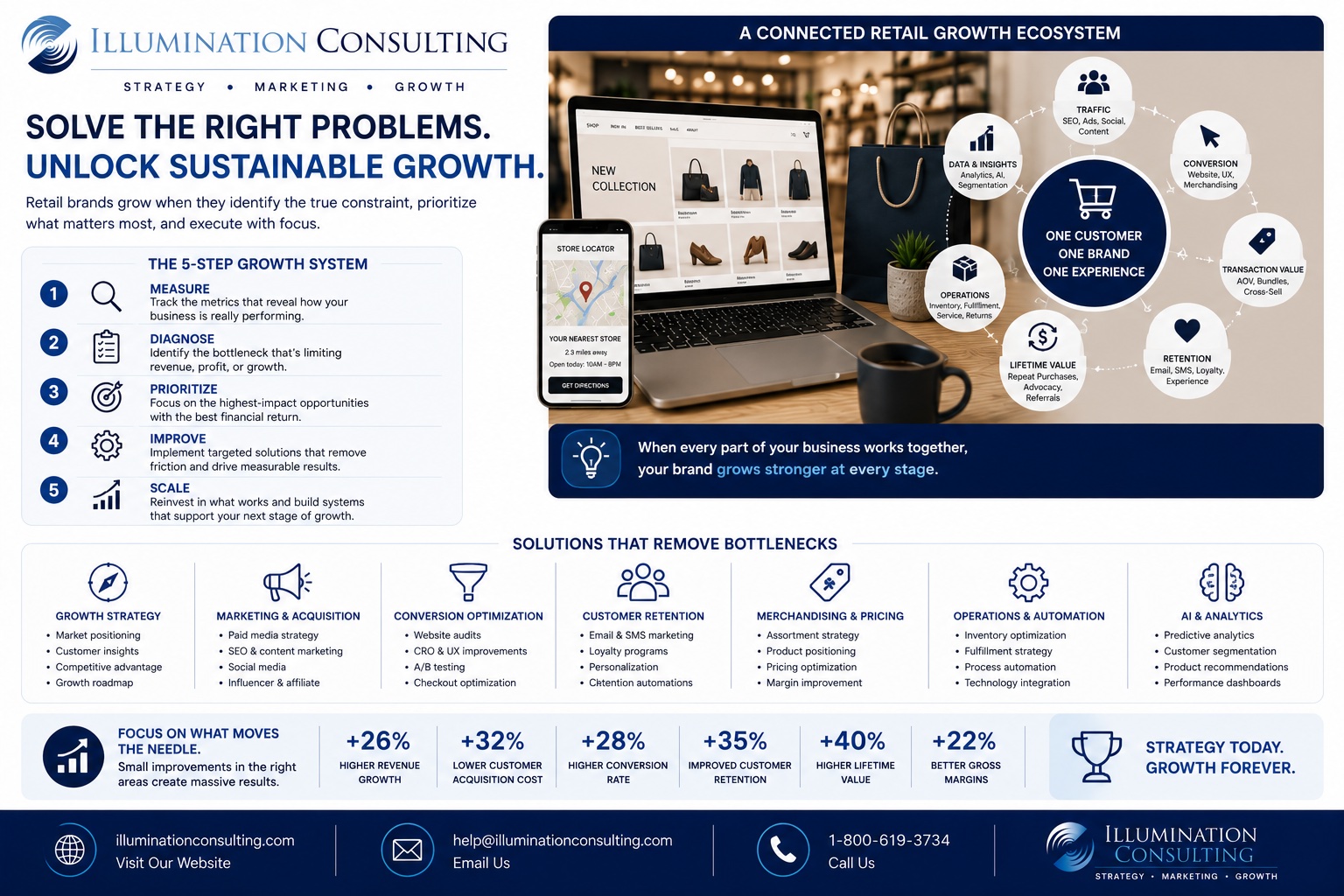
Measure → Diagnose → Prioritize → Improve → Measure Again
This approach creates continuous improvement rather than dependence on occasional large initiatives.
Frequently Asked Questions
Why do retail businesses stop growing?
Retail businesses can stop growing because of weak differentiation, rising acquisition costs, poor ecommerce conversion, low customer retention, inventory problems, excessive discounting, operational constraints, or declining profitability. The key is identifying which factor currently limits growth.
How can a retailer increase revenue without increasing advertising?
Retailers can increase revenue by improving conversion rates, average order value, merchandising, customer retention, repeat purchasing, ecommerce usability, inventory availability, and cross-selling.
What metrics are most important for retail business growth?
Important metrics include traffic, conversion rate, average order value, customer acquisition cost, gross margin, contribution margin, repeat purchase rate, customer lifetime value, return rate, and inventory turnover.
How can retailers reduce customer acquisition costs?
Retailers can improve acquisition economics through stronger positioning, higher conversion rates, SEO, content marketing, referrals, organic social media, better advertising targeting, stronger retention, and increased customer lifetime value.
When should a retailer invest more in marketing?
Increasing marketing investment makes the most sense when the company has healthy margins, effective conversion, sufficient inventory, strong customer economics, and operational capacity. If those fundamentals are weak, fixing the underlying constraint may generate a higher return.
Growth Comes From Removing the Right Constraint
When a retail business reaches a plateau, the solution is rarely doing everything at once.
It is identifying what currently prevents the company from reaching the next level.
For one retailer, that may be customer acquisition. For another, conversion. For another, retention, merchandising, inventory, margins, technology, or organizational capacity.
Once the primary constraint is identified, resources can be concentrated where they have the greatest financial impact.
That is the difference between activity and strategy.
Sustainable retail business growth comes from continually improving the system that turns awareness into customers, customers into repeat buyers, and revenue into profit.
At Illumination Consulting, we help retail companies identify and remove growth constraints across business strategy, retail marketing, ecommerce website design, search engine optimization, digital advertising, conversion optimization, customer acquisition, AI-powered solutions, and operational growth strategy.
The objective is not simply generating more activity.
It is determining what is holding the business back, fixing it, and building a stronger platform for the next stage of profitable growth.