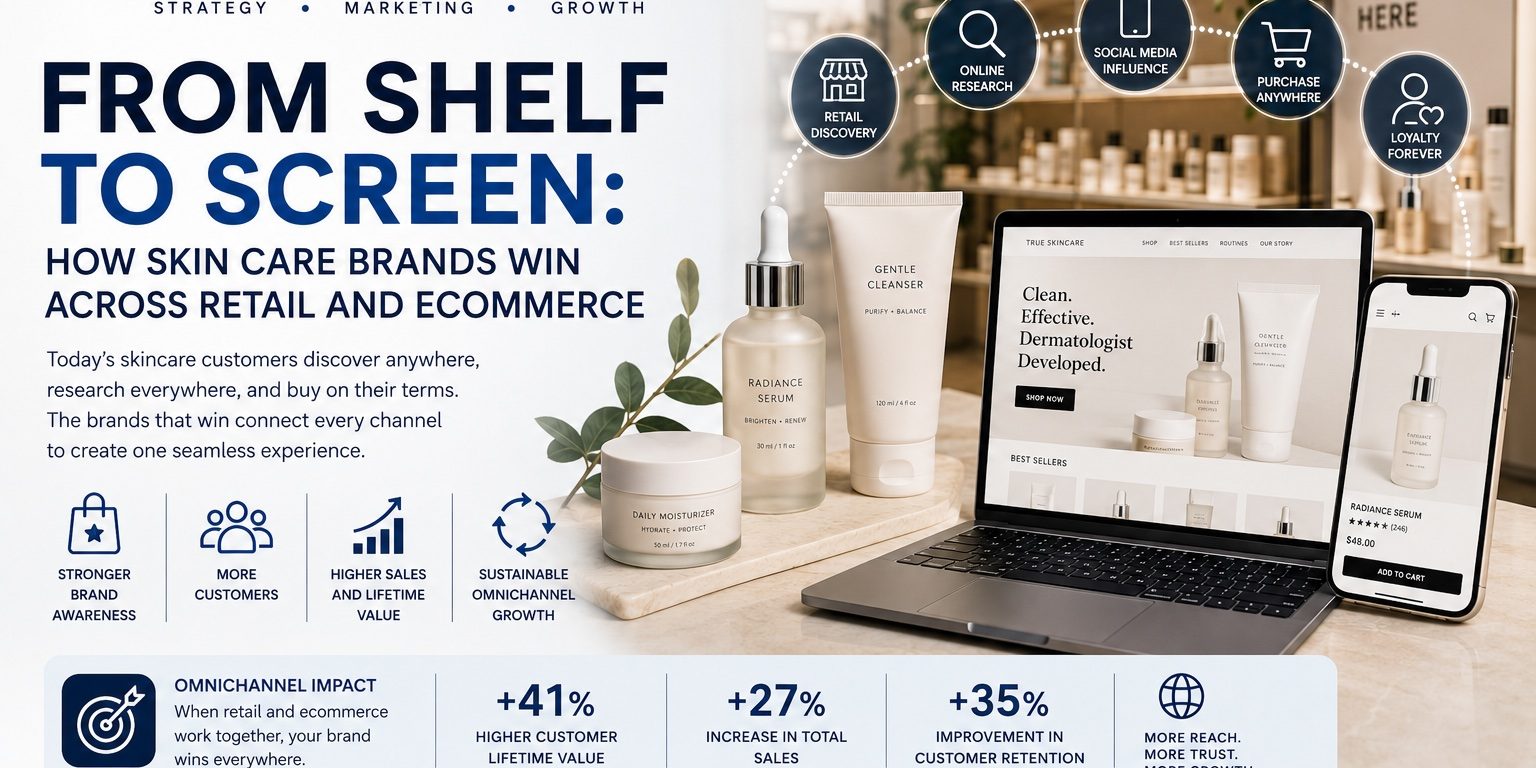
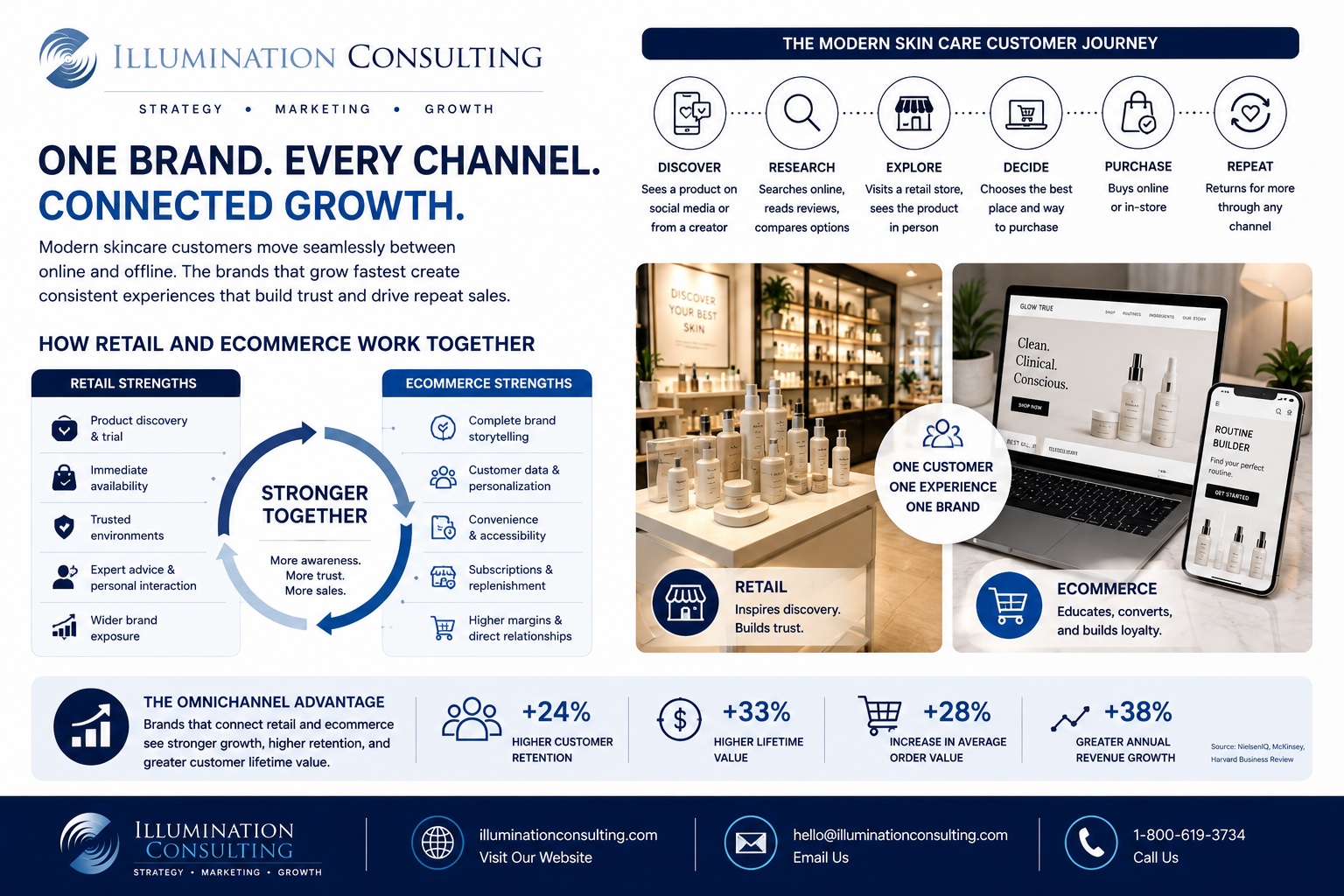
The traditional divide between retail and ecommerce is disappearing. Today’s skin care consumer may discover a product through social media, research its ingredients on Google, read reviews on a brand’s website, examine it inside a retail store, watch a creator demonstrate it on TikTok, and ultimately purchase it through a smartphone.
The next purchase may happen somewhere completely different.
For skin care companies, this creates both enormous opportunity and significant complexity.
Direct-to-consumer ecommerce gives brands control over customer relationships, merchandising, data, storytelling, and potentially stronger margins. Physical retail creates product discovery, credibility, immediate access, sensory experiences, and exposure to shoppers the brand may never have reached independently.
The strongest growth strategy is not necessarily choosing one over the other.
Increasingly, it is understanding how skin care retail and ecommerce can reinforce each other.
A customer who discovers a product at a retailer may later purchase directly from the brand. An ecommerce customer may become more confident when they see the same products carried by a respected retailer. Social media can generate demand for both channels, while search engines and skin care marketing campaigns connect consumers to whichever purchasing option is most convenient.
This interconnected environment changes how skin care brands should think about marketing, distribution, customer acquisition, inventory, merchandising, and retention.
Winning from shelf to screen requires building one recognizable brand across multiple buying environments.
Understand the Role of Direct-to-Consumer Ecommerce
Direct-to-consumer ecommerce has transformed the skin care industry because brands no longer need widespread retail distribution before reaching a meaningful customer base.
A company can launch products, test positioning, acquire customers, collect feedback, and build brand awareness through its own website.
This provides several strategic advantages.
Brands can control:
- Product presentation
- Pricing
- Brand storytelling
- Customer education
- Promotions
- Product bundles
- Customer data
- Email and SMS relationships
- Cross-selling
- Post-purchase communication
That direct relationship can become extremely valuable.
When a customer purchases through the brand’s website, the company can potentially understand what they purchased, how frequently they return, which communications they engage with, and which additional products interest them.
This information can improve both marketing and product development.
Ecommerce Is More Than a Sales Channel
The company website should not be viewed simply as another place to process transactions.
It is often the most complete representation of the brand.
A retailer may give a product several inches of shelf space and limited room for education. The brand’s website can tell the complete story.
It can explain:
- Product benefits
- Ingredients
- Formulation philosophy
- Clinical information
- Skin concerns
- Application
- Routines
- Founder story
- Brand values
- Customer reviews
- Frequently asked questions
This makes ecommerce an important education and credibility platform even when consumers ultimately purchase elsewhere.
A shopper standing inside a physical store may still visit the manufacturer’s website before deciding whether to buy.
Understand What Retail Distribution Can Provide
Retail offers a different set of advantages.
Established retailers already possess customers, traffic, locations, merchandising infrastructure, brand recognition, and consumer trust.
For an emerging skin care company, gaining placement with the right retailer can introduce products to audiences that would be expensive to acquire independently.
Retail can provide:
- Increased brand exposure
- Physical product discovery
- Customer trust
- Geographic reach
- Product trial
- Professional merchandising
- Immediate purchasing
- Retailer marketing opportunities
- Category credibility
Physical environments are particularly relevant to beauty because customers often want to see packaging, experience textures, test products, smell formulations, or speak with knowledgeable associates.
Those experiences are difficult to reproduce completely online.
Retail Placement Is Not the Finish Line
Getting onto a shelf can feel like a major victory.
It is.
But placement alone does not guarantee success.
The retailer ultimately needs products to sell through.
If products remain on shelves, the account can become a liability rather than a growth engine. Inventory may be discounted, purchase orders may decline, and valuable retail relationships can disappear.
Successful retail strategy therefore focuses on two separate objectives:
Sell-in: convincing retailers to carry the products.
Sell-through: creating enough consumer demand for those products to leave the shelves.
The second objective is what creates sustainable distribution.
Choose Channels Based on Strategy, Not Prestige
Not every skin care brand belongs in every retailer.
Distribution should reinforce positioning.
A luxury clinical line may benefit from a very different retail environment than an accessible natural skin care brand. Placement affects how customers perceive the product, which competitors surround it, what price points appear normal, and what type of consumer discovers it.
Brands should evaluate potential retail partners based on:
- Customer demographics
- Brand positioning
- Geographic reach
- Category strength
- Competitive assortment
- Margin requirements
- Promotional expectations
- Merchandising support
- Payment terms
- Sales potential
A famous retailer is not automatically the best retailer.
The strongest distribution relationships connect the brand with the right customers under commercially sustainable terms.
Protect Brand Consistency Across Every Channel
As distribution expands, maintaining consistency becomes harder.
The brand may appear on its own ecommerce website, retailer websites, marketplaces, physical shelves, social media, advertising, email campaigns, and influencer content simultaneously.
Consumers should still recognize the same company.
Consistency should extend across:
- Product imagery
- Packaging
- Product descriptions
- Brand messaging
- Pricing strategy
- Claims
- Visual identity
- Educational content
- Customer experience
This does not mean every channel must look identical.
Retailers have different merchandising systems, and content should be adapted appropriately.
The underlying brand, however, should remain coherent.
When the ecommerce experience communicates luxury while marketplace listings appear cheap or inconsistent, customers receive conflicting signals.
Strong omnichannel brands adapt without losing their identity.
Create Channel Economics That Support Growth
Expanding across skin care retail and ecommerce can increase revenue, but every sales channel has different economics.
A direct-to-consumer order may generate a higher gross margin because the brand captures the retail price. However, the company also absorbs expenses associated with customer acquisition, fulfillment, payment processing, shipping incentives, returns, ecommerce technology, and customer service.
Wholesale operates differently.
The retailer purchases products below the suggested retail price, reducing the brand’s revenue per unit. Depending on the relationship, additional costs may include distributors, brokers, promotional allowances, samples, testers, markdown support, freight, or retailer-specific programs.
Brands should understand the actual contribution economics of each channel.
Important considerations include:
- Cost of goods
- Wholesale pricing
- Retail pricing
- Gross margin
- Customer acquisition cost
- Fulfillment
- Freight
- Discounts
- Returns
- Retailer margins
- Distributor margins
- Promotional expenses
A channel producing substantial revenue is not necessarily the channel producing the greatest profit.
Establish Pricing Before Distribution Expands
Pricing decisions made early in the company’s development can affect future distribution opportunities.
A brand that prices products exclusively around direct-to-consumer economics may discover later that insufficient margin exists to support wholesale relationships.
This can create difficult choices.
The company may need to increase prices, reduce manufacturing costs, accept weak margins, or abandon potentially valuable distribution opportunities.
Founders should model multiple channel scenarios before expansion.
Even when retail is not an immediate priority, understanding future wholesale economics can prevent today’s pricing decisions from limiting tomorrow’s growth.
Build an Ecommerce Experience Worth Returning To
A skin care ecommerce website needs to do more than display attractive products.
It should help customers understand their skin concerns, evaluate solutions, build routines, make confident purchases, and return when products need replenishment.
Successful ecommerce experiences combine brand storytelling with practical shopping functionality.
Important elements include:
- Intuitive navigation
- Mobile optimization
- Fast page speed
- Strong product photography
- Ingredient information
- Product benefits
- Usage instructions
- Reviews
- Frequently asked questions
- Routine recommendations
- Related products
- Easy checkout
Skin care consumers frequently require more information than shoppers purchasing simpler consumer products.
They may want to know whether a formulation works for sensitive skin, how frequently it should be used, which ingredients are included, what products can be combined, and where it belongs within an existing routine.
Every unanswered question can become a conversion obstacle.
Treat Product Detail Pages as Digital Salespeople
A physical retail environment may provide associates who explain products and make recommendations.
An ecommerce product page needs to perform many of those functions independently.
Strong product pages can communicate:
- What the product does
- Who it is designed for
- Why it is different
- How to use it
- When to use it
- Which ingredients matter
- What customers can reasonably expect
- What products complement it
Photography should also do more than display packaging.
Brands can use a combination of:
- Product photography
- Texture imagery
- Ingredient visuals
- Lifestyle photography
- Application imagery
- Packaging details
- Product-scale references
- Routine graphics
The objective is to reduce uncertainty.
Customers who cannot physically touch or test the product need enough information to purchase confidently.
Use Reviews as a Bridge Between Channels
Customer reviews create social proof across both ecommerce and retail environments.
Prospective buyers may encounter reviews on:
- Brand websites
- Retailer websites
- Marketplaces
- Social media
- Beauty communities
Strong review volume can make an unfamiliar product feel considerably less risky.
Brands should develop ethical, consistent processes for requesting authentic feedback after purchases.
Reviews can also become a source of business intelligence.
Recurring comments can reveal:
- Product strengths
- Packaging problems
- Application confusion
- Customer expectations
- Frequently mentioned benefits
- Common objections
- Potential product improvements
The value extends beyond the star rating.
Use Search to Connect Product Discovery With Purchase
Search engines frequently sit between initial awareness and final purchase.
A consumer may hear about a product through a friend, see it in a store, encounter it on Instagram, or watch an influencer discuss it before searching Google for more information.
Brands should build search visibility around the questions customers ask during this process.
Search opportunities can include:
- Brand searches
- Product searches
- Ingredient searches
- Skin concern searches
- Product category searches
- Comparison searches
- Routine searches
- Retail availability searches
A strong SEO strategy allows the brand to remain visible while consumers move from awareness toward consideration.
Build Search Authority Beyond Product Pages
Product pages are commercially important, but they represent only part of the search opportunity.
Educational content can attract consumers earlier in the buying journey.
Useful topics may include:
- Ingredient education
- Skin concerns
- Product routines
- Application guidance
- Product comparisons
- Seasonal skin care
- Frequently asked questions
- Professional advice
The objective is not to publish generic beauty content simply to generate traffic.
Content should reinforce the categories, ingredients, concerns, and products where the company wants to build authority.
When done strategically, content marketing creates a bridge between education and commerce.
Coordinate Paid Advertising Across Channels
Paid advertising can generate demand for both ecommerce and retail.
However, brands sometimes evaluate advertising too narrowly.
A consumer may click an advertisement, visit the website, and later purchase the product at a physical retailer.
If attribution focuses exclusively on the ecommerce transaction, the campaign may appear less valuable than it actually was.
Conversely, retail placement can increase brand recognition and improve the performance of digital advertising.
Consumers may be more comfortable purchasing from a company they recognize from a trusted store.
Brands should therefore consider the broader commercial impact of advertising.
Paid media can support:
- Ecommerce sales
- Product launches
- Retail launches
- Store traffic
- Brand awareness
- Retargeting
- Customer acquisition
- Replenishment
The appropriate measurement strategy depends on the objective.
Use Geographic Advertising to Support Retail Partners
When products enter physical retail locations, digital advertising can help create local demand.
Brands can target consumers near stores carrying their products and communicate availability.
Campaigns can direct shoppers toward:
- Store locators
- Retailer product pages
- Local locations
- Product launches
- In-store events
- Sampling opportunities
This approach helps connect digital marketing investment directly with retail sell-through.
Retail buyers want brands capable of creating demand, not merely supplying inventory.
Demonstrating that capability can strengthen retailer relationships and future expansion opportunities.
Turn Social Media Into an Omnichannel Discovery Engine
Skin care is naturally suited to social media.
Products are visual, routines can be demonstrated, ingredients can be explained, and customer experiences can be shared.
Social media can influence both online and offline purchases.
Content can include:
- Product demonstrations
- Skin care routines
- Ingredient education
- Founder stories
- Customer testimonials
- Behind-the-scenes content
- Product launches
- Retail announcements
- User-generated content
- Expert commentary
A social post does not need to produce an immediate ecommerce transaction to create value.
It may introduce a customer to the brand who later purchases through a retailer.
This is another reason omnichannel brands need to evaluate marketing beyond last-click attribution.
Use Influencers to Create Demand, Not Just Awareness
Influencer marketing can become particularly valuable when brands expand into retail.
Creators can introduce products while simultaneously communicating where customers can purchase them.
However, successful partnerships require alignment.
Brands should evaluate:
- Audience demographics
- Engagement quality
- Content style
- Brand fit
- Geographic relevance
- Credibility
- Historical partnerships
- Conversion potential
A creator with a smaller but highly relevant audience can produce stronger commercial results than a celebrity account with millions of poorly matched followers.
Connect Influencer Campaigns to Distribution
Influencer activity should support actual business objectives.
When launching with a retailer, brands can coordinate creators around:
- Launch dates
- Store availability
- Retailer websites
- Product demonstrations
- Store visits
- Exclusive products
- Promotional events
This creates concentrated demand rather than isolated social mentions.
The goal is not simply getting people to talk about the product.
It is creating enough interest to move customers toward purchase.
Use Retail as a Brand-Building Environment
Physical stores provide opportunities that digital channels cannot fully reproduce.
Consumers can interact directly with:
- Packaging
- Texture
- Fragrance
- Product size
- Displays
- Testers
- Samples
- Sales associates
These interactions influence perception.
Retail merchandising should therefore reinforce the same positioning customers encounter online.
Display materials, testers, signage, product education, packaging, and associate training can all affect whether a customer understands the product quickly enough to purchase it.
In a crowded beauty environment, shelf presence matters.
The product may have only seconds to earn attention.
Invest in Product Education
Complex or differentiated products often require education.
Retail associates who understand the product can become valuable advocates.
Brands can support them with:
- Product training
- Ingredient information
- Usage guidance
- Key differentiators
- Product comparisons
- Customer profiles
- Frequently asked questions
- Samples
Education should be concise enough to remember and practical enough to use during customer conversations.
The better retail teams understand why the product matters, the more effectively they can communicate its value.
Connect Inventory Across Retail and Ecommerce
Inventory becomes more complicated as a skin care company expands across channels.
Direct-to-consumer orders, wholesale accounts, marketplaces, samples, promotional programs, subscriptions, and retail launches may all compete for the same inventory.
Poor forecasting can create two expensive problems.
Too little inventory results in:
- Lost ecommerce sales
- Retail stockouts
- Missed promotions
- Frustrated customers
- Damaged retailer relationships
Too much inventory creates:
- Excess working capital requirements
- Storage costs
- Aging products
- Discount pressure
- Potential write-offs
- Cash-flow problems
Brands should connect marketing plans, sales forecasts, production schedules, and inventory purchasing rather than managing each independently.
Forecast Demand by Channel
Different channels behave differently.
Ecommerce demand may respond quickly to advertising, influencer exposure, email campaigns, or viral social content. Retail demand may depend on store count, shelf placement, promotional calendars, seasonality, and retailer traffic.
Brands should forecast demand separately while maintaining a consolidated view of total inventory.
Useful inputs include:
- Historical sales
- Ecommerce growth
- Retail sell-through
- Marketing calendars
- Product launches
- Seasonality
- Promotional events
- New store openings
- Replenishment cycles
- Lead times
Forecasting will never be perfect.
The objective is to make increasingly informed decisions while maintaining enough flexibility to respond when demand changes.
Manage Cash Flow as Distribution Expands
Growth can consume cash.
This is particularly important for skin care companies because inventory may need to be manufactured months before the company receives payment.
Retail expansion can intensify the problem.
A large purchase order may require significant spending on formulation, components, packaging, manufacturing, freight, and warehousing before retailer payments arrive.
Meanwhile, the company still needs capital for:
- Payroll
- Ecommerce operations
- Advertising
- Marketing
- Samples
- Fulfillment
- Product development
- Customer service
A brand can therefore appear successful based on revenue while experiencing significant financial pressure.
Model Working Capital Before Accepting Growth
Not every growth opportunity should automatically be accepted.
Before expanding into a large retailer or significantly increasing distribution, leadership should model:
- Inventory requirements
- Production deposits
- Manufacturing lead times
- Payment terms
- Expected sell-through
- Marketing commitments
- Promotional allowances
- Freight
- Returns
- Reorder timing
The question is not simply:
How much revenue could this account generate?
The more important question is:
Can the company finance and profitably support this account?
Sustainable growth requires both demand and sufficient working capital to fulfill it.
Use Ecommerce Data to Strengthen Retail Strategy
Direct-to-consumer ecommerce creates valuable information that can help brands make better retail decisions.
Online sales can reveal:
- Best-selling products
- Geographic demand
- Product combinations
- Repeat purchase behavior
- Customer demographics
- Seasonal trends
- Customer questions
- Product reviews
This information can strengthen conversations with potential retail partners.
Instead of presenting only a brand concept, companies can demonstrate actual customer behavior.
For example, strong ecommerce demand within a particular geographic market may support expansion into retail locations within that region.
Likewise, clear hero products can help retailers understand which SKUs deserve initial shelf space.
Use Retail Data to Improve Ecommerce
The information flow should work in both directions.
Retail performance can reveal:
- Products attracting new customers
- Geographic opportunities
- Category trends
- Pricing sensitivity
- Promotional performance
- Store-level demand
- Product education needs
Brands should use those insights to improve ecommerce merchandising, advertising, content, and product development.
When retail and ecommerce teams operate separately, valuable information can remain trapped within each channel.
An omnichannel business should learn across both.
Create One Customer Relationship Across Channels
A customer may purchase from a retailer today and directly from the brand six months later.
Another may begin as a direct-to-consumer customer before discovering the products at a nearby store.
The brand should view both as part of the same customer ecosystem.
This requires thinking beyond transaction ownership.
Retailers naturally control most customer data from purchases made through their stores. However, brands can still create direct relationships through:
- Product education
- Social media
- Email subscriptions
- SMS programs
- Loyalty programs
- Product registration
- Sampling
- QR codes
- Educational content
- Community programs
The objective should not be to undermine retail partners.
It should be to create enough brand value that consumers want an ongoing relationship regardless of where they purchase.
Build Retention Across the Entire Brand
Skin care has a natural retention advantage because products are consumable.
A customer who likes a moisturizer, cleanser, serum, or treatment eventually needs another one.
Brands should build systems that encourage those repeat purchases.
Retention strategies can include:
- Replenishment reminders
- Email marketing
- SMS marketing
- Subscriptions
- Loyalty programs
- Product education
- Personalized recommendations
- New product introductions
- Routine-building
- Customer service
The challenge in an omnichannel environment is that not every repeat purchase occurs through the same channel.
A customer may initially purchase from Sephora, replenish through the brand website, and later buy from another retailer while traveling.
Brand loyalty therefore matters more than channel loyalty.
Increase Customer Lifetime Value Through Routines
Skin care brands have substantial cross-selling opportunities because customers frequently use multiple products together.
Instead of thinking exclusively about individual SKUs, brands can help customers construct appropriate routines.
For example:
Cleanse → Treat → Hydrate → Protect
This approach can improve:
- Product education
- Average order value
- Cross-selling
- Customer results
- Repeat purchasing
- Customer lifetime value
However, recommendations should remain relevant.
The goal is not maximizing the number of products in every transaction. It is helping customers understand which products genuinely belong together.
Protect Channel Relationships
Channel conflict can emerge when brands sell through their own websites while also relying on retailers.
Problems can arise through:
- Inconsistent pricing
- Aggressive direct discounts
- Exclusive products
- Promotional timing
- Inventory allocation
- Product availability
Retail partners may become frustrated if the brand continuously undercuts them through direct promotions.
Consumers may also become confused when pricing varies significantly across channels.
Brands should develop clear policies governing:
- Promotional calendars
- Pricing
- Product exclusivity
- Bundles
- Launch timing
- Inventory allocation
Healthy retail relationships require trust.
The direct-to-consumer channel should strengthen the overall brand rather than constantly compete with wholesale partners.
Decide Carefully Whether Marketplaces Fit the Brand
Marketplaces can provide enormous reach and convenience, but they introduce another set of strategic considerations.
Potential advantages include:
- Large existing audiences
- Search visibility
- Convenience
- Fast fulfillment
- Customer trust
- Geographic reach
Potential challenges include:
- Fees
- Price competition
- Counterfeit products
- Unauthorized sellers
- Reduced customer ownership
- Brand presentation limitations
Marketplace strategy should reflect positioning.
Some skin care companies can benefit significantly from platforms such as Amazon, while others may determine that selective distribution better supports their premium positioning.
The decision should be strategic rather than automatic.
Use Technology to Connect the Omnichannel Business
As the company expands, technology increasingly becomes part of the infrastructure required to manage complexity.
Systems may need to coordinate:
- Ecommerce
- Inventory
- Orders
- Customer data
- SMS
- Loyalty
- Analytics
- Retail accounts
- Customer service
The objective is not accumulating software.
It is creating reliable information flows and reducing unnecessary manual work.
Disconnected systems can lead to inaccurate inventory, fragmented customer information, inconsistent reporting, and inefficient operations.
Apply AI Where It Improves Performance
Artificial intelligence can support both skin care retail and ecommerce operations.
Potential applications include:
- Demand forecasting
- Customer segmentation
- Product recommendations
- Marketing personalization
- Advertising analysis
- Search optimization
- Customer service
- Review analysis
- Inventory planning
- Performance reporting
AI becomes most valuable when it improves an identifiable business process.
Brands should begin with the problem they need to solve rather than adopting technology and searching afterward for a reason to use it.
Measure Omnichannel Performance Differently
Traditional attribution models often struggle with omnichannel behavior.
A consumer may interact with five marketing touchpoints before purchasing through a channel that receives all the credit.
Brands should therefore examine performance from several perspectives.
Important measurements include:
- Total revenue
- Revenue by channel
- Gross margin by channel
- Customer acquisition cost
- Ecommerce conversion rate
- Average order value
- Repeat purchase rate
- Customer lifetime value
- Retail sell-through
- Inventory turnover
- Geographic sales growth
- Branded search volume
No individual metric captures the entire customer journey.
Leadership should look for patterns across channels.
Measure Incremental Growth
A useful question is whether adding a channel increases the overall business or simply redistributes existing sales.
For example, when a brand enters a new retail market, leadership can examine whether:
- Total regional sales increase
- Ecommerce sales remain stable
- Branded searches increase
- Social engagement grows
- New customers enter the ecosystem
Retail expansion may create benefits beyond the wholesale revenue itself.
Likewise, digital marketing may influence retail sales that are difficult to attribute directly.
The goal is understanding total commercial impact.
Common Omnichannel Growth Mistakes
Expanding into more channels can create the appearance of progress without necessarily creating a stronger company.
Common mistakes include:
- Entering retail too early
- Choosing retailers based on prestige instead of fit
- Weak wholesale margins
- Inconsistent pricing
- Insufficient inventory
- Poor retail sell-through support
- Disconnected marketing
- Fragmented customer data
- Inconsistent branding
- Overdependence on discounts
- Weak cash-flow planning
- Treating ecommerce and retail as competing businesses
The solution is not necessarily adding another channel.
Often, the better decision is improving the economics and execution of existing channels before expanding further.
Frequently Asked Questions
Should a skin care brand focus on ecommerce or retail first?
The right starting point depends on the brand’s products, customers, capital, positioning, and distribution opportunities. Ecommerce often gives emerging brands greater control and valuable customer data, while retail can provide reach, credibility, and physical product discovery.
How can skin care brands increase retail sell-through?
Brands can support sell-through through digital advertising, social media, influencer campaigns, sampling, product education, store locators, geographic marketing, retailer-specific promotions, and strong merchandising.
How does ecommerce support retail growth?
Ecommerce can build brand awareness, generate customer data, identify geographic demand, demonstrate product performance, educate consumers, and create digital demand that eventually produces purchases through retail stores.
How can skin care brands avoid channel conflict?
Brands can establish consistent pricing policies, coordinate promotional calendars, manage product exclusivity carefully, maintain transparent retailer relationships, and avoid routinely undercutting retail partners through direct-to-consumer promotions.
What should skin care brands measure across retail and ecommerce?
Important metrics include revenue by channel, gross margin, customer acquisition cost, ecommerce conversion, average order value, repeat purchase rate, customer lifetime value, retail sell-through, inventory turnover, and total geographic growth.
Build One Brand Across Every Buying Environment
Consumers increasingly move between physical and digital shopping without thinking about the organizational boundaries behind those experiences.
Skin care companies need to do the same.
The strongest skin care retail and ecommerce strategies do not treat wholesale, direct-to-consumer sales, search, social media, influencers, email, and physical stores as isolated activities.
They connect them.
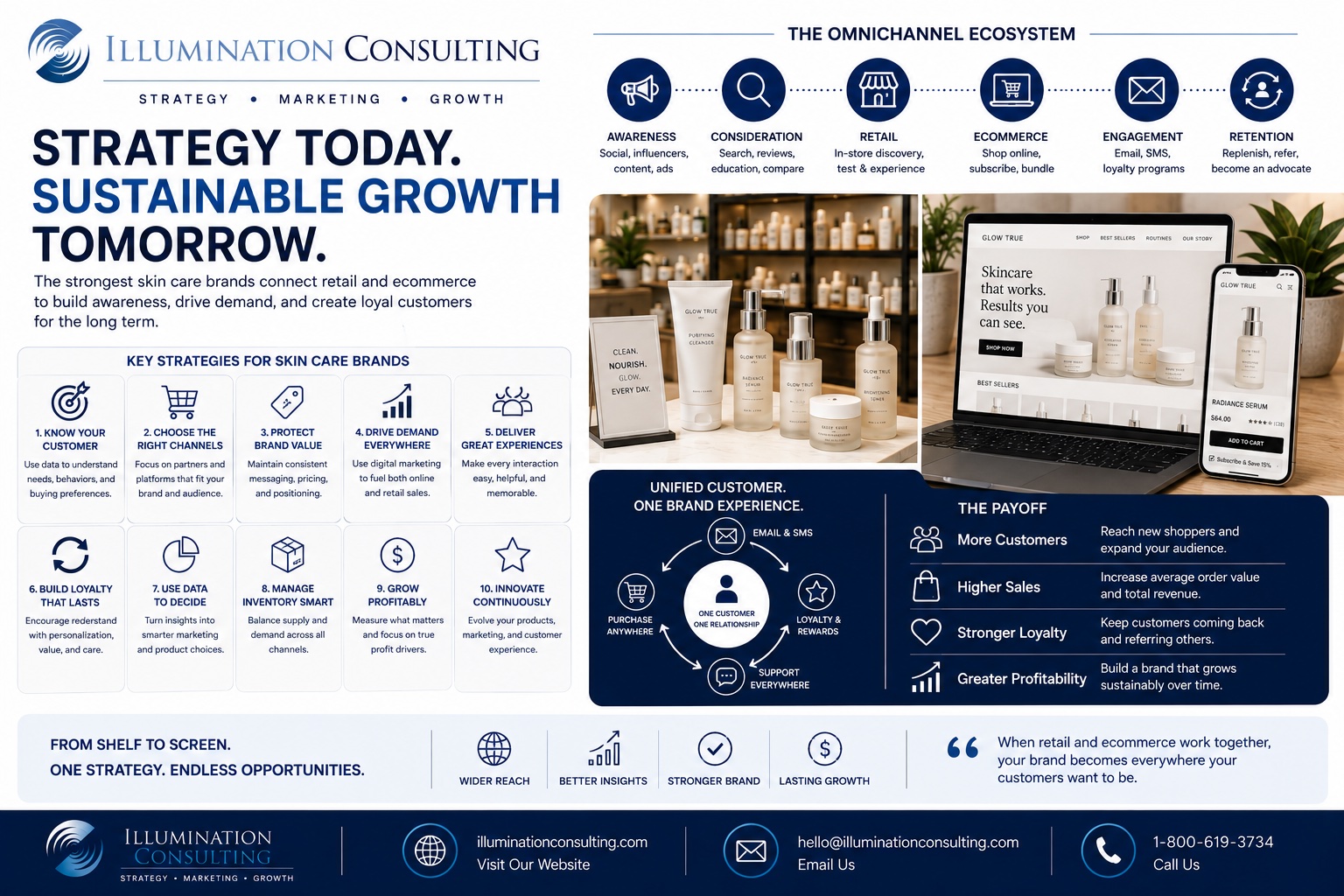
Ecommerce provides control, customer relationships, education, and data. Retail provides discovery, credibility, reach, and physical experience. Search and social media create demand across both. Retention transforms transactions into customer relationships. Data helps leadership understand where future growth should come from.
At Illumination Consulting, we help skin care companies develop strategies across business consulting, skin care marketing, ecommerce website design, search engine optimization, digital advertising, branding, retail growth, customer acquisition, and AI-powered business solutions.
The objective is not simply to put products in more places.
It is to build a recognizable, profitable skin care brand that customers can discover, trust, purchase, and return to—whether that relationship begins on a shelf, a search engine, a social platform, or a screen.