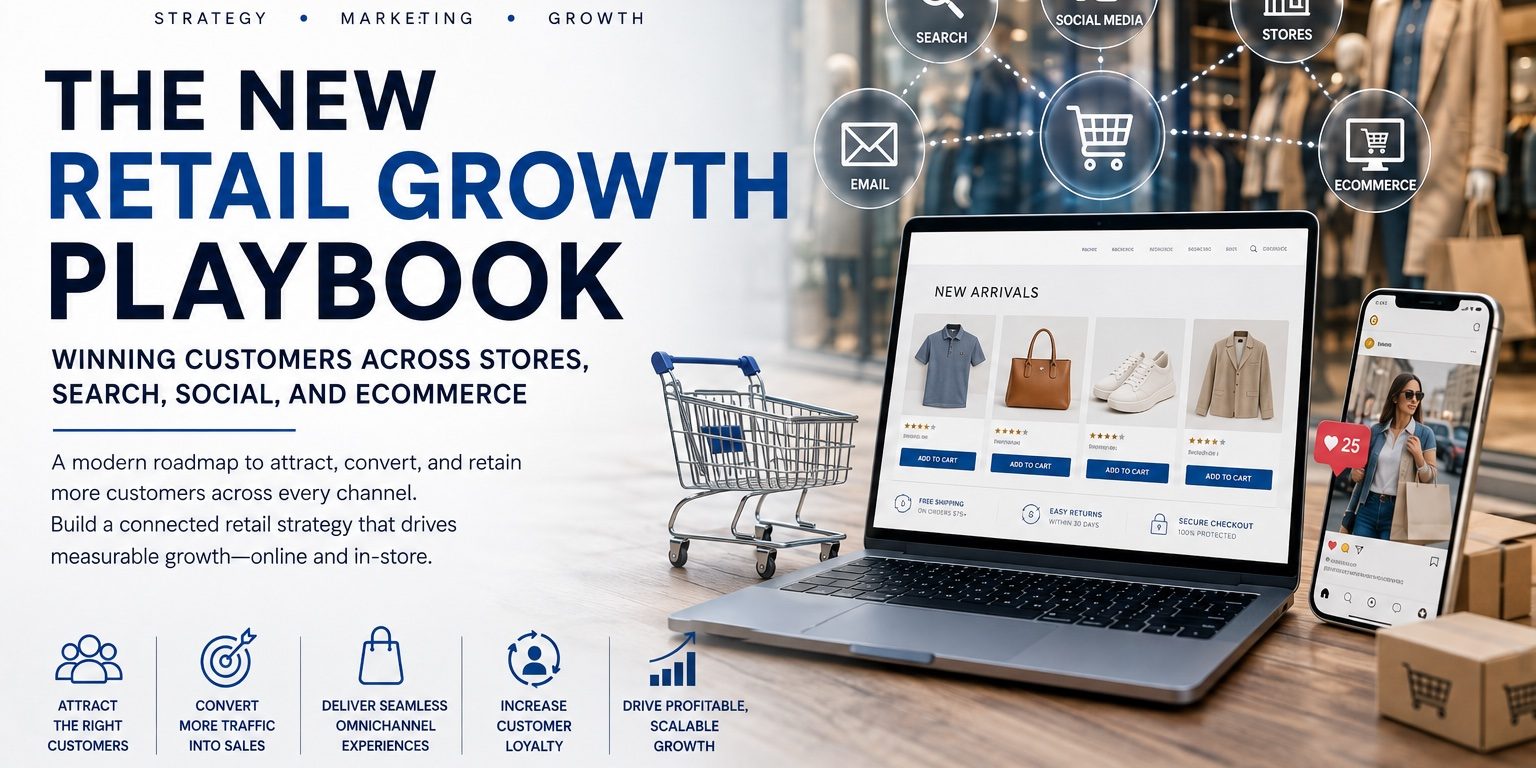
Retail growth no longer happens in a single place. Consumers move continuously between Google searches, social media, ecommerce websites, marketplaces, email, mobile devices, physical stores, reviews, influencers, and recommendations from other customers. They may discover a product on Instagram, research it on Google, compare alternatives on a retailer’s website, visit a physical store, and eventually purchase through their phone.
For retailers, this has fundamentally changed how growth works.
Traditional marketing channels have not disappeared. Stores, merchandising, advertising, promotions, and customer service remain important. However, successful retail growth strategies now connect those fundamentals with search visibility, digital advertising, social commerce, ecommerce, customer data, automation, retention, and increasingly artificial intelligence. Modern retail marketing services encompass these fundamentals.
The opportunity is significant. Retailers have more ways than ever to reach customers, understand purchasing behavior, personalize experiences, and build direct relationships.
The challenge is fragmentation.
Adding more channels does not automatically create more growth. A retailer can spend heavily across Google, Meta, TikTok, email, influencers, marketplaces, and ecommerce technology while producing disappointing financial results. Growth occurs when these channels work together around a coherent customer acquisition and retention system.
The modern retail playbook is therefore not about being everywhere.
It is about creating a connected commercial ecosystem that helps customers discover the brand, choose its products, complete a purchase, and return again.
Retail Has Become a Connected Customer Journey
The distinction between “online customer” and “store customer” is increasingly artificial.
Customers do not necessarily think in channels. They think about what they want and how conveniently they can get it.
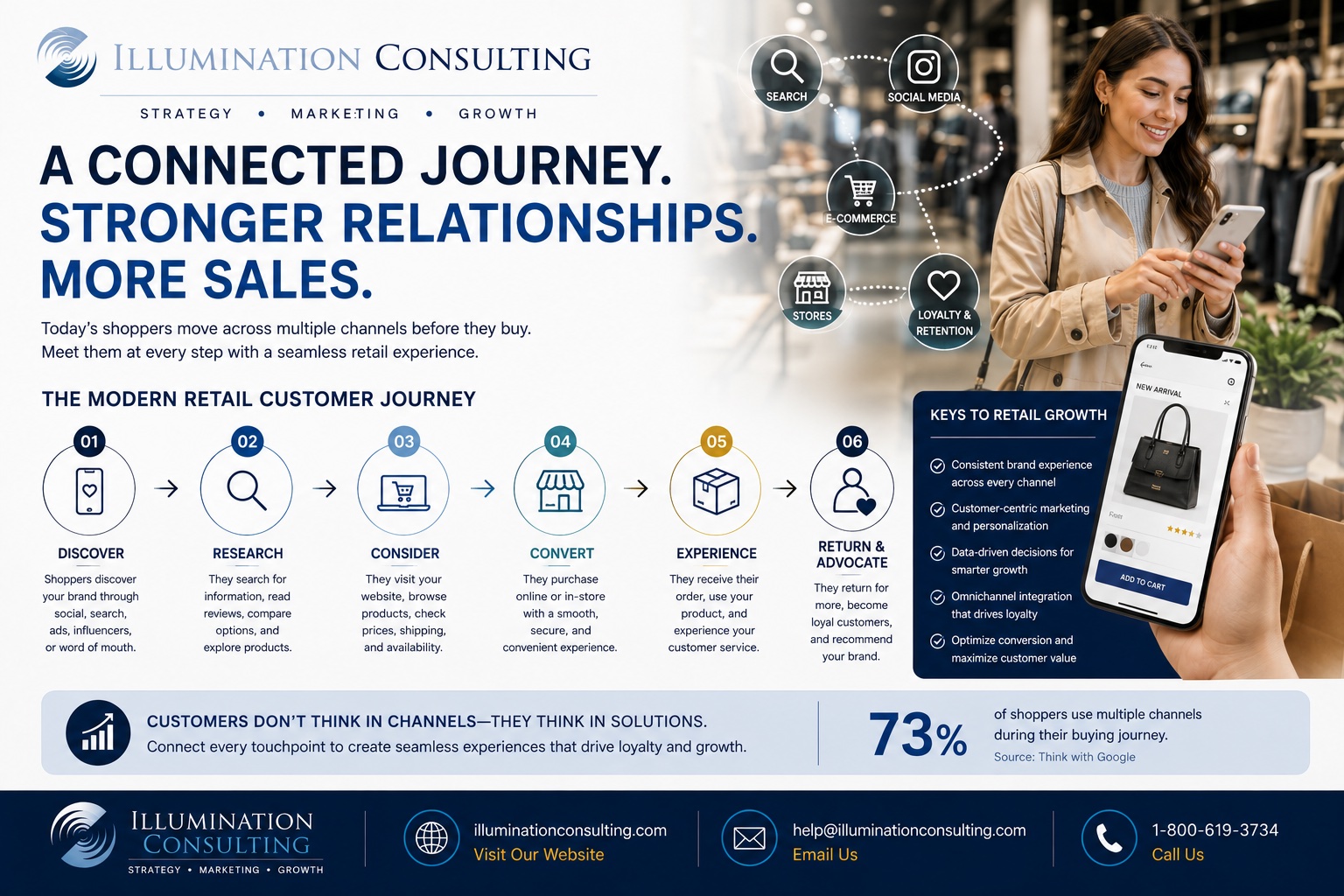
A single purchase journey might involve:
- Discovering a product through social media
- Searching for the brand on Google
- Reading customer reviews
- Visiting the retailer’s website
- Comparing products
- Checking local inventory
- Visiting a store
- Purchasing in person
- Joining an email list
- Reordering online
Every interaction influences the next.
This means retailers should stop evaluating stores, ecommerce, search, social media, and retention as completely separate business activities.
They are components of one customer journey.
Start With the Customer, Not the Channel
One of the most common mistakes in retail marketing is beginning with tactics.
Should we advertise on TikTok?
Should we increase Google Ads?
Should we hire influencers?
Should we send more emails?
Those questions matter only after the retailer understands its customer.
A stronger strategy begins by identifying:
- Who the highest-value customers are
- What motivates their purchases
- Which products initially attract them
- Where they discover new brands
- How they research products
- What prevents them from purchasing
- Which channels they prefer
- Why they purchase again
- What causes them to leave
The answers determine where marketing resources should be deployed.
A retailer serving affluent homeowners will require a very different acquisition strategy from a fashion company targeting Gen Z consumers. A specialty retailer selling complex products may require substantial educational content, while an impulse-driven brand may depend more heavily on visual merchandising and social discovery.
The channel strategy should follow customer behavior.
Build a Retail Brand Customers Can Recognize
Retailers compete for attention before they compete for transactions.
Consumers encounter enormous numbers of products, advertisements, websites, stores, social posts, emails, and promotional messages every day.
Recognition creates an advantage.
A strong retail brand establishes consistency across:
- Visual identity
- Product presentation
- Packaging
- Store environments
- Website design
- Photography
- Advertising
- Social media
- Customer service
- Messaging
The objective is not simply aesthetic consistency.
Branding should help customers quickly understand what the retailer represents, who it serves, and why its products deserve consideration.
Strong positioning makes every acquisition channel more effective because consumers have a clearer reason to pay attention.
Differentiate Beyond Price
Competing primarily on price is difficult to sustain.
Unless a retailer has a structural cost advantage, another company can usually discount more aggressively.
Retailers can instead differentiate through combinations of:
- Product selection
- Exclusive merchandise
- Expertise
- Convenience
- Customer experience
- Quality
- Brand identity
- Community
- Service
- Speed
- Personalization
- Loyalty benefits
Price will always influence purchasing decisions, but it does not need to be the only reason customers choose the business.
The strongest retail brands create value that competitors cannot reproduce simply by offering another discount.
Make Search a Customer Acquisition Channel
Search engines capture something especially valuable: intent.
When consumers search for a product, category, brand, solution, or local retailer, they are actively expressing interest.
That makes search visibility an important component of modern retail growth strategies.
Retail SEO can include:
- Product page optimization
- Category page optimization
- Local SEO
- Buying guides
- Product comparisons
- Educational content
- Image optimization
- Technical SEO
- Structured data
- Internal linking
- Google Business Profile optimization
The objective is to build visibility throughout the buying journey rather than ranking for one broad keyword.
A customer searching for general information today may become a product shopper tomorrow.
Retailers that consistently answer those searches can create a compounding source of qualified traffic rather than depending entirely on paid acquisition.
Turn Product and Category Pages Into Sales Assets
Retail ecommerce websites often contain hundreds or thousands of product pages, yet many retailers treat them primarily as inventory listings.
That leaves substantial growth potential unused.
Product and category pages can simultaneously support search visibility, customer education, merchandising, conversion, cross-selling, and brand positioning.
A strong product page should help customers answer the questions that stand between interest and purchase.
Depending on the product, that can include:
- Clear product benefits
- Multiple high-quality images
- Product specifications
- Size or dimension information
- Materials and ingredients
- Availability
- Shipping information
- Customer reviews
- Frequently asked questions
- Related products
- Usage information
- Returns information
The exact content should reflect what customers actually need to make a confident purchasing decision.
Improve Category Page Merchandising
Category pages are equally important.
Customers entering a broad category need help navigating potentially dozens or hundreds of options.
Effective category merchandising can include:
- Logical product organization
- Useful filters
- Clear subcategories
- Featured products
- Best sellers
- New arrivals
- Promotional collections
- Educational content
- Relevant recommendations
This is where ecommerce merchandising and SEO increasingly overlap.
A well-developed category page can rank for commercially valuable searches while simultaneously helping visitors find the right products faster.
Use Paid Search to Capture Existing Demand
Organic visibility creates long-term value, but paid search can place retailers directly in front of consumers who are ready to shop.
Search advertising can be particularly effective for:
- Product searches
- Category searches
- Branded searches
- Competitor searches
- Local shopping intent
- Seasonal demand
- Promotional campaigns
Google Shopping and product-focused campaigns can also place merchandise directly within search results, reducing the distance between discovery and purchase.
However, retailers should evaluate advertising based on business economics rather than clicks or impressions.
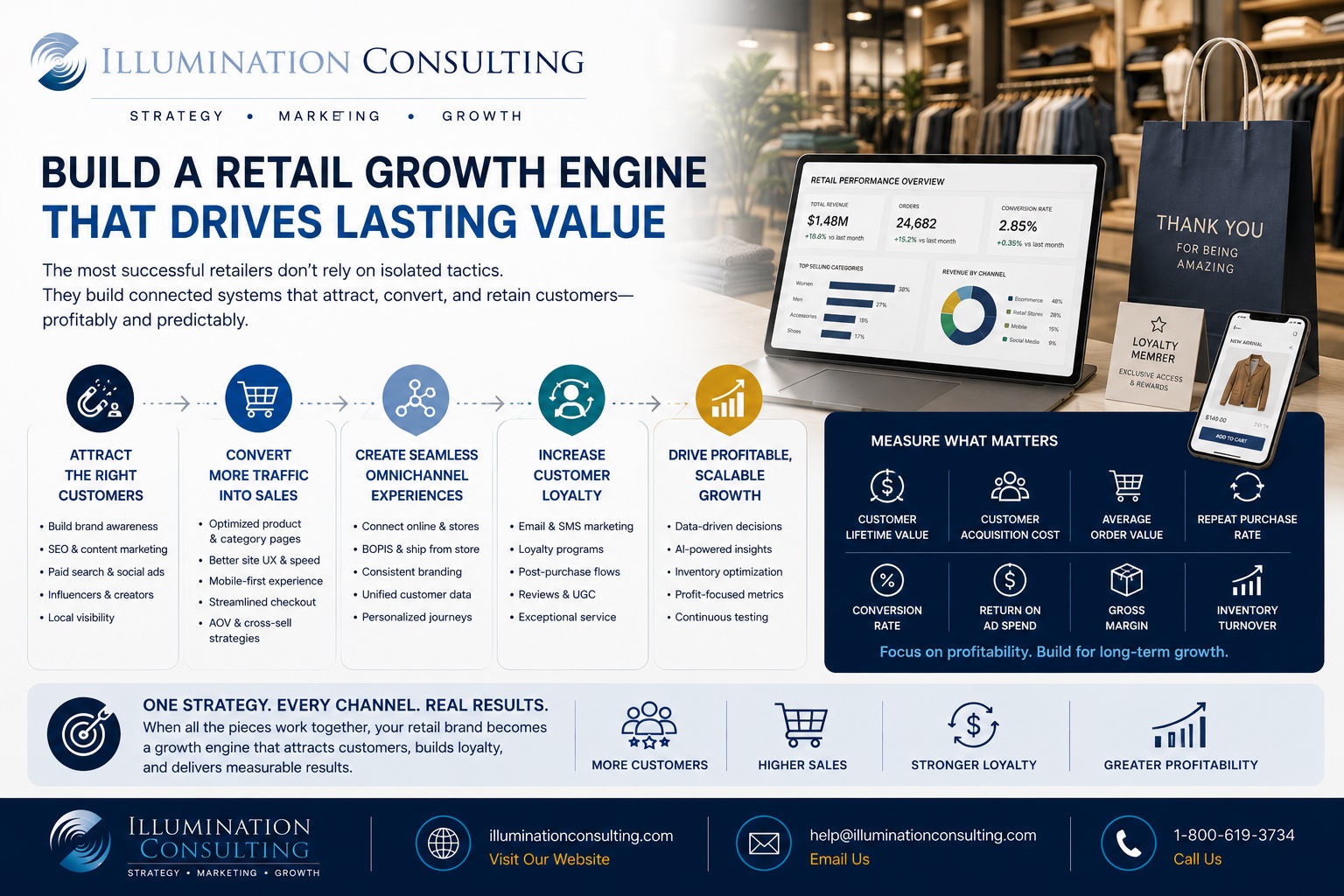
Important measurements include:
- Customer acquisition cost
- Conversion rate
- Average order value
- Gross margin
- Return on advertising spend
- New versus returning customers
- Customer lifetime value
A campaign generating substantial revenue may still be financially weak if discounts, advertising costs, fulfillment expenses, and product costs consume most of the margin.
Turn Social Media Into a Commerce Environment
Social media has evolved from a communication channel into a major retail discovery environment.
Consumers use social platforms to find products, evaluate trends, watch demonstrations, compare brands, read comments, interact with creators, and increasingly purchase directly.
Retailers should therefore think beyond posting frequency.
Strong social media strategies combine:
- Product discovery
- Education
- Entertainment
- Community
- Social proof
- Customer stories
- Product demonstrations
- Brand storytelling
- Promotional content
- User-generated content
Different platforms serve different audiences and behaviors.
A retailer does not need to dominate every social network.
It needs to understand where its customers spend time and what type of content influences their purchasing decisions.
Create Content That Helps Products Sell
Retail content should give consumers reasons to stop, watch, save, share, click, and ultimately purchase.
Depending on the category, useful formats can include:
- Product demonstrations
- Styling ideas
- Before-and-after examples
- How-to videos
- Buying advice
- Comparisons
- Behind-the-scenes content
- Customer stories
- New-product introductions
- Seasonal recommendations
The strongest content often reduces the distance between inspiration and commerce.
A customer who understands how a product fits into their life is more likely to consider purchasing it.
Use Creators and Influencers Strategically
Influencer marketing can give retailers access to trusted audiences, but follower count alone is a weak selection criterion.
Retailers should evaluate creators based on:
- Audience relevance
- Engagement quality
- Content quality
- Brand compatibility
- Geographic reach
- Customer demographics
- Credibility
- Historical partnerships
- Conversion potential
Micro-influencers can sometimes outperform much larger creators because their audiences are more concentrated and engaged.
The relationship should also be measured.
Affiliate links, promotional codes, dedicated landing pages, attribution tools, and customer surveys can help retailers understand which partnerships produce actual commercial value.
Turn Customers Into Content Creators
Existing customers can become another important source of content.
User-generated content provides social proof while showing products in real environments.
Retailers can encourage customers to share:
- Product photos
- Videos
- Reviews
- Styling ideas
- Unboxing experiences
- Product applications
- Before-and-after results
- Recommendations
With appropriate permission, this content can support social media, product pages, advertising, email campaigns, and other marketing initiatives.
Authentic customer content can be particularly persuasive because it reduces the distance between polished brand marketing and real-world product experience.
Build an Ecommerce Experience Around Conversion
Generating traffic is only half of the growth equation.
The ecommerce website must convert that traffic into revenue.
Conversion rate optimization examines the points where customers encounter friction and systematically improves them.
Important areas include:
- Site navigation
- Mobile usability
- Search functionality
- Product discovery
- Product pages
- Category pages
- Shopping cart
- Checkout
- Payment options
- Shipping information
- Website speed
- Trust signals
Retailers should study where visitors abandon the journey.
If large numbers of shoppers view products but never add them to their carts, the problem may involve merchandising, price, product information, photography, trust, or the offer.
If customers add products but abandon checkout, the problem may be shipping costs, account requirements, payment options, checkout complexity, or unexpected fees.
Different problems require different solutions.
Design for Mobile Commerce First
For many retailers, smartphones account for a substantial share of traffic.
Yet ecommerce experiences are still sometimes designed primarily around desktop screens and adapted to mobile afterward.
Mobile shoppers need:
- Fast pages
- Readable text
- Simple navigation
- Clear product images
- Easy filtering
- Accessible buttons
- Streamlined forms
- Simple checkout
- Mobile-friendly payment options
Small usability problems become more significant on smaller screens.
Mobile optimization should therefore be treated as a revenue priority rather than merely a technical requirement.
Reduce Checkout Friction
The checkout process represents one of the most commercially sensitive areas of an ecommerce website.
Customers reaching checkout have already demonstrated significant purchase intent.
Unnecessary friction at this stage can waste the marketing investment required to acquire them.
Retailers should evaluate:
- Guest checkout
- Form length
- Shipping transparency
- Payment options
- Mobile usability
- Error messages
- Promotional code placement
- Account creation
- Order review
- Checkout speed
The objective is straightforward: make it easy for customers who have decided to purchase to complete the transaction.
Increase Average Order Value Through Better Merchandising
Acquiring a new customer can be expensive.
Increasing the value of each transaction can improve marketing economics without requiring additional customer acquisition.
Retailers can increase average order value through:
- Product bundles
- Complementary recommendations
- Volume incentives
- Free-shipping thresholds
- Premium alternatives
- Gift-with-purchase promotions
- Strategic upsells
- Cross-selling
The key is relevance.
Random recommendations create clutter. Useful recommendations help customers complete a purchase or discover products that genuinely complement what they already want.
For example, a retailer selling footwear might recommend appropriate care products. A home retailer might suggest complementary accessories. A beauty retailer might assemble products into a complete routine.
Good merchandising improves both customer experience and transaction economics.
Connect Physical Stores and Ecommerce
Physical stores remain an important competitive advantage for many retailers.
They provide immediate product access, personal interaction, sensory experience, local visibility, service, and trust.
Digital commerce provides convenience, broader assortment, customer data, personalization, and continuous accessibility.
The strongest omnichannel strategies allow these advantages to reinforce one another.
Capabilities can include:
- Buy online, pick up in store
- Local inventory visibility
- Ship from store
- Buy in store, ship to home
- Online returns in store
- Digital receipts
- Unified loyalty programs
- Store locators
- Local product availability
Customers should not have to understand the retailer’s internal systems.
They should simply be able to shop in the way that is most convenient for them.
Use Stores as Customer Acquisition Assets
A physical location is more than a point of sale.
Stores can also create:
- Local awareness
- Email and SMS subscribers
- Loyalty memberships
- Product education
- Customer data
- Community engagement
- Events
- Product demonstrations
- Repeat purchasing
Store associates can introduce customers to digital services, loyalty programs, online inventory, and future purchasing options.
Likewise, digital marketing can drive consumers into physical locations.
The relationship should work in both directions.
Make Local Search Part of the Store Strategy
Retailers with physical locations should treat local search visibility as a customer acquisition channel.
Consumers frequently search for products and stores using phrases such as “near me,” city names, product categories, and brand names.
Local optimization can include:
- Google Business Profile management
- Accurate store information
- Local landing pages
- Customer reviews
- Store photography
- Product information
- Local citations
- Location-specific content
Every store represents an opportunity to capture geographically relevant demand.
Retailers operating multiple locations should develop a repeatable local SEO system rather than managing each location inconsistently.