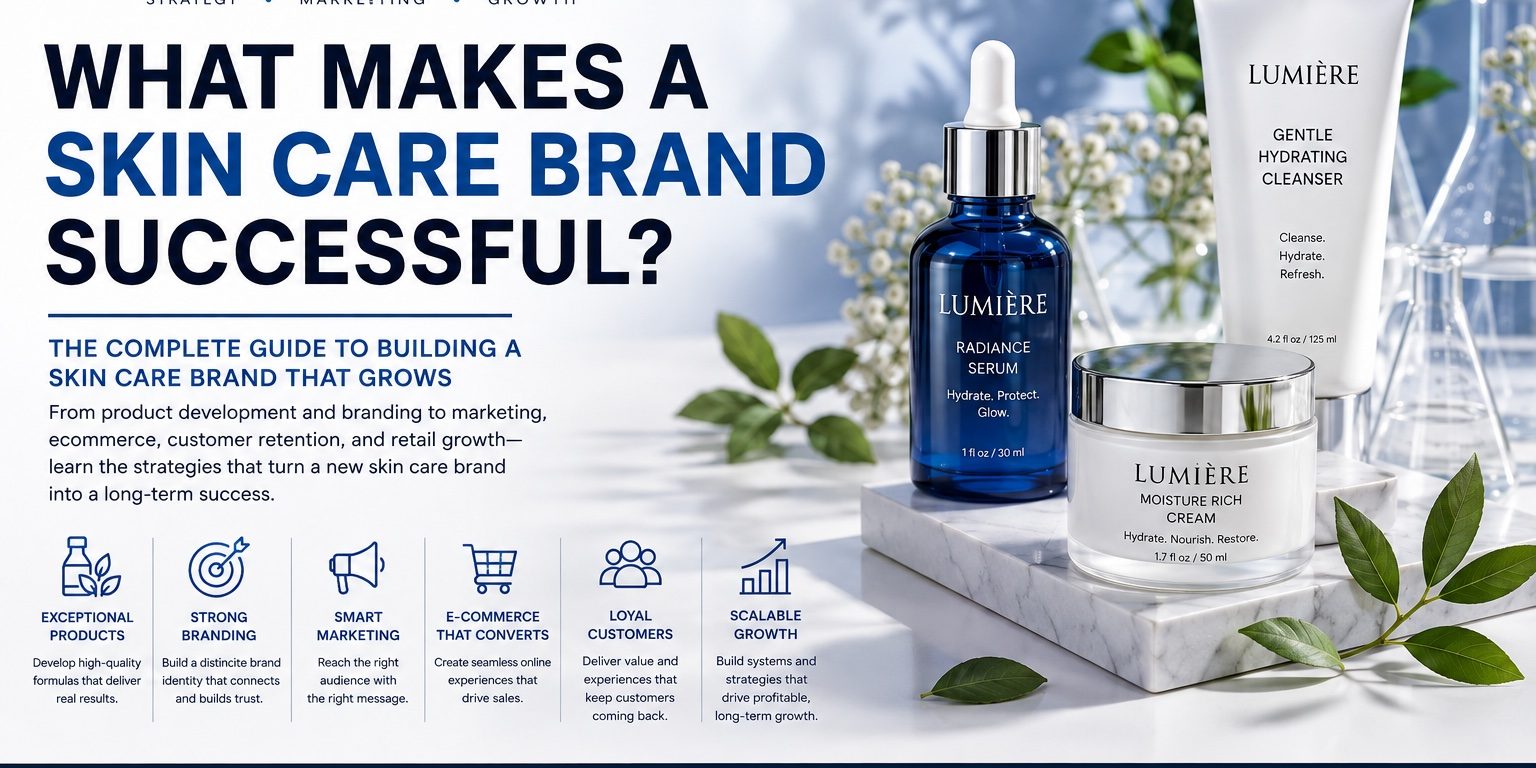
Building a successful skin care brand requires far more than developing an attractive product and launching an ecommerce website. Today’s skin care market includes emerging brands, established manufacturers, dermatologist-developed products, clinical formulations, luxury lines, clean beauty companies, celebrity-backed businesses, and mass-market competitors all fighting for consumer attention.
Yet new brands continue to break through.
The difference is rarely one marketing tactic, breakthrough ingredient, or beautiful package. Successful skin care companies align product strategy, market positioning, formulation, branding, packaging, pricing, distribution, customer acquisition, retention, and operational execution around a clearly defined opportunity.
A great formulation without differentiation can disappear in a crowded category. Strong branding cannot compensate indefinitely for an average product. Advertising can generate initial sales, but poor margins or weak repeat purchase rates can make growth financially unsustainable. Retail distribution can dramatically increase exposure while simultaneously creating inventory and cash-flow problems if the company is not prepared to support expansion. Retail marketing efforts when not done right, can lack delivering the much needed momentum at the start.
The strongest brands understand how these elements work together.
This article examines what makes a successful skin care brand from initial concept through sustained market growth, including the strategic decisions that separate scalable businesses from brands that struggle to gain traction.
Success Begins Before the Product Launch
One of the most consequential periods in the life of a skin care company occurs before consumers ever see the product.
Founders frequently begin with a product idea. They may envision a moisturizer, serum, cleanser, acne solution, anti-aging formulation, body treatment, or another product they believe consumers will want.
However, developing the product first and determining how to sell it afterward can create significant problems.
Successful brand development begins with a larger question:
What meaningful position can this brand occupy in the market?
The objective is not simply to manufacture another skin care product. It is to create a compelling reason for a particular customer to choose that product instead of hundreds of available alternatives.
Before investing heavily in formulations, packaging, inventory, website development, or advertising, founders should understand:
- Who the ideal customer is
- Which problem or desire the brand addresses
- Why existing solutions are insufficient
- Which competitors already serve the market
- How the brand will differentiate itself
- What consumers are willing to pay
- Where customers are likely to discover the product
- Which sales channels make economic sense
- Whether the margins can support profitable growth
- What could make customers purchase repeatedly
This strategic foundation influences almost every decision that follows.
Validate the Market Opportunity
A compelling idea does not automatically represent a compelling business opportunity.
Before committing substantial capital, skin care entrepreneurs should evaluate whether sufficient demand exists and whether the market provides room for meaningful differentiation.
Market validation can include:
- Competitor research
- Keyword and search-demand analysis
- Consumer reviews
- Social media conversations
- Marketplace research
- Retail assortment analysis
- Customer interviews
- Product trend analysis
- Pricing research
- Small-scale product testing
Customer reviews of competing products can be particularly valuable. Consumers routinely explain what they like, dislike, wish were different, or cannot find.
These insights can reveal opportunities involving texture, packaging, ingredients, price, product size, application, positioning, or specific skin concerns.
The goal is not to copy competitors. It is to understand where customer expectations are being met and where gaps may remain.
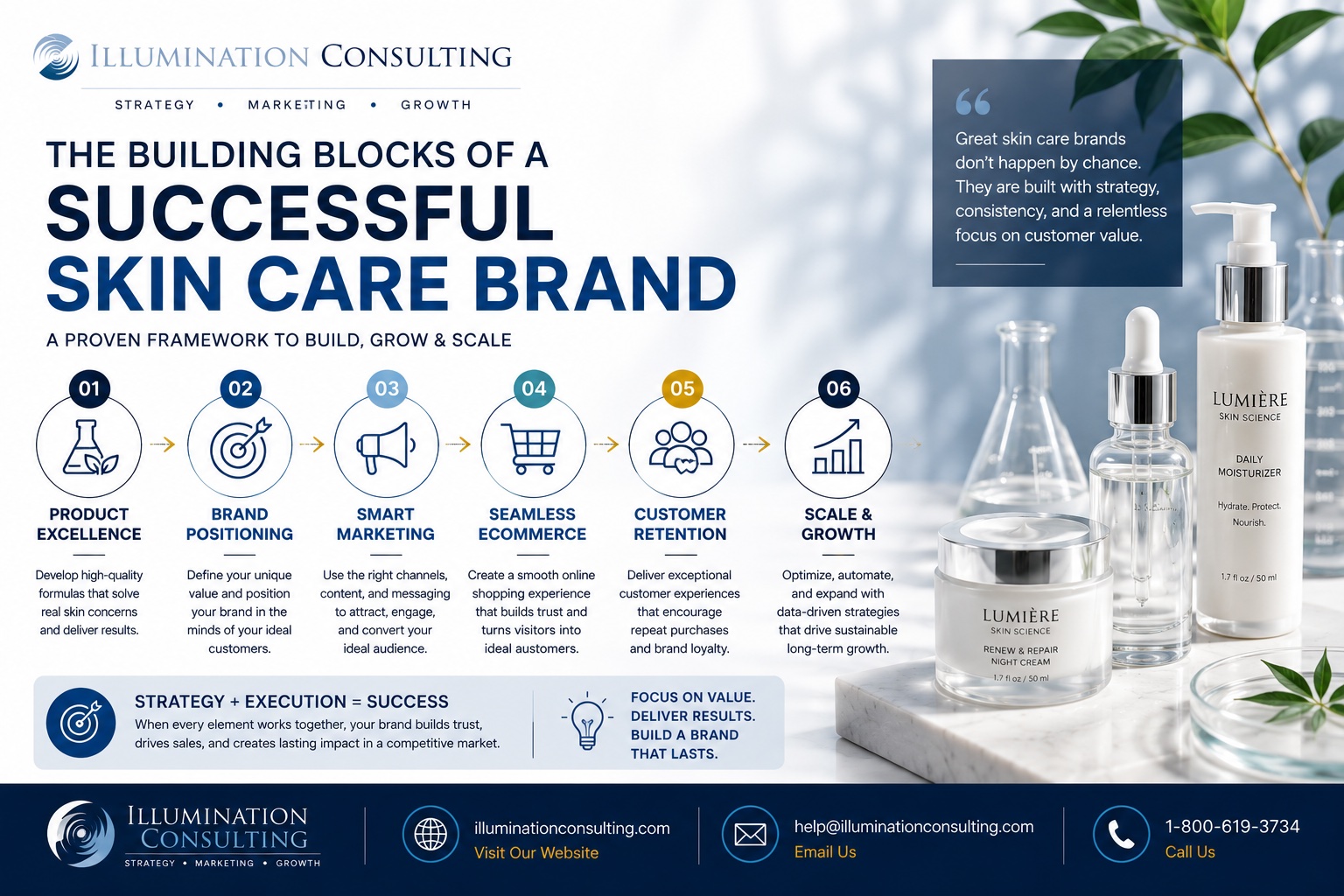
Define the Customer Before Defining the Brand
Skin care companies sometimes describe their target audience so broadly that the definition becomes almost meaningless.
“Women interested in skin care” is not a useful customer profile.
Neither is “people who want healthier skin.”
Successful brands develop a much deeper understanding of the people they intend to serve.
The target customer may be defined through a combination of:
- Age and life stage
- Skin concerns
- Purchasing power
- Lifestyle
- Beauty routines
- Product preferences
- Values
- Shopping behavior
- Preferred retailers
- Digital habits
- Geographic location
- Brand expectations
For example, the customer purchasing a $160 clinical anti-aging serum may have very different expectations from someone purchasing a $24 daily moisturizer.
Those differences influence product development, messaging, packaging, photography, pricing, advertising, website design, influencer partnerships, and distribution.
The clearer the customer becomes, the easier it is to build a coherent brand around that customer.
Find a Defensible Position in the Skin Care Market
Differentiation is one of the greatest challenges facing emerging skin care companies.
Consumers already have enormous choice. Another serum, moisturizer, cleanser, or eye cream does not automatically give shoppers a reason to change their existing routines.
A new brand therefore needs more than attractive packaging and claims about quality.
It needs a recognizable position that customers can understand quickly.
That position might develop around:
- A specific skin concern
- Ingredient innovation
- Clinical credibility
- Proprietary formulations
- Dermatologist involvement
- A particular demographic
- Sensitive skin
- Luxury positioning
- Simplified routines
- Professional-grade products
- Sustainability
- A distinctive lifestyle or philosophy
However, differentiation must be commercially meaningful.
A feature matters only when the target customer values it enough to influence purchasing behavior.
Strong positioning ultimately answers three questions:
Who is this brand for?
Why should that customer care?
Why should they choose this brand instead of another?
When those answers are unclear, marketing becomes significantly more expensive because every advertisement must work harder to explain why the brand deserves attention.
Build a Brand Consumers Can Recognize
A skin care brand is much more than its logo.
The brand represents the complete collection of associations consumers develop through packaging, photography, messaging, website design, advertising, social media, customer service, product experience, and reputation.
Strong skin care branding creates consistency across these touchpoints.
Important brand elements include:
- Name
- Logo
- Color system
- Typography
- Packaging architecture
- Photography
- Brand voice
- Messaging
- Product naming
- Website experience
- Social media presentation
Each element should reinforce the same market position.
A premium clinical brand should not look inexpensive on its website. A youthful lifestyle brand should not communicate like a pharmaceutical company. A science-driven formulation should have enough supporting information to substantiate that positioning.
Consistency makes brands easier to recognize, remember, and trust.
For emerging companies, that recognition becomes increasingly valuable as marketing exposure grows.
Build Products Around a Cohesive Strategy
A successful skin care brand does not need dozens of products to establish credibility. In fact, launching too many products too early can create unnecessary operational complexity and dilute marketing resources.
Every additional SKU introduces new requirements involving formulation, packaging, manufacturing, inventory, photography, website merchandising, fulfillment, forecasting, and promotion.
For emerging brands, a focused product portfolio often creates a stronger foundation.
Each product should have a clear role within the assortment. Products should complement one another while addressing specific customer needs rather than existing simply to make the catalog appear larger.
A strategic product portfolio considers:
- Customer demand
- Product differentiation
- Manufacturing requirements
- Gross margins
- Repeat purchase potential
- Cross-selling opportunities
- Inventory requirements
- Customer routines
- Competitive positioning
- Future product expansion
The objective is to build a collection that makes commercial sense as well as cosmetic sense.
Develop a Hero Product
Many successful skin care companies initially become known for one exceptional product.
A hero product gives consumers something specific to remember. It also gives advertising, public relations, influencers, social media, and retail buyers a clear focal point.
Instead of introducing consumers to ten unfamiliar products simultaneously, the company can build awareness around one compelling solution.
Once customers trust that product, the brand can introduce complementary products and expand the relationship.
For example, a customer might initially purchase a serum before adding a cleanser, moisturizer, eye treatment, mask, or complementary treatment.
This creates a natural progression from customer acquisition toward increased average order value and customer lifetime value.
A strong hero product can therefore function as both a product-development strategy and a customer-acquisition strategy.
Product Quality Must Support the Brand Promise
Marketing creates expectations.
The product must fulfill them.
Skin care businesses are particularly dependent on customer experience because long-term profitability often relies heavily on repeat purchases.
Consumers evaluate more than whether a formulation technically works. They experience the entire product.
That experience includes:
- Texture
- Absorption
- Fragrance
- Application
- Packaging functionality
- Product stability
- Routine compatibility
- Visible results
- Perceived quality
- Overall value
When the experience matches or exceeds expectations, satisfied customers can become one of the company’s strongest growth assets.
They generate reviews, referrals, testimonials, repeat purchases, recommendations, and user-generated content.
However, aggressive marketing can become counterproductive when the actual experience does not support the promise. Customer acquisition may initially increase while retention, reviews, and brand reputation deteriorate.
Sustainable growth requires alignment between what marketing promises and what customers actually receive.
Formulation, Claims, and Compliance Must Work Together
Skin care companies operate within a regulated environment.
Product formulation, labeling, advertising claims, website copy, packaging, influencer campaigns, and other marketing materials cannot be treated as completely independent activities.
This becomes particularly important when brands make claims involving conditions such as acne or language implying that products diagnose, treat, cure, prevent, heal, or alter bodily functions.
Companies should establish appropriate regulatory and legal review processes for their products and claims rather than attempting to resolve compliance problems after packaging and marketing materials have already been produced.
The marketing objective is still to communicate compelling benefits.
However, those benefits need to be communicated accurately and appropriately.
This coordination can involve:
- Formulation
- Testing
- Product claims
- Ingredient information
- Labeling
- Packaging
- Website content
- Advertising
- Influencer messaging
- Customer communications
Building compliance into the process from the beginning is generally easier and less expensive than correcting problems after launch.
Packaging Is Part of the Product Experience
Packaging performs several jobs simultaneously.
It protects the formulation, communicates positioning, influences perceived value, affects usability, creates shelf presence, and contributes heavily to photography, social media, advertising, and ecommerce merchandising.
Consumers often encounter the package before experiencing the formulation.
That means packaging can influence whether someone stops scrolling, clicks an advertisement, picks up a product in a store, or considers the brand credible enough to purchase.
Effective skin care packaging balances:
- Visual differentiation
- Brand consistency
- Product protection
- Functionality
- Regulatory requirements
- Manufacturing feasibility
- Shipping durability
- Cost
- Sustainability
- Retail presentation
The appropriate solution depends on the brand.
A prestige product may require packaging that communicates luxury and justifies a higher price. A clinically positioned product may benefit from a cleaner, more technical aesthetic. A sustainability-focused company may prioritize material choices and reduced packaging.
However, design cannot be evaluated independently from economics.
Beautiful packaging that destroys margins or creates fulfillment problems is not successful packaging. Neither is inexpensive packaging that undermines the intended brand position.
The objective is alignment between presentation, functionality, positioning, and profitability.
Establish Pricing That Supports Growth
Pricing is both a branding decision and a financial decision.
Skin care entrepreneurs sometimes establish retail prices primarily by comparing competing products. Competitive analysis is useful, but sustainable pricing requires understanding the complete economics underneath each SKU.
Brands should account for costs involving:
- Formulation and manufacturing
- Primary packaging
- Secondary packaging
- Freight
- Warehousing
- Fulfillment
- Payment processing
- Returns
- Discounts
- Samples
- Advertising
- Influencer programs
- Retail margins
- Distributor margins
A product can appear highly profitable when its retail price is compared only with manufacturing cost. Once customer acquisition and operating expenses are included, the economics may look substantially different.
Pricing also communicates market position.
A product priced substantially below its competitive set may attract price-sensitive customers but undermine a premium positioning strategy. Conversely, premium pricing creates higher expectations surrounding formulation, packaging, branding, customer service, and overall experience.
Plan for Wholesale Before You Need It
This becomes particularly important for brands that eventually want retail distribution.
A pricing structure designed exclusively around direct-to-consumer sales may leave insufficient margin once retailers, distributors, brokers, promotional allowances, or other channel costs become involved.
Even if retail distribution is several years away, founders should model potential channel economics early.
This does not mean every brand should pursue wholesale.
It means today’s pricing decisions should not unnecessarily eliminate tomorrow’s opportunities.
Build an Ecommerce Experience That Sells the Product
For many emerging skin care companies, the website becomes the most important sales environment the brand controls.
An effective ecommerce website must do more than look attractive.
It must educate consumers, establish trust, communicate differentiation, answer objections, merchandise products effectively, and make purchasing easy.
Important ecommerce elements include:
- Clear navigation
- Strong product photography
- Detailed product pages
- Ingredient information
- Benefit-driven copy
- Reviews
- Usage instructions
- Routine recommendations
- Mobile optimization
- Fast page speed
- Simple checkout
- Clear shipping and return information
Skin care products frequently require more education than ordinary consumer goods.
Customers may want to understand who the product is for, how it works, when to use it, which ingredients it contains, what products complement it, and what results they can reasonably expect.
Product pages should answer those questions without overwhelming the shopper.
Treat Product Pages as Sales Assets
A product detail page should not function like a digital inventory listing.
It is one of the most important conversion assets in the entire business.
Effective product pages can combine:
- Product benefits
- Ingredient education
- Directions
- Skin-type information
- Product photography
- Lifestyle imagery
- Reviews
- Frequently asked questions
- Related products
- Routine recommendations
- Trust signals
Every unanswered question creates potential friction between interest and purchase.
Improving product pages can therefore increase revenue without requiring the company to purchase additional traffic.
That distinction becomes increasingly important as customer acquisition costs rise.
Create a Customer Acquisition System
Even an exceptional product cannot grow if consumers never discover it.
A successful skin care brand needs a diversified customer acquisition system that consistently introduces the company to qualified prospective buyers.
Depending too heavily on one channel creates risk. A brand built almost entirely through paid social advertising can struggle when advertising costs rise. A company dependent on one influencer can lose momentum when that relationship ends. A brand relying exclusively on organic social media remains vulnerable to algorithm changes.
Stronger acquisition strategies combine multiple channels, including:
- Search engine optimization
- Paid search
- Paid social media
- Organic social media
- Influencer marketing
- Content marketing
- Email marketing
- Public relations
- Affiliate marketing
- Retail exposure
- Strategic partnerships
Not every channel needs equal investment.
The objective is to identify which channels produce qualified customers at economics the business can sustain.
Match Marketing Channels to Customer Behavior
Marketing decisions should follow the customer rather than the latest industry trend.
Different audiences discover skin care products differently.
Some consumers begin with Google searches for specific concerns. Others discover brands through Instagram, TikTok, YouTube, dermatologists, estheticians, beauty publications, retailers, influencers, or recommendations from friends.
Understanding those discovery patterns helps determine where marketing resources should be concentrated.
For example, a clinically positioned brand may benefit heavily from educational search content and expert credibility. A visually distinctive lifestyle brand may perform exceptionally well through social media and creator partnerships.
The strongest channel mix reflects the brand’s actual customer journey.
Build Organic Search Visibility
Search engine optimization can become one of the most valuable long-term acquisition assets for a skin care company.
Consumers perform enormous numbers of searches related to ingredients, skin concerns, routines, product categories, and specific solutions.
Those searches create opportunities to reach customers while they are actively researching their needs.
A comprehensive skin care SEO strategy can include:
- Product optimization
- Category pages
- Ingredient content
- Skin concern guides
- Educational articles
- Comparison content
- Frequently asked questions
- Technical SEO
- Internal linking
- Structured data
Unlike advertising, organic content can continue generating traffic long after it is published.
However, SEO should not become an exercise in publishing large quantities of generic articles.
Content needs to support genuine customer questions while reinforcing the commercial areas where the company wants authority.
A brand specializing in sensitive skin, for example, should develop deep topical authority around the concerns, ingredients, routines, and products relevant to that customer.
Use Content to Educate Before Asking for the Sale
Skin care consumers frequently need education before purchasing.
This creates an important role for content marketing.
High-quality content can explain:
- Ingredients
- Skin concerns
- Product benefits
- Routines
- Application methods
- Product combinations
- Seasonal skin care
- Common misconceptions
- Treatment expectations
Educational content allows the brand to demonstrate expertise without making every interaction promotional.
It can also support multiple marketing channels simultaneously.
One substantial educational article might later become social posts, short videos, email content, infographics, FAQs, product-page information, and sales materials.
This makes content an asset rather than simply another marketing expense.
Use Social Media to Create Discovery and Proof
Social media has transformed the skin care industry because products are highly visual, demonstrable, and discussion-driven.
However, successful social media marketing requires more than repeatedly posting product photography.
Strong skin care content can include:
- Product demonstrations
- Ingredient education
- Skin care routines
- Founder stories
- Behind-the-scenes content
- Customer experiences
- Expert commentary
- Frequently asked questions
- User-generated content
- Product launches
The objective is to combine discovery with credibility.
Consumers may first encounter the brand through a short video but visit the website, read reviews, search Google, examine ingredients, and view additional social content before purchasing.
Social media therefore works best as part of a larger conversion ecosystem.
Choose Influencers for Fit, Not Follower Count
Influencer marketing can generate significant awareness, but audience size alone does not determine effectiveness.
Brands should evaluate:
- Audience relevance
- Engagement quality
- Content quality
- Brand alignment
- Audience demographics
- Historical partnerships
- Credibility
- Conversion potential
A smaller creator whose audience closely matches the target customer can outperform a much larger account with weak relevance.
Brands should also measure influencer activity commercially rather than relying exclusively on impressions or engagement.
Trackable links, promotional codes, landing pages, affiliate structures, and post-purchase surveys can provide better insight into actual performance.
Use Paid Advertising to Scale What Already Works
Advertising can accelerate growth, but it should not be expected to repair weak positioning, poor conversion, or unfavorable economics.
Before aggressively increasing advertising budgets, brands should understand:
- Conversion rate
- Customer acquisition cost
- Average order value
- Gross margin
- Repeat purchase rate
- Customer lifetime value
- Return on advertising spend
- Contribution margin
These metrics determine how much the company can reasonably spend to acquire a customer.
Advertising becomes considerably more powerful when the business already has a compelling offer and an ecommerce experience that converts effectively.
Improve Conversion Before Buying More Traffic
One of the most expensive mistakes growing brands make is attempting to solve every revenue problem by purchasing additional traffic.
If 100,000 visitors reach an ecommerce website and only a small percentage purchase, increasing traffic may simply increase advertising costs.
Conversion rate optimization addresses the economics differently.
Improvements may involve:
- Stronger product pages
- Better photography
- Clearer messaging
- More prominent reviews
- Improved mobile usability
- Simplified navigation
- Better offers
- Faster checkout
- Stronger trust signals
- More effective product recommendations
Small conversion improvements can have significant financial impact because they increase the value of traffic the company is already generating.
Increase Average Order Value
Customer acquisition is expensive.
Once a consumer decides to purchase, brands should make it easy to build a more complete routine when doing so genuinely benefits the customer.
Average order value can be increased through:
- Product bundles
- Regimen sets
- Complementary recommendations
- Free-shipping thresholds
- Gift-with-purchase offers
- Travel sizes
- Product subscriptions
- Strategic upsells
The goal should not be to pressure customers into unnecessary purchases.
Effective merchandising helps customers discover products that naturally complement what they already intend to buy.
For skin care companies, routine-based merchandising can be particularly effective because products frequently work together.
Retention Is Where Strong Brand Economics Develop
Customer acquisition receives substantial attention because new customer growth is visible and exciting.
However, retention frequently determines whether a skin care company can scale profitably.
A customer who purchases once may barely recover the cost required to acquire them. A customer who purchases repeatedly can become highly valuable.
Retention strategies can include:
- Email marketing
- SMS marketing
- Replenishment reminders
- Loyalty programs
- Subscriptions
- Personalized recommendations
- Educational follow-up
- Exclusive offers
- New product introductions
- Exceptional customer service
The objective is to create reasons for customers to remain connected to the brand between purchases.
Understand the Replenishment Cycle
Skin care has an inherent advantage over many retail categories: products are consumed.
A satisfied customer eventually needs more.
Brands should understand approximately how long each product lasts and build communication around realistic replenishment periods.
If a serum typically lasts 60 days, for example, the company can create relevant communications before the customer runs out rather than waiting indefinitely for another purchase.
This can improve repeat purchase behavior without relying on constant discounting.
Build Customer Lifetime Value, Not Just First Orders
The economics of a successful skin care brand become considerably stronger when customers purchase repeatedly and expand into additional products.
Customer lifetime value can increase through:
- Better retention
- Cross-selling
- Product expansion
- Subscriptions
- Loyalty
- Higher satisfaction
- Personalized marketing
- Improved customer service
This changes how the company can approach acquisition.
A business that understands its customer lifetime value can make more informed decisions about advertising costs, promotions, influencer partnerships, and other growth investments.
Without that information, brands risk optimizing marketing around immediate revenue while overlooking long-term profitability.
Prepare the Brand for Retail Distribution
Direct-to-consumer ecommerce provides control, customer data, and potentially stronger margins. Retail distribution provides reach, credibility, physical discovery, and access to consumers who prefer shopping through established retailers.
For the right company, combining both can create substantial growth.
However, retail readiness requires more than convincing a buyer to carry the product.
Brands need to consider:
- Wholesale margins
- Inventory capacity
- Packaging requirements
- Retailer expectations
- Product education
- Merchandising
- Promotional support
- Sales forecasting
- Replenishment
- Operational capacity
Winning a retail account is only the beginning.
Products must sell through after reaching the shelf.
Support Sell-Through, Not Just Sell-In
A purchase order can create the appearance of immediate success.
However, long-term retail relationships depend on consumers purchasing the products from the retailer.
Brands should therefore support retail partners through activities such as:
- Geographic advertising
- Social media promotion
- Influencer campaigns
- Store locators
- Sampling
- Retailer-specific content
- Product education
- Launch campaigns
- In-store support
The objective is not simply getting products into stores.
It is creating enough consumer demand to keep them there.
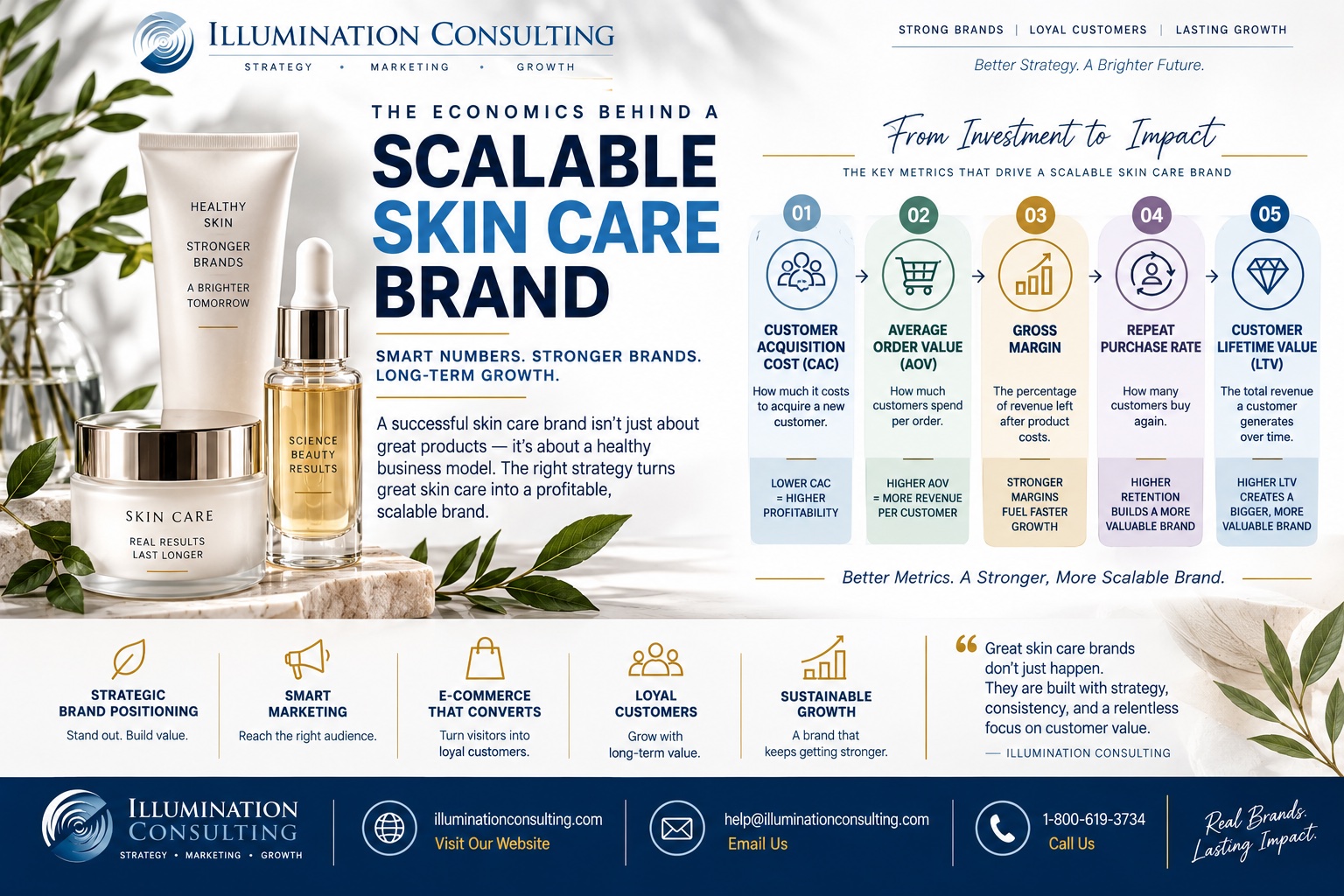
Measure the Metrics That Actually Drive Growth
Revenue is important, but revenue alone does not explain whether a skin care business is becoming healthier.
A company can increase sales while simultaneously becoming less profitable if customer acquisition costs rise, discounts increase, inventory becomes inefficient, or repeat purchase rates decline.
Leadership should monitor the metrics underneath revenue.
Important performance indicators include:
- Customer acquisition cost
- Conversion rate
- Average order value
- Gross margin
- Contribution margin
- Repeat purchase rate
- Customer lifetime value
- Return on advertising spend
- Email and SMS revenue
- Organic search traffic
- Inventory turnover
- Retail sell-through
These metrics work together.
For example, an advertising campaign may appear unsuccessful based on first-purchase return alone. However, if those customers demonstrate exceptional retention and lifetime value, the campaign economics may ultimately be attractive.
Conversely, a campaign generating impressive revenue may be unprofitable after discounts, advertising costs, fulfillment, and product costs are considered.
Successful brands increasingly make decisions using contribution and customer economics rather than vanity metrics.
Understand Customer Acquisition Cost
Customer acquisition cost measures how much the company spends to acquire a new customer.
It should be evaluated by channel because acquisition economics can differ significantly between paid social, search advertising, influencers, affiliates, organic search, and other sources.
The goal is not necessarily to achieve the lowest possible acquisition cost.
A more valuable question is whether the cost of acquiring each customer is justified by the value that customer creates.
This is why acquisition cost and customer lifetime value should rarely be evaluated independently.
Use Data Without Losing the Customer
Modern ecommerce platforms provide extraordinary amounts of information.
Skin care companies can analyze:
- Traffic sources
- Search behavior
- Product views
- Conversion paths
- Cart abandonment
- Purchase frequency
- Product combinations
- Geographic demand
- Email engagement
- Advertising performance
Data can reveal where growth is occurring and where customers encounter friction.
However, analytics should not replace direct customer understanding.
Reviews, customer service conversations, surveys, returns, social comments, and interviews can reveal motivations that dashboards cannot.
The strongest companies combine quantitative data with qualitative customer insight.
Use AI to Improve Efficiency and Decision-Making
Artificial intelligence is rapidly changing how skin care companies operate and market themselves.
AI can help businesses analyze large amounts of information, automate repetitive processes, identify patterns, and improve marketing efficiency.
Potential applications include:
- Customer segmentation
- Product recommendations
- SEO research
- Content optimization
- Advertising analysis
- Email personalization
- Customer service support
- Competitive research
- Demand forecasting
- Performance reporting
- Review analysis
- Marketing automation
However, AI should improve decision-making rather than replace strategic judgment.
A tool can identify keywords, generate content ideas, or analyze advertising performance. It cannot independently determine what a brand should stand for or why consumers should care about it.
Technology becomes most valuable when it strengthens a clear business strategy.
Know When to Expand the Product Line
Product expansion can increase revenue and customer lifetime value, but expansion should be driven by opportunity rather than impatience.
Before introducing additional products, companies should evaluate:
- Customer requests
- Existing product performance
- Cross-selling opportunities
- Market demand
- Brand positioning
- Manufacturing capacity
- Inventory requirements
- Cash-flow implications
- Marketing resources
- Retail opportunities
A new product should strengthen the existing brand ecosystem.
Launching unrelated products simply because a category is trending can dilute positioning and consume resources that might produce better returns elsewhere.
Expand Around the Customer
One of the strongest approaches to product expansion is following the existing customer’s needs.
If customers already trust the company for one stage of their routine, complementary products can extend that relationship naturally.
This approach offers several advantages.
The company already understands the customer. The audience already recognizes the brand. Existing customers provide an initial market for new products. Cross-selling becomes easier, and acquisition costs can be lower than entering an unrelated category.
Expansion becomes a continuation of the customer relationship rather than a completely new business proposition.
Avoid Scaling Before the Economics Work
Rapid growth receives enormous attention in the beauty industry.
However, scaling an inefficient business simply creates a larger inefficient business.
Before aggressively increasing advertising, inventory, staffing, or distribution, leadership should determine whether the underlying model is functioning properly.
Warning signs can include:
- Rising acquisition costs
- Weak repeat purchasing
- Heavy dependence on discounts
- Low gross margins
- Excess inventory
- High return rates
- Poor conversion
- Negative customer feedback
- Increasing fulfillment problems
- Insufficient working capital
Growth magnifies both strengths and weaknesses.
A brand experiencing operational problems at $100,000 in monthly revenue may experience significantly larger problems at $500,000.
Building systems before they become emergencies makes growth more sustainable.
Cash Flow Can Determine Whether Growth Is Sustainable
Profitability and cash flow are related, but they are not identical.
Skin care companies often pay for formulations, packaging, manufacturing, freight, and inventory long before receiving revenue from customers.
As the company grows, those requirements can increase dramatically.
Retail can create additional pressure because large purchase orders may require substantial inventory production while payment terms delay incoming cash.
Leadership should forecast:
- Inventory purchases
- Manufacturing deposits
- Freight
- Warehousing
- Payroll
- Advertising
- Retail receivables
- Seasonal demand
- Product launches
- Reorder requirements
A company can be growing rapidly and still encounter serious financial pressure if working capital is poorly managed.
Sustainable growth requires enough financial capacity to support the next stage of the business.
Build Systems That Can Support a Larger Company
Early-stage businesses often depend heavily on founders.
That is understandable initially, but it eventually becomes a constraint.
As the company grows, repeatable systems should be developed for:
- Product development
- Vendor management
- Inventory
- Marketing
- Customer service
- Fulfillment
- Reporting
- Financial management
- Retail relationships
- Content production
Documentation and automation can reduce operational dependency on individual people while improving consistency.
This becomes especially important if the long-term objective includes outside investment, acquisition, or building a company that can operate without constant founder involvement.
Common Reasons Skin Care Brands Fail to Scale
There is rarely one reason a promising brand stalls.
More often, several weaknesses compound over time.
Common problems include:
- Weak market differentiation
- Too many products too early
- Poor product economics
- Insufficient working capital
- Inconsistent branding
- Dependence on one acquisition channel
- Weak ecommerce conversion
- High customer acquisition costs
- Low repeat purchase rates
- Excessive discounting
- Premature retail expansion
- Inadequate operational systems
The solution is not necessarily more marketing.
If the underlying problem is retention, margins, positioning, conversion, or operations, increasing advertising may simply make the problem more expensive.
Effective growth strategy begins by identifying the actual constraint.
Frequently Asked Questions
What makes a skin care brand successful?
A successful skin care brand combines strong products with clear positioning, effective branding, sustainable pricing, customer acquisition, ecommerce optimization, retention, sound operations, and disciplined financial management. Long-term success comes from making these elements work together rather than relying on one product or marketing channel.
How can a new skin care brand stand out?
New brands can differentiate through a clearly defined customer, specific skin concerns, unique formulations, ingredient innovation, clinical credibility, distinctive branding, superior customer experience, or another meaningful market position. The differentiation must matter to the target customer.
How important is marketing when launching a skin care brand?
Marketing is essential because even exceptional products need visibility. However, marketing works best when the brand already has strong positioning, competitive products, effective packaging, sustainable margins, and a website capable of converting traffic into customers.
Should a skin care brand start with many products?
Not necessarily. A focused assortment can reduce inventory requirements and concentrate marketing resources. Many successful brands initially build recognition around a hero product before expanding into complementary products based on customer demand.
How do skin care brands create long-term growth?
Long-term growth usually requires balancing customer acquisition with retention, increasing customer lifetime value, maintaining healthy margins, expanding products strategically, diversifying marketing channels, managing cash flow, and building operational systems that can support scale.
Build a Skin Care Brand Designed for Sustainable Growth
There is no single formula for creating a successful skin care brand.
The strongest companies align product quality, market positioning, branding, packaging, pricing, ecommerce, marketing, customer retention, distribution, operations, and financial discipline around a clearly defined customer.
That alignment creates leverage.
Better positioning improves advertising. Better products improve retention. Better retention improves customer economics. Better economics allow greater investment in acquisition. Stronger operations make expansion possible without sacrificing customer experience.
The result is not simply a skin care company that can generate sales.
It is a business capable of creating durable market value.
At Illumination Consulting, we work with skin care companies across critical stages of business development and growth. Our services include skin care business consulting, marketing strategy, search engine optimization, ecommerce website design, branding, retail marketing, product and packaging support, and growth strategy.
Whether you’re developing a new concept, preparing a product launch, improving an existing ecommerce business, expanding into retail, or trying to move beyond a growth plateau, the objective should remain the same: identify the constraints preventing the next stage of growth and build the strategy, marketing, and infrastructure required to overcome them.