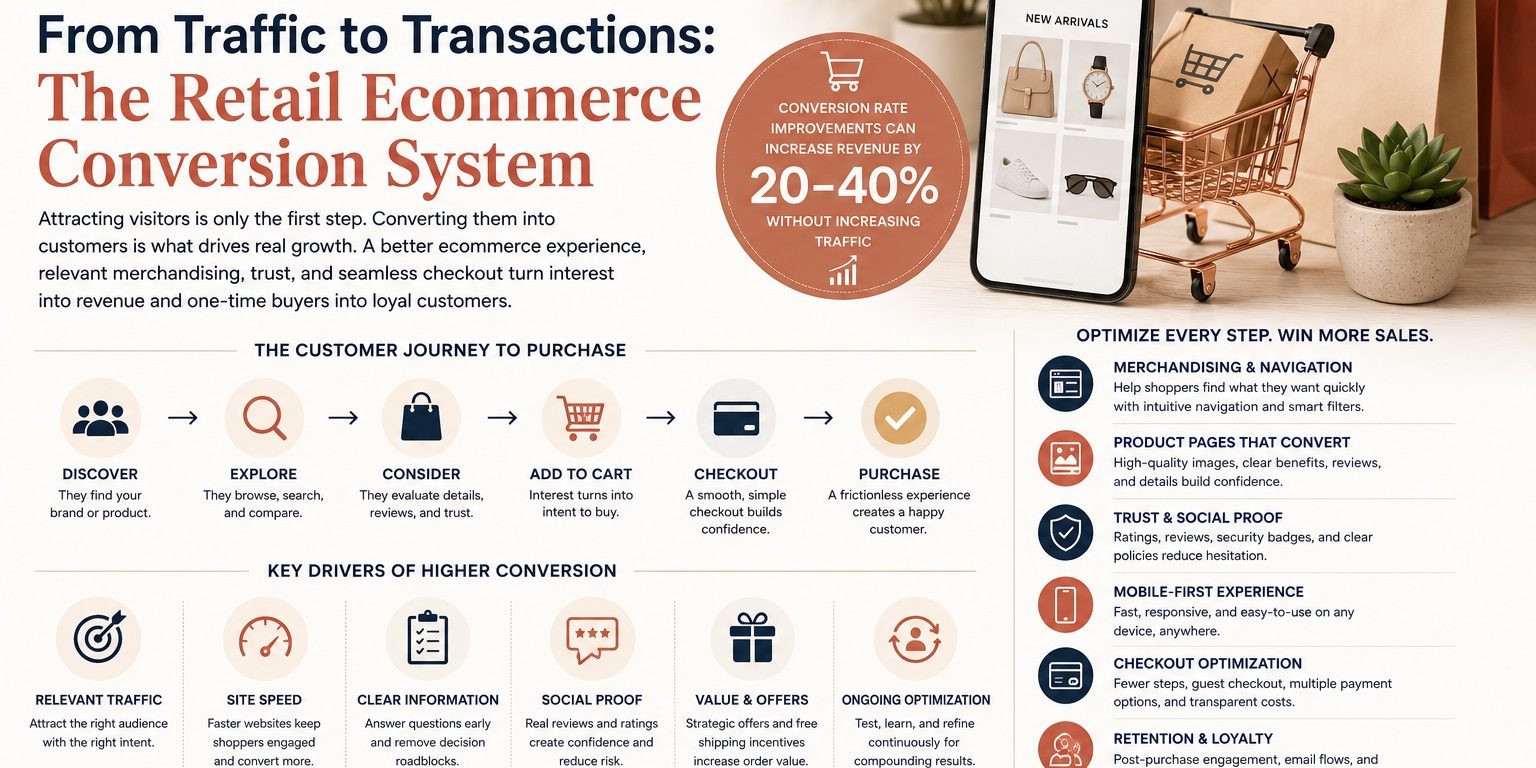
Retailers spend enormous amounts of time and money trying to attract more website visitors. They invest in paid advertising, search engine optimization, social media, influencers, email campaigns, content, public relations, and promotions, all designed to bring potential customers into the ecommerce environment. Yet traffic alone does not create a successful retail business. The website still has to turn those visitors into customers, and relatively small weaknesses throughout the shopping experience can cause a substantial amount of otherwise valuable demand to disappear.
This makes retail ecommerce conversion one of the most important financial levers available to an established retailer. Improving conversion allows a company to generate more revenue from traffic it already possesses rather than continually paying to acquire additional visitors. It can also improve advertising economics, reduce customer acquisition pressure, increase the productivity of organic traffic, and make virtually every other retail marketing investment more valuable. When conversion improves sustainably, the benefits can compound throughout the business.
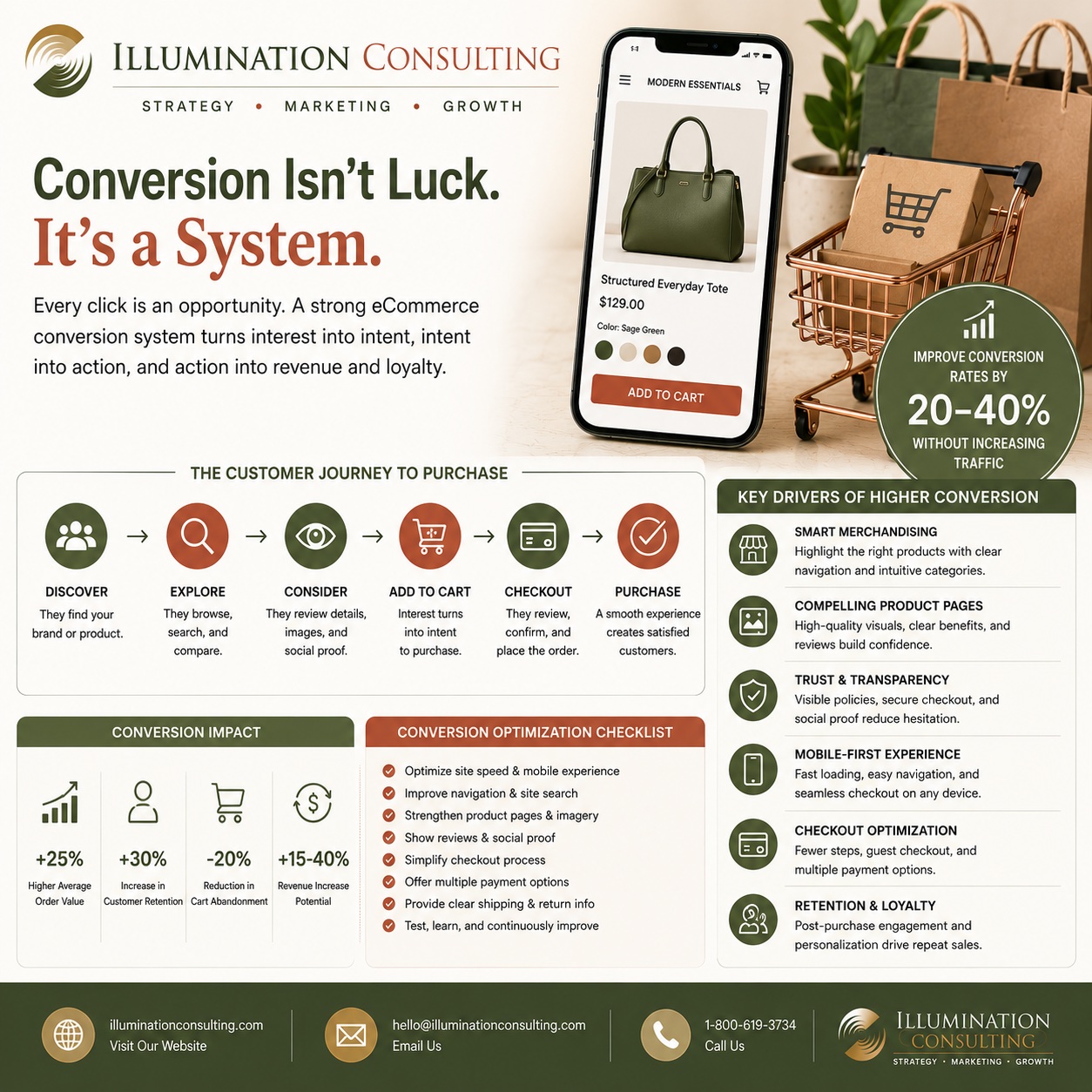
Conversion optimization, however, should not be reduced to changing button colors or adding another promotional pop-up. A customer’s decision to purchase reflects the entire ecommerce experience, including brand credibility, product assortment, merchandising, photography, pricing, navigation, search, reviews, shipping, mobile usability, website performance, checkout, and trust. Strong conversion therefore comes from building a coherent commercial system rather than accumulating isolated optimization tactics.
Understand What Conversion Rate Really Measures
An ecommerce conversion rate generally represents the percentage of website visits that result in a desired action, most commonly a completed purchase. If 100,000 visits produce 2,000 orders, the website has a 2% purchase conversion rate. That number provides a useful benchmark, but the overall percentage alone cannot explain why customers purchase or where potential revenue is being lost.
Retailers should examine conversion throughout the funnel. A shopper must typically navigate several stages before completing a transaction: entering the website, discovering relevant merchandise, viewing products, adding something to the cart, beginning checkout, and completing payment. Each transition provides information about customer behavior and potential friction.
For example, strong product-page traffic combined with a weak add-to-cart rate suggests a different problem than a strong add-to-cart rate followed by high checkout abandonment. The first may indicate issues with pricing, merchandise, photography, product information, or trust. The second may point toward shipping costs, payment options, checkout complexity, or unexpected fees.
Effective retail ecommerce conversion work begins by identifying precisely where customers stop progressing.
Stop Treating Every Visitor as Equally Valuable
Traffic quality has a direct relationship with conversion. A retailer can increase website visits substantially while lowering its overall conversion rate if the new audience has weak purchasing intent. Conversely, a smaller group of highly qualified visitors may generate significantly more revenue.
Retailers should therefore segment conversion performance by acquisition source. Organic search, branded search, paid social, Google Ads, email, direct traffic, influencers, affiliates, and referral sources can produce dramatically different customer behavior.
Important comparisons include:
- Conversion rate by traffic source
- New versus returning visitor conversion
- Mobile versus desktop conversion
- Branded versus non-branded search
- Geographic conversion
- Conversion by landing page
- Conversion by campaign
These comparisons help distinguish an acquisition problem from a website problem. If qualified returning customers convert well while a particular advertising campaign performs poorly, redesigning the entire website may not be the answer. The campaign may simply be attracting the wrong audience.
Make the Homepage Establish Relevance Quickly
The homepage is not always the highest-converting page on a retail website, but it frequently serves as an important orientation point. Customers arriving there should understand what the company sells, how the brand is positioned, and where they should go next without unnecessary effort.
A homepage becomes less effective when it attempts to communicate everything simultaneously. Too many promotions, competing banners, excessive categories, overlapping calls to action, and unclear visual hierarchy can force visitors to process more information than necessary. Retailers should instead establish clear priorities based on customer behavior and commercial importance.
Strong homepage merchandising may emphasize key categories, best sellers, new arrivals, seasonal collections, major differentiators, and strategically important promotions. The exact composition should change as customer demand, inventory, and business priorities change. A retail homepage should function as active merchandising space rather than a static corporate brochure.

Build Navigation Around How Customers Shop
Internal organizational structures do not always match the way consumers think. A retailer may organize merchandise according to purchasing departments, internal product classifications, or supplier structures that make perfect sense to employees but create unnecessary friction for customers.
Navigation should reflect customer language and shopping intent. Category names should be recognizable, product hierarchies should be logical, and important merchandise should not require several layers of navigation to discover. Retailers with large assortments also need effective filtering so shoppers can narrow choices without repeatedly starting over.
Useful filters vary by category but may include size, color, price, brand, material, features, availability, rating, style, or intended use. The goal is not offering the largest possible number of filters. It is helping customers reduce a large assortment into a manageable set of relevant choices.
Treat Site Search as a High-Intent Sales Tool
Customers who use internal search frequently know what they want. That makes site search commercially important, particularly for retailers with extensive catalogs. Poor search results can lose customers who were already demonstrating meaningful purchase intent.
Search functionality should account for common product terminology, synonyms, misspellings, categories, brands, and relevant attributes. Results should also prioritize useful merchandise rather than merely matching exact text. If customers repeatedly search for terms that produce no results, those searches can reveal gaps in navigation, merchandising, content, or assortment.
Search data can also provide direct insight into demand. What customers type into the search box tells retailers what people expect to find.
Turn Category Pages Into Digital Merchandising Environments
Category pages occupy a critical position between discovery and product evaluation. They need to help shoppers understand the assortment, compare options, and identify products worthy of closer consideration. Yet many ecommerce websites treat category pages as little more than grids of product thumbnails.
Strong category merchandising can incorporate best sellers, new arrivals, relevant subcategories, filters, product badges, customer ratings, promotional collections, and concise educational guidance. The appropriate combination depends on the complexity of the merchandise and the customer’s familiarity with the category.
Product ordering also matters. Automatically displaying products according to arbitrary database rules can bury commercially important merchandise. Retailers should consider demand, inventory, margin, seasonality, conversion, and strategic priorities when determining what shoppers encounter first.
Use Merchandising to Reduce Choice Overload
Large assortments can be an advantage until customers struggle to distinguish between options. When dozens of similar products appear without meaningful guidance, shoppers may postpone the decision rather than investigate every alternative.
Retailers can reduce this friction through comparisons, best-seller indicators, curated collections, recommended uses, product attributes, and clear differentiation. Instead of merely presenting choices, the website should help customers understand those choices.
This is one reason ecommerce merchandising directly influences conversion. Better organization reduces the cognitive work required to purchase.
Make Product Pages Answer Buying Questions
The product detail page is one of the most commercially important components of a retail website. By the time shoppers reach it, they have demonstrated interest in a specific item. The page now needs to provide enough information and confidence for them to continue toward purchase.
Effective product pages combine persuasion with practical information. Depending on the merchandise, customers may need product benefits, specifications, dimensions, ingredients, materials, sizing, compatibility, usage instructions, inventory status, shipping expectations, reviews, and return information. The objective is to anticipate the questions that prevent someone from confidently clicking “Add to Cart.”
Strong product copy should also distinguish benefits from features. A specification explains what something is; a benefit helps the customer understand why that characteristic matters. Retailers frequently need both.
Product Photography Must Replace Physical Inspection
Online shoppers cannot pick up an item, rotate it, examine its texture, compare its scale, or inspect details in person. Product imagery has to compensate for much of that missing physical experience.
Depending on the category, retailers can use multiple angles, close-up details, lifestyle photography, scale references, product-in-use imagery, texture images, video, or interactive views. The appropriate visual system depends on what customers need to evaluate before purchasing.
High-quality imagery is not merely decorative. It reduces uncertainty, communicates quality, supports positioning, and can directly influence conversion.
Use Social Proof to Reduce Purchase Uncertainty
Customers rarely evaluate products based solely on what the retailer says about them. They also want evidence from other buyers. Reviews, ratings, customer photographs, testimonials, questions and answers, and user-generated content can all reduce uncertainty by showing that real people have purchased and experienced the product.
However, social proof should be useful rather than decorative. A five-star rating provides some reassurance, but detailed reviews can answer practical questions about fit, quality, durability, appearance, performance, sizing, or ease of use. Retailers can make this information easier to navigate by allowing shoppers to sort or filter reviews when sufficient volume exists.
Negative reviews should not automatically be viewed as a problem. A realistic distribution of customer feedback can increase credibility, while recurring complaints can identify genuine product or merchandising issues. The objective is not manufacturing perfect social proof. It is giving customers reliable information that helps them make better decisions.
Make Trust Visible Throughout the Shopping Experience
Trust influences conversion at every stage of ecommerce. Customers are being asked to provide payment information and purchase something they cannot physically inspect from a business they may never have encountered before. The website needs to reduce that perceived risk.
Trust can be strengthened through professional design, secure checkout, transparent policies, accurate product information, authentic reviews, recognizable payment methods, accessible customer service, and clear business information. Retailers should also make shipping and return expectations easy to locate rather than forcing customers to search for them after they become interested in a product.
Trust becomes particularly important for unfamiliar brands. Established retailers benefit from accumulated recognition, while emerging companies need to establish credibility more deliberately. In either case, inconsistencies, outdated pages, broken functionality, weak photography, or unclear policies can undermine confidence quickly.
Do Not Hide Information Customers Need to Decide
Retailers sometimes delay potentially undesirable information, such as shipping costs or return restrictions, until late in the checkout process. This may preserve earlier funnel metrics, but it can create frustration when customers finally encounter the information.
Transparency generally produces a healthier conversion system. Customers should understand relevant shipping thresholds, delivery expectations, return policies, subscriptions, warranties, or other significant purchasing conditions before committing substantial effort to checkout.
The objective is not maximizing the number of people who begin checkout. It is increasing the number of qualified customers who confidently complete purchases.
Optimize Ecommerce for Mobile Behavior
Mobile commerce should be treated as its own customer experience rather than a smaller version of desktop ecommerce. Shoppers using smartphones have less screen space, different navigation behavior, and often less patience for unnecessary friction. They may also be shopping while distracted, traveling, watching television, or moving between other applications.
Retailers should evaluate mobile navigation, site search, filters, product imagery, page speed, calls to action, forms, cart functionality, and checkout independently. A feature that feels effortless with a mouse and large monitor can become frustrating on a phone.
Particular attention should be given to product-page hierarchy. The most important information and actions should appear without requiring excessive scrolling or interaction. Customers should be able to understand the product, evaluate key information, select relevant options, and add it to their cart efficiently.
Remove Mobile Friction One Step at a Time
Mobile conversion problems often result from several small obstacles rather than one catastrophic design flaw. A slow image, awkward filter, intrusive pop-up, difficult size selector, tiny button, and lengthy checkout form may each reduce conversion slightly. Together, they can materially affect revenue.
Retailers should test the complete mobile shopping journey regularly on actual devices. Analytics reveal where customers leave, but direct usability testing can help explain why.
Improving several small points of friction can sometimes produce a meaningful aggregate improvement in retail ecommerce conversion.
Treat Website Speed as a Revenue Issue
Page performance affects both usability and customer patience. Retail websites are especially vulnerable because they often contain large product catalogs, high-resolution photography, tracking scripts, advertising technology, personalization tools, reviews, recommendations, and third-party applications.
Each addition may appear individually reasonable while collectively creating a slow website.
Retailers should monitor performance across important templates, including:
- Homepage
- Category pages
- Product pages
- Search results
- Cart
- Checkout
Performance should also be evaluated on mobile networks rather than only fast office connections.
The goal is not achieving a perfect technical score at the expense of useful functionality. It is maintaining a sufficiently fast experience while preserving the merchandising and customer features that contribute to sales.
Build a Cart That Encourages Completion
The shopping cart occupies an interesting position in the conversion journey. Customers have demonstrated meaningful intent, but the transaction is not yet complete. The cart should reinforce the purchase while making the next step obvious.
Useful cart information can include product selections, quantities, pricing, estimated shipping, promotional discounts, availability, and a clear checkout action. Relevant cross-sells can sometimes increase order value, but the cart should not become so crowded with additional offers that customers lose focus.
Retailers should also consider whether customers can easily modify quantities or remove products. Forcing shoppers backward through the website to make simple adjustments creates unnecessary friction.
Use Free-Shipping Thresholds Strategically
Shipping costs can strongly influence ecommerce behavior. A free-shipping threshold can simultaneously reduce shipping objections and encourage customers to increase order value.
The threshold should be based on economics rather than an arbitrary round number. Retailers can analyze current average order value, gross margin, shipping costs, and purchasing behavior to determine an appropriate level.
If the average order is $82, for example, a strategically chosen threshold somewhat above that amount may encourage customers to add another relevant item. However, a threshold set unrealistically high may provide little motivational value.
Eliminate Checkout Friction
Checkout is where accumulated customer intent becomes revenue. Every unnecessary obstacle at this stage deserves scrutiny because the retailer has already invested resources to bring the customer this far.
Common checkout friction includes mandatory account creation, excessive form fields, unclear error messages, limited payment options, unexpected shipping costs, confusing promotional code fields, poor mobile usability, and unnecessary navigation.
Retailers should make completion straightforward while still collecting information genuinely required to fulfill the transaction.
Guest checkout is particularly important for many businesses. Customers should not necessarily be required to establish a formal account before making their first purchase. Account creation can be offered after the transaction when the value is easier to communicate.
Offer Payment Methods Customers Expect
Payment preferences continue to evolve. Depending on the retailer’s audience and geography, customers may expect traditional credit cards alongside digital wallets or other payment methods.
The correct payment mix depends on the business, but retailers should examine whether limited payment options are creating avoidable abandonment. Mobile wallets can be particularly useful because they reduce the amount of information customers need to enter manually on smartphones.
Payment convenience should reduce friction without unnecessarily complicating the checkout interface.
Recover Abandoned Carts Without Creating Bad Incentives
Cart abandonment is a normal part of ecommerce. Customers become distracted, compare alternatives, reconsider spending, encounter shipping costs, or simply decide they are not ready.
Automated recovery campaigns can reconnect with some of those customers through email or SMS. However, immediately offering a discount after every abandoned cart can train shoppers to intentionally abandon purchases in anticipation of an incentive.
A stronger sequence may begin with a simple reminder, followed by useful product or customer-service information. Discounts can be reserved for situations where they are economically justified.
The objective is recovering genuine purchase intent without creating unnecessary promotional dependency.
Increase Average Order Value Through Relevant Merchandising
Conversion rate receives substantial attention, but the value of each converted order matters as well. If a retailer improves both conversion and average order value, the financial impact can compound.
Average order value can be influenced through complementary products, bundles, quantity incentives, premium alternatives, free-shipping thresholds, and carefully designed upsells. However, recommendations should remain contextually relevant.
A customer purchasing cookware may appreciate complementary utensils. Someone buying footwear may need care products. A shopper purchasing electronics may need compatible accessories. These recommendations improve the transaction because they anticipate additional needs.
Random cross-selling does the opposite. It adds noise without increasing customer value.
Use Bundles to Simplify Decisions
Bundles can improve both merchandising and transaction value when products naturally belong together. They can reduce the effort required to assemble a complete solution while helping customers discover products they may otherwise overlook.
Effective bundles may be organized around:
- Use cases
- Product routines
- Occasions
- Complementary items
- Starter collections
- Seasonal needs
Retailers should understand the margin implications before introducing bundle discounts. Bundling does not necessarily require aggressive price reductions. Convenience and curation can themselves create value.
Personalize Without Making the Experience Complicated
Personalization can improve ecommerce conversion when it helps customers discover relevant merchandise faster. Product recommendations based on browsing behavior, previous purchases, category interest, geography, or other appropriate signals can reduce the amount of searching required.
However, personalization should not become a layer of complexity that makes the website unpredictable. Customers still need understandable navigation, consistent categories, reliable search, and the ability to explore freely.
The strongest personalization is often subtle. It improves relevance without forcing the customer to understand why the website is behaving differently.
Use Returning-Customer Data Intelligently
Returning customers provide particularly valuable opportunities because the retailer already has behavioral information.
Depending on customer consent and available data, the experience may incorporate previous purchases, recently viewed products, loyalty status, replenishment needs, saved items, or relevant recommendations. This can reduce friction and increase the usefulness of the shopping experience.
The objective is convenience rather than surveillance. Personalization should feel helpful and proportionate to the relationship the customer has established with the retailer.
Improve Conversion Through Better Offers, Not Constant Discounts
A weak conversion rate can tempt retailers to increase promotional intensity. Discounts frequently produce an immediate response, but they can also conceal deeper problems with positioning, merchandising, customer experience, or perceived value.
Before reducing prices, retailers should determine why customers are hesitating.
Alternative offers can include free shipping, product bundles, gifts with purchase, loyalty benefits, limited editions, added services, extended warranties, or exclusive access. Depending on the category, these can create additional perceived value while protecting margin.
Price is one conversion lever. It should not become the only one.
Use Testing to Replace Opinions With Evidence
Retail teams can spend significant time debating what customers might prefer. Conversion optimization provides a better approach: test meaningful hypotheses and observe actual behavior. A/B testing can help retailers evaluate changes to product-page structure, merchandising, promotional messaging, checkout elements, navigation, calls to action, and other commercially important components.
Testing should focus on changes with a credible connection to customer behavior. Randomly changing colors, wording, or layouts simply because testing software makes it possible can create activity without useful learning. Instead, each experiment should begin with an identified problem, a hypothesis about why it exists, and a measurable expectation for improvement.
Retailers also need sufficient traffic for testing to produce meaningful results. Smaller ecommerce businesses may gain more from qualitative research, analytics, customer feedback, and established usability principles than from running dozens of statistically weak experiments.
Measure More Than Conversion Rate
A test that increases conversion can still damage the business if it reduces average order value, margin, customer quality, or retention. Therefore, optimization decisions should consider the broader economics of each change.
Important metrics can include conversion rate, revenue per visitor, average order value, gross margin, contribution margin, return rate, new customer rate, and customer lifetime value. The correct measurement depends on what the experiment is designed to improve.
For example, an aggressive discount may increase conversion immediately while reducing revenue quality. A slightly lower conversion rate from full-price customers could ultimately produce stronger profitability.
Analyze Conversion by Product and Category
A sitewide conversion rate can hide substantial variation within a retail catalog. Some categories may convert exceptionally well while others struggle. Likewise, individual products can attract significant traffic but produce few purchases.
Retailers should analyze performance at multiple levels, including category, product, device, traffic source, and customer segment. This helps identify where optimization resources can generate the greatest return.
A poorly converting product may suffer from weak photography, inadequate information, negative reviews, inappropriate pricing, low inventory, or poor product-market fit. Meanwhile, a category with strong demand but weak conversion may require better filtering, navigation, merchandising, or educational guidance.
The objective is to identify patterns rather than assume every part of the catalog has the same problem.
Study Internal Search for Conversion Opportunities
Site-search data is one of the clearest expressions of customer intent available to ecommerce retailers. Customers literally tell the website what they want.
Retailers should regularly examine:
- Most common searches
- Searches producing no results
- Searches with low conversion
- Searches with high conversion
- Product terminology customers use
- Seasonal changes in search behavior
This information can improve product naming, navigation, categories, merchandising, inventory decisions, content, and even future assortment planning.
If thousands of shoppers search for a product attribute that the website does not allow them to filter by, the customers have identified a usability opportunity directly.
Use Customer Service Data to Find Hidden Friction
Analytics can show where customers leave, but customer service interactions often explain why.
Questions repeatedly submitted through chat, email, telephone, reviews, or social media may reveal unclear product information, confusing policies, sizing problems, shipping uncertainty, technical issues, or product compatibility concerns.
Retailers should create a feedback loop between customer service, ecommerce, marketing, and merchandising teams. Recurring customer questions can then become improvements to product pages, FAQs, navigation, email communication, and checkout.
If customers repeatedly need human assistance to complete the same task, the website may be failing to provide information at the appropriate point in the journey.
Reduce Returns Through Better Pre-Purchase Decisions
Increasing conversion is not valuable if a disproportionate number of additional orders are subsequently returned. Returns can consume margin through shipping, processing, damaged inventory, customer service, and markdowns.
The better objective is increasing qualified conversion: helping customers purchase products they are likely to keep.
Depending on the category, retailers can reduce preventable returns through better:
- Product descriptions
- Sizing information
- Photography
- Video
- Dimensions
- Compatibility information
- Materials
- Customer reviews
- Comparison tools
- Product education
Return reasons should be analyzed systematically. If a product repeatedly comes back because customers say it appears different from the photographs, the imagery may be creating inaccurate expectations. If sizing drives returns, additional fit information may be required.
Conversion and returns should therefore be optimized together.
Connect Conversion With Inventory Availability
A retailer cannot convert demand into revenue when the products customers want are unavailable.
Inventory problems can undermine otherwise successful marketing. Advertising may drive visitors toward sold-out merchandise, organic search may rank unavailable products, and high-demand sizes or variants may disappear at critical moments.
Retailers should monitor the relationship between traffic, demand, and availability. Useful ecommerce features can include back-in-stock notifications, alternative recommendations, local inventory information, preorder functionality where appropriate, and transparent availability messaging.
Back-in-stock alerts can also become valuable demand signals. Large numbers of requests for a particular SKU or variant can inform inventory purchasing and forecasting.
Avoid Sending Paid Traffic Toward Dead Ends
Advertising campaigns should reflect current inventory whenever possible. Spending money to promote unavailable products creates poor customer experiences and unnecessary acquisition costs.
Marketing, merchandising, and inventory teams should therefore share information. Product availability should influence advertising budgets, promotional calendars, email campaigns, and homepage merchandising.
This is another example of why conversion optimization extends beyond website design. Operational decisions directly influence digital performance.
Connect Physical Retail With Ecommerce Conversion
For omnichannel retailers, the website can help customers complete purchases even when the final transaction occurs in a store.
Features such as local inventory visibility, store locators, buy-online-pickup-in-store, ship-from-store, and easy cross-channel returns reduce the distinction between physical and digital commerce.
A shopper may visit a product page primarily to determine whether an item is available nearby. If that information is missing, the website can lose a transaction even though the customer was willing to purchase from the retailer.
Conversion should therefore be understood according to the customer’s objective rather than only the ecommerce checkout.
Use Local Inventory to Capture High-Intent Shoppers
Local product availability can be especially powerful because it combines digital research with immediate fulfillment. A customer who needs a product today may prefer a nearby retailer over an ecommerce competitor offering delivery several days later.
Retailers with physical locations can use product pages, local landing pages, Google Business Profiles, and search optimization to make that availability easier to discover.
This creates an important competitive advantage that pure ecommerce businesses cannot always replicate.
Build Retention Into Conversion Strategy
Conversion optimization should not end when the customer completes checkout. The quality of the first purchase experience influences whether the customer returns.
Order communication, fulfillment, packaging, customer service, product quality, returns, and post-purchase marketing all affect the economic value of the converted customer.
A retailer that increases first-order conversion while generating dissatisfied customers has not created sustainable improvement.
Post-purchase systems can include order updates, product education, review requests, loyalty enrollment, replenishment reminders, complementary recommendations, and win-back campaigns. These activities turn conversion from a transaction metric into the beginning of customer lifetime value.
Measure Second-Purchase Conversion
Retailers should pay particular attention to the percentage of first-time customers who make a second purchase.
The first transaction demonstrates initial interest. The second provides stronger evidence that the retailer has created enough value for the customer to return.
Analyzing the time between first and second purchases can also improve retention marketing. Retailers can then communicate around natural repurchase cycles rather than sending generic promotions indefinitely.
Use AI Where It Removes Friction or Improves Relevance
Artificial intelligence is creating new opportunities throughout ecommerce, but retailers should evaluate applications based on measurable commercial value rather than novelty.
AI can potentially support:
- Product recommendations
- Search relevance
- Customer segmentation
- Merchandising
- Personalization
- Customer service
- Review analysis
- Inventory forecasting
- Content optimization
- Conversion analysis
For example, improved search technology can help customers find relevant products despite imperfect queries. Recommendation systems can identify complementary merchandise. AI-assisted analytics can surface unusual conversion patterns across large product catalogs.
These applications are valuable when they reduce friction or improve decision-making. Adding AI features that complicate the experience can produce the opposite result.
Build a Retail Ecommerce Conversion Dashboard
Retailers need a concise view of how customers move through the shopping journey. The dashboard should connect customer behavior with commercial outcomes rather than overwhelming leadership with every metric available in the analytics platform.
A practical conversion dashboard can monitor:
- Qualified website traffic
- Product-view rate
- Add-to-cart rate
- Checkout initiation rate
- Checkout completion rate
- Purchase conversion rate
- Average order value
- Revenue per visitor
- Cart abandonment
- Mobile conversion
- Return rate
- Contribution margin
These metrics should then be segmented where useful by device, traffic source, category, product, customer type, and geography.
The purpose of reporting is not producing more charts. It is identifying where revenue is being lost and determining which improvements deserve priority.
Prioritize Conversion Projects by Financial Impact
Retailers frequently identify dozens of potential website improvements. Attempting all of them simultaneously makes it difficult to determine what actually changed performance.
Instead, prioritize opportunities according to potential financial impact, confidence, and implementation effort.
A checkout defect affecting thousands of high-intent customers should generally take priority over a cosmetic homepage adjustment. Likewise, fixing mobile product selection on a site where mobile represents 70% of traffic may produce substantially more value than redesigning a low-traffic informational page.
The highest-return conversion projects are often not the most visually dramatic. They are the improvements that remove friction from the largest pools of qualified customer intent.
Conversion Optimization Is a Continuous System
Customer expectations change. Product assortments change. Competitors improve. New devices emerge. Advertising channels shift. Retailers install new technology. Website updates introduce new friction.
Consequently, conversion optimization cannot be treated as a one-time redesign project.
A sustainable process follows a recurring cycle:
Measure → Diagnose → Prioritize → Improve → Test → Learn
Each improvement creates new information. Once one major bottleneck is removed, another may become the next constraint.
This continuous approach allows the ecommerce operation to become progressively more efficient rather than waiting several years for another complete website redesign.
Frequently Asked Questions
What is retail ecommerce conversion optimization?
Retail ecommerce conversion optimization is the systematic process of improving the percentage and economic value of website visitors who become customers. It can involve merchandising, product pages, mobile usability, navigation, site search, trust, checkout, personalization, website performance, and customer experience.
How can retailers increase ecommerce conversion rates?
Retailers can improve conversion by attracting more qualified traffic, simplifying navigation, improving category merchandising, strengthening product pages, adding useful social proof, optimizing mobile experiences, increasing website speed, reducing checkout friction, and improving customer trust.
What is a good ecommerce conversion rate for a retailer?
There is no universal conversion rate that applies to every retailer. Performance varies according to product category, price, traffic source, device, customer type, geography, and purchasing frequency. Retailers should benchmark against relevant competitors when reliable data exists, but improving their own segmented historical performance is generally more actionable.
Why is mobile conversion often lower than desktop conversion?
Mobile shoppers face smaller screens, more distractions, slower connections, and greater difficulty completing forms or evaluating complex products. Retailers can improve mobile conversion through faster pages, simplified navigation, effective filtering, clear product information, streamlined checkout, and mobile-friendly payment methods.
Should retailers focus on traffic or conversion first?
The answer depends on the current bottleneck. A retailer with strong conversion but insufficient qualified traffic may need additional acquisition. A retailer already attracting substantial traffic but converting poorly may generate a higher return by improving the ecommerce experience before increasing marketing spending.
Turn More Existing Demand Into Revenue
Retail ecommerce growth is frequently discussed as a traffic problem. More advertising, more search visibility, more social media reach, and more visitors are assumed to produce more sales.
Sometimes they do. However, every additional visitor enters a commercial system that either helps or hinders the purchase decision. Weak navigation wastes acquisition. Poor merchandising hides relevant products. Incomplete product pages create uncertainty. Mobile friction drives abandonment. Complicated checkout loses customers who were already prepared to buy.
Improving retail ecommerce conversion makes the entire customer acquisition system more productive. It allows organic search traffic to generate more revenue, improves the economics of paid advertising, increases the value of social media traffic, and creates more customers from the audience the retailer has already worked to attract.
At Illumination Consulting, we help retail companies improve ecommerce performance through retail marketing strategy, ecommerce website design, search engine optimization, conversion optimization, customer acquisition, digital advertising, merchandising strategy, AI-powered solutions, and business consulting.
The goal is not simply increasing a percentage inside an analytics dashboard. It is building a better retail experience—one that makes products easier to discover, decisions easier to make, purchases easier to complete, and customers more likely to return.