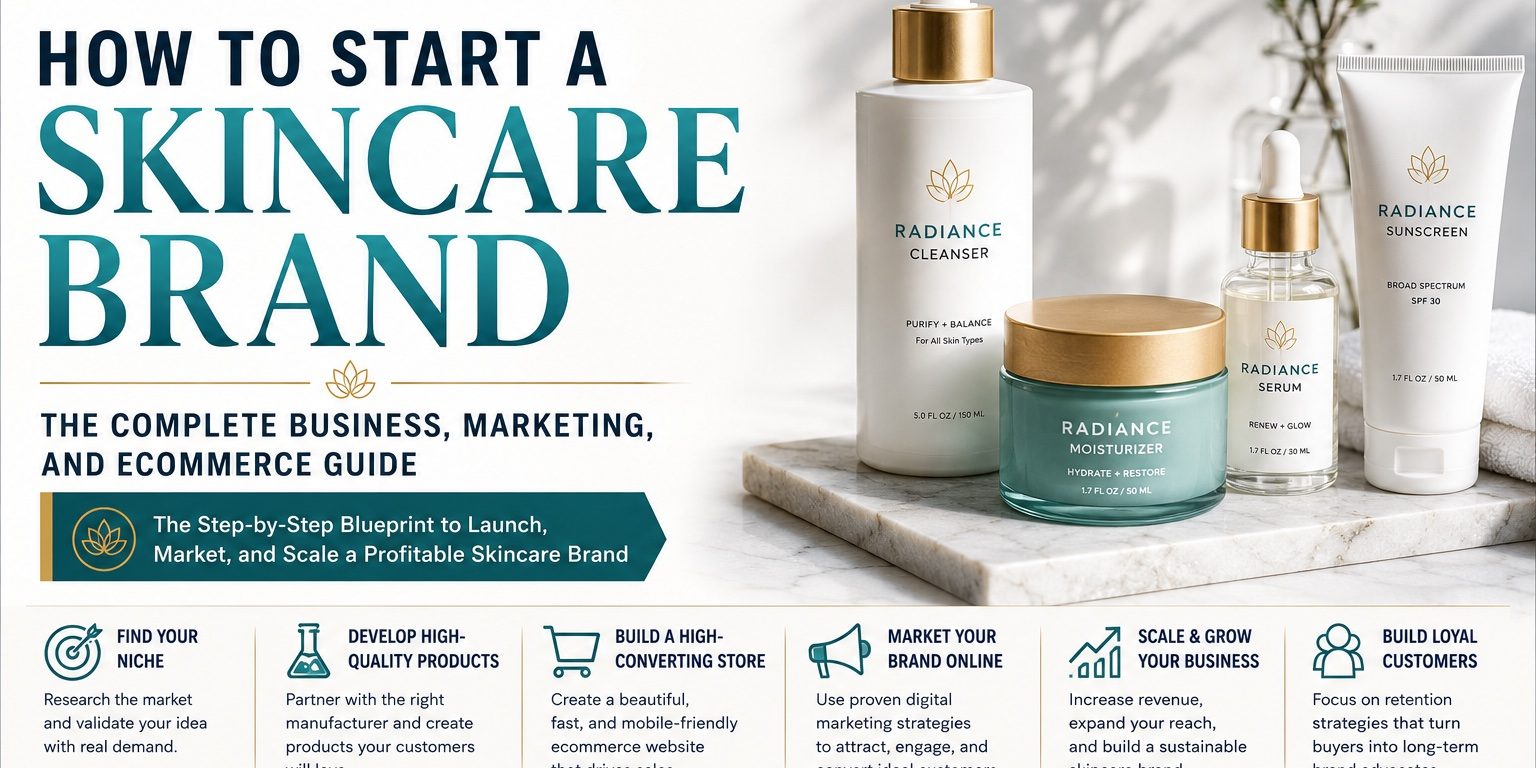
The global skincare industry continues to create strong opportunities for entrepreneurs, estheticians, dermatologists, healthcare professionals, influencers, investors, and existing beauty companies that want to build profitable brands. Consumers are more educated than ever before. They research ingredients, compare brands, read reviews, watch videos, evaluate packaging, and expect companies to communicate clearly before they purchase.
Starting a skincare brand today requires much more than choosing a cleanser, serum, or moisturizer. A successful skincare business needs a clear market position, thoughtful product development, compliant labeling, strong brand identity, professional ecommerce infrastructure, and a digital marketing strategy capable of attracting and converting customers. The brands that succeed are rarely the ones with the most products. They are the brands that understand their customers, communicate value clearly, and build trust across every touchpoint.
This guide explains how to start a skincare brand from a complete business perspective. It covers market research, niche selection, product development, private label versus custom formulation, manufacturing, compliance, packaging, pricing, ecommerce, SEO, social media, email marketing, customer retention, and long-term growth. It is designed for founders who want to build a real company, not simply launch a product collection.
By the end of this guide, you will have a practical roadmap for transforming a skincare idea into a recognizable, profitable, and scalable business.
Why the Skincare Industry Is an Exceptional Business Opportunity
Skincare has evolved from a traditional beauty category into a major part of wellness, self-care, preventative care, personal identity, and lifestyle. Consumers increasingly view skincare as an investment in confidence and long-term wellbeing. This shift gives emerging brands room to compete when they address specific needs with strong messaging and high-quality customer experiences.
Several trends continue to support opportunity in the skincare market. Consumers increasingly purchase skincare products online. Personalized product recommendations are becoming more common. Subscription programs help brands create recurring revenue. Science-backed ingredients influence buying decisions. Social media drives discovery. Sustainability, transparency, and ethical sourcing affect customer trust. These trends create opportunity, but they also raise the standard for new brands entering the market.
A founder can no longer rely on attractive packaging alone. Customers expect education, proof, convenience, and credibility. That means skincare entrepreneurs must think like brand strategists, ecommerce operators, content publishers, and growth marketers from the beginning.
Illumination Consulting Expert Insight: Many first-time founders believe the product determines success. In reality, consumers rarely purchase a product alone. They purchase a brand they trust. Your website, educational content, customer reviews, packaging, product photography, email communication, and digital presence all influence buying decisions before a customer tries the formula.
Define Your Brand Vision Before Developing Products
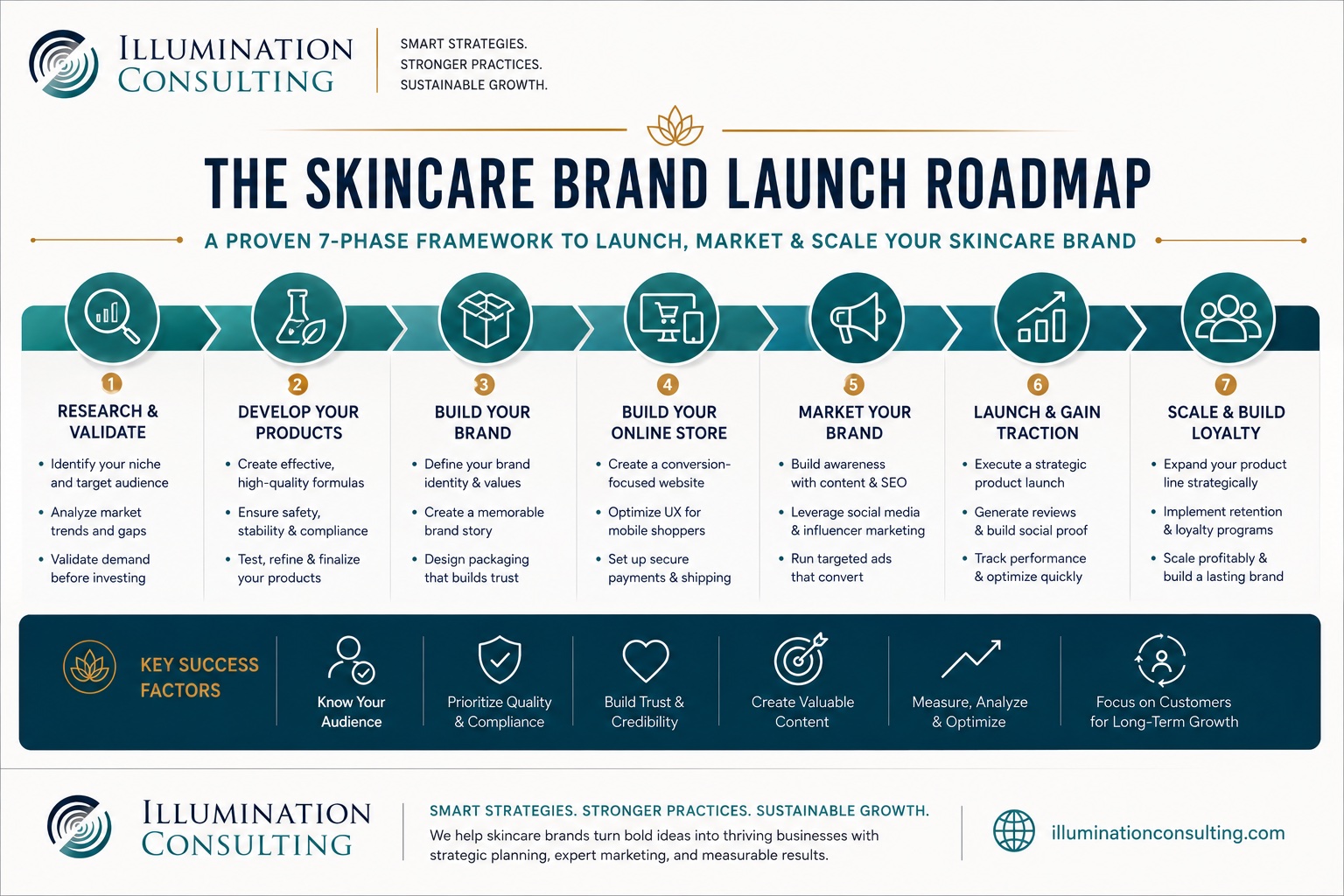
Every successful skincare company begins with a clear brand vision. Without strategic direction, many startups create products that compete in crowded markets without meaningful differentiation. Before contacting manufacturers or designing labels, define the problem your brand solves, the audience you serve, and the position you want to own in the market.
A skincare brand should not begin with the question, “What products should we sell?” A stronger question is, “Who are we helping, and what specific skincare problem are we solving better than competitors?” This shift immediately strengthens your marketing strategy because it forces the business to focus on customer needs rather than product assumptions.
What Problem Does Your Brand Solve?
Consumers rarely search for another generic moisturizer. They search for solutions to specific concerns, such as:
- Acne-prone skin
- Hyperpigmentation
- Rosacea and redness
- Sensitive skin
- Dry or dehydrated skin
- Mature skin
- Men’s skincare
- Teen skincare
- Medical-grade skincare
- Organic or natural skincare
- Pregnancy-safe skincare
The more clearly you define the problem your products solve, the easier your messaging, website copy, advertising, social media content, and SEO strategy become.
Identify Your Ideal Customer
Creating detailed customer personas helps ensure that every future decision remains consistent. Consider age, gender, income, location, lifestyle, purchasing habits, preferred platforms, skin concerns, brand preferences, and the type of education customers need before they buy.
For example, a luxury skincare brand targeting women over 45 requires different packaging, photography, language, pricing, and advertising than an affordable acne line for teenagers or a clinical brand sold through dermatology practices.
Determine Your Brand Positioning
Brand positioning answers one essential question: why should customers choose your skincare brand instead of hundreds of competitors?
| Positioning | Description |
| Luxury | Premium formulations, refined visual identity, elevated packaging, and higher perceived value. |
| Clinical | Dermatologist-developed or science-backed products supported by education and credible claims. |
| Organic | Natural ingredients, responsible sourcing, and transparency around formulation standards. |
| Vegan | Cruelty-free, plant-based products appealing to values-driven consumers. |
| Affordable | Accessible pricing and clear value for everyday skincare buyers. |
| Boutique | Small-batch products with a personal, founder-led brand story. |
Validate Market Demand Before Investing Money
One of the most expensive mistakes skincare startups make is developing products before confirming demand. A founder may love an idea, and friends may respond positively, but real validation occurs when people who do not know you show interest, join a waitlist, request samples, or pay full price.
Market validation helps identify what customers want, what they dislike about existing products, how much they are willing to pay, and which claims or benefits resonate most. It also prevents founders from spending heavily on inventory before proving that a specific audience wants the product.
- Survey potential customers.
- Analyze competitor reviews on ecommerce sites and marketplaces.
- Research keyword demand using SEO tools.
- Review Google Trends and social media trends.
- Participate in skincare communities and forums.
- Study TikTok, Instagram, Pinterest, and YouTube beauty content.
- Interview estheticians, dermatologists, and skincare professionals.
- Build a landing page with an email waitlist before launch.
Illumination Consulting Expert Insight: Never confuse compliments with customer validation. True validation occurs when people take measurable action. That may include joining a waitlist, requesting a consultation, ordering samples, sharing your content, or purchasing your first product at full price.
Choose the Right Business Model
Modern skincare companies can launch through several business models. The right option depends on your budget, desired level of control, timeline, operational capabilities, and long-term ambitions.
| Business Model | Investment | Control | Speed to Market | Best For |
| White Label | Very Low | Low | Very Fast | Testing simple market concepts quickly. |
| Private Label | Low to Medium | Medium | Fast | Startups validating demand with proven formulas. |
| Custom Formulation | High | Very High | Slow | Brands seeking proprietary products and long-term differentiation. |
| Contract Manufacturing | Medium to High | High | Moderate | Growing brands that need production scale. |
| In-House Manufacturing | Very High | Complete | Slowest | Established companies with operational expertise and capital. |
Many successful brands begin with private label products to validate demand, then invest in custom formulations after understanding their customers, pricing, and marketing channels. The best model is the one that aligns with your capital, risk tolerance, and long-term strategy.
Choose a Profitable Skincare Niche
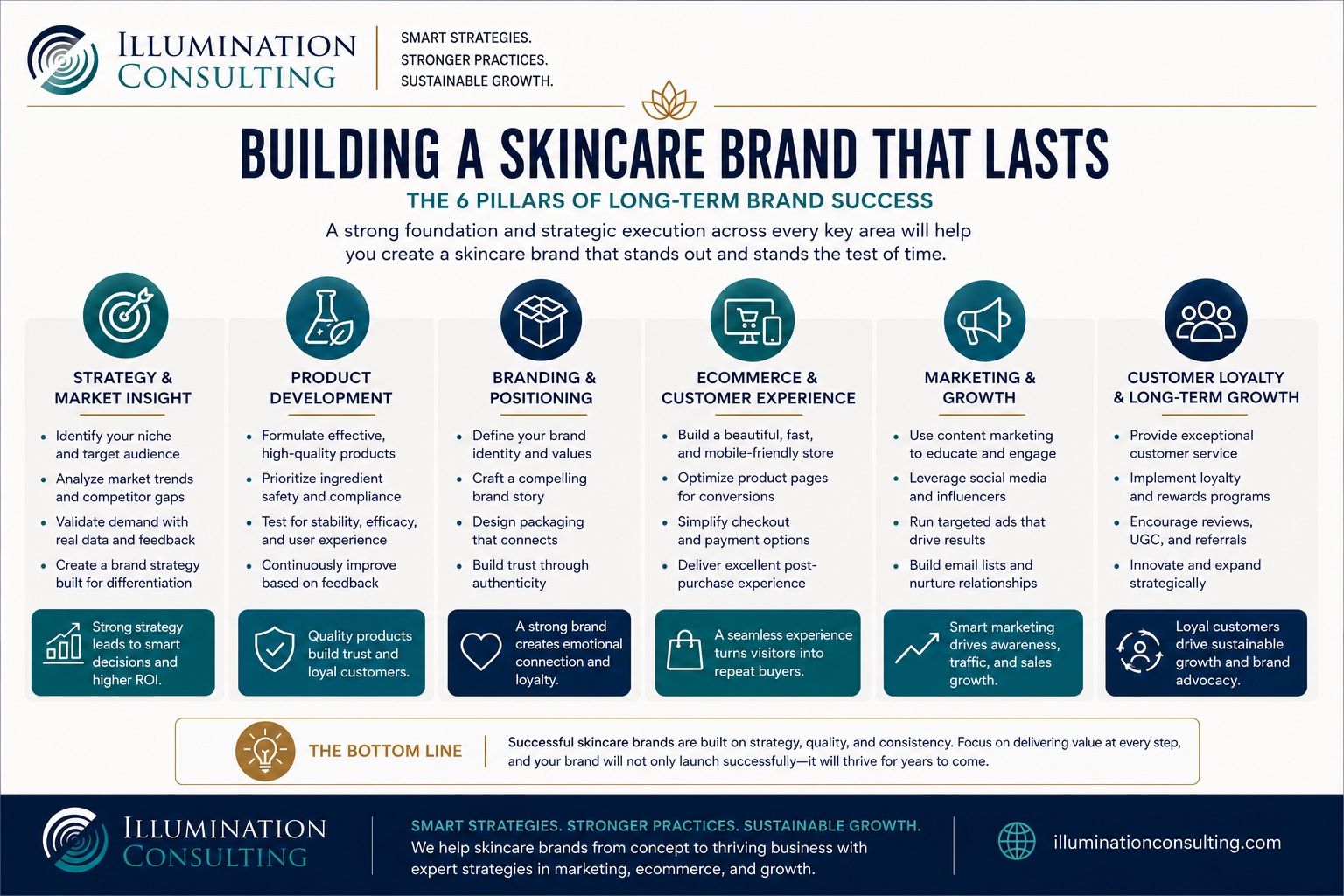
Trying to serve everyone usually produces weak positioning. A focused niche makes it easier to create products, write website copy, develop content, select influencers, build ads, and establish authority. Choosing a niche does not prevent future expansion. It gives the brand a clear starting point.
| Skincare Niche | Target Customer | Opportunity |
| Anti-aging and healthy aging | Adults 40+ | Strong demand and premium pricing potential. |
| Acne treatment | Teenagers and young adults | High recurring need and strong educational content opportunity. |
| Sensitive skin | Broad audience | Excellent for trust-based positioning. |
| Men’s skincare | Men 25-55 | Growing category with room for differentiated branding. |
| Organic and natural | Eco-conscious buyers | Strong values-driven purchasing behavior. |
| Hyperpigmentation | Diverse skin types | High search demand and strong product education potential. |
| Medical-grade skincare | Dermatology and aesthetics customers | High trust and professional partnership opportunity. |
| Luxury skincare | Affluent consumers | Premium margins when branding and experience are strong. |
Evaluate Competition Strategically
Competition is not always a negative signal. In many cases, it confirms demand. Instead of avoiding competitive categories, study where competitors fail. Look for poor reviews, outdated packaging, confusing websites, weak educational content, limited subscription options, slow shipping, or inadequate customer support. Every customer complaint can reveal an opportunity to position your brand more effectively.
Decide Between Private Label and Custom Formulation
Product development is one of the most important early decisions. Private label skincare allows brands to sell existing formulations under their own name. Custom formulation involves developing unique products with chemists and laboratories. Both options can work, but they serve different business strategies.
| Factor | Private Label | Custom Formulation |
| Startup Cost | Lower | Higher |
| Time to Launch | Faster | Slower |
| Product Exclusivity | Limited | Strong |
| Risk | Lower | Higher |
| Ingredient Control | Limited to moderate | High |
| Long-Term Brand Value | Good | Excellent when executed well |
Private label is often the practical choice for founders who want to test demand quickly. Custom formulation is better for brands seeking proprietary differentiation, premium positioning, or long-term intellectual property value.
Find the Right Manufacturing Partner
Your manufacturer becomes one of the most important partners in your business. The wrong manufacturer can create delays, inconsistent quality, labeling issues, inventory problems, and unhappy customers. The right manufacturer can support growth, quality control, product development, packaging, compliance, and operational reliability.
Evaluate manufacturers based on more than price. Consider experience, certifications, GMP practices, FDA registration status, ingredient sourcing, minimum order quantities, stability testing, quality control, packaging capabilities, communication, production timelines, and scalability.
- What are your minimum order quantities?
- Can formulations be customized?
- Who owns the formulation?
- What testing is included?
- What certifications do you maintain?
- What is the average production timeline?
- How do you handle quality control?
- Do you provide stability testing?
- Can you support packaging and labeling review?
- What happens if a batch fails inspection?
Illumination Consulting Expert Insight: Choosing a manufacturer based only on the lowest unit cost is risky. Product consistency, reliability, communication, and quality control will usually affect profitability more than saving a small amount per unit.
Understand Cosmetic Regulations and Compliance
Skincare brands must take cosmetic regulations seriously. Compliance protects customers, reduces legal risk, and helps preserve the credibility of the business. In the United States, cosmetic labeling and product claims are regulated by the U.S. Food and Drug Administration, and brands should understand requirements related to labeling, facility registration, product listing, safety substantiation, and claim language.
The FDA provides cosmetic labeling guidance and resources related to required label information, ingredient names, net quantity statements, warnings, and cosmetic claims. MoCRA, the Modernization of Cosmetics Regulation Act of 2022, also introduced significant requirements for cosmetic companies, including facility registration and product listing obligations for many businesses.
- Avoid unsubstantiated medical claims.
- Review ingredient labeling requirements before printing packaging.
- Understand whether claims may classify a product as a drug.
- Maintain product safety documentation.
- Track batches and suppliers carefully.
- Work with regulatory professionals when selling across multiple regions.
A statement such as “hydrates dry skin” is different from claiming a product “treats eczema” or “heals psoriasis.” Claim language matters. Before finalizing labels, packaging, advertising, or website copy, obtain qualified regulatory guidance.
Build a Brand That Customers Remember
Your products may attract the first sale, but your brand determines whether customers return. Successful skincare companies create a consistent identity across packaging, website design, photography, social media, email, advertising, and customer support. Every touchpoint should reinforce what the brand stands for.
A strong skincare brand needs a clear personality. It may feel clinical and science-driven, luxury and sophisticated, natural and organic, minimalist and modern, friendly and approachable, premium wellness-oriented, eco-conscious, or professional and medical. The chosen personality should influence every visual and verbal decision.
Choose a Memorable Brand Name
A strong brand name should be easy to pronounce, easy to spell, easy to remember, available as a domain name, available on social media, and suitable for trademark research. Avoid names that restrict future growth. A name focused only on one ingredient, one city, or one skin concern may limit expansion later.
Create a Professional Visual Identity
Your visual identity includes logo, typography, colors, product labels, packaging, photography style, website design, email templates, social media graphics, and advertising assets. Consistency builds recognition. Recognition builds trust. Trust supports conversion.
Illumination Consulting Expert Insight: Many startups spend heavily on logo design while underinvesting in the website and customer experience. Customers rarely purchase because of a logo alone. They purchase because the complete brand experience feels professional, credible, and trustworthy.
Design Packaging That Supports Sales
Packaging is both a protective container and a marketing asset. It communicates quality, price point, ingredients, brand personality, sustainability, and product benefits within seconds. Strong packaging helps a brand command higher perceived value, especially in competitive ecommerce and retail environments.
- Clear typography and readable product information.
- Premium materials aligned with the brand position.
- Sustainable packaging options when appropriate.
- Accurate ingredient lists and usage instructions.
- QR codes for education, tutorials, or authenticity verification.
- Batch numbers, expiration dates, and tamper-evident features where applicable.
Sustainability also influences modern beauty purchasing behavior. Brands may consider refillable containers, recycled materials, glass packaging, reduced secondary packaging, FSC-certified paper, and responsible inks. Sustainability should be authentic and operationally realistic, not simply used as a marketing claim.
Price Products for Long-Term Profitability
Pricing products based only on manufacturing cost can create serious financial problems. Your pricing must support packaging, shipping, warehousing, ecommerce platform fees, payment processing, advertising, customer service, returns, software, professional services, taxes, and profit margin.
| Pricing Strategy | Best For | Risk |
| Cost-Plus Pricing | Simple early-stage pricing | Can undervalue the brand. |
| Value-Based Pricing | Premium and results-driven products | Requires strong positioning and proof. |
| Competitive Pricing | Crowded categories | Can create margin pressure. |
| Luxury Pricing | High-end products and premium experience | Requires exceptional branding and customer experience. |
| Subscription Pricing | Products used consistently | Requires retention systems and inventory planning. |
Illumination Consulting Expert Insight: Avoid competing on price whenever possible. Competing on value creates healthier margins, attracts better customers, and gives the business more resources to invest in marketing, product development, customer experience, and long-term growth.
Build an Ecommerce Website Designed to Convert
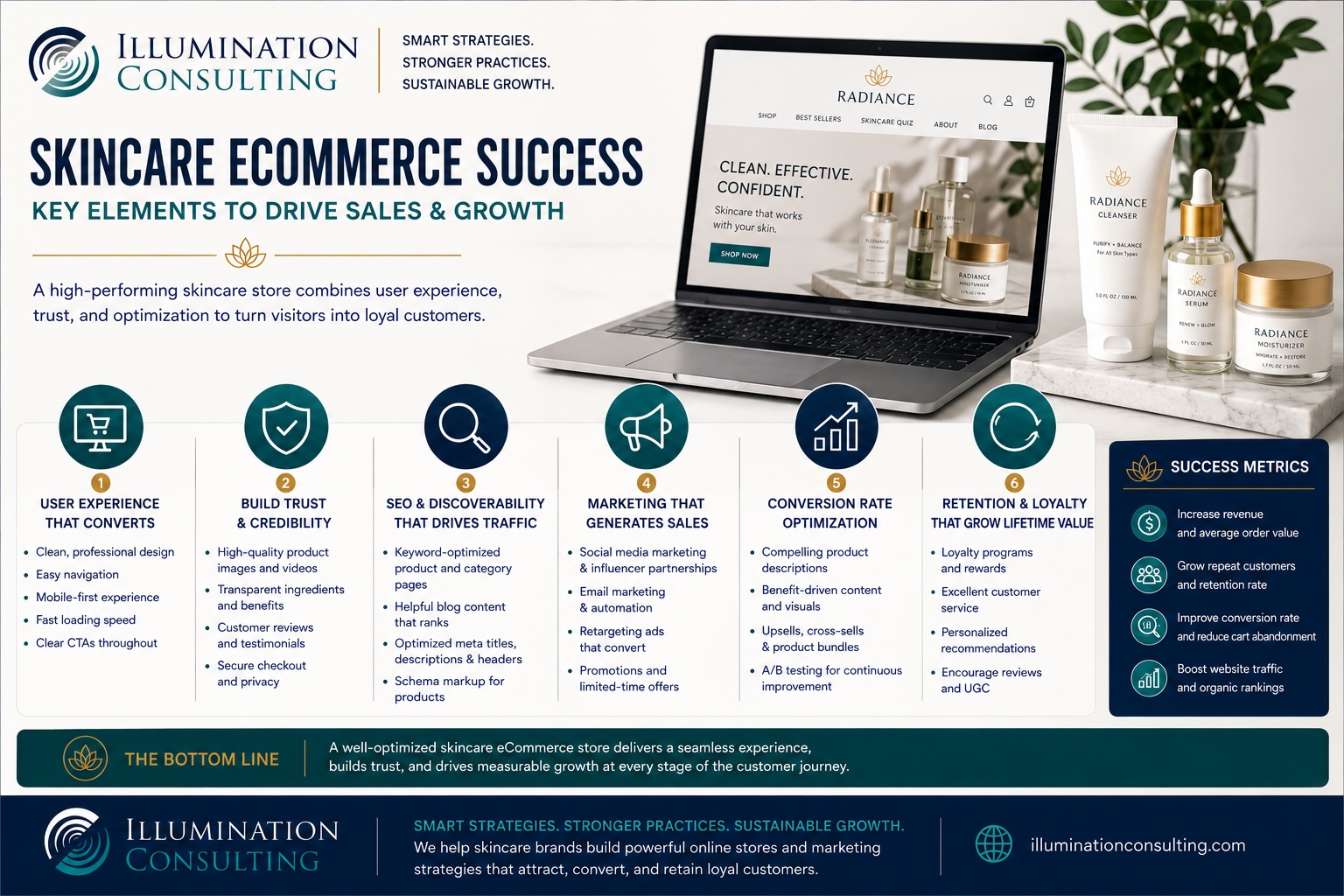
Your website is not just an online catalog. It is your most important sales platform and often the first serious credibility test customers use before purchasing. A beautiful website that fails to educate, build trust, and guide users toward checkout will struggle to generate revenue.
For skincare brands, product pages must answer customer questions before they arise. Customers want to understand benefits, ingredients, usage instructions, expected results, shipping, returns, subscriptions, and whether the products are right for their skin concerns.
- Mobile-responsive design
- Fast loading speeds
- Secure checkout
- High-quality product photography
- Educational product pages
- Ingredient explanations
- Customer reviews
- Frequently asked questions
- Product recommendations
- Subscription options
- Email signup forms
- Live chat or customer support options
Illumination Consulting provides Retail Ecommerce Website Design services that help ecommerce brands create online stores designed for usability, trust, conversion, and long-term growth.
Prepare for Launch Before Inventory Arrives
A successful launch rarely happens by accident. Instead of waiting until inventory arrives, begin building attention, education, and demand weeks or months before products become available. Pre-launch marketing helps create an audience before the first sale.
- Create a waitlist landing page.
- Share behind-the-scenes product development.
- Educate customers about ingredients and skin concerns.
- Publish founder story content.
- Preview packaging and product photography.
- Collect early customer feedback.
- Build an email welcome sequence.
- Create a social media countdown.
- Prepare launch offers and referral incentives.
By launch day, your audience should already know who you are, what problem your products solve, and why your brand deserves attention.
Develop a Digital Marketing Strategy Before Launch
Marketing should begin before products are available for purchase. The goal is to build awareness, establish credibility, and create demand before the official launch. The strongest skincare companies use multiple channels rather than relying on one platform.
- Search engine optimization
- Content marketing
- Google Ads
- Social media marketing
- Email marketing
- Influencer marketing
- Video marketing
- Public relations
- Affiliate marketing
- Referral programs
Illumination Consulting provides Skin Care Marketing services for brands that need strategic support with positioning, customer acquisition, content, SEO, advertising, ecommerce, and digital growth.
Build Marketing Around Customer Intent
Not every visitor is ready to purchase immediately. Some are researching ingredients. Others are comparing brands. Some are looking for product recommendations. A strong marketing strategy provides value throughout the entire buying journey.
| Buying Stage | Customer Search Behavior | Content Opportunity |
| Awareness | What causes hyperpigmentation? | Educational guides and ingredient explainers. |
| Consideration | Vitamin C vs. retinol | Comparison articles and video tutorials. |
| Decision | Best serum for dark spots | Product pages, reviews, testimonials, and offers. |
| Retention | How often should I reorder? | Email reminders, subscriptions, and skincare routine content. |
Invest in Search Engine Optimization for Sustainable Growth
Search engine optimization is one of the most valuable long-term investments for skincare brands. Paid advertising stops generating traffic when spending stops. SEO can continue attracting visitors, leads, and customers for years when implemented correctly.
Google Search Central explains SEO as helping search engines understand content while helping users find a site and decide whether to visit. For skincare brands, that means organizing content clearly, answering customer questions, optimizing technical performance, and building pages that satisfy search intent.
- Keyword research
- Technical SEO
- Product page optimization
- Educational blog content
- Internal linking
- Image optimization
- Schema markup
- Backlink acquisition
- Mobile optimization
- Page speed improvements
A skincare brand should not only rank for its brand name. It should rank for the problems, ingredients, routines, and product categories customers search before purchasing.
Use Content Marketing to Build Trust
Consumers rarely buy skincare after seeing one advertisement. They research, compare, read reviews, watch videos, and evaluate credibility. Content marketing supports this process by turning your brand into an educational resource.
- Ingredient breakdowns
- Morning and evening skincare routines
- Seasonal skincare advice
- Product tutorials
- Before-and-after case studies where appropriate
- Customer success stories
- Dermatologist or esthetician interviews
- Frequently asked questions
- Behind-the-scenes manufacturing content
Every customer question can become a useful article, video, email, or social post. Over time, this creates a library of content that supports SEO, email marketing, social media, paid advertising, and customer service.
Use Social Media to Build Relationships, Not Just Followers
Follower count is not the most important metric for skincare brands. Engagement, trust, and purchase intent matter more. A smaller audience that comments, shares, saves, asks questions, and purchases is more valuable than a large inactive audience.
| Platform | Best Use |
| Brand awareness, product visuals, reels, testimonials, and lifestyle storytelling. | |
| TikTok | Short educational videos, product discovery, creator partnerships, and trend participation. |
| Long-term traffic, visual search, routines, and product inspiration. | |
| YouTube | Tutorials, ingredient education, product demonstrations, and search visibility. |
| Community building, retargeting, groups, and paid advertising. | |
| B2B partnerships, professional skincare, investor content, and wholesale relationships. |
Choose platforms based on customer behavior, not personal preference. A luxury clinical brand and a Gen Z acne brand may require very different channel strategies.
Build an Email Marketing System
Email remains one of the most valuable marketing assets for skincare companies because you own the audience. Algorithms can change. Advertising costs can rise. Social reach can decline. An engaged email list gives your company a direct communication channel with prospects and customers.
- Welcome sequences
- Product launch campaigns
- Educational newsletters
- Abandoned cart emails
- Replenishment reminders
- Birthday offers
- Personalized product recommendations
- Customer surveys
- Loyalty rewards
Segment subscribers based on purchase history, product interests, browsing behavior, engagement, and customer lifecycle stage. Personalized messages generally outperform generic campaigns because they reflect each customer’s needs more clearly.
Use Artificial Intelligence to Improve Efficiency and Personalization
Artificial intelligence is becoming increasingly valuable for skincare brands, especially in ecommerce, personalization, customer service, forecasting, and marketing. AI should enhance human expertise rather than replace it.
- Personalized product recommendations
- Customer service chatbots
- Email segmentation and personalization
- Product description assistance
- Advertising optimization
- Inventory forecasting
- Customer sentiment analysis
- Market research
- Content planning
- Sales forecasting
The most effective AI strategies combine automation with authentic brand communication. Customers still want human trust, but AI can help brands deliver more relevant experiences at scale.
Improve Customer Retention Before Scaling Acquisition
Many skincare startups focus almost entirely on finding new customers while underinvesting in existing customers. Retention often produces a higher return because current customers already trust the brand. Even small improvements in repeat purchase rates can significantly improve profitability.
- Loyalty programs
- Product subscriptions
- Referral programs
- Personalized email campaigns
- VIP customer communities
- Early access to new products
- Educational newsletters
- Birthday rewards
- Customer feedback loops
Retention begins immediately after the first purchase. Post-purchase emails, usage education, product pairing recommendations, and replenishment reminders can all increase customer lifetime value.
Expand Beyond Direct-to-Consumer Sales
A direct-to-consumer ecommerce website gives a skincare brand control over customer data, pricing, branding, and profit margins. As the company grows, additional sales channels can reduce risk and increase reach.
- Independent beauty boutiques
- Medical spas
- Dermatology practices
- Plastic surgery clinics
- Wellness centers
- Salons
- Specialty retailers
- Luxury hotels
- Subscription beauty boxes
- Amazon or other marketplaces when strategically appropriate
Illumination Consulting also provides Retail Marketing services for brands that want to strengthen visibility, customer acquisition, and sales across retail and ecommerce channels.
Measure the Metrics That Matter
You cannot improve what you do not measure. Successful skincare companies use data to make decisions instead of relying on assumptions. Review performance regularly and connect marketing activity to revenue outcomes.
| Metric | Why It Matters |
| Conversion Rate | Shows how effectively the website turns visitors into buyers. |
| Average Order Value | Measures how much customers spend per purchase. |
| Customer Acquisition Cost | Shows how expensive it is to acquire each customer. |
| Customer Lifetime Value | Measures long-term customer profitability. |
| Repeat Purchase Rate | Indicates customer satisfaction and retention. |
| Cart Abandonment Rate | Identifies checkout friction. |
| Organic Traffic | Reflects SEO growth and content performance. |
| Return on Advertising Spend | Measures paid advertising efficiency. |
Small improvements across multiple metrics often create significant growth. Improving product pages, email sequences, checkout flow, ad targeting, and retention systems can compound over time.
Avoid Common Skincare Startup Mistakes
Many promising skincare companies struggle because of avoidable business mistakes rather than poor products. Understanding these challenges early can save substantial time and capital.
- Launching too many products before validating demand.
- Ignoring SEO and relying only on paid advertising.
- Underinvesting in branding, packaging, and website quality.
- Using weak product photography.
- Choosing vendors solely based on price.
- Making unsupported product claims.
- Failing to build an email list before launch.
- Not measuring conversion rates, customer acquisition cost, and repeat purchases.
Illumination Consulting Expert Insight: Most skincare startups do not fail because they have bad products. They fail because they underestimate how difficult it is to generate qualified traffic, convert visitors into customers, and retain those customers over time. Products create opportunity. Marketing builds the business.
The Illumination Skincare Brand Growth Framework
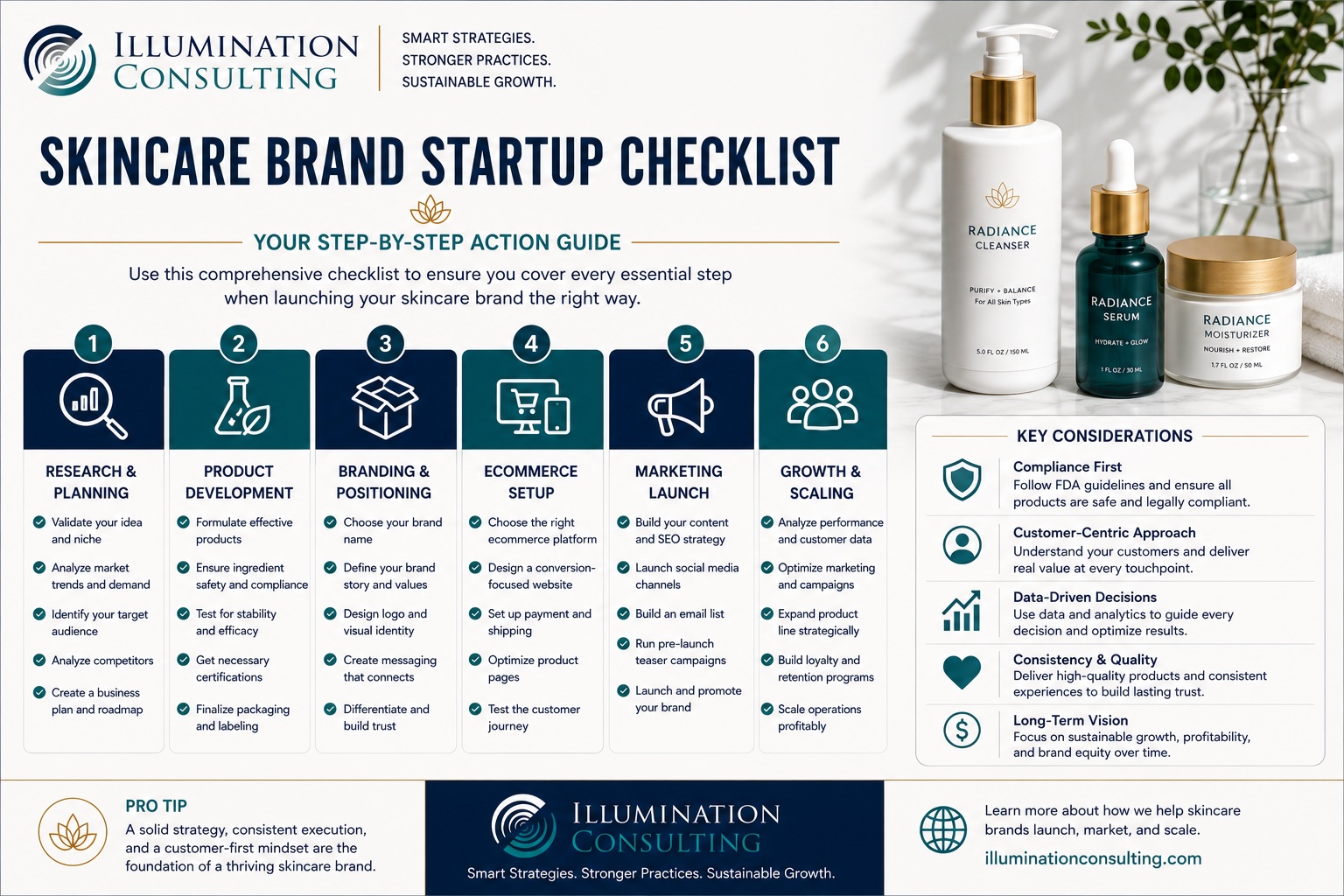
A profitable skincare brand requires more than a product launch. Illumination Consulting evaluates skincare growth through seven connected pillars:
- Market Positioning: Define the audience, category, promise, and differentiation.
- Product Strategy: Align formulation, packaging, pricing, and claims with customer demand.
- Brand Identity: Create a professional visual and verbal system that builds trust.
- Ecommerce Infrastructure: Build a fast, mobile-friendly, conversion-focused website.
- Content and SEO: Publish educational content that attracts qualified search traffic.
- Customer Acquisition: Use social media, influencers, ads, email, and partnerships to generate sales.
- Retention and Scaling: Increase repeat purchases, subscriptions, lifetime value, wholesale, and operational efficiency.
When these pillars work together, the brand becomes easier to discover, easier to trust, easier to buy from, and easier to scale.
Build a Skincare Brand Designed for Long-Term Success
Launching a skincare company is an exciting opportunity, but building a successful brand requires much more than creating excellent products. Modern consumers expect transparency, education, convenience, professional presentation, personalized recommendations, and brands they can genuinely trust.
The companies that thrive approach skincare as a complete business. They validate demand, choose a focused niche, build memorable branding, work with reliable manufacturers, respect compliance requirements, develop high-quality ecommerce experiences, invest in SEO, publish helpful content, and build long-term customer relationships.
Growth rarely happens overnight. It results from consistently executing a thoughtful strategy while improving every part of the customer experience.
Illumination Consulting helps skincare brands, beauty companies, medical aesthetics businesses, and ecommerce retailers develop comprehensive growth strategies through branding, website design, ecommerce development, SEO, digital marketing, AI consulting, and business strategy. Whether you are launching a new skincare product or scaling an established beauty company, the right strategy can reduce costly mistakes and accelerate growth.
Get Your Growth Strategy to discover how Illumination Consulting can help transform your skincare business into a recognized, profitable brand.
Frequently Asked Questions
How much does it cost to start a skincare brand?
Startup costs vary depending on the business model. A private label skincare brand may launch for approximately $10,000 to $50,000, while a custom-formulated brand with professional branding, ecommerce development, inventory, and marketing may require $75,000 to $250,000 or more.
Is private label skincare a good option for startups?
Yes. Private label skincare can be a practical way to validate demand, reduce product development costs, and launch faster. It is especially useful for entrepreneurs who want to test positioning, pricing, and marketing before investing in custom formulations.
What is the best ecommerce platform for skincare brands?
Shopify is one of the most common ecommerce platforms for skincare startups because it is flexible, scalable, and supported by many apps. WooCommerce can also work well for brands already committed to WordPress.
How important is SEO for a skincare business?
SEO is extremely important for long-term growth. It helps skincare brands attract qualified organic traffic, reduce dependence on paid advertising, and establish authority around ingredients, skin concerns, product categories, and routines.
Should a skincare brand sell only through its own website?
Most brands benefit from launching with their own ecommerce website because it provides control over branding, customer data, pricing, and margins. As the business grows, wholesale, professional partnerships, retail stores, and marketplaces can create additional revenue channels.
What marketing channels work best for skincare brands?
Successful skincare companies often combine SEO, content marketing, social media, influencer partnerships, email marketing, video marketing, Google Ads, affiliate marketing, and customer referral programs.
How long does it take to build a successful skincare brand?
Most successful skincare companies take years to refine products, improve branding, build customer trust, develop marketing systems, and increase repeat purchases. Some brands grow quickly, but sustainable success usually requires consistent execution over time.
What is the biggest mistake new skincare entrepreneurs make?
One of the biggest mistakes is focusing almost entirely on product development while neglecting branding, ecommerce, customer acquisition, SEO, and retention. Even excellent products need effective marketing systems to achieve long-term success.