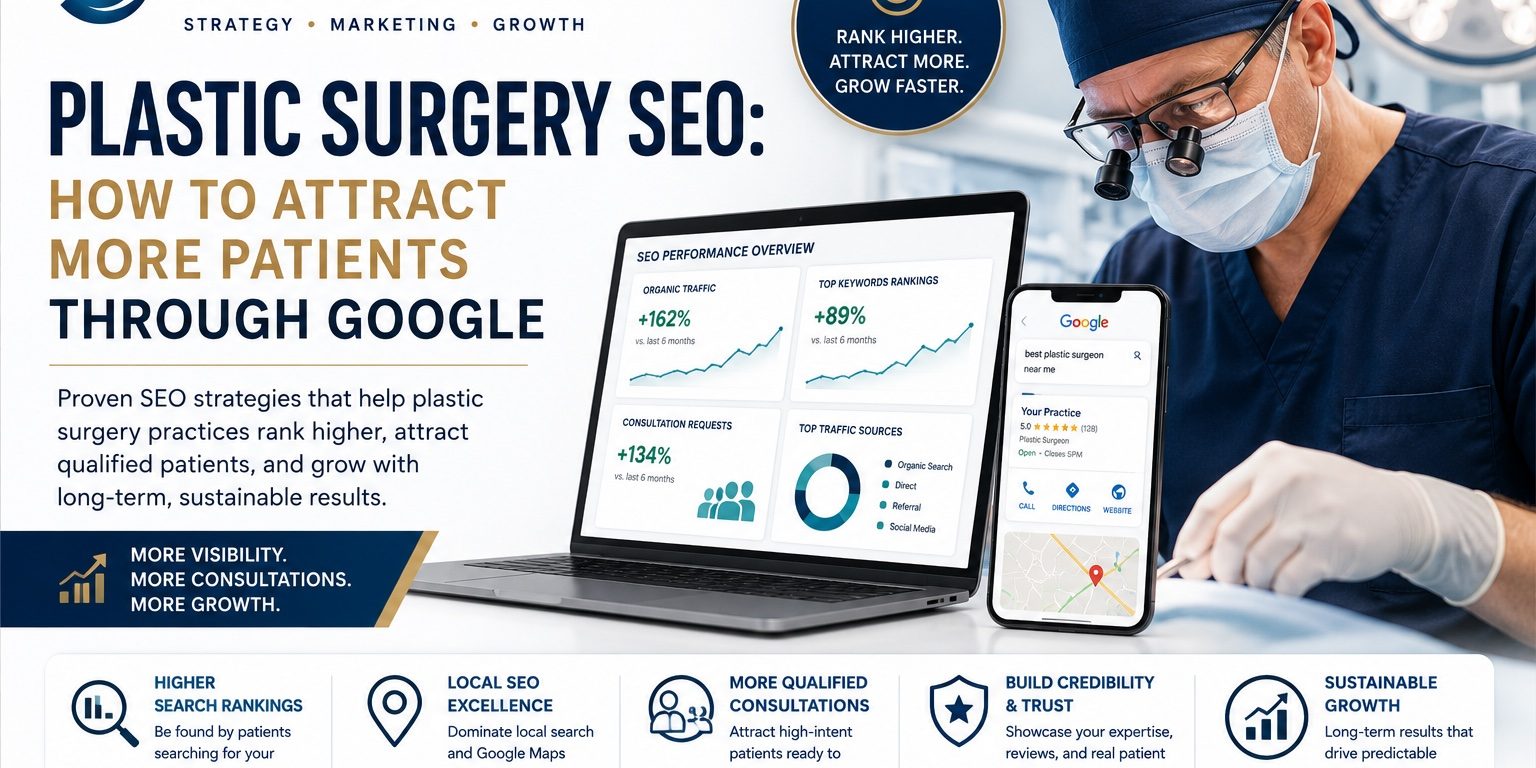
Plastic surgery is one of the most competitive specialties in healthcare marketing. Patients considering cosmetic or reconstructive procedures rarely choose the first practice they encounter. Instead, they spend days or even weeks researching surgeons, comparing before-and-after results, reading online reviews, evaluating credentials, and exploring treatment options before scheduling a consultation.
For plastic surgery practices, this means your website is much more than an online brochure—it is often the first impression prospective patients have of your practice. If your website fails to appear prominently in Google search results or doesn’t establish immediate trust, those prospective patients will likely schedule consultations with competing practices instead.
This is where search engine optimization (SEO) becomes one of the most valuable long-term marketing investments available. Unlike paid advertising, which generates traffic only while campaigns are active, SEO helps practices build lasting visibility by improving their organic rankings for the procedures and services prospective patients actively search for every day.
Modern plastic surgery SEO extends far beyond inserting keywords throughout a website. Google’s algorithms now evaluate hundreds of ranking factors, including website performance, medical authority, content quality, local relevance, user experience, and overall trustworthiness. Practices that consistently invest in these areas position themselves to attract highly qualified patients while building sustainable online authority.
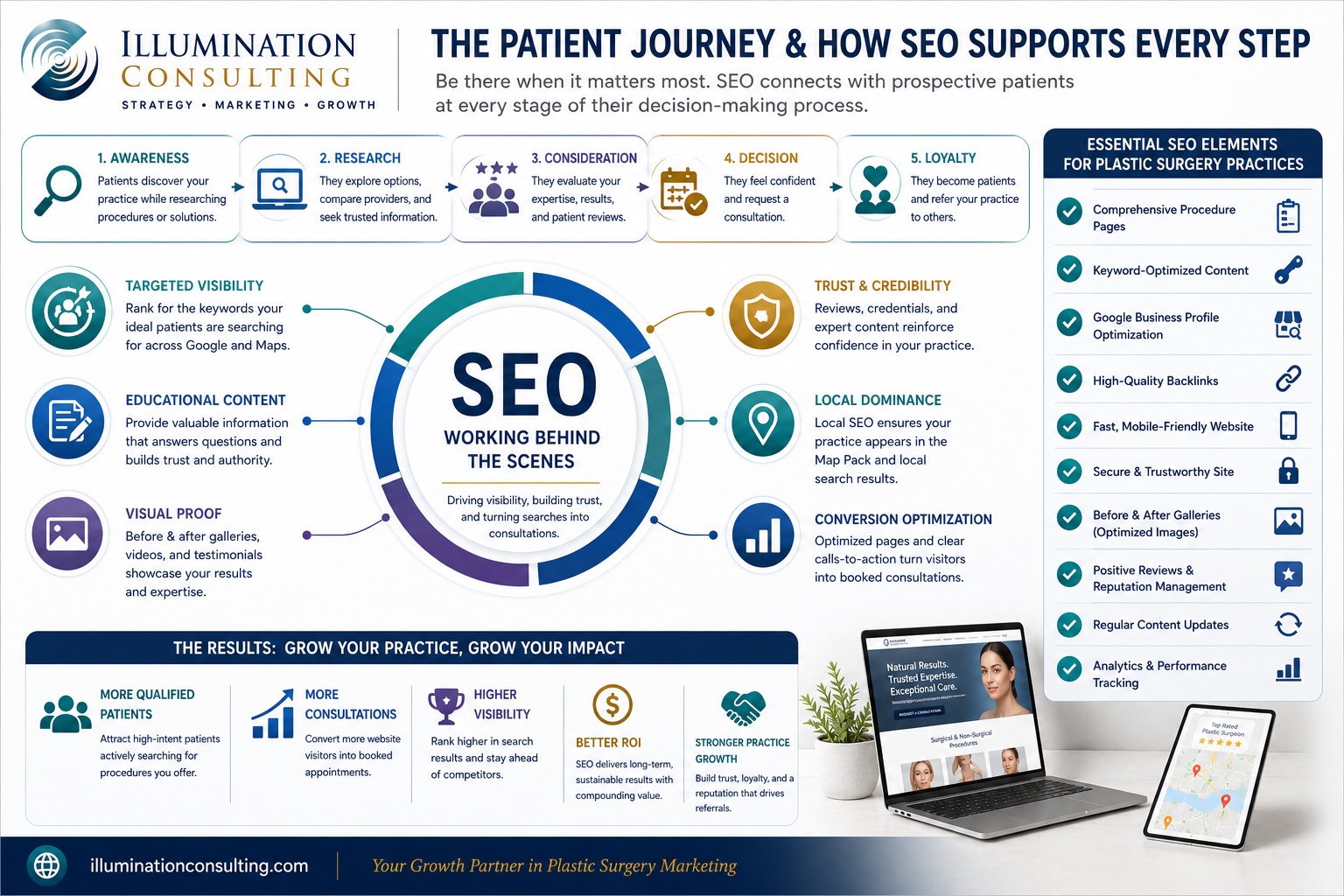
SEO is particularly important because cosmetic procedures often involve significant financial and emotional decisions. Prospective patients want confidence that they are choosing a highly qualified surgeon with extensive experience and outstanding results. Before contacting a practice, they typically research provider credentials, review patient testimonials, examine before-and-after galleries, compare treatment options, and consume educational content that helps them understand their choices.
An effective SEO strategy supports every stage of this decision-making process. It ensures your practice appears when patients search for procedures, answers their most important questions, demonstrates your expertise, and provides a seamless online experience that encourages consultation requests.
Whether your practice specializes in facial plastic surgery, breast procedures, body contouring, reconstructive surgery, or non-surgical cosmetic treatments, SEO provides an opportunity to reach prospective patients before they ever contact another provider.
In this comprehensive guide, we’ll explore the essential components of plastic surgery SEO, explain why it differs from traditional search engine optimization, and outline the strategies that help practices improve their rankings, increase consultation requests, and build sustainable long-term growth.
Why SEO Matters for Plastic Surgeons
Consumer behavior has changed dramatically over the past decade. Word-of-mouth referrals remain valuable, but most prospective patients now begin their search online. Google has become the primary resource for researching procedures, comparing surgeons, and evaluating practices before scheduling consultations.
This shift has made search visibility one of the strongest competitive advantages a plastic surgery practice can develop.
When prospective patients search phrases such as:
- Plastic surgeon near me
- Best facelift surgeon
- Breast augmentation specialist
- Rhinoplasty surgeon
- Mommy makeover consultation
- Liposuction specialist
- Tummy tuck surgeon
- Facial rejuvenation procedures
- Eyelid surgery
- Cosmetic surgeon in my area
they are demonstrating high purchase intent. These individuals are actively researching procedures and are often much closer to scheduling consultations than someone casually browsing social media.
Appearing prominently in these search results places your practice in front of prospective patients precisely when they are making important healthcare decisions.
Organic Search Builds Trust
Unlike paid advertisements, organic search rankings are often viewed as more credible by prospective patients.
When Google consistently ranks a practice near the top of search results, patients naturally associate those rankings with expertise, authority, and professionalism. While rankings alone do not guarantee trust, they create an important first impression that influences how patients perceive your practice.
This credibility becomes even more valuable in plastic surgery, where patients invest significant time evaluating providers before making treatment decisions.
SEO Produces Long-Term Results
Paid advertising can generate consultations quickly, but its effectiveness ends the moment campaigns are paused.
SEO works differently.
Each optimized service page, educational article, location page, patient resource, and technical improvement contributes to building long-term online authority. Over time, these assets continue generating qualified traffic without requiring payment for every website visitor.
Although SEO requires patience and consistency, it often delivers one of the highest long-term returns on investment for plastic surgery practices because successful rankings continue attracting prospective patients month after month.
Patients Conduct Extensive Research
Plastic surgery patients rarely make impulsive decisions.
Most will spend considerable time researching:
- Surgical procedures
- Recovery expectations
- Before-and-after results
- Surgeon credentials
- Board certifications
- Financing options
- Risks and benefits
- Practice reviews
- Patient testimonials
- Frequently asked questions
A comprehensive SEO strategy ensures your website provides the educational resources patients need throughout this research process while reinforcing your expertise and building confidence before the first consultation request.
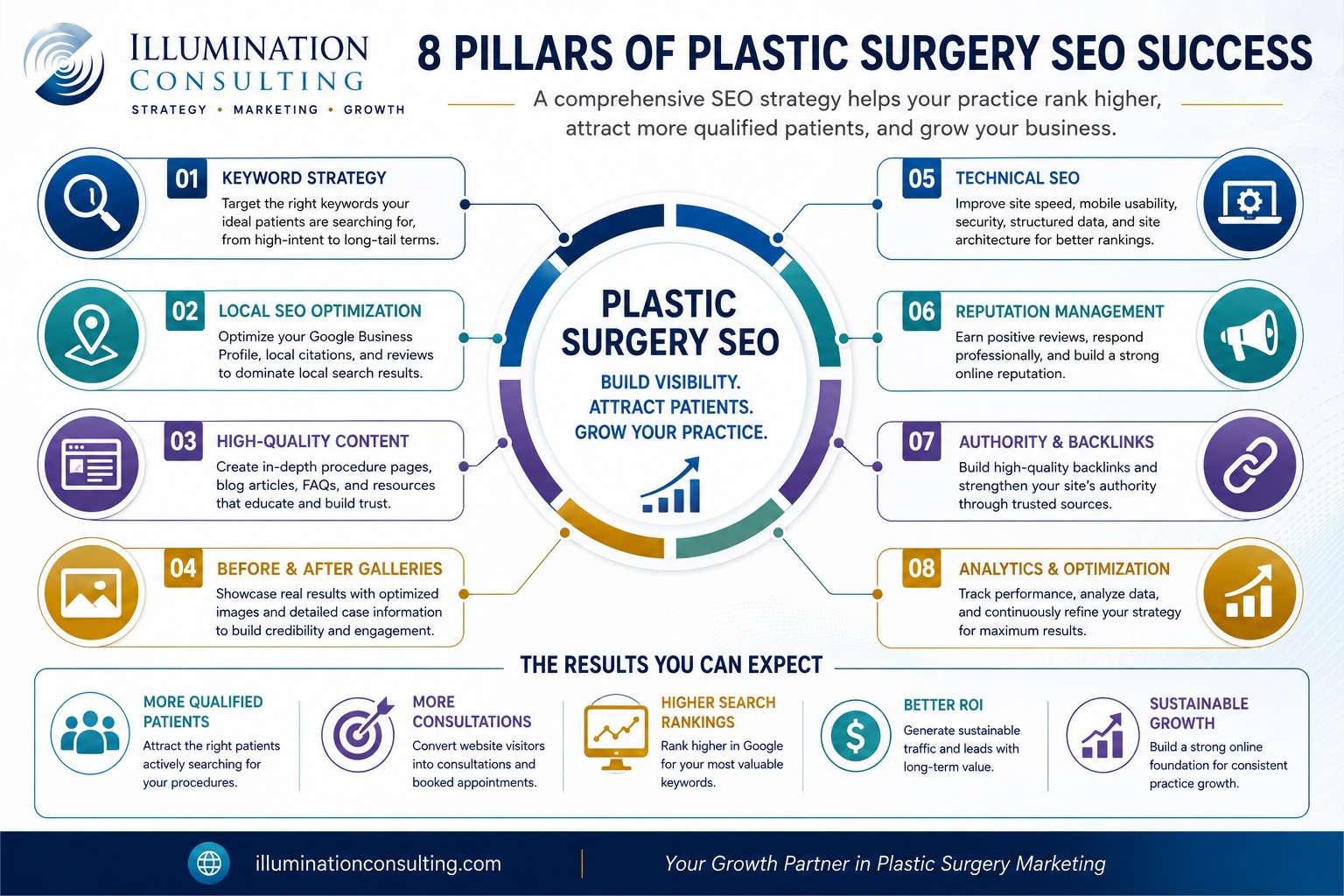
How Google Evaluates Plastic Surgery Websites
Google’s primary objective is to provide users with the most relevant, accurate, and trustworthy information possible. This objective becomes even more important when users are searching for healthcare providers or medical procedures that could significantly impact their health, appearance, or well-being.
Plastic surgery websites fall within Google’s Your Money or Your Life (YMYL) category, meaning they are evaluated under much stricter quality standards than many other industries. Because patients rely on search results to make important healthcare decisions, Google expects plastic surgery practices to demonstrate expertise, authority, transparency, and trustworthiness throughout their websites.
Practices that understand these expectations are far more likely to achieve strong organic rankings while building credibility with prospective patients.
E-E-A-T Is Essential
One of the most important concepts in modern SEO is Google’s E-E-A-T framework:
- Experience
- Expertise
- Authoritativeness
- Trustworthiness
Although E-E-A-T is not a direct ranking factor, it influences many of the quality signals Google uses to evaluate healthcare websites.
For plastic surgeons, demonstrating these qualities is critical.
Your website should clearly communicate:
- Board certification
- Medical education
- Years of surgical experience
- Areas of specialization
- Professional memberships
- Hospital affiliations
- Awards and recognitions
- Published research
- Speaking engagements
- Media appearances
These trust signals not only strengthen search visibility but also reassure prospective patients that they are considering a qualified and experienced surgeon.
Content Quality Matters More Than Ever
Many plastic surgery websites make the mistake of publishing short service pages containing only a few paragraphs of text.
Unfortunately, this approach rarely performs well in today’s search environment.
Google rewards comprehensive content that genuinely helps users understand procedures before making treatment decisions.
Each procedure page should thoroughly explain:
- Who is an ideal candidate
- How the procedure is performed
- Benefits and expected outcomes
- Recovery timeline
- Potential risks
- Frequently asked questions
- Available alternatives
- Consultation process
- Expected results
The goal is not simply to rank higher but to educate prospective patients while demonstrating your expertise.
Website Trust Signals
Trust extends beyond physician credentials.
Google also evaluates numerous indicators that reflect the overall quality and legitimacy of a practice.
Important trust signals include:
- Secure HTTPS encryption
- Complete contact information
- Professional provider biographies
- HIPAA-conscious contact forms
- Privacy policy
- Terms of service
- High-quality photography
- Consistent branding
- Fast-loading pages
- Mobile-friendly design
Together, these elements contribute to a stronger user experience while reinforcing confidence in your practice.
Local SEO: Winning Patients in Your Service Area
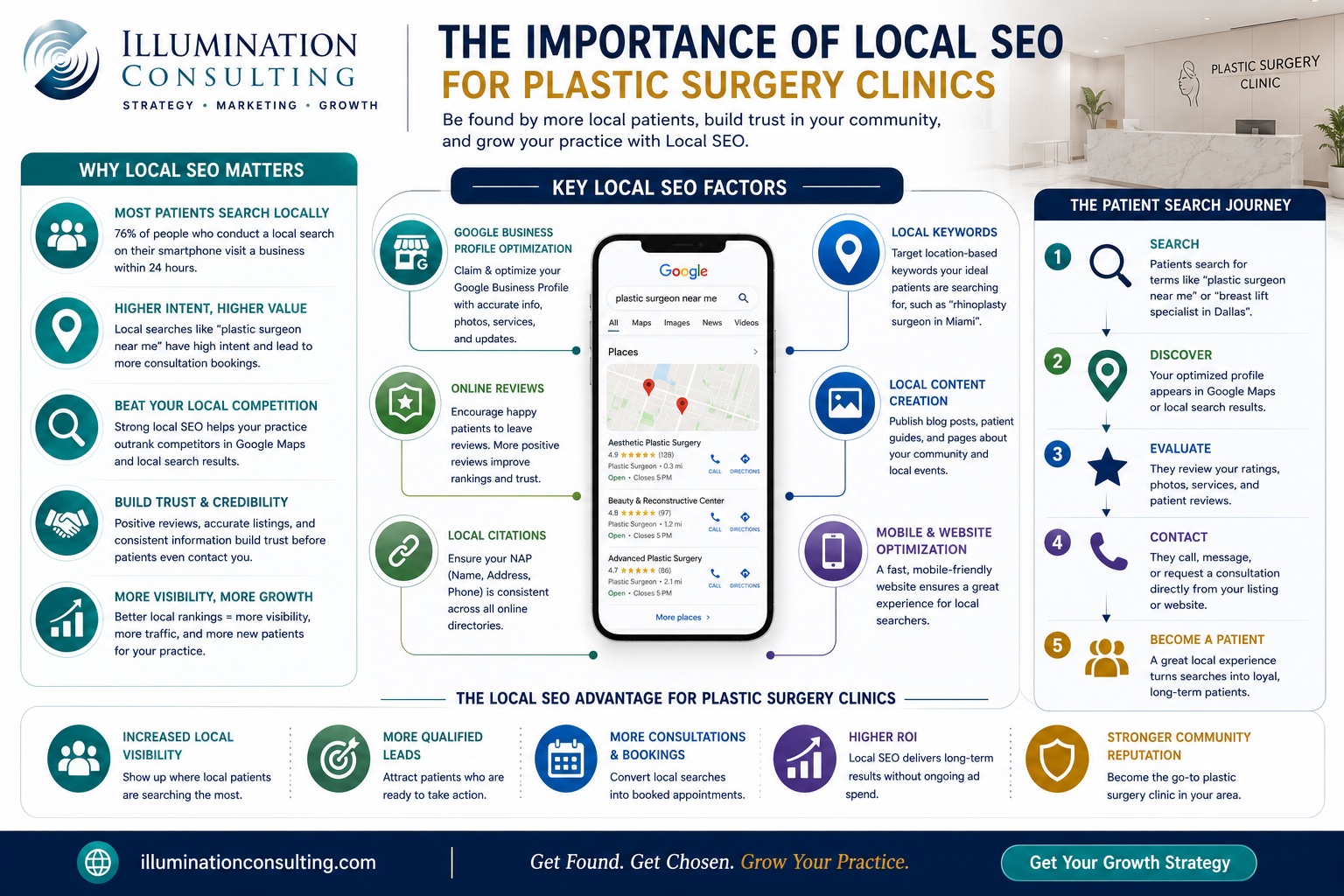
Unlike many industries that serve customers nationally, most plastic surgery practices compete within defined geographic markets. Even surgeons with national reputations rely heavily on local visibility because prospective patients frequently search for providers within their city or surrounding region.
Searches such as:
- Plastic surgeon near me
- Best plastic surgeon in Portland
- Breast augmentation Seattle
- Facelift specialist Los Angeles
- Rhinoplasty surgeon Scottsdale
all indicate strong local intent.
Appearing prominently for these searches requires a comprehensive local SEO strategy that extends well beyond your website.
Optimize Your Google Business Profile
Your Google Business Profile is often the first impression prospective patients have of your practice.
A fully optimized profile should include:
- Accurate business name
- Correct address
- Phone number
- Website link
- Office hours
- Professional photographs
- Surgeon biographies
- Procedure categories
- Service descriptions
- Regular updates and posts
Practices that actively manage their profiles often experience higher visibility in Google’s local map results.
Encourage Authentic Patient Reviews
Online reviews play a major role in both local rankings and patient decision-making.
Prospective patients frequently compare practices based on review quality before scheduling consultations.
Encourage satisfied patients to leave reviews on platforms such as:
- Healthgrades
- RealSelf
- Yelp
Responding professionally to reviews—both positive and negative—demonstrates that your practice values patient feedback while strengthening your online reputation.
Maintain Consistent Business Information
Google compares business information across hundreds of online directories.
Your practice’s:
- Name
- Address
- Phone number
- Website
should remain consistent across every platform.
Even small inconsistencies can reduce Google’s confidence in your business information and negatively affect local rankings.
Create Location-Specific Pages
If your practice serves multiple cities or operates several office locations, develop dedicated pages for each location.
These pages should include:
- Office address
- Driving directions
- Local landmarks
- Procedure availability
- Provider information
- Community involvement
- Location-specific FAQs
- Patient testimonials
Avoid duplicating content between locations. Each page should provide unique information relevant to patients searching within that specific geographic area.
Optimizing Procedure Pages for Search Engines
Procedure pages are among the most valuable assets on a plastic surgery website because they target patients with high purchase intent.
Instead of creating short descriptions, develop comprehensive resources that answer every major question prospective patients may have before scheduling a consultation.
High-performing procedure pages typically include:
- Overview of the procedure
- Candidate qualifications
- Surgical techniques
- Preparation guidelines
- Recovery expectations
- Risks and complications
- Before-and-after galleries
- Frequently asked questions
- Related procedures
- Consultation information
Supporting content with professional photography, illustrations, and educational videos further enhances both patient engagement and search performance.
Each procedure page should also include natural internal links to related treatments. For example, a breast augmentation page might link to breast lift surgery, breast revision procedures, body contouring services, and financing options. This internal linking structure helps visitors explore additional services while strengthening your website’s SEO architecture.
The Power of Before-and-After Galleries
Visual proof is one of the strongest trust-building tools available to plastic surgeons.
Before-and-after galleries allow prospective patients to evaluate real outcomes while gaining a better understanding of what different procedures can achieve.
From an SEO perspective, these galleries also increase user engagement by encouraging visitors to spend more time exploring your website.
To maximize their effectiveness:
- Organize galleries by procedure.
- Use high-resolution professional photography.
- Include concise case descriptions when appropriate.
- Ensure patient consent has been obtained.
- Optimize image file names and alt text.
- Compress images for fast page loading.
Well-structured galleries not only improve the user experience but also reinforce your expertise, credibility, and the quality of your surgical outcomes—factors that influence both patient confidence and long-term search performance.
Content Marketing That Builds Patient Trust
Content marketing is one of the most effective long-term SEO strategies for plastic surgery practices because it aligns perfectly with how prospective patients research cosmetic procedures. Before scheduling a consultation, patients typically want detailed information that helps them understand their options, compare treatments, and feel confident in their decision.
Rather than relying solely on service pages, successful practices build comprehensive content libraries that answer questions throughout the patient’s decision-making journey.
Educational content demonstrates expertise while helping search engines recognize your website as an authoritative resource within your specialty.
Develop Educational Resources
Patients frequently search for information long before they are ready to contact a surgeon.
Examples include:
- How long does rhinoplasty recovery take?
- What is the difference between a facelift and a neck lift?
- Are breast implants safe?
- What should I expect after liposuction?
- How much downtime follows eyelid surgery?
- Is a tummy tuck permanent?
- What is the best age for a facelift?
- How long do breast implants last?
Publishing detailed, informative articles that answer these questions positions your practice as a trusted educational resource while increasing opportunities to rank for valuable long-tail keywords.
Create Procedure Comparison Articles
Comparison content performs exceptionally well because patients often evaluate multiple treatment options before making a decision.
Examples include:
- Facelift vs. Mini Facelift
- Liposuction vs. Tummy Tuck
- Breast Lift vs. Breast Augmentation
- Botox vs. Dermal Fillers
- Surgical vs. Non-Surgical Facial Rejuvenation
- Chin Implant vs. Neck Liposuction
These articles help prospective patients understand their options while naturally guiding them toward scheduling a consultation.
Frequently Asked Questions
FAQ sections provide value for both users and search engines.
Consider answering questions such as:
- How long is recovery?
- Will there be visible scars?
- How soon can I return to work?
- Is financing available?
- Who is a good candidate?
- What results should I expect?
- How long will results last?
- When can I exercise again?
Well-written FAQs improve user engagement while increasing opportunities to appear in Google’s featured snippets and voice search results.
Technical SEO for Plastic Surgery Websites
Outstanding content alone is not enough to achieve strong rankings.
Search engines also evaluate how well a website performs from a technical perspective. A slow, outdated, or poorly structured website can negatively impact both user experience and search visibility.
Technical SEO ensures your website is easy for search engines to crawl while providing visitors with a fast, secure, and enjoyable browsing experience.
Website Speed
Today’s patients expect websites to load almost instantly.
Slow websites often experience:
- Higher bounce rates
- Lower conversion rates
- Reduced engagement
- Lower search rankings
Practices should regularly optimize:
- Image sizes
- Code efficiency
- Browser caching
- Server response times
- Video delivery
- Core Web Vitals
Improving page speed enhances both SEO performance and the overall patient experience.
Mobile Optimization
More than half of healthcare-related searches now occur on smartphones.
Patients frequently research procedures while commuting, watching television, or discussing treatment options with family members.
A mobile-friendly website should provide:
- Responsive layouts
- Easy-to-read typography
- Large touch-friendly buttons
- Simple navigation
- Fast loading speeds
- Click-to-call functionality
- Convenient appointment forms
Google primarily evaluates websites using mobile-first indexing, making responsive design essential for every plastic surgery practice.
Structured Data
Structured data helps search engines better understand website content.
Plastic surgery practices should implement schema markup where appropriate for:
- Physicians
- Medical organizations
- Reviews
- FAQs
- Articles
- Videos
- Local businesses
- Breadcrumb navigation
Although structured data does not guarantee higher rankings, it often improves search result appearance and click-through rates.
Secure Website Architecture
Healthcare websites should always prioritize patient privacy and security.
Essential technical requirements include:
- HTTPS encryption
- Secure contact forms
- Privacy policy
- Cookie disclosures
- Accessible navigation
- Clean URL structures
- XML sitemaps
- Optimized robots.txt files
A technically sound website creates confidence among both search engines and prospective patients.
Reputation Management and Online Reviews
For plastic surgeons, reputation is one of the strongest influences on patient decision-making.
Even if your website ranks first in Google, prospective patients will often compare online reviews before requesting a consultation.
Positive reviews reinforce your expertise while strengthening local SEO performance.
Encourage Patient Feedback
Practices should develop a consistent review generation process following successful patient experiences.
Patients can be encouraged to leave reviews on:
- RealSelf
- Healthgrades
- Yelp
A steady stream of authentic reviews demonstrates ongoing patient satisfaction while improving local search visibility.
Respond Professionally
Every review presents an opportunity to reinforce professionalism.
Responding thoughtfully to positive reviews shows appreciation, while responding appropriately to negative feedback demonstrates transparency and commitment to patient care.
Always protect patient privacy and avoid discussing confidential medical information in public responses.
Showcase Testimonials
In addition to third-party reviews, include patient testimonials throughout your website.
Testimonials can strengthen:
- Procedure pages
- Before-and-after galleries
- Consultation pages
- Landing pages
Combined with professional photography and educational content, testimonials provide powerful social proof that helps prospective patients feel more confident about choosing your practice.
Measuring SEO Success
Effective SEO requires continuous monitoring and improvement.
Rather than focusing solely on keyword rankings, plastic surgery practices should evaluate how SEO contributes to meaningful business growth.
Important performance indicators include:
- Organic website traffic
- Local keyword rankings
- Google Business Profile visibility
- Consultation requests
- Qualified patient inquiries
- Conversion rates
- Phone calls from organic search
- Online appointment requests
- Time spent on key pages
- Revenue generated from organic traffic
These metrics provide a clearer understanding of how SEO contributes to practice growth and help identify opportunities for continued optimization.
Practices that regularly analyze performance data can refine their content strategy, improve user experience, and strengthen their competitive position over time, ensuring their SEO investment continues generating qualified patient inquiries year after year.
Common Plastic Surgery SEO Mistakes
Even practices that invest heavily in digital marketing often make SEO mistakes that limit their ability to generate consistent organic traffic and consultation requests. Avoiding these common issues can significantly improve your website’s performance while strengthening your long-term online authority.
Some of the most common plastic surgery SEO mistakes include:
- Publishing thin procedure pages with minimal educational content.
- Targeting only broad keywords while ignoring long-tail search opportunities.
- Neglecting local SEO optimization.
- Failing to optimize Google Business Profile.
- Using duplicate content across procedure or location pages.
- Ignoring technical SEO issues that affect website performance.
- Publishing outdated information that no longer reflects current surgical techniques.
- Neglecting image optimization for before-and-after galleries.
- Inconsistent business information across online directories.
- Treating SEO as a one-time project instead of an ongoing marketing strategy.
Practices that continuously improve their websites, publish valuable educational content, and monitor performance consistently outperform competitors who make only occasional updates.
Why SEO Works Better Than Short-Term Marketing Campaigns
Many plastic surgery practices rely heavily on paid advertising because it can generate immediate visibility. While paid search and social media advertising certainly have their place, they require continuous investment. Once advertising budgets are paused, website traffic and lead generation often decline immediately.
SEO operates differently.
Instead of renting visibility through advertising, search engine optimization builds long-term digital assets that continue generating qualified traffic long after they are published.
Every optimized page contributes to the overall authority of your website, including:
- Procedure pages
- Physician biographies
- Educational articles
- Before-and-after galleries
- FAQ sections
- Location pages
- Patient resources
- Video content
As these assets grow, search engines gain greater confidence in your practice, resulting in improved rankings across an increasingly broad range of search terms.
This compounding effect is one of the reasons SEO consistently delivers one of the highest long-term returns on investment for plastic surgery practices.
The Future of Plastic Surgery SEO
Search engine optimization continues to evolve as Google becomes increasingly sophisticated in evaluating healthcare websites.
Several emerging trends are shaping the future of plastic surgery marketing.
Artificial Intelligence
Artificial intelligence is transforming how practices approach SEO by improving:
- Keyword research
- Content planning
- Competitive analysis
- Technical SEO audits
- Internal linking recommendations
- Performance forecasting
- Marketing automation
Practices that responsibly incorporate AI into their marketing strategy can improve efficiency while maintaining the high-quality, medically accurate content that prospective patients expect.
Voice Search
More patients are using voice assistants to search for healthcare providers and procedures.
Voice searches often include conversational phrases such as:
- Who is the best plastic surgeon near me?
- How much does rhinoplasty cost?
- What is the recovery time for a facelift?
- Which plastic surgeon specializes in breast reconstruction?
Optimizing content around natural language questions helps practices capture this growing segment of search traffic.
Video SEO
Video continues to become an increasingly important ranking and engagement factor.
Plastic surgery practices can use video to educate prospective patients through:
- Procedure explanations
- Frequently asked questions
- Surgeon introductions
- Patient testimonials
- Recovery timelines
- Office tours
- Consultation expectations
Video content improves engagement while helping prospective patients become more comfortable with your practice before scheduling consultations.
Patient Experience
Google increasingly rewards websites that provide exceptional user experiences.
Practices that prioritize:
- Fast-loading websites
- Mobile responsiveness
- Simple navigation
- Helpful educational resources
- Secure browsing
- Accessible design
- Clear calls to action
will continue strengthening both their search visibility and patient satisfaction.
Frequently Asked Questions
How long does plastic surgery SEO take to produce results?
SEO is a long-term investment. While some improvements may become visible within a few months, meaningful growth typically develops over six to twelve months as search engines recognize your website’s authority, content quality, and technical improvements.
Is SEO better than Google Ads for plastic surgeons?
Both strategies have value. Google Ads can generate immediate visibility, while SEO builds sustainable long-term traffic and reduces dependence on paid advertising. Many successful practices use both as part of a comprehensive digital marketing strategy.
What pages should every plastic surgery website include?
Every practice should have comprehensive procedure pages, physician biographies, before-and-after galleries, patient testimonials, educational blog articles, FAQ sections, contact information, and location-specific pages where appropriate.
Why is local SEO important for plastic surgeons?
Most patients search for surgeons within a specific geographic area. Local SEO helps practices appear in Google Maps, local search results, and location-based searches, making it easier for prospective patients to find nearby providers.
How often should a plastic surgery website be updated?
Websites should be reviewed regularly throughout the year. Publishing fresh educational content, updating procedure information, improving technical performance, and adding patient reviews all help maintain strong search visibility and demonstrate ongoing expertise.
Grow Your Plastic Surgery Practice with Strategic SEO
The plastic surgery industry has never been more competitive, and your online presence often determines whether prospective patients contact your practice or continue searching for another provider. Search engine optimization is no longer simply about improving rankings—it is about building trust, demonstrating expertise, educating patients, and creating a digital experience that inspires confidence from the very first interaction.
A successful SEO strategy combines technical excellence, comprehensive educational content, strong local visibility, reputation management, and an exceptional user experience. Together, these elements help practices attract highly qualified patients while establishing long-term authority within their specialty.
At Illumination Consulting, we specialize in helping plastic surgery practices improve their search visibility, generate more qualified consultation requests, and build sustainable patient acquisition strategies through proven healthcare SEO solutions. From comprehensive website optimization and local SEO to content marketing and ongoing performance analysis, our team develops customized strategies designed to deliver measurable results.
Whether you’re launching a new practice or looking to outperform established competitors, we’re ready to help you build a stronger online presence.
Get Your Growth Strategy today or Speak with a Growth Specialist to learn how a customized SEO strategy can help your plastic surgery practice attract more patients, increase consultation requests, and achieve long-term growth.