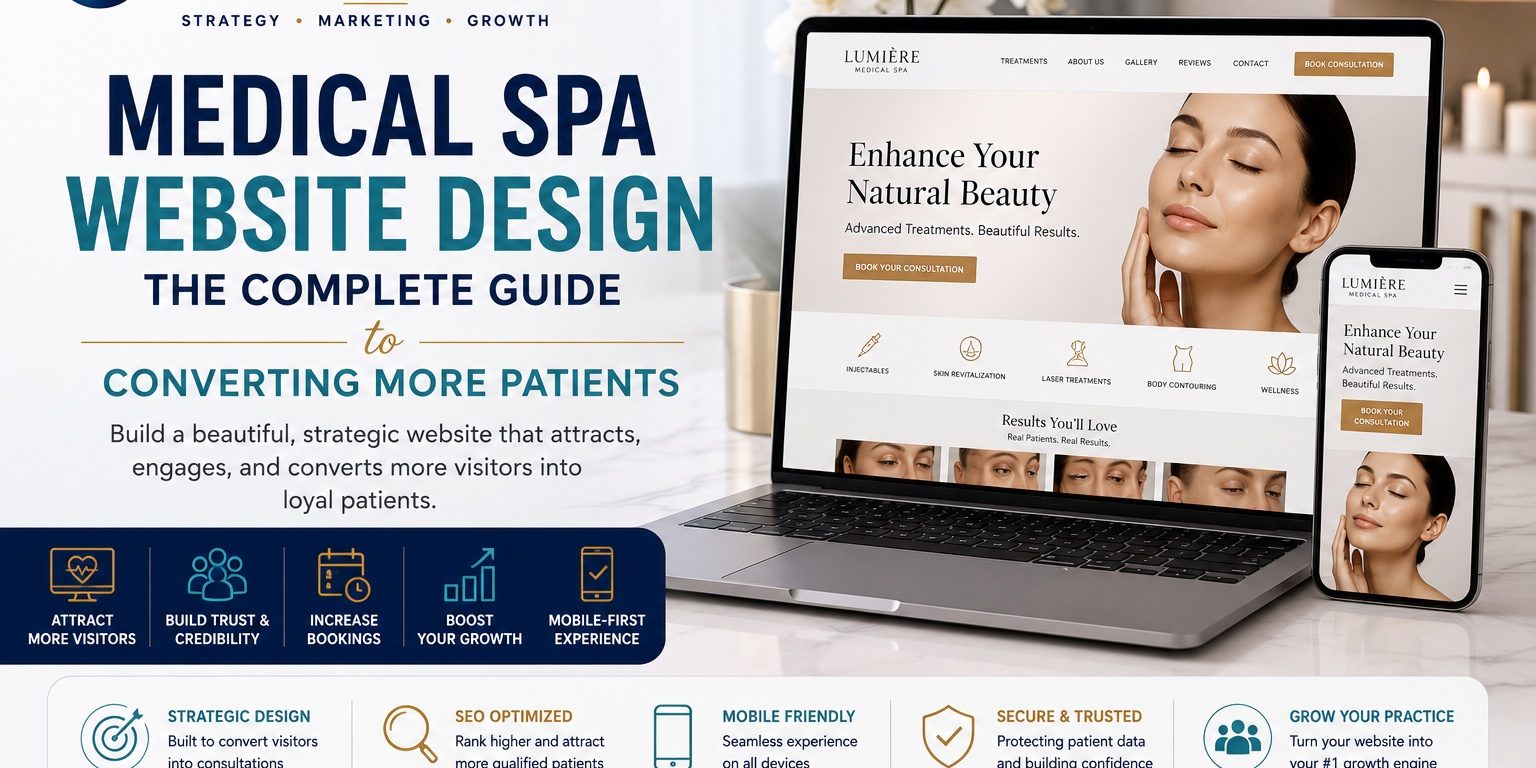
A medical spa’s website is far more than a digital brochure—it’s often the first interaction prospective patients have with your business. Long before they schedule a consultation or walk through your doors, they evaluate your professionalism, services, expertise, and credibility based almost entirely on their online experience.
Today’s patients expect a website that is visually impressive, easy to navigate, fast to load, and filled with trustworthy information. They want to learn about treatments, compare providers, review before-and-after results, read testimonials, and understand what makes your medical spa different from dozens of competitors in the same market. If your website fails to provide that experience, prospective patients will likely leave within seconds and continue their search elsewhere.
The medical aesthetics industry has become increasingly competitive. New medical spas, cosmetic dermatology clinics, wellness centers, and aesthetic practices continue entering the market every year, making first impressions more important than ever. An outdated website can unintentionally communicate that a practice is outdated as well, regardless of the quality of care it actually provides.
A professionally designed medical spa website serves as both a marketing platform and a patient acquisition system. Every page should guide visitors naturally toward booking a consultation while simultaneously educating them about treatments, building trust, and reinforcing your expertise. Effective website design combines visual appeal with strategy, ensuring every element contributes to improving user experience and increasing conversion rates.
Modern website design also plays a significant role in search engine optimization. Google rewards websites that provide exceptional user experiences through fast loading speeds, mobile responsiveness, intuitive navigation, secure browsing, and high-quality content. A beautiful website that ignores these technical considerations may struggle to rank in search results, limiting its ability to attract new patients organically.
Artificial intelligence, automation, online scheduling, live chat, personalized content, and interactive patient tools have further transformed what patients expect from healthcare websites. Practices that embrace these innovations create smoother digital experiences while reducing administrative workloads and improving patient satisfaction.
Whether your medical spa specializes in injectables, laser treatments, body contouring, skin rejuvenation, wellness therapies, or a comprehensive range of aesthetic services, your website should function as your highest-performing marketing asset. Every visitor represents an opportunity to educate, engage, and convert someone who is actively searching for the services you provide.
In this guide, you’ll learn the essential principles of high-performing medical spa website design, discover the features that consistently generate more patient inquiries, and explore the strategies that help practices transform website visitors into long-term patients.
Why Website Design Matters for Medical Spas
Patients often make decisions within seconds of arriving on a website. During those first few moments, they subconsciously evaluate professionalism, credibility, trustworthiness, and overall quality before reading a single paragraph of content.
An attractive website alone isn’t enough.
Successful medical spa websites combine exceptional design with strategic marketing principles that encourage visitors to explore treatments, learn about providers, and ultimately request consultations.
Your Website Creates the First Impression
For many prospective patients, your website becomes the equivalent of walking into your reception area for the first time.
Everything influences perception, including:
- Overall visual design
- Photography quality
- Branding consistency
- Typography
- Page organization
- Navigation
- Website speed
- Mobile experience
- Professional content
A polished website immediately communicates professionalism while reducing uncertainty during the patient’s decision-making process.
Patients Research Before Booking
Unlike impulse purchases, aesthetic treatments involve careful consideration.
Patients commonly spend days or weeks researching:
- Available treatments
- Provider qualifications
- Pricing information
- Recovery expectations
- Before-and-after galleries
- Reviews and testimonials
- Frequently asked questions
- Financing options
Your website should answer these questions naturally while guiding visitors toward scheduling consultations.
Website Design Impacts SEO
Many practice owners think of SEO and website design as separate projects.
In reality, they’re closely connected.
Google evaluates factors such as:
- Mobile responsiveness
- Page speed
- Navigation structure
- User experience
- Internal linking
- Website security
- Accessibility
- Content organization
A properly designed website creates the technical foundation necessary for strong organic search rankings while improving the overall patient experience.
Better Design Produces Higher Conversion Rates
Generating website traffic is only part of the equation.
The real objective is converting visitors into consultation requests.
Effective medical spa website design improves conversion rates by:
- Building trust quickly
- Simplifying navigation
- Highlighting treatments
- Showcasing results
- Displaying testimonials
- Providing clear calls-to-action
- Making appointment scheduling effortless
Even small improvements in conversion rates can produce significant increases in patient acquisition without increasing advertising budgets.
Understanding the Modern Medical Spa Patient
Successful website design begins with understanding how patients research aesthetic treatments online.
Today’s patients rarely visit a website with the intention of immediately booking an appointment. Instead, they gather information, compare providers, evaluate treatment options, and build confidence before making contact.
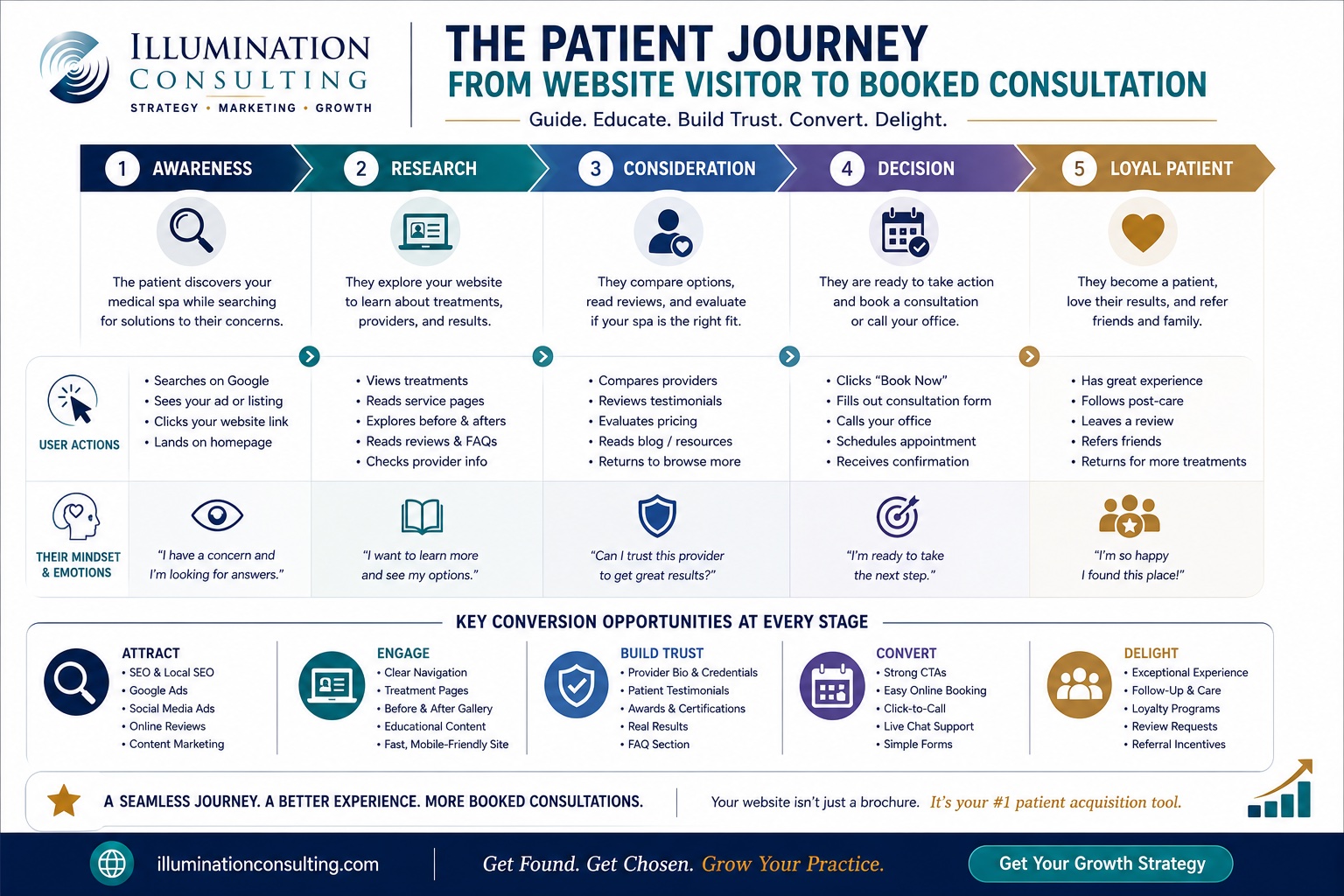
This journey often follows several stages:
Awareness
Patients first recognize a concern or treatment they wish to explore.
Examples include:
- Fine lines and wrinkles
- Acne scars
- Sun damage
- Facial volume loss
- Unwanted body fat
- Hair removal
- Skin rejuvenation
- Preventative skincare
At this stage, educational content helps establish trust while introducing available treatment options.
Research
Patients begin comparing providers.
They evaluate:
- Website quality
- Services offered
- Provider experience
- Reviews
- Treatment descriptions
- Pricing transparency
- Before-and-after photos
- Practice reputation
A comprehensive, professionally designed website keeps prospective patients engaged while answering their questions before they need to contact the office.
Consideration
As patients narrow their options, trust becomes increasingly important.
They look for evidence that supports your credibility, including:
- Provider biographies
- Certifications
- Awards
- Testimonials
- Patient success stories
- Frequently asked questions
- Educational resources
These trust signals reduce uncertainty while encouraging consultation requests.
Decision
At this point, patients are ready to take action—but only if the process feels simple and convenient.
Your website should make scheduling effortless through:
- Online appointment requests
- Click-to-call buttons
- Consultation forms
- Live chat
- Mobile-friendly booking
- Clear calls-to-action
Every unnecessary step increases the likelihood that a prospective patient abandons the process and contacts another practice instead.
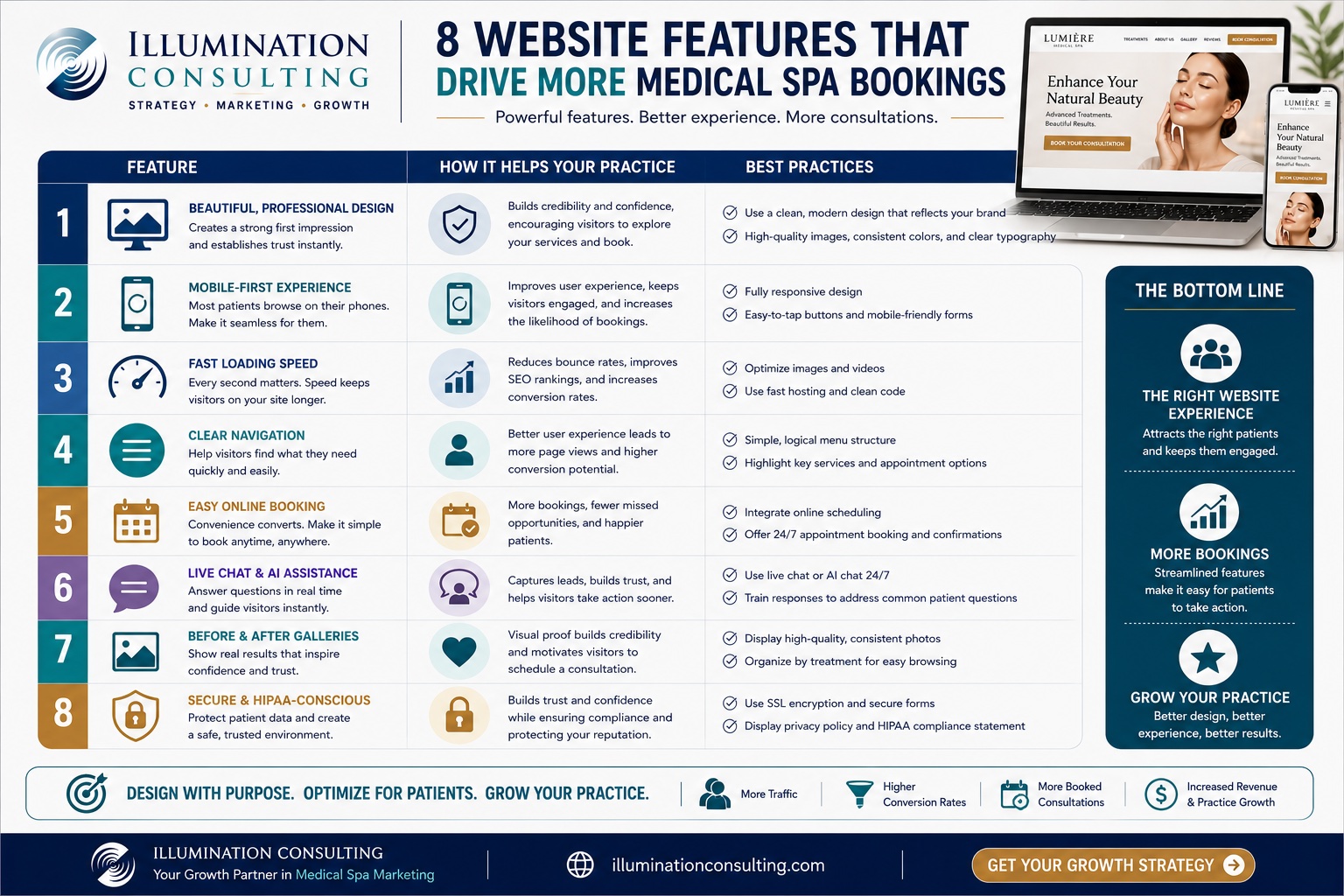
Essential Features Every High-Converting Medical Spa Website Needs
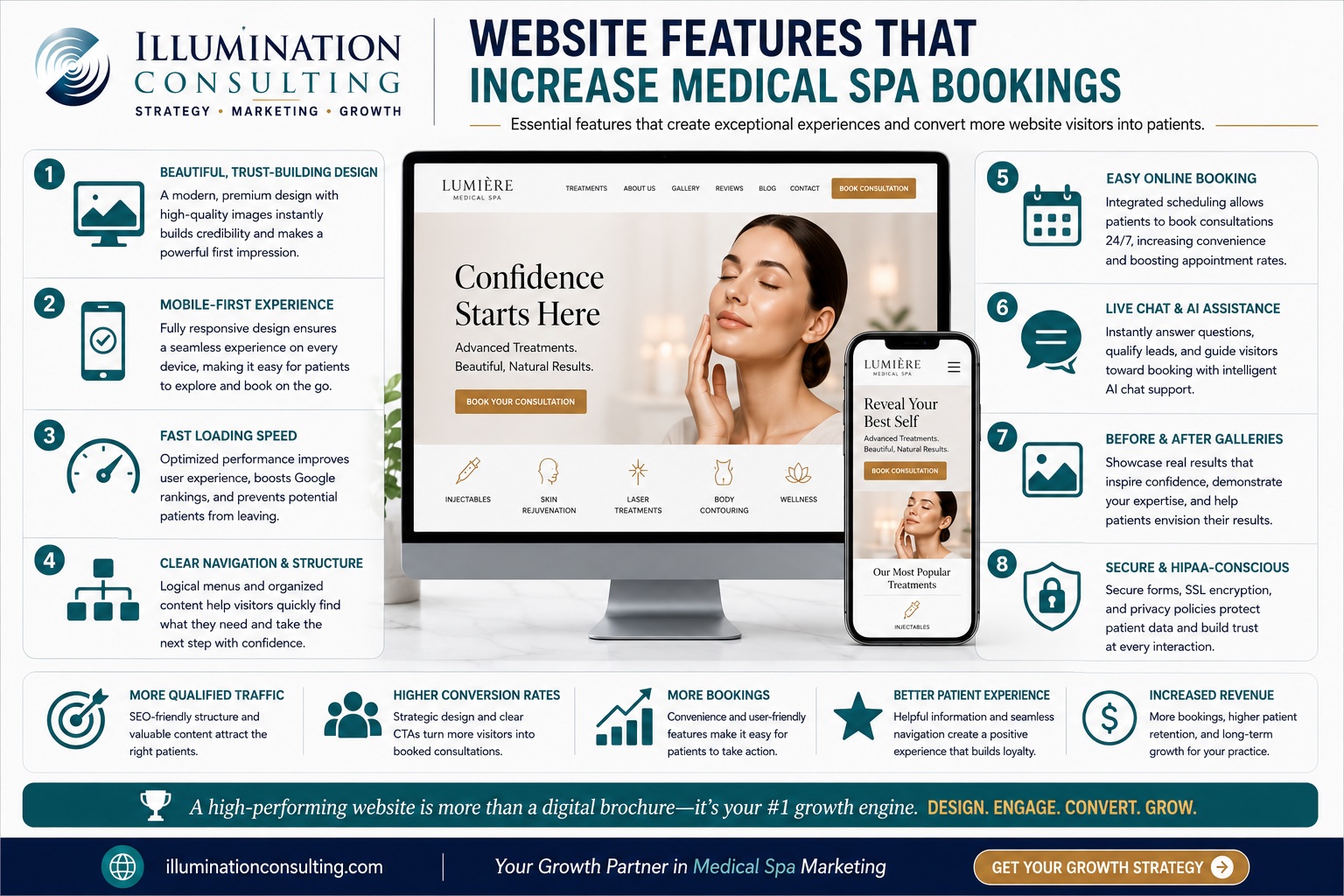
The most successful medical spa websites are carefully designed to guide prospective patients from curiosity to consultation. Every page, image, and call-to-action should contribute to building trust while making it easy for visitors to take the next step.
Rather than overwhelming users with unnecessary information, high-performing websites present content in a logical, intuitive manner that answers questions while encouraging engagement.
Professional Branding
Your website should immediately communicate the quality and professionalism of your medical spa.
Consistent branding includes:
- A professionally designed logo
- Cohesive color palette
- Premium typography
- High-quality photography
- Consistent graphic elements
- Clean page layouts
Luxury aesthetic services require a premium online presentation. Every visual element should reinforce the experience patients can expect when visiting your practice.
Clear Navigation
Patients should never struggle to find information.
A well-organized navigation menu should provide quick access to:
- Treatments
- About the Practice
- Meet the Providers
- Before-and-After Gallery
- Patient Reviews
- Blog
- FAQs
- Contact Information
- Book Appointment
Simple navigation improves the user experience while helping search engines better understand your website structure.
Strong Calls-to-Action
Every important page should encourage visitors to take action.
Examples include:
- Book Your Consultation
- Schedule Your Appointment
- Request a Personalized Treatment Plan
- Speak with a Specialist
- Contact Our Team
Calls-to-action should be visually prominent and appear naturally throughout the website without feeling overly aggressive.
Trust-Building Elements
Medical aesthetics is a trust-driven industry.
Patients often invest significant time researching providers before scheduling consultations.
Your website should prominently feature:
- Provider credentials
- Medical licenses
- Professional memberships
- Patient testimonials
- Awards and certifications
- Years of experience
- Before-and-after galleries
- Media features
- Frequently asked questions
These elements help reduce uncertainty while increasing patient confidence.
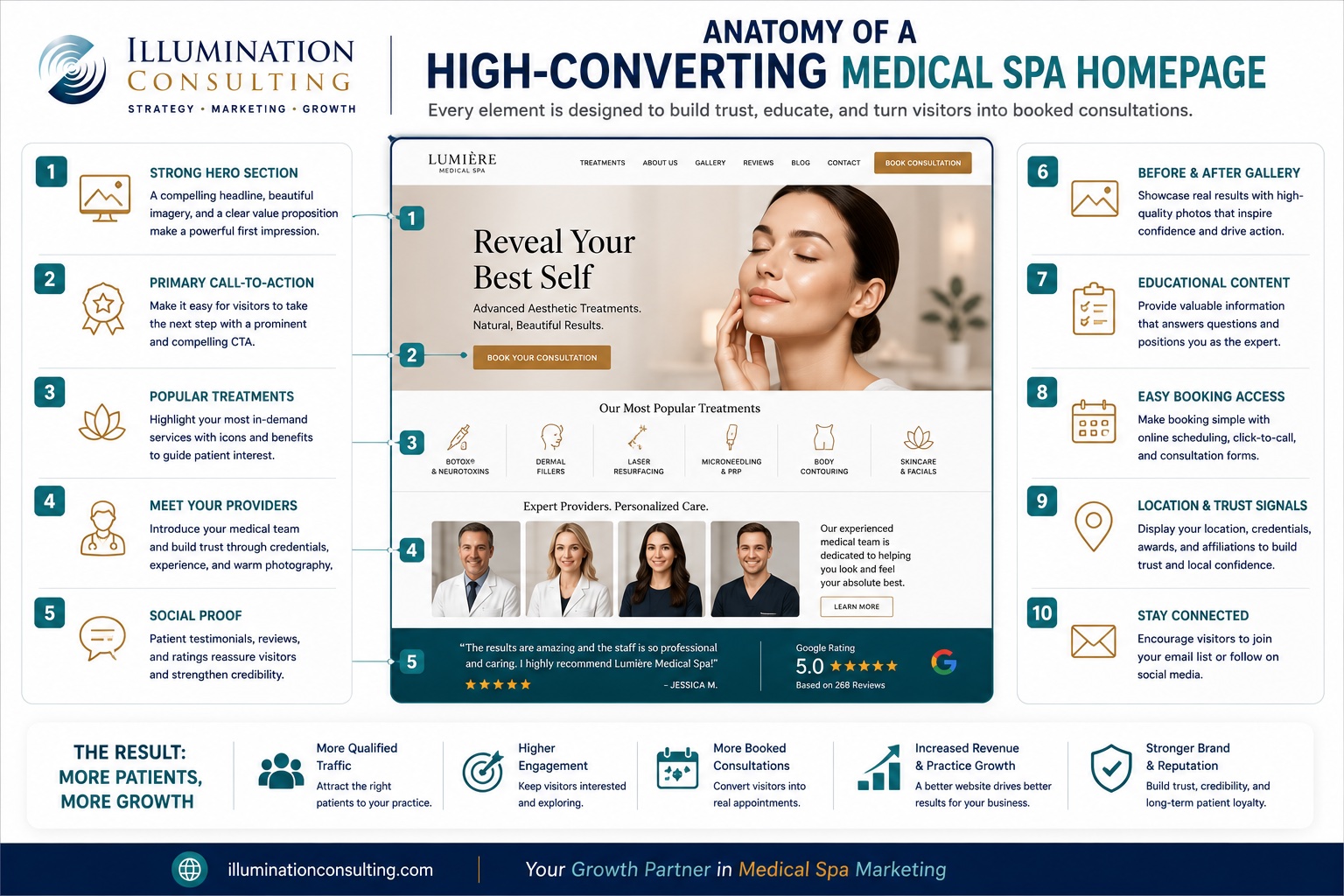
Homepage Best Practices
Your homepage serves as the central hub of your entire website. It should quickly communicate who you are, what you offer, and why prospective patients should choose your medical spa over competing practices.
Visitors should understand your value proposition within just a few seconds of arriving on the page.
Create a Powerful Hero Section
The hero section is the first content visitors see.
It should include:
- Professional imagery
- Clear value proposition
- Brief supporting message
- Primary call-to-action
- Secondary navigation option
Avoid cluttering this section with excessive text. Instead, focus on communicating your expertise and encouraging visitors to explore further.
Highlight Your Most Popular Treatments
Rather than listing every available service immediately, showcase the treatments that generate the highest patient demand.
Examples include:
- Botox
- Dermal Fillers
- Laser Skin Resurfacing
- Microneedling
- Chemical Peels
- Body Contouring
- Laser Hair Removal
- Skin Tightening
Each featured treatment should link to a dedicated service page that provides comprehensive educational information.
Introduce Your Providers
Patients want to know who will perform their treatments.
Include professional introductions featuring:
- Physician photographs
- Credentials
- Years of experience
- Areas of specialization
- Brief biographies
Humanizing your practice builds trust while creating stronger emotional connections with prospective patients.
Showcase Social Proof
Patient reviews remain one of the strongest conversion factors for medical spa websites.
Display:
- Google Reviews
- Patient testimonials
- Success stories
- Ratings
- Awards
- Media mentions
Authentic social proof reassures visitors that previous patients have had positive experiences with your practice.
Treatment Pages That Generate Consultations
Treatment pages are among the highest-converting pages on your website because they attract visitors actively researching specific procedures.
Rather than offering only brief service descriptions, develop comprehensive educational resources that answer the questions patients are most likely to ask.
Each treatment page should include:
- Procedure overview
- Benefits
- Ideal candidates
- Treatment process
- Recovery expectations
- Frequently asked questions
- Before-and-after images
- Related treatments
- Clear consultation CTA
Well-developed treatment pages improve both SEO performance and patient confidence.
Use High-Quality Photography
Professional photography significantly influences patient perception.
Avoid generic stock photography whenever possible.
Instead, showcase:
- Your office
- Treatment rooms
- Providers
- Staff
- Actual equipment
- Patient consultations (with permission)
- Lifestyle imagery that reflects your brand
Authentic imagery creates a stronger emotional connection while distinguishing your practice from competitors.
Write Patient-Focused Content
Many treatment pages focus too heavily on technical explanations.
Patients care most about outcomes.
Rather than simply describing how a treatment works, explain:
- What concerns it addresses
- Expected results
- Typical recovery time
- Comfort level during treatment
- Maintenance recommendations
- Long-term benefits
Answering these questions naturally improves both engagement and conversion rates.
Before-and-After Galleries That Inspire Confidence
Few website features influence aesthetic treatment decisions more than before-and-after photography.
These galleries provide visual proof of your expertise while helping prospective patients understand realistic treatment outcomes.
Well-organized galleries also increase the amount of time visitors spend on your website—an important engagement signal that supports SEO.
To maximize their effectiveness:
- Organize galleries by treatment.
- Use consistent lighting and angles.
- Include multiple patient examples.
- Optimize images for fast loading.
- Add descriptive captions where appropriate.
- Ensure patient consent has been obtained.
Avoid overly edited photographs or unrealistic representations of treatment outcomes. Authenticity strengthens credibility and builds lasting patient trust.
Online Booking Should Be Effortless
Every additional step in the appointment process increases the likelihood that a prospective patient abandons the website before scheduling.
Modern medical spa websites should make booking simple from any page.
Best practices include:
- Online appointment scheduling
- Click-to-call functionality
- Mobile-friendly booking forms
- Live chat assistance
- Automated confirmations
- Consultation request forms
- Calendar integrations
Convenience is no longer a luxury—it is an expectation. Practices that remove friction from the scheduling process consistently convert more website visitors into booked consultations.
Mobile-First Website Design
More than 70% of medical spa website visitors now browse from smartphones or tablets. Whether they’re researching treatments during lunch, scrolling social media in the evening, or searching for providers while on the go, mobile devices have become the primary way patients discover aesthetic practices.
Google recognizes this shift and now evaluates websites using mobile-first indexing, meaning the mobile version of your website plays the largest role in determining search rankings.
A website that performs poorly on mobile devices not only frustrates visitors but can also negatively impact SEO, conversion rates, and patient acquisition.
Responsive Design Is Essential
A responsive website automatically adjusts to different screen sizes without sacrificing usability or visual appeal.
Patients should be able to:
- Read content without zooming.
- Navigate menus easily.
- Tap buttons comfortably.
- View before-and-after galleries.
- Complete consultation forms.
- Schedule appointments from any device.
Every interaction should feel seamless regardless of whether visitors use a smartphone, tablet, laptop, or desktop computer.
Prioritize Mobile User Experience
Mobile visitors often have less patience than desktop users.
Your website should emphasize:
- Fast loading speeds
- Clear navigation
- Large touch-friendly buttons
- Minimal scrolling
- Click-to-call functionality
- Mobile appointment scheduling
- Easy-to-read typography
- Compressed images for faster performance
Removing unnecessary friction significantly increases the likelihood that visitors will remain engaged and schedule consultations.
Website Speed and Performance
Website speed influences both patient experience and search engine rankings.
Studies consistently show that even small delays in page loading can increase bounce rates and reduce conversions. In an industry where patients have numerous provider options, slow websites often result in lost opportunities before visitors even begin exploring your services.
Improve Core Web Vitals
Google measures website performance using several user experience metrics known as Core Web Vitals.
These include:
- Loading performance
- Visual stability
- Page responsiveness
- User interaction speed
Improving these metrics benefits both SEO and patient satisfaction.
Optimize Website Performance
Medical spa websites frequently include high-resolution photography and video, both of which require careful optimization.
Performance improvements include:
- Compressing images
- Using next-generation image formats
- Minimizing unnecessary scripts
- Browser caching
- Content delivery networks (CDNs)
- Optimized hosting
- Lazy loading for images
- Clean website code
These technical improvements help create a faster, smoother browsing experience.
SEO-Friendly Website Architecture
A beautiful website delivers little value if prospective patients cannot find it through Google.
Website architecture provides the structural foundation that allows search engines to understand your content while helping visitors navigate your services efficiently.
Create Logical Navigation
Organize your website into clearly defined sections.
For example:
Home
About
- Meet Our Providers
- Our Philosophy
- Patient Testimonials
Treatments
- Injectables
- Laser Treatments
- Facial Rejuvenation
- Body Contouring
- Skin Tightening
- Wellness Services
Resources
- Blog
- FAQs
- Patient Forms
Gallery
Contact
A logical structure improves usability while helping search engines crawl your website more effectively.
Optimize Internal Linking
Internal links help visitors discover related information while strengthening SEO.
For example:
A Botox treatment page may naturally link to:
- Dermal Fillers
- Wrinkle Prevention
- Facial Rejuvenation
- Membership Programs
- Skincare Products
Likewise, educational blog articles should connect readers to related treatments and service pages.
This interconnected structure strengthens topical authority while encouraging visitors to explore more of your website.
Build Comprehensive Service Pages
Every treatment deserves its own dedicated page rather than grouping multiple procedures together.
Individual pages allow you to target specific keywords while providing detailed educational content for each service.
Examples include:
- Botox
- Dysport
- Dermal Fillers
- PRP Therapy
- Laser Hair Removal
- Microneedling
- Chemical Peels
- IPL Photofacials
- Body Contouring
- Skin Tightening
Dedicated pages provide greater SEO opportunities while improving the patient experience.
Conversion Rate Optimization (CRO)
Generating website traffic is only half the equation.
The ultimate objective is converting visitors into consultations.
Conversion Rate Optimization (CRO) focuses on improving every aspect of the website to encourage prospective patients to take action.
Even small improvements in conversion rates can dramatically increase new patient acquisition without increasing marketing expenses.
Make Calls-to-Action Impossible to Miss
Every important page should include clear calls-to-action.
Examples include:
- Book Your Consultation
- Schedule Online
- Request a Personalized Treatment Plan
- Speak with a Specialist
- Contact Our Team Today
Buttons should stand out visually while appearing naturally throughout the patient journey.
Reduce Friction
Visitors abandon websites whenever unnecessary obstacles appear.
Simplify the experience by:
- Reducing form fields
- Eliminating unnecessary clicks
- Offering online scheduling
- Displaying phone numbers prominently
- Including live chat
- Providing quick contact forms
Convenience increases conversion rates.
Build Trust Throughout the Website
Patients need reassurance before scheduling aesthetic treatments.
Trust-building elements include:
- Google Reviews
- Before-and-after galleries
- Provider credentials
- Awards
- Certifications
- Patient testimonials
- Professional affiliations
- Years of experience
Displaying these elements strategically throughout the website reinforces credibility while encouraging consultation requests.
AI Features for Modern Medical Spa Websites
Artificial intelligence is changing how medical spa websites engage visitors and convert leads.
Rather than simply presenting information, AI allows websites to create interactive, personalized experiences that improve patient satisfaction while reducing administrative workloads.
Examples include:
- AI chat assistants
- Intelligent appointment scheduling
- Personalized treatment recommendations
- Automated follow-up emails
- Smart FAQ assistants
- Lead qualification tools
- Content personalization
- Predictive analytics
- Marketing automation
These technologies help practices respond faster, improve efficiency, and provide a more modern digital experience.
As AI continues evolving, practices that adopt these tools early will be better positioned to improve patient engagement while creating competitive advantages in increasingly crowded local markets.
HIPAA, Security, and Patient Privacy
Patient trust extends far beyond exceptional treatments and attractive website design. Healthcare organizations are responsible for protecting sensitive patient information, and your website plays an important role in maintaining that trust.
Every interaction—from a consultation request form to an online appointment booking—should demonstrate your commitment to security and privacy.
While a website alone does not determine HIPAA compliance, it should support secure communication and protect patient data wherever possible.
Secure Website Infrastructure
Every medical spa website should include:
- HTTPS encryption
- Secure web hosting
- SSL certificates
- Protected contact forms
- Secure appointment requests
- Regular software updates
- Firewall protection
- Malware monitoring
- Routine website backups
These safeguards help protect both your practice and your patients while reinforcing confidence in your online presence.
Privacy Policies and Transparency
Patients want to understand how their information will be used.
Your website should clearly provide:
- Privacy Policy
- Terms of Use
- Cookie Policy
- Accessibility Statement
- Contact Information
Transparent communication demonstrates professionalism while helping visitors feel more comfortable sharing their information.
Secure Online Forms
Consultation requests should be simple while avoiding unnecessary collection of sensitive medical information.
Best practices include:
- Request only essential information.
- Avoid collecting protected health information unless necessary.
- Clearly explain how submitted information will be used.
- Route submissions through secure systems.
- Integrate securely with your CRM or scheduling platform.
A secure experience strengthens trust before patients even enter your office.
Common Medical Spa Website Design Mistakes
Many medical spas invest in attractive websites but overlook the strategic elements that convert visitors into patients.
Avoiding these common mistakes can significantly improve both user experience and website performance.
Outdated Design
An outdated website can unintentionally suggest outdated treatments or technology.
Refresh your website regularly to reflect:
- Current branding
- Modern design standards
- Updated services
- Current provider information
- Recent photography
Poor Navigation
Visitors should never struggle to locate important information.
Avoid:
- Overly complicated menus
- Hidden service pages
- Broken links
- Confusing navigation structures
- Excessive dropdown menus
Simple navigation improves both SEO and user satisfaction.
Weak Calls-to-Action
Many websites explain treatments well but fail to tell visitors what to do next.
Every major page should encourage action through clear calls-to-action such as:
- Book Your Consultation
- Schedule Online
- Speak with a Specialist
- Request More Information
Without guidance, visitors often leave without contacting the practice.
Stock Photography Everywhere
Patients recognize generic stock photography immediately.
Whenever possible, showcase:
- Your physicians
- Your providers
- Your office
- Actual treatment rooms
- Real equipment
- Team members
- Authentic patient experiences (with permission)
Authentic visuals create stronger emotional connections while differentiating your practice.
Slow Website Performance
Large image files, unnecessary animations, and outdated coding frequently slow medical spa websites.
Regular performance optimization helps improve:
- User experience
- Search rankings
- Conversion rates
- Mobile usability
Fast websites consistently outperform slow competitors.
Thin Service Pages
Many practices provide only brief descriptions of treatments.
Instead, create comprehensive pages that answer common patient questions while demonstrating your expertise.
Detailed pages generally perform better in search results while increasing consultation requests.
Measuring Website Success
A successful medical spa website should do far more than look attractive—it should consistently generate measurable business growth.
Monitoring website performance allows practices to identify strengths, uncover opportunities, and make informed marketing decisions.
Key performance indicators include:
- Organic website traffic
- Local keyword rankings
- Consultation requests
- Appointment bookings
- Contact form submissions
- Phone calls
- Conversion rate
- Average session duration
- Bounce rate
- Google Business Profile interactions
Rather than focusing on traffic alone, evaluate how your website contributes to patient acquisition and overall revenue growth.
Frequently Asked Questions
How often should a medical spa website be redesigned?
Most medical spa websites benefit from a redesign every three to five years. However, content, images, SEO improvements, and technical updates should be performed continuously to maintain strong performance and remain competitive.
Why is mobile website design so important?
Most prospective patients now research treatments using smartphones. A mobile-friendly website improves user experience, increases appointment requests, and supports higher Google rankings through mobile-first indexing.
Does website design affect SEO?
Yes. Google evaluates page speed, mobile responsiveness, website architecture, user experience, internal linking, and technical performance when determining search rankings. A professionally designed website provides the foundation for successful SEO.
What pages should every medical spa website include?
Every practice should include a homepage, treatment pages, provider biographies, before-and-after gallery, patient testimonials, FAQ section, educational blog, contact page, and online appointment scheduling.
Can AI improve medical spa websites?
Absolutely. AI-powered chat assistants, appointment scheduling, personalized recommendations, automated follow-up campaigns, and intelligent analytics can improve patient engagement while increasing operational efficiency and conversion rates.
Build a Medical Spa Website That Drives Long-Term Growth
Your website is one of the most valuable investments your medical spa can make. It serves as your digital storefront, your most effective marketing asset, and often the deciding factor in whether a prospective patient schedules a consultation or chooses another provider.
An exceptional medical spa website combines beautiful design with strategic functionality. It educates visitors, builds trust, supports search engine optimization, simplifies appointment scheduling, and guides prospective patients naturally toward becoming loyal clients. When paired with high-quality content, local SEO, and ongoing optimization, your website becomes a powerful engine for sustainable practice growth.
At Illumination Consulting, we design high-performing medical spa websites that combine premium design, conversion optimization, healthcare SEO, and AI-powered marketing strategies to help practices attract more qualified patients and increase appointment bookings. Whether you’re launching a new practice or redesigning an existing website, our team develops customized solutions that support long-term business growth and measurable results.
Get Your Growth Strategy today or Speak with a Growth Specialist to discover how a professionally designed medical spa website can elevate your brand, improve patient acquisition, and help your practice stand out in today’s competitive aesthetic marketplace.