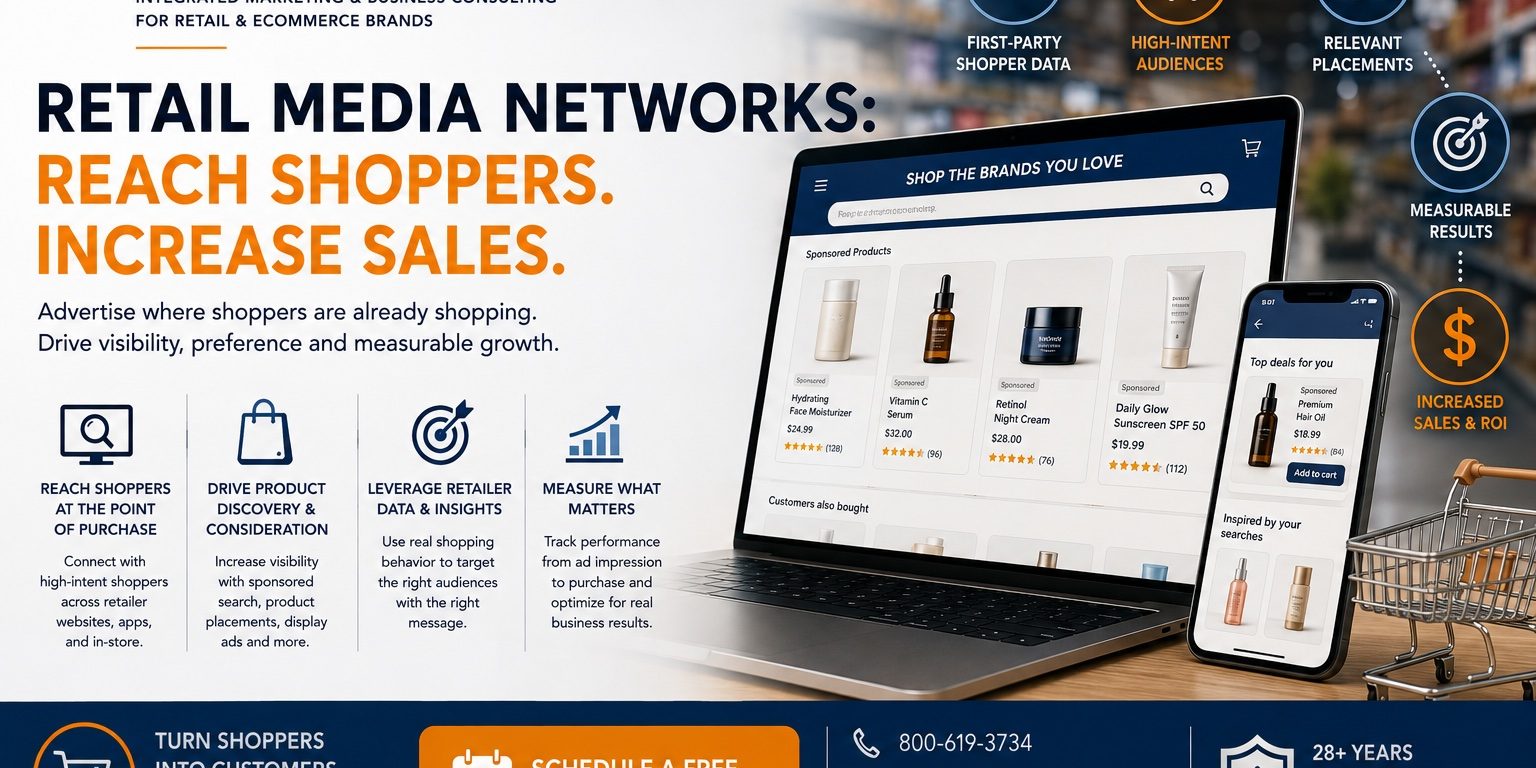
Retail brands face an increasingly fragmented path to purchase. Consumers discover products through search engines, social media, marketplaces, retailer websites, mobile apps, email, physical stores, and numerous other channels before making a buying decision. Retail media networks give brands another way to reach shoppers closer to the point of purchase by advertising within retailer-owned digital and physical environments.
For growing brands, retail media can complement traditional digital advertising, search engine optimization, social media, and other forms of retail marketing. The opportunity is especially relevant when a brand already sells through retailers or marketplaces that possess valuable first-party shopper data.
However, retail media is not simply another advertising channel. Brands need to understand where it fits within the customer journey, how campaigns should be measured, and when the economics justify additional investment.
What Is a Retail Media Network?
A retail media network is an advertising platform operated by a retailer or commerce company that allows brands to reach consumers using the retailer’s owned properties, shopper relationships, and first-party data.
Advertising may appear across:
- retailer websites
- retailer mobile applications
- search results
- product category pages
- product detail pages
- digital displays
- connected television
- off-site websites
- social platforms
- physical stores
A consumer searching a retailer’s website for moisturizer, running shoes, kitchen appliances, or another product category may encounter sponsored products or display advertising from brands competing for visibility.
The important distinction is context.
The shopper is already operating within a commerce environment rather than simply consuming unrelated media.
That proximity to purchase is one reason retail media has become important to many consumer brands.
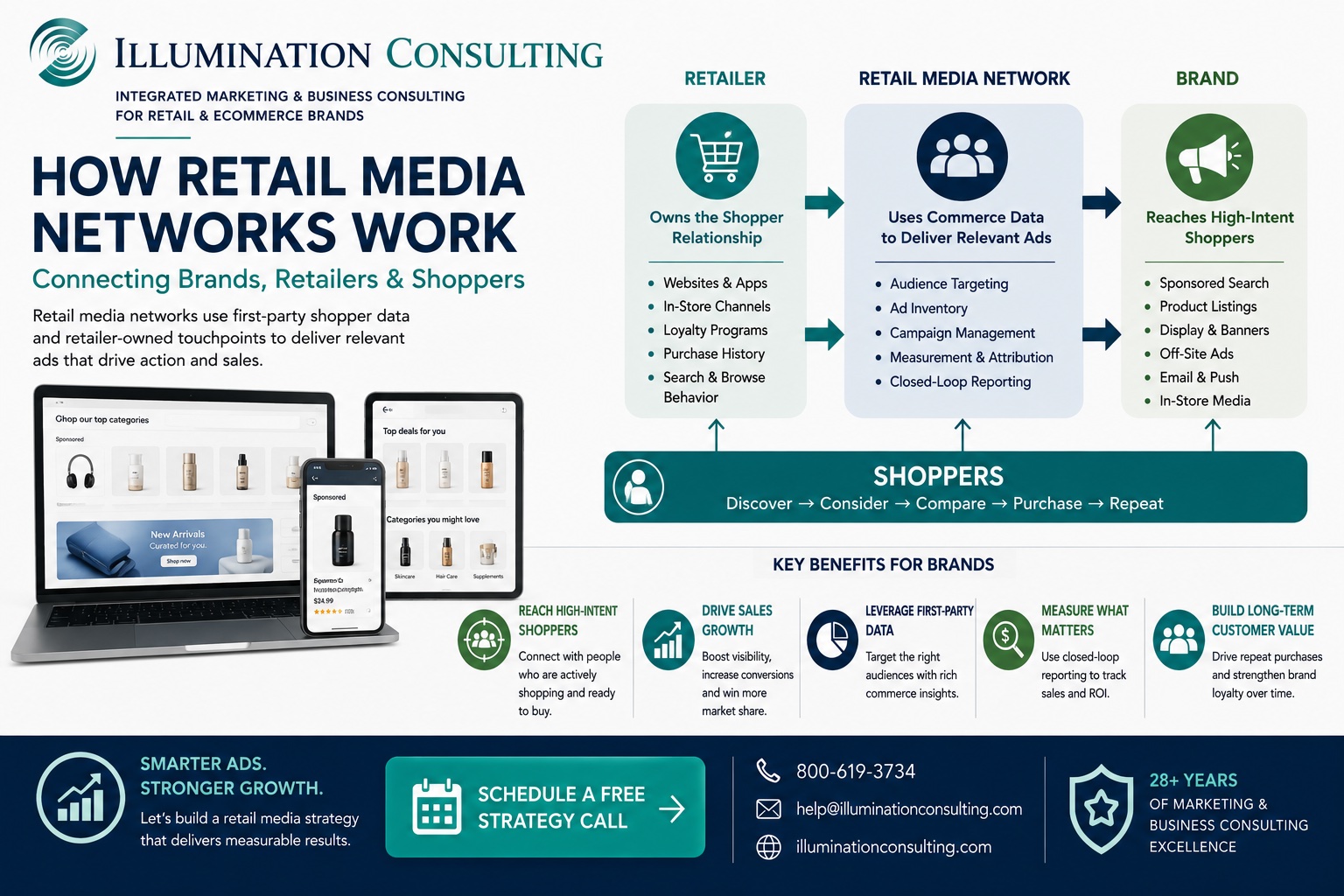
How Retail Media Networks Work
Retailers accumulate significant information about how customers shop.
Depending on the retailer and applicable privacy requirements, this can include signals involving product searches, categories viewed, purchases, shopping frequency, loyalty-program activity, and other commerce behavior.
Retail media platforms can use these first-party signals to help advertisers reach relevant audiences.
A skincare company, for example, might advertise a new moisturizer to shoppers browsing facial skincare products. A household brand could promote a product to customers who previously purchased related items. A retailer might also allow brands to reach relevant audience segments outside its own website.
The retailer creates advertising inventory.
Brands purchase access to that inventory.
Consumers receive advertising within or connected to their shopping experience.
The retailer gains an additional revenue stream while brands gain access to audiences with meaningful commerce signals.
Why Retail Media Has Become Important
Several changes in digital marketing have contributed to the growth of retail media.
Retailers Have Valuable First-Party Data
Retailers often possess something advertisers value enormously: information connected directly to shopping behavior.
Traditional advertising platforms may know what users viewed, searched, clicked, or engaged with.
Retailers can often connect advertising exposure more closely with actual product purchases within their ecosystem.
That can create valuable opportunities for targeting and measurement.
Consumers Are Already Shopping
Retail media frequently reaches consumers closer to a commercial decision.
Someone browsing a product category on a retailer website is displaying different intent from someone casually scrolling through entertainment content.
This does not guarantee a sale.
However, the advertising context can be highly relevant.
Brands Want Better Measurement
Retail brands increasingly want to understand what happens after an advertisement receives a click.
Did the shopper purchase?
Which product?
How much did the customer spend?
Did advertising contribute to incremental sales?
Retail media can potentially provide stronger closed-loop measurement because the retailer controls both advertising inventory and commerce data.
Retailers Want Additional Revenue
Retail media is also attractive to retailers themselves.
Advertising creates a revenue source beyond product margins.
As retail media programs mature, retailers can monetize their digital traffic, customer relationships, physical locations, and first-party data while providing brands with additional promotional opportunities.
Where Retail Media Ads Appear
Retail media extends well beyond sponsored product listings.
Brands may encounter several advertising formats.
Sponsored Search Results
Sponsored search allows brands to promote products when shoppers search within a retailer’s website or app.
For example, a consumer searching for “vitamin C serum” may see sponsored products above or among organic product results.
These placements can be particularly valuable because the shopper has expressed clear category or product intent.
Sponsored Product Listings
Retailers can place promoted products throughout category pages, recommendation areas, or other merchandising locations.
The objective is to increase product visibility while the consumer is actively shopping.
Display Advertising
Brands may purchase banner or display placements across retailer websites and apps.
Display campaigns can support product launches, seasonal promotions, category awareness, and broader brand-building objectives.
Off-Site Advertising
Some retail media networks allow brands to use retailer audience data to reach consumers beyond retailer-owned properties.
Ads may appear on other websites, social platforms, streaming environments, or connected television depending on the network.
This expands retail media beyond the retailer’s immediate digital storefront.
In-Store Media
Physical retail locations are becoming part of the retail media ecosystem.
Advertising can appear through digital screens, displays, checkout areas, shelf-level placements, and other in-store formats.
This creates another opportunity to influence consumers near the point of purchase.
Retail Media Versus Traditional Digital Advertising
Retail media does not replace search advertising, social advertising, SEO, email, or other digital channels.
It serves a different role.
Traditional paid search can capture demand when consumers search Google or another search engine.
Social advertising can introduce products to audiences based on interests, behavior, or other targeting signals.
SEO can build long-term organic visibility.
Retail media can reach consumers inside or close to a shopping environment.
That difference can be significant.
A brand may use social media to introduce a new product, search marketing to capture product research, content to educate buyers, email to nurture existing customers, and retail media to increase visibility when consumers are ready to shop.
The strongest retail digital marketing strategy coordinates these channels rather than evaluating them independently.
Retail Media Versus Marketplace Advertising
Marketplace advertising and retail media overlap considerably.
Large marketplaces have operated advertising businesses for years. However, the broader retail media category now includes traditional retailers, grocery chains, pharmacies, specialty retailers, department stores, and other commerce companies developing their own advertising platforms.
For brands, this creates both opportunity and complexity.
Instead of managing advertising through only a few dominant platforms, brands may need to decide which retailer networks deserve investment.
That decision should be based on distribution, customer behavior, product economics, available data, and measurable sales opportunity.
Benefits of Retail Media for Brands
Retail media can provide several advantages when the channel aligns with the brand’s distribution strategy.
Greater Product Visibility
Retailers frequently carry numerous competing products.
Even when a product is available, consumers may never discover it.
Sponsored placements can increase visibility within crowded categories.
Access to High-Intent Shoppers
Retail environments naturally attract consumers who are researching or purchasing products.
This can allow brands to reach shoppers at commercially meaningful moments.
First-Party Audience Signals
Retailer data can provide targeting capabilities based on commerce behavior rather than relying exclusively on third-party audience information.
Product Launch Support
New products often struggle with visibility.
Retail media can help brands introduce products within retailer environments where relevant shoppers are already browsing.
Better Connection Between Advertising and Sales
When the advertising platform and transaction environment are connected, brands may gain better insight into how media exposure relates to purchases.
That does not eliminate attribution challenges, but it can provide useful commerce-level measurement.
Retail Media Is Particularly Relevant for Omnichannel Brands
Retail brands increasingly sell through multiple channels.
A company might simultaneously operate:
- a direct-to-consumer website
- Amazon
- specialty retailers
- department stores
- marketplaces
- wholesale accounts
- physical retail locations
Consumers may encounter the brand in one channel and purchase through another.
This makes channel attribution more complicated.
A customer might discover a skincare brand on Instagram, research it through Google, visit the brand’s website, and eventually purchase the product from a retailer.
Retail media can help brands influence the later stages of this journey.
At the same time, brands should avoid evaluating retail media in isolation because demand may have been created elsewhere.
How Retail Brands Should Choose a Retail Media Network
Not every available network deserves investment.
Brands should begin with distribution.
Where Are Products Already Selling?
A retail media network becomes much more relevant when the retailer already represents meaningful product distribution.
Advertising where inventory is weak, availability is inconsistent, or distribution is minimal may produce poor economics.
Where Are the Brand’s Customers Shopping?
The retailer’s audience should align with the brand’s target market.
A large retail media network is not automatically the best network for every brand.
Audience relevance matters.
Which Products Need Additional Support?
Brands should determine whether the objective is:
- launching a new product
- increasing category share
- supporting seasonal demand
- improving visibility
- defending competitive position
- moving inventory
- acquiring new customers
Campaign objectives should determine product selection and advertising strategy.
What Measurement Is Available?
Brands should understand what the network can actually report.
Useful information may include:
- impressions
- clicks
- product detail views
- attributed sales
- units sold
- return on advertising spend
- new-to-brand customers
- conversion rates
- audience performance
- product-level performance
Measurement capabilities differ between platforms.
Retail Media Strategy Should Begin With Product Economics
Advertising can generate sales while still destroying profitability.
Retail brands need to understand the economics before scaling campaigns.
Consider:
Gross margin
How much contribution remains after product costs?
Retailer margin
What portion of the sale belongs to the retailer?
Advertising cost
How much media investment is required to generate the sale?
Promotional discounts
Are discounts reducing contribution further?
Fulfillment and logistics
What additional costs affect profitability?
Repeat purchase behavior
Does acquiring a customer create future revenue?
A campaign producing impressive revenue may still be unattractive if advertising costs consume the remaining margin.
This is why ROAS alone can be misleading.
Measure Incremental Sales, Not Just Attributed Sales
One of the most important questions in retail media is whether advertising generated additional sales.
Suppose a loyal customer regularly buys a particular product.
If that customer sees an advertisement and purchases the product again, the retail media platform may attribute the sale to advertising.
But would the customer have purchased anyway?
That distinction matters.
Attributed revenue and incremental revenue are not necessarily the same thing.
More sophisticated retail media analysis attempts to determine whether campaigns actually changed customer behavior.
Brands should therefore ask:
Did advertising generate additional demand, or did it simply receive credit for demand that already existed?
This becomes increasingly important as budgets grow.
Avoid Cannibalizing Direct-to-Consumer Sales
Retail media can help wholesale and marketplace performance, but brands should also consider their direct-to-consumer economics.
A brand may earn a different margin when a customer purchases through its own ecommerce website compared with a retailer.
This does not mean brands should avoid retailer advertising.
Retail distribution can provide scale, credibility, convenience, discovery, and access to customers the brand might not otherwise reach.
However, the entire channel mix should be evaluated together.
A strong ecommerce marketing strategy should account for how direct sales, marketplaces, retail partners, paid media, organic search, and customer retention interact.
Connect Retail Media With SEO and Content
Retail media captures commerce intent, but brands should also build demand outside retailer platforms.
SEO and content can help consumers discover products during earlier research.
A skincare consumer might search:
“What ingredients help dry skin?”
“What is the difference between retinol and bakuchiol?”
“Best skincare routine for mature skin”
Educational content can introduce the brand before the consumer reaches a retailer.
Later, retail media can reinforce visibility when that shopper enters a commerce environment.
This combination creates a broader customer acquisition system.
Use Retail Media to Support Product Launches
Product launches are one of the strongest potential applications of retail media.
New products often begin without:
- search visibility
- reviews
- sales history
- retailer ranking
- customer awareness
Advertising can create initial visibility while other marketing channels build demand.
A coordinated launch might include:
Pre-launch: content, PR, social media, influencer activity, email, retailer preparation.
Launch: retail media, paid search, social advertising, promotional support, ecommerce merchandising.
Post-launch: review generation, SEO, remarketing, retention, performance optimization.
The objective is to create demand across multiple touchpoints rather than expecting one advertising platform to carry the entire launch.
Common Retail Media Mistakes
Brands can waste significant money when retail media is treated as an isolated advertising tactic.
Common mistakes include:
- advertising products with weak margins
- promoting products with inventory problems
- spreading budgets across too many networks
- optimizing exclusively for ROAS
- ignoring incremental sales
- failing to coordinate promotions
- neglecting organic product visibility
- sending insufficient support to new products
- overlooking direct-to-consumer economics
- failing to analyze repeat purchases
Another mistake is allowing each retail partner to become a separate marketing silo.
Management needs a consolidated view of customer acquisition and product performance.
Build a Retail Media Testing Framework
Brands entering retail media do not need to invest everywhere simultaneously.
Start with controlled testing.
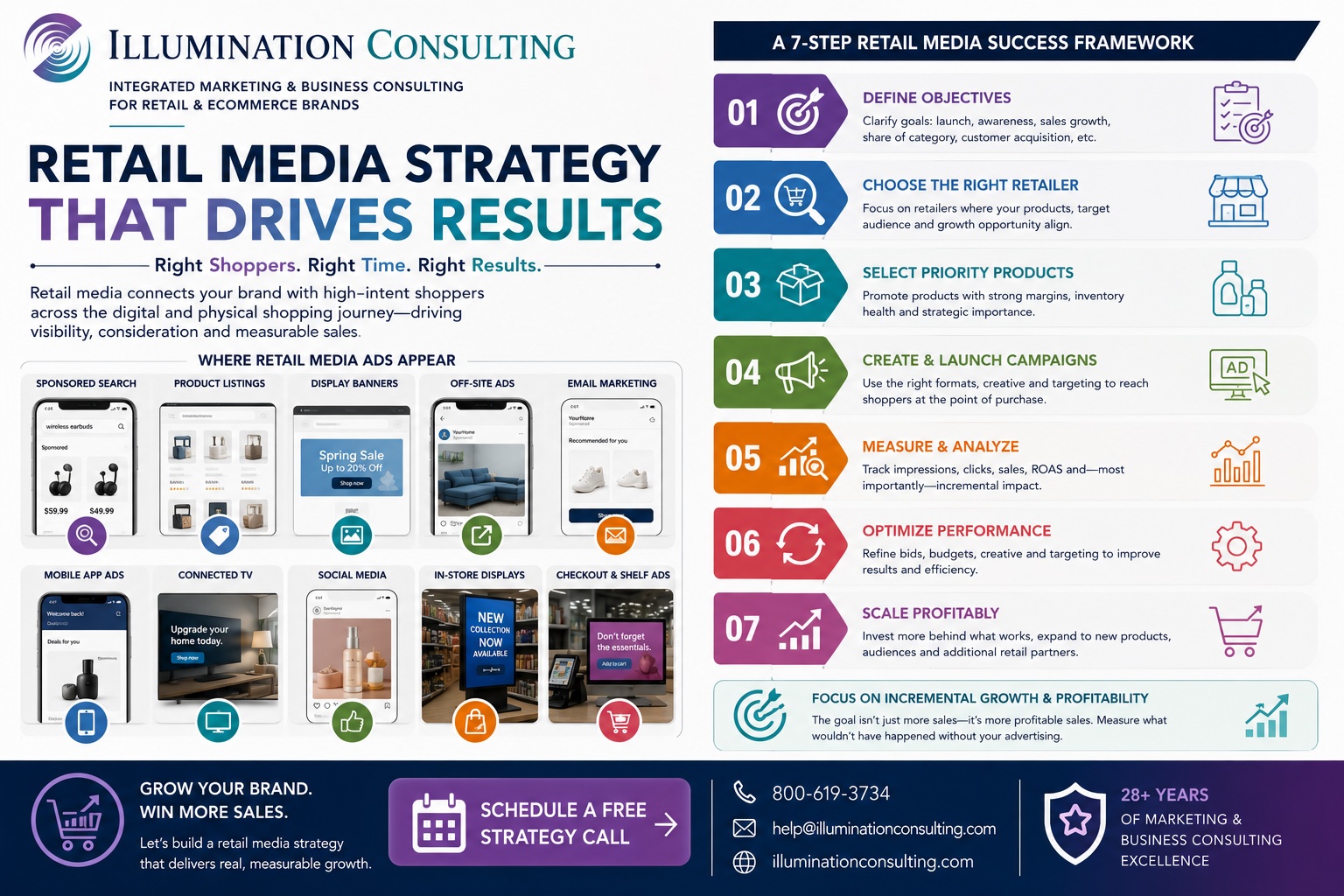
Step 1: Select the Right Retailer
Choose a retailer with meaningful distribution, relevant customers, and sufficient sales opportunity.
Step 2: Select Priority Products
Focus on products with strong economics, adequate inventory, and strategic importance.
Step 3: Establish Baseline Performance
Understand existing sales before advertising begins.
Step 4: Define the Objective
Determine whether the campaign is intended to generate awareness, launch a product, acquire customers, increase sales, or defend category position.
Step 5: Set a Controlled Budget
Use enough investment to generate useful data without scaling prematurely.
Step 6: Measure Business Results
Analyze sales, margin, acquisition, conversion, and incremental performance.
Step 7: Scale What Works
Increase investment only after the economics support expansion.
This disciplined approach reduces the risk of treating advertising activity as business growth.
Retail Media Should Be Part of a Larger Retail Growth Strategy
Retail media networks create an important opportunity for brands because they connect advertising with commerce environments and valuable first-party shopper signals.
But the channel is not a substitute for product quality, positioning, distribution, ecommerce performance, SEO, content, social media, customer retention, or broader brand development.
The strongest retail businesses integrate these disciplines.
A consumer may discover a brand through content, encounter it on social media, research it through Google, visit the direct website, see the product inside a retailer, and eventually purchase through whichever channel offers the greatest convenience.
Marketing strategy should reflect that reality.
Illumination Consulting works with consumer brands through integrated retail marketing services that connect customer acquisition, ecommerce, digital visibility, conversion, and long-term growth. Retail media can become another valuable component of that system when brands select the right networks, understand their economics, and measure actual business performance rather than advertising activity alone.
Frequently Asked Questions
What is a retail media network?
A retail media network is an advertising platform operated by a retailer or commerce company. It allows brands to advertise across retailer-owned websites, apps, search results, physical stores, and, in some cases, external digital channels using retailer audience and commerce data.
How do retail media networks make money?
Retailers sell advertising inventory to brands and suppliers. This can include sponsored products, search placements, display advertising, off-site campaigns, and in-store media. Advertising creates an additional revenue stream beyond traditional product sales.
Are retail media networks only for large brands?
No. Smaller and growing brands may also benefit when they have meaningful distribution through a retailer, sufficient margins, appropriate inventory, and a measurable opportunity to increase product sales. The economics should determine whether participation makes sense.
How should brands measure retail media performance?
Brands can evaluate impressions, clicks, conversion rates, attributed sales, units sold, customer acquisition, return on advertising spend, new-to-brand customers, incremental sales, and profitability. The most useful metrics depend on the campaign objective.
Does retail media replace traditional digital marketing?
No. Retail media generally works best as part of a broader strategy that may include SEO, content marketing, paid search, social media, email, ecommerce marketing, PR, and customer retention. Different channels influence different stages of the customer journey.