Server Setup Services: Securing Your Clinic Server Setup
By Illumination Consulting Editorial Team · Updated 2026-07-29
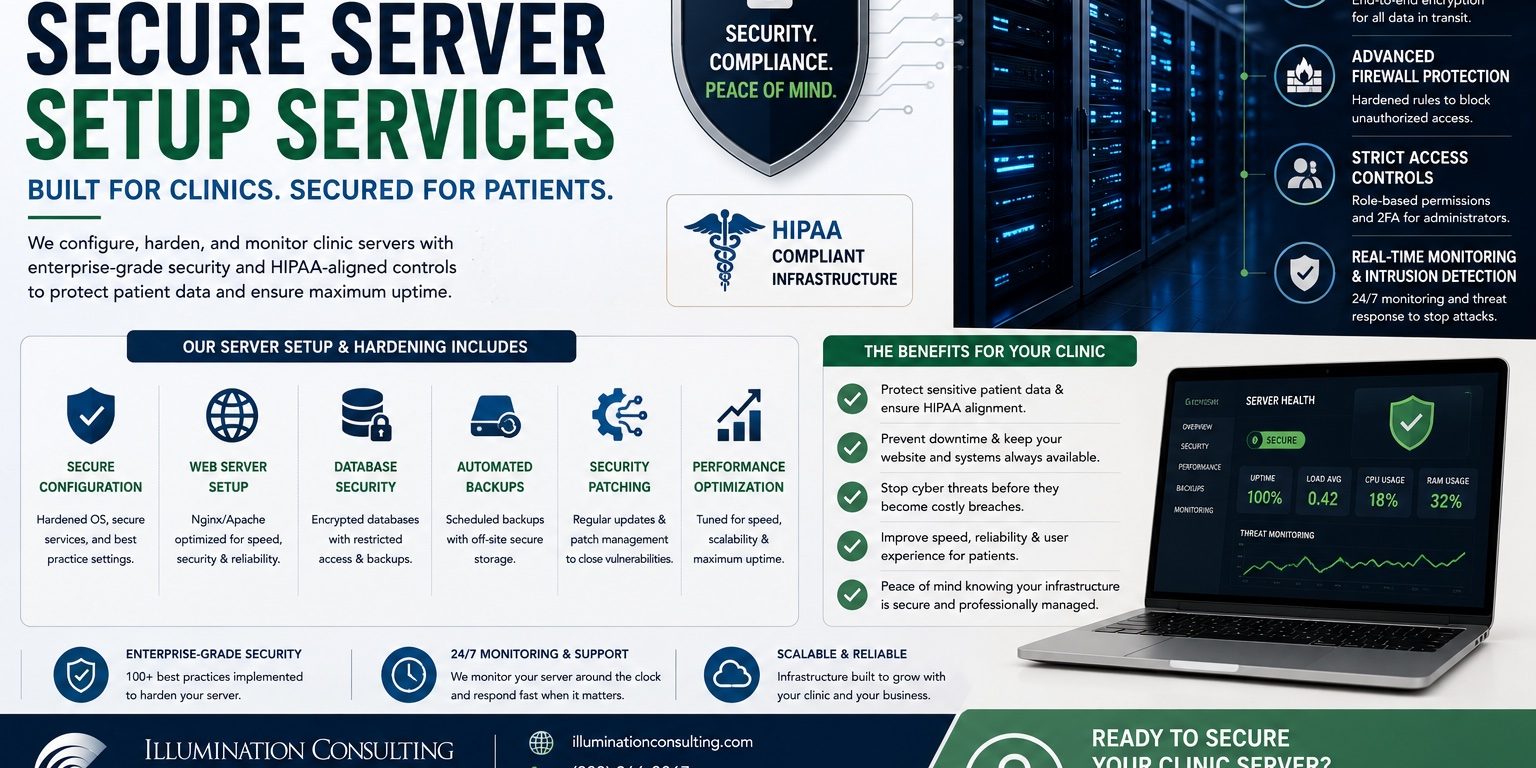
Illumination Consulting configures Ubuntu servers with TLS 1.3 encryption, firewall rules, and HIPAA-compliant access controls to protect patient data. Regular security patches, automated backups, and intrusion detection systems safeguard the clinic website against breaches, ensuring compliance and uptime for healthcare providers requiring strict data protection standards.
Server hardening requires implementing 100+ documented security best practices, including
Clinic servers require HTTPS/SSL encryption, hardened firewall rules, and strict access controls limiting administrative privileges to essential IT staff only. Patient portals demand HIPAA-aligned safeguards: encrypted databases, regular patching, and continuous monitoring for intrusion attempts. A properly configured content management system, paired with routine security audits, keeps clinic websites resilient against breaches while protecting sensitive patient data and maintaining operational trust.
Key Takeaways
- Servers face constant hacking threats targeting sensitive data, making security the most critical issue for online businesses.
- Web servers require the same security measures as websites themselves to protect hosted patient information effectively.
- Over 100 server security best practices exist to guide clinic administrators in hardening their infrastructure.
- Learning server setup independently provides better security understanding than relying solely on third-party hosting companies.
What Do You Need Before Server Setup?
Four elements determine readiness before any clinic launches new hosting: a documented content strategy, a clear inventory of patient-facing software, a defined content management approach, and a security-first hosting partner. A clinic website often serves as the first touchpoint a patient has with the practice, long before a phone call or an office visit. That reality makes the hosting environment behind it a business decision, not a back-office technical detail.
Reliable Secure Server Setup Healthcare: HIPAA Compliance Guide start with an audit of what the practice actually runs. Radiology information systems, billing platforms, and appointment portals often store personal and financial records on the same infrastructure. Skipping this inventory step creates blind spots that surface later as security gaps or performance failures.
What role does the CMS play in server readiness?
A properly built content management system creates a scalable, secure foundation for the site before hosting decisions get locked in. cite-1 Usability, search visibility, and performance all depend on this groundwork being solid first.
Does location matter for choosing a hosting partner?
Working with a firm familiar with healthcare requirements, such as Illumination Consulting in Beverly Hills, CA, helps clinics align secure server configuration with broader growth and marketing strategy. Practices should confirm before setup:
- Software inventory (RIS, billing, EHR integrations)
- Data sensitivity classification
- CMS architecture plan
- Website hosting for clinics with security built in, not bolted on
How Do You Configure And Secure The Server?
Configuring and securing a clinic server requires a defined sequence, not guesswork. Clinic administrators who follow secure server configuration practices reduce exposure across the website, the patient portal, and the network connecting both. Skipping steps creates gaps that hackers and automated bots actively search for.
Before configuration begins, practice managers should confirm two prerequisites: administrative access credentials and a documented list of every application running on the server, including the content management platform and patient portal software.
- Inventory all software and services running on the server, since securing a web server matters as much as securing the website or application itself.
- Lock down administrative access with unique credentials for each staff member or vendor.
- Apply security patches and updates on a fixed schedule rather than an ad-hoc basis.
- Configure firewall rules to restrict traffic to only what the practice’s website and portal require.
- Enable encrypted connections across every page that handles patient data.
- Set up monitoring and logging so unusual activity gets flagged quickly.
Why does portal security depend on both the application and the server?
A well-built patient portal offers little protection if the server underneath sits unsecured, and the reverse is equally true. Practices need both layers hardened simultaneously, because a single weak point undermines the entire system.
Does the content platform affect server security?
Yes. A properly built content management system lets clinic staff publish updates, manage media, and adjust pages without waiting on developer availability, closing the window that delayed changes leave open. Aesthetic Clinics & Med Spas, paired with reliable website hosting for clinics, strengthens search visibility and security together, giving practices a stable foundation as they add locations or services. Server setup services built around these steps give administrators a repeatable, defensible process instead of a one-time fix.
What Mistakes Undermine Clinic Server Security?
Neglecting routine maintenance ranks as the top failure among small practices managing patient portals. Treating server setup services as a one-time task, rather than an ongoing discipline, leaves clinics exposed. Server protection depends on continuous configurations, tools, and monitoring, not a single launch-day checklist.
Common errors include:
- Skipping software and firmware updates after initial deployment
- Relying on default credentials or unmanaged access controls
- Ignoring secure server configuration reviews after staff or vendor changes
- Treating hosting as separate from overall practice security posture
Why does slow or unreliable hosting hurt patient trust?
An outdated, sluggish, or confusing website drives patients away, sending them back to search results. The same pattern applies to poorly secured or unreliable hosting: uptime failures and slow load times signal neglect. A professionally managed platform builds confidence and supports bookings, while a fragile one erodes it.
Is website hosting a security issue or just an IT detail?
Website hosting for clinics functions as a core piece of the security posture, not a background utility. Weak hosting choices compound every other vulnerability across the practice’s digital footprint.
Securing your clinic website’s server infrastructure represents a foundational investment in patient trust and operational continuity. By implementing the security protocols and best practices outlined throughout this guide—from SSL certificates to regular updates. Access controls—you establish a resilient digital environment that protects sensitive patient data while supporting your clinic’s growth objectives. A fortified server foundation enables your aesthetic practice to operate with confidence, knowing your digital assets remain safeguarded against evolving threats.
FAQ
What do you need before setting up a clinic server?
A documented content strategy, an inventory of patient-facing software, a defined content management approach, and a security-first hosting partner determine readiness for launch.
Does the hosting partner’s location matter for clinic security?
Yes, working with a firm familiar with healthcare requirements, such as Illumination Consulting in Beverly Hills, CA, helps clinics align secure server configuration with growth and marketing strategy.
What does secure server configuration require?
Configuration requires a defined sequence, including administrative access credentials and a documented list of every application running on the server, such as the CMS and patient portal software.
Facts
- Illumination Consulting is located in Beverly Hills, CA, USA.