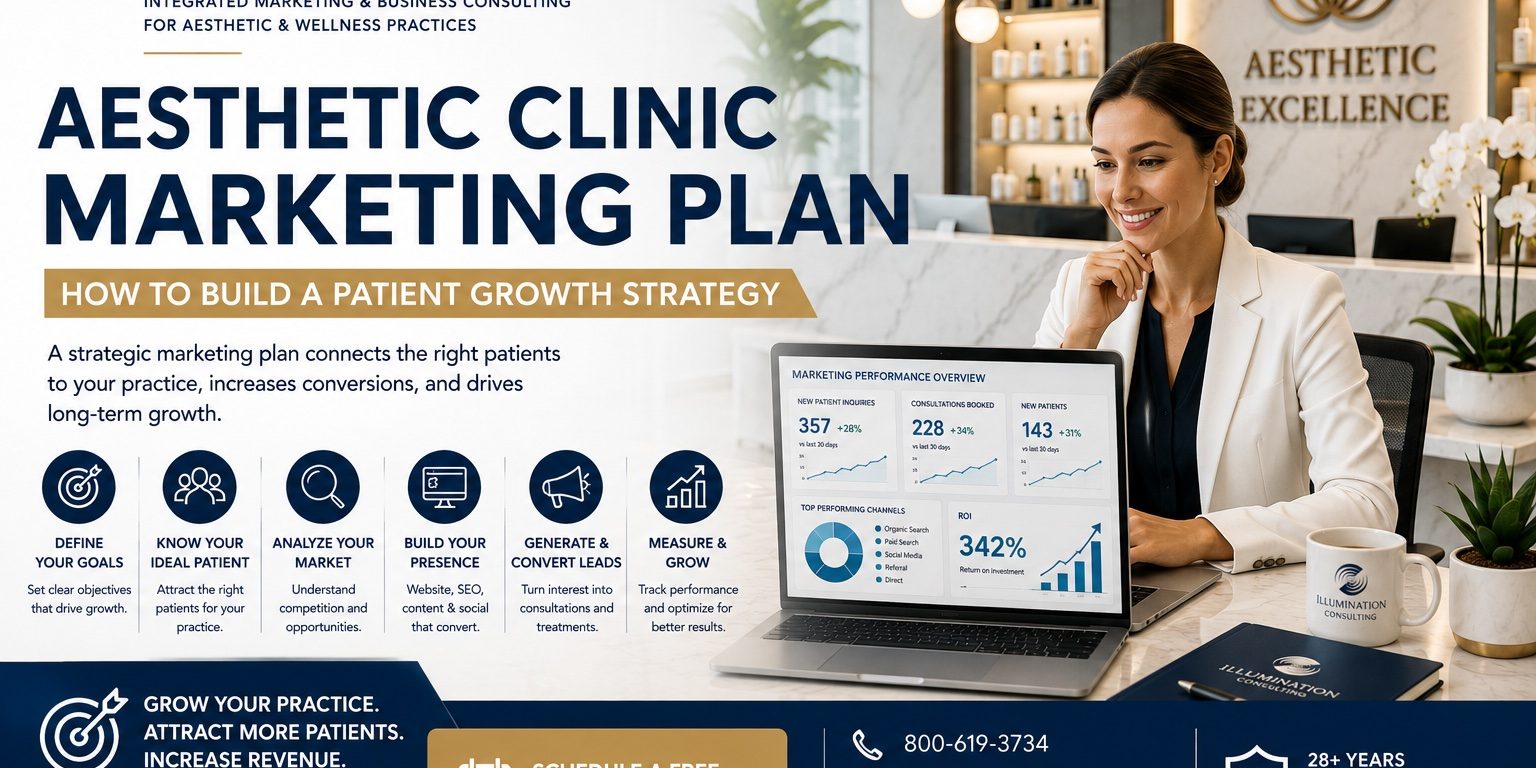
An aesthetic clinic marketing plan should do more than generate attention. It should create a structured system for attracting the right prospective patients, converting interest into consultations, turning consultations into treatments, and developing long-term patient relationships. Clinics often invest in websites, social media, SEO, advertising, content, and promotions independently. The stronger approach connects these activities to measurable business objectives and a clearly defined patient acquisition strategy.
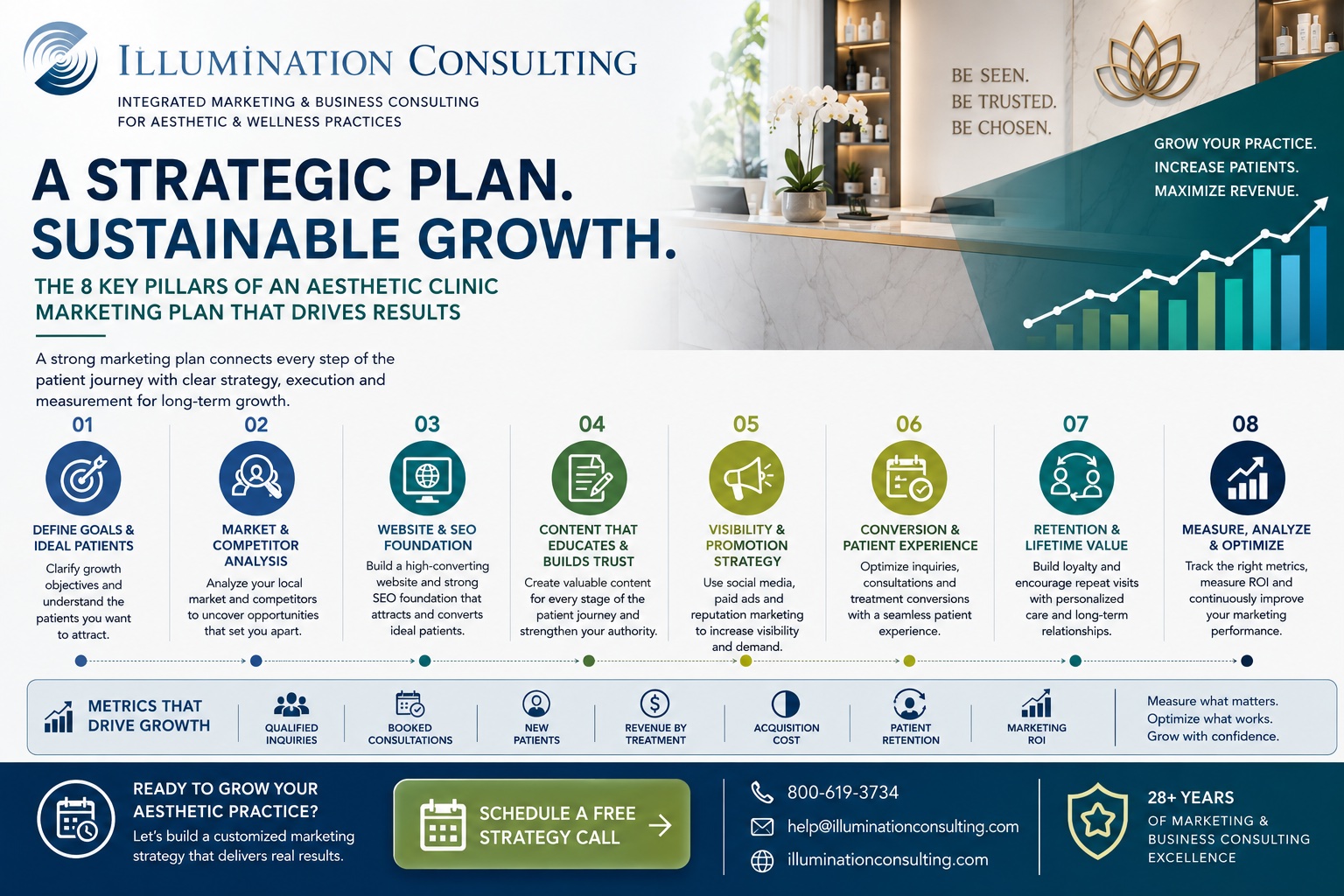
A successful plan begins with the economics and positioning of the clinic rather than selecting marketing channels first. Treatment priorities, ideal patients, geographic market, competitive environment, provider capacity, acquisition costs, retention, and revenue goals should determine how marketing resources are allocated.
For aesthetic practices competing in increasingly crowded markets, this integrated approach can create a much stronger foundation for sustainable growth.
Start With the Clinic’s Growth Objectives
Marketing becomes difficult to measure when the objective is simply to “get more patients.”
A clinic should first establish what growth actually means.
One practice may need more first-time injectable patients. Another may have sufficient patient volume but need greater adoption of higher-value treatments. A new clinic may require initial market awareness, while an established practice may need to improve retention and patient lifetime value.
Useful objectives might include:
- increasing monthly new-patient consultations
- growing revenue from priority treatments
- improving consultation-to-treatment conversion
- increasing repeat visits
- filling unused provider capacity
- expanding into a new geographic market
- launching a new treatment category
- reducing dependence on paid advertising
Each objective can require a different marketing strategy.
A clinic trying to increase laser-treatment volume, for example, should not necessarily allocate its budget the same way as a practice trying to build recurring injectable revenue.
Define the Ideal Patient
Effective aesthetic marketing begins with understanding who the clinic wants to attract.
Demographics are useful, but they are only the beginning.
A stronger patient profile considers motivations, concerns, purchasing behavior, treatment interests, geographic proximity, disposable income, expectations, and how prospective patients research providers.
Questions to answer include:
What treatments are they considering?
What problem or desired outcome motivates the search?
What prevents them from scheduling?
What factors create trust?
Where do they research aesthetic treatments?
How far are they willing to travel?
What alternatives are they considering?
What makes them choose one clinic over another?
These answers influence everything from website content and advertising to social media and consultation messaging.
Establish Clear Market Positioning
Many aesthetic clinics offer similar treatments.
Injectables, laser procedures, skin rejuvenation, body treatments, and medical-grade skincare are available from numerous competing practices.
The marketing challenge is therefore not simply explaining what the clinic offers.
It is communicating why a prospective patient should choose this particular clinic.
Positioning can be influenced by:
- provider expertise
- treatment philosophy
- specialization
- patient experience
- technology
- natural-looking results
- luxury positioning
- clinical credibility
- personalized treatment planning
- geographic convenience
- reputation
- specific patient populations
The positioning should be consistent across the website, search presence, social media, advertising, content, reviews, and patient experience.
A clinic that presents itself as a premium aesthetic practice on its website but competes primarily through discounts on social media creates a conflicting message.
Analyze the Local Competitive Market
Aesthetic medicine is highly local.
Patients may research treatments nationally, but most eventually select a provider within a reasonable geographic area.
Every aesthetic clinic marketing strategy should therefore include a competitive analysis of the clinic’s actual market.
Review competing practices for:
- Google rankings
- Google Maps visibility
- treatment offerings
- website quality
- patient reviews
- pricing transparency
- promotions
- social media activity
- advertising
- educational content
- positioning
- reputation
- conversion experience
The purpose is not to imitate competitors.
It is to understand what prospective patients encounter when comparing available providers.
Competitive research frequently reveals opportunities competitors have overlooked.
Prioritize Treatments Before Marketing Them
Not every treatment deserves equal marketing investment.
Clinics should prioritize services using both demand and business economics.
A useful treatment-priority framework considers:
Search demand: Are prospective patients actively looking for the treatment?
Profitability: Does the procedure generate attractive margins?
Patient lifetime value: Can the treatment lead to recurring visits or additional services?
Provider capacity: Can the clinic accommodate additional demand?
Competitive intensity: How difficult is it to win visibility?
Strategic importance: Does the treatment support the clinic’s positioning?
This prevents marketing budgets from being distributed equally across services simply because they appear on the treatment menu.
High-priority treatments should receive stronger website content, SEO attention, educational resources, advertising support, and conversion pathways.
Build the Website as the Conversion Hub
Most digital marketing eventually leads prospects to the clinic’s website.
That makes the website much more than an online brochure.
It should function as the central conversion infrastructure for the patient acquisition system.
An effective aesthetic clinic website should make it easy for visitors to understand:
- what the clinic specializes in
- which treatments are available
- who provides the treatments
- why patients should trust the practice
- what results they may reasonably expect
- where the clinic is located
- how to schedule a consultation
Strong treatment pages are particularly important.
Prospective patients researching Botox, fillers, laser resurfacing, body contouring, or other procedures often arrive with different questions and levels of intent.
Each priority treatment should have a dedicated page that addresses those questions while providing a clear next step.
Professional aesthetic clinic website design should therefore integrate branding, usability, SEO, trust, and conversion rather than treating design as a purely visual exercise.
Develop an SEO Strategy Around Patient Search Behavior
Search engine optimization helps clinics become visible when prospective patients actively research treatments and providers.
This can include several layers.
Treatment SEO
Priority treatment pages should target relevant patient searches while providing genuinely useful information.
Local SEO
The clinic should strengthen visibility for geographically relevant searches through local content, business information, reviews, citations, structured data, and Google Business Profile optimization.
Educational SEO
Articles can answer questions patients ask before scheduling.
Examples include:
- treatment comparisons
- preparation
- recovery
- candidacy
- expected outcomes
- treatment frequency
- maintenance
- combination treatments
Educational content should support the treatment architecture rather than becoming a disconnected collection of blog posts.
Technical SEO
Search engines also need to crawl and understand the website efficiently.
Technical performance, internal linking, structured data, mobile usability, indexing, and site architecture all influence the effectiveness of the organic search strategy.
Professional SEO services can coordinate these elements around the clinic’s actual patient acquisition priorities.
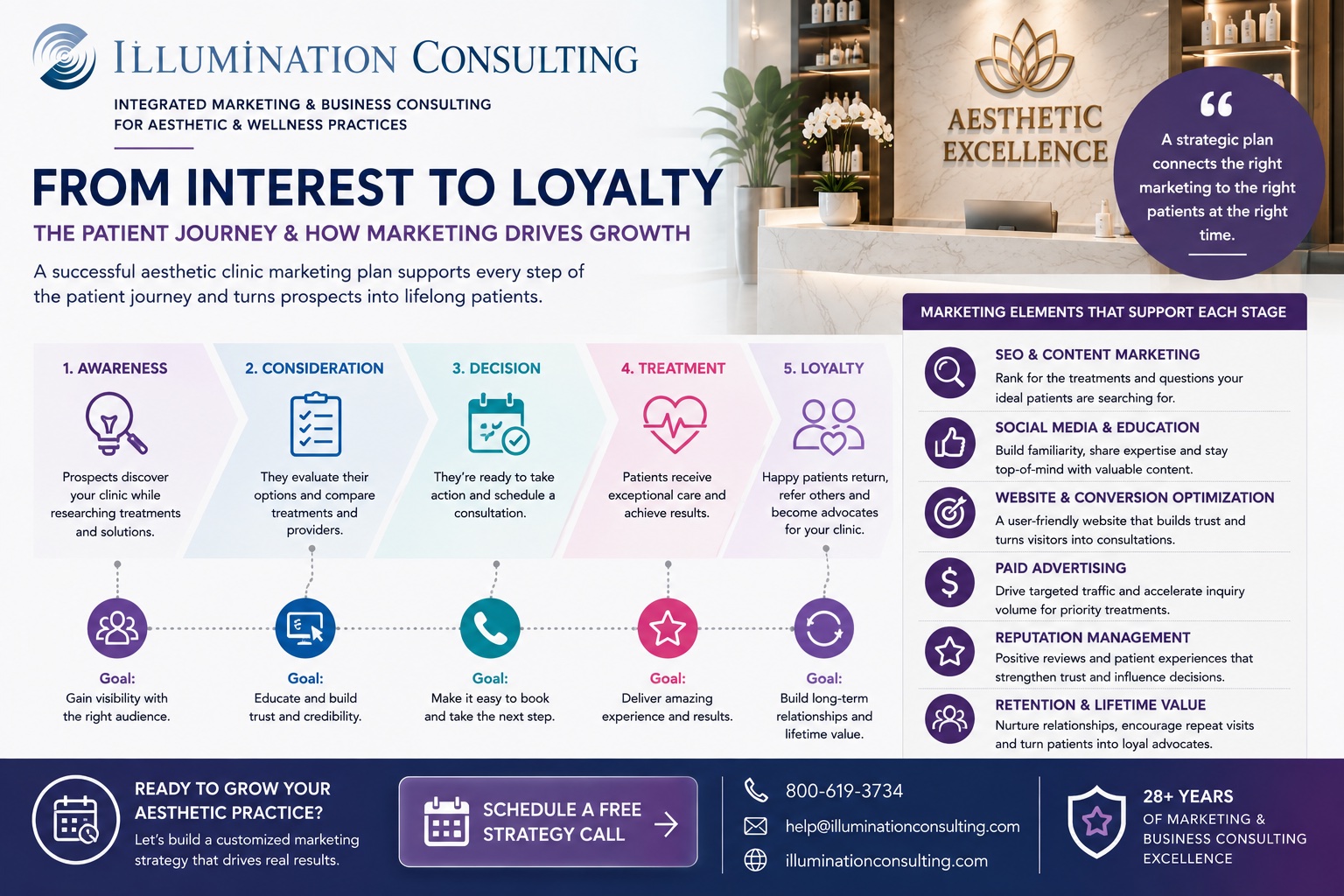
Create Content for the Patient Decision Journey
Not every prospective patient is ready to book immediately.
Some are discovering treatments. Others are comparing options. Some are evaluating providers. Others are nearly ready to schedule but need reassurance.
Content should support each stage.
Awareness
Content helps patients understand available solutions.
For example:
What treatments help improve skin texture?
Consideration
Content helps compare alternatives.
For example:
Chemical Peel vs. Laser Resurfacing: What’s the Difference?
Evaluation
Content helps prospects determine whether a treatment or clinic is appropriate.
For example:
What Should You Look for When Choosing an Aesthetic Clinic?
Decision
Content removes final barriers.
This may include treatment FAQs, provider information, patient reviews, before-and-after examples where appropriate, consultation information, and clear booking instructions.
A structured content marketing strategy allows the clinic to educate patients while strengthening search visibility and trust throughout the decision process.
Use Social Media to Build Familiarity and Trust
Social media serves a different role than search.
Search captures existing demand. Social media can create familiarity before a patient begins actively searching for a provider.
Useful aesthetic clinic content may include:
- provider education
- treatment explanations
- clinic culture
- frequently asked questions
- skincare education
- technology demonstrations
- patient-experience information
- treatment preparation and aftercare
- myth-versus-fact content
- appropriate before-and-after content
Consistency matters more than simply posting frequently.
The objective is to reinforce the clinic’s positioning and expertise while helping prospective patients become comfortable with the practice.
Use Paid Advertising Strategically
Paid advertising can accelerate patient acquisition when campaigns are connected to the right treatments, landing pages, offers, and tracking.
Advertising may include search ads, social advertising, remarketing, or other targeted campaigns.
However, paid media should not compensate indefinitely for weak infrastructure.
Sending paid traffic to a poor website, unclear treatment page, or ineffective booking process wastes acquisition budget.
Before scaling advertising, verify that:
- treatment positioning is clear
- landing pages convert
- calls and forms are tracked
- staff respond quickly
- consultations are handled effectively
- patient acquisition cost is measurable
The objective is profitable patient acquisition, not inexpensive clicks.
Build Reputation Into the Marketing Plan
Patient reviews influence both trust and local search visibility.
Prospective aesthetic patients often evaluate providers carefully because treatments involve appearance, health, money, and personal confidence.
A systematic reputation strategy should therefore be part of the marketing plan.
Clinics can establish processes for requesting feedback from appropriate patients, monitoring review platforms, responding professionally, and identifying recurring patient-experience issues.
Reviews should never be treated simply as an SEO tactic.
They are market feedback.
Patterns within reviews can reveal strengths to emphasize and weaknesses requiring operational improvement.
Improve Consultation Conversion
Generating inquiries is only part of the patient acquisition process.
What happens after someone calls, submits a form, or requests a consultation can dramatically affect marketing ROI.
Track:
Lead response time
How quickly does the clinic respond?
Contact rate
How many inquiries successfully connect with staff?
Consultation booking rate
How many qualified inquiries schedule?
Show rate
How many scheduled consultations actually occur?
Treatment conversion rate
How many consultations become paying patients?
Marketing can appear unsuccessful when the actual constraint exists inside the intake process.
A clinic generating 100 qualified inquiries but converting only a small percentage has a different problem than a clinic generating only ten inquiries.
Build Patient Retention Into Growth Planning
Patient acquisition receives considerable attention, but retention can materially change the economics of aesthetic marketing.
Existing patients already know the clinic.
If they had a positive experience, future treatment decisions may require less persuasion than acquiring an entirely new patient.
Retention strategies can include:
- appropriate treatment reminders
- personalized follow-up
- email communication
- skincare education
- memberships
- loyalty programs
- treatment planning
- cross-service education
- seasonal campaigns
The objective should not be excessive promotion.
It should be maintaining a valuable relationship with patients while helping them understand relevant future treatment opportunities.
Establish the Marketing Budget Around Economics
A marketing budget should reflect growth objectives rather than an arbitrary percentage alone.
Important considerations include:
- current revenue
- desired growth
- patient lifetime value
- average treatment value
- gross margin
- acquisition cost
- provider capacity
- geographic competition
- maturity of the clinic
- existing brand visibility
A newer clinic may need greater investment relative to current revenue because awareness and acquisition infrastructure are still being established.
An established clinic may allocate more toward protecting market share, introducing treatments, improving retention, or expanding locations.
The correct budget depends on what the practice is attempting to accomplish.
Measure the Metrics That Affect Revenue
Aesthetic clinic marketing should be measurable beyond followers, impressions, and website visits.
Important metrics include:
- qualified leads
- consultation requests
- booked consultations
- show rate
- consultation-to-treatment conversion
- new patients
- patient acquisition cost
- revenue by treatment
- marketing return on investment
- patient retention
- patient lifetime value
- organic search conversions
- paid advertising conversions
- website conversion rate
These measurements reveal where the growth system is working and where revenue is being lost.
A clinic may discover, for example, that SEO is producing strong inquiries but consultation conversion is weak.
That insight changes where management should invest next.
Create a 90-Day Aesthetic Clinic Marketing Plan
A practical marketing plan can be organized into three stages.
Days 1–30: Foundation
Establish the baseline.
Audit:
- positioning
- competitors
- website
- SEO
- analytics
- reviews
- advertising
- social media
- treatment priorities
- conversion processes
Define the ideal patient and establish measurable growth objectives.
Days 31–60: Implementation
Begin executing the highest-priority improvements.
This may include treatment-page optimization, technical SEO corrections, content production, Google Business Profile improvements, conversion changes, advertising campaigns, reputation processes, and social content.
Avoid trying to improve every channel simultaneously.
Prioritize the constraints most likely to affect growth.
Days 61–90: Optimization
Evaluate the data.
Identify which treatments, channels, messages, pages, and campaigns produce qualified patient activity.
Increase investment where performance supports it.
Correct weak conversion points.
Remove activities that consume resources without contributing to meaningful growth.
Then establish the next 90-day cycle.
Build a Patient Growth System, Not a Collection of Marketing Tactics
The strongest aesthetic clinic marketing plan connects every stage of patient acquisition.
Positioning determines who the clinic wants to attract.
SEO, content, social media, reputation, and advertising create visibility and trust.
The website converts interest into action.
The intake process converts inquiries into consultations.
Providers and staff convert consultations into treatments.
Patient experience and retention create lifetime value.
When these elements operate independently, marketing becomes difficult to measure and expensive to scale.
When they operate as a system, management can identify constraints, allocate resources intelligently, and improve performance over time.
Illumination Consulting works with aesthetic practices through integrated marketing services designed to connect digital visibility with patient acquisition and sustainable growth. A successful strategy begins with understanding the practice’s market, economics, capacity, competitive position, and growth objectives before deciding which marketing tactics deserve investment.
Frequently Asked Questions
What should an aesthetic clinic marketing plan include?
An aesthetic clinic marketing plan should define growth objectives, ideal patients, positioning, priority treatments, competitive strategy, website requirements, SEO, content, social media, advertising, reputation management, patient conversion, retention, budget allocation, and performance measurement.
How much should an aesthetic clinic spend on marketing?
There is no universal budget appropriate for every clinic. Investment should reflect growth objectives, current revenue, patient lifetime value, treatment economics, competition, available provider capacity, existing visibility, and the maturity of the practice.
Which marketing channels work best for aesthetic clinics?
The strongest mix depends on the clinic and market. SEO can capture treatment-related search demand, paid advertising can create immediate visibility, social media can build familiarity, content can educate patients, and reputation marketing can strengthen trust. These channels are generally more effective when integrated rather than managed independently.
How long does an aesthetic clinic marketing plan take to produce results?
Different channels operate on different timelines. Paid campaigns can produce activity relatively quickly, while SEO and content usually require more time to compound. Website conversion, reputation, intake, and retention improvements can also influence performance independently of traffic growth.
How should an aesthetic clinic measure marketing success?
Measure qualified inquiries, consultations, booked patients, acquisition cost, treatment revenue, conversion rates, retention, lifetime value, and marketing ROI. Traffic and rankings remain useful diagnostic metrics but should ultimately connect to business outcomes.