By Illumination Consulting Editorial Team · Updated 2026-07-29
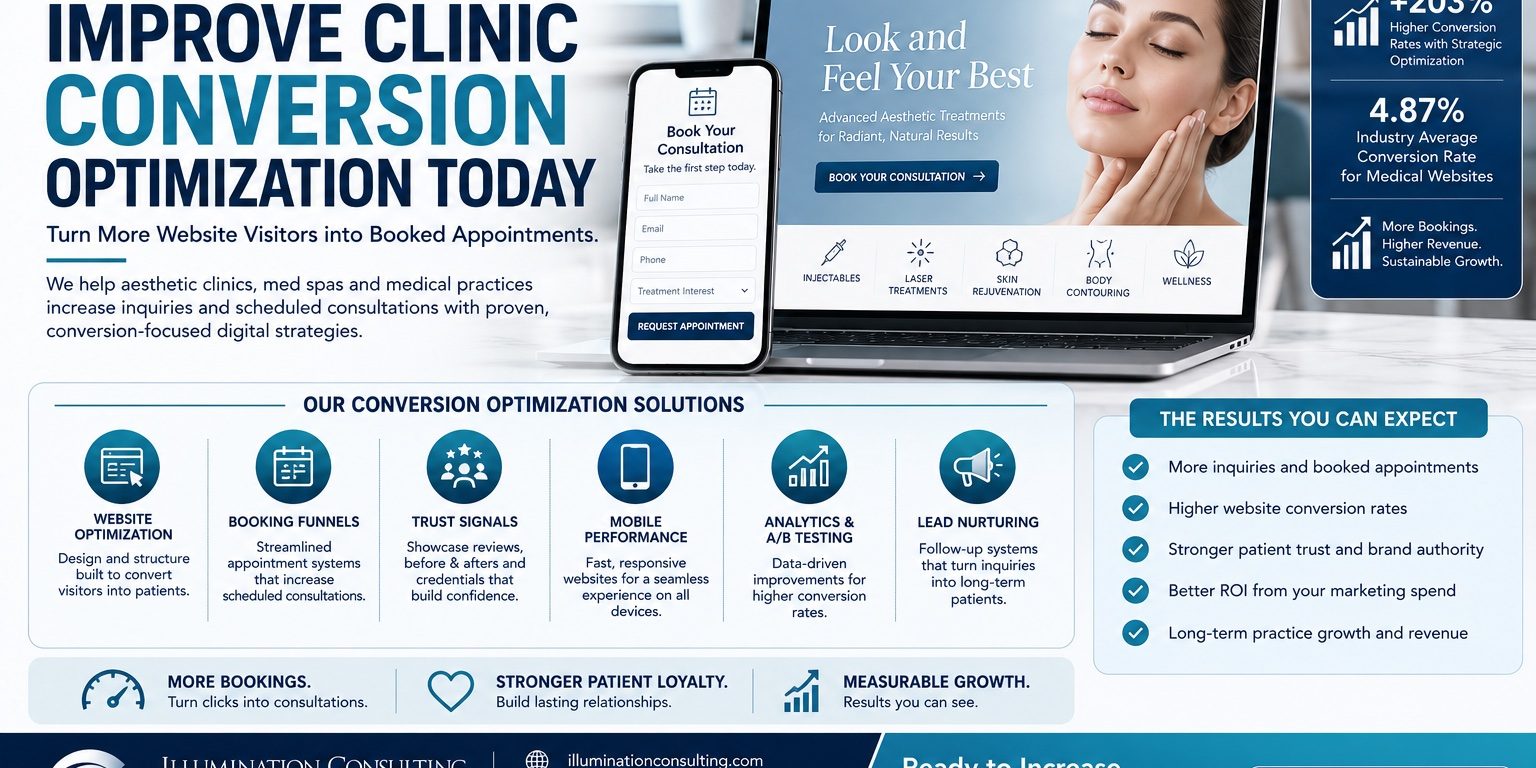
Illumination Consulting, based in Beverly Hills, CA, improves clinic website conversion rates by optimizing appointment booking forms, adding trust signals like patient testimonials, ensuring fast mobile load speeds, and simplifying navigation to reduce bounce rates. Clear calls-to-action and streamlined intake forms directly increase patient inquiry submissions and scheduled consultations.
Clinic websites improve conversion rates by combining clear calls-to-action, patient testimonials, and streamlined booking systems that reduce friction between interest and appointment. Illumination Consulting builds conversion-focused strategies pairing SEO-driven traffic with website optimization, strategic review placement, and measurable booking funnels, turning existing visitors into scheduled consultations and loyal patients.
Key Takeaways
- Conversion-focused healthcare website redesigns increase conversion rates by 203% through strategic optimization.
- Medical websites average 4.87% conversion rates; holistic clinics achieve higher performance through targeted improvements.
- Patient trust builds through every digital interaction, directly impacting clinic website conversion success.
- Healthcare websites require conversion-focused design strategies to maximize return on traffic investment.
Why Isn’t Your Website Traffic Booking Appointments?
Low booking numbers usually trace back to a trust gap, not a traffic gap. The average conversion rate for medical websites is typically low, meaning the vast majority of visitors leave without scheduling anything. For clinic owners already investing in SEO or paid ads, that statistic represents wasted budget rather than wasted clicks.
Patients today research heavily before committing to a provider. They compare reviews, scan websites, and judge whether a practice looks professional enough to trust with their care. A site that fails this credibility test loses the appointment before a phone even rings.
What actually stops patients from scheduling?
Weak signals of legitimacy are the most common culprit. Missing testimonials, unclear next steps, and slow-loading pages all raise doubt at the exact moment a patient should feel confident.
Effective clinic conversion optimization addresses this gap directly, turning existing visitors into consultations instead of chasing more clicks. Illumination Consulting builds systems focused on website conversion for clinics, pairing SEO with content and technical fixes designed to convert search traffic into booked visits. cite-2 That strategy typically includes:
- Strengthening trust signals through reviews and clear credentials
- Streamlining scheduling paths from homepage to booking form
- Applying landing page optimization for spas and medical sites alike to reduce drop-off
Visibility gains mean little without a parallel focus on strengthening conversions and patient acquisition.
What Makes a Clinic Landing Page Convert?
Clarity, trust, and a frictionless path to booking separate a high-performing page from one that quietly bleeds leads. Strong landing page optimization for spa and clinic sites treats design as a growth lever, not decoration. A distinct service focus separate from general marketing efforts. Layout, copy, and calls to action all carry equal weight in this equation.
Trust signals matter as much as design polish. Reviews, testimonials, and visible credentials answer the unspoken question every prospective patient asks: can this clinic be trusted? Pairing clinic conversion optimization with active reputation management strengthens that answer. Social proof directly influences whether a visitor books or bounces. cite-3
Why do clinic websites get traffic but few bookings?
Traffic without structure rarely converts. Visitors arriving from search or ads need an immediate, obvious next step, not a maze of menus.
- Place clear calls to action above the fold and again near the page’s end
- Shorten intake and contact forms to reduce abandonment
- Keep phone numbers and booking links visible on every scroll depth
Should conversion work stand alone or connect to marketing?
Effective website conversion for clinics functions as one coordinated element within a broader system. SEO, content, paid advertising, and conversion design must work together. Isolating conversion fixes from the rest of the strategy limits results.
How Do You Sustain Conversion Gains Over Time?
Sustaining conversion gains requires continuous refinement, not a single redesign. One clinic proved the ceiling is high: a conversion-focused overhaul lifted its rate from 4.87% to 14.77%. That kind of jump rarely holds without ongoing attention to what patients see, read, and trust on the site.
Reviews carry lasting weight. Positive patient testimonials remain one of the most reliable levers for improving clinic conversion optimization once traffic and design fundamentals are already working. Clinics that keep collecting and displaying fresh reviews maintain credibility long after launch.
Does a redesign alone guarantee lasting results?
No single redesign locks in gains permanently. Website conversion for clinics depends on ongoing performance monitoring, since patient expectations, search algorithms, and competitor tactics keep shifting. Treating optimization as a continuous cycle protects the ceiling a strong redesign first establishes.
What keeps landing pages converting month after month?
Fresh testimonials, updated calls-to-action, and periodic testing keep landing page optimization spa pages relevant. Static pages lose momentum as patient expectations evolve.
Illumination Consulting builds scalable growth systems designed for the long game. The approach focuses on increasing patient bookings, improving retention, and growing revenue over time, paired with continuous website performance improvement that keeps search traffic converting into booked consultations rather than abandoned tabs.
A/B Testing High-Ticket Aesthetic Landing Pages: Formats, Copy, and Visual Triggers
This section explores strategic A/B split testing methodologies essential for optimizing high-ticket aesthetic landing pages. Testing varies across multiple dimensions including headline value propositions, visual formats, lead capture forms, and mobile CTA placements to maximize conversion rates effectively.
Headline Value Propositions: Outcome-Driven vs. Price-Driven
Testing headlines that emphasize desired outcomes (e.g., “Restore Your Youthful Glow Naturally”) against those highlighting pricing transparency (e.g., “$299 Per Session – Affordable Transformations”) enables understanding of visitor motivation. Outcome-driven headlines generally appeal to emotional aspirations, while price-driven focus reduces initial friction by setting clear expectations.
Static vs. Interactive Before-and-After Displays
Visual proof influences patient trust substantially. Static images provide immediate impact, but interactive displays like sliders or hover effects encourage engagement. A/B tests comparing these styles reveal the engagement level and conversion impact, informing whether more dynamic multimedia enhances the booking funnel.
Single-Step vs. Multi-Step Lead Capture Forms
Lead capture optimization often tests between a single-step form requesting minimal information upfront and multi-step forms that progressively obtain details. Multi-step forms reduce perceived effort but risk abandonment if too lengthy, while single-step forms simplify user interaction but may deter cautious visitors.
Mobile CTA Placement
Mobile user behavior demands optimized CTA (Call To Action) placement. Testing CTAs fixed at the bottom of the screen versus those integrated within content scrolls determines highest visibility and tap-through rates. Given the predominance of mobile users, this optimization directly contributes to conversion improvements.
Consistent application of A/B testing frameworks across these elements empowers clinics to identify winning combinations that align with their unique patient demographics, thereby maximizing conversion value from paid and organic traffic streams.
Lowering Price Resistance: Integrating Patient Financing Calculators (Cherry, CareCredit)
High-ticket aesthetic procedures, often ranging from $1,500 to over $5,000, present a purchasing barrier rooted in price resistance. Embedding patient financing solutions directly into landing pages acts as a potent strategy to mitigate cognitive friction and promote conversion.
Patient financing integrations such as Cherry and CareCredit offer pre-qualification widgets and monthly payment calculators that can be seamlessly embedded adjacent to treatment pricing. This transparency reassures prospects by breaking down costs into manageable monthly amounts, making procedures feel more accessible.
Analytics from tested implementations demonstrate significant conversion lifts when monthly payment breakdowns replace static price tags, as visitors better understand their financing options without navigating away from the page. This context-sensitive financing integration reduces drop-off and increases lead capture quality by filtering patients prepared to commit.
Illumination Consulting advises placing these financing tools prominently near bookings and calls to action. Strategically combined with trust signals and frictionless booking forms, patient financing calculators create a full-funnel solution addressing both emotional and financial barriers to commitment.
User Behavior Analytics: Heatmaps, Scroll Maps, and Session Replay Diagnosis
Understanding visitor interactions in real-time is foundational for data-driven Conversion Rate Optimization (CRO). Tools like Hotjar and Microsoft Clarity provide robust behavioral analytics including heatmaps, scroll maps, and session recordings that illuminate how users engage with clinic websites.
Heatmaps visualize areas of highest attention and clicks, identifying which sections of landing pages garner engagement or induce confusion. Scroll maps reveal depth of page consumption, highlighting where users drop off before reaching critical conversion points such as booking forms or CTAs.
Session replay analysis enables diagnosis of user frustrations evidenced by rage clicks or abandonment, especially on mobile forms. This granular insight uncovers technical or design obstacles limiting conversion, such as slow-loading elements or unresponsive buttons.
Regular behavioral tracking empowers iterative refinement of landing pages by spotlighting invisible barriers and informing targeted fixes. Incorporating these findings alongside A/B tests completes the data feedback loop, accelerating sustainable CRO performance improvements for aesthetic clinics.
Optimizing Micro-Conversions and Secondary Lead Capture Mechanisms
Not all visitors immediately book appointments. Optimizing for micro-conversions and secondary leads captures mid-funnel prospects, nurturing them toward eventual commitment while expanding the intake pipeline.
High-value secondary offers include:
- Downloadable treatment preparation guides that provide educational value and demonstrate clinic expertise
- Aesthetic procedure cost calculators helping patients explore pricing scenarios customized to their needs
- Self-assessment questionnaires that engage users in evaluating suitability for procedures, fostering personalized interaction
These mechanisms capture emails or contact details with minimal friction, enabling clinics to deploy targeted email nurturing campaigns and personalized marketing. This approach intercepts prospects who are interested but not yet ready to book immediately, increasing overall funnel efficiency and patient lifetime value.
Integrating micro-conversion tracking into analytics platforms further enhances campaign insight and continuous CRO strategy adjustments.
FAQ
Why do clinics with strong traffic still see few bookings?
Traffic without structure rarely converts, since visitors need an immediate, obvious next step instead of a maze of menus. Weak trust signals, missing testimonials, and slow-loading pages raise doubt at the exact moment patients should feel confident.
What elements make a clinic landing page convert visitors into patients?
Clarity, trust, and a frictionless path to booking separate high-performing pages from ones that bleed leads. Layout, copy, and calls to action carry equal weight, while reviews and visible credentials answer whether the clinic deserves trust.
How does Illumination Consulting approach clinic conversion optimization?
Illumination Consulting, based in Beverly Hills, CA, pairs SEO-driven traffic with website optimization, strategic review placement, and measurable booking funnels. This strengthens trust signals, streamlines scheduling paths, and applies landing page optimization to reduce drop-off.
Facts
- Illumination Consulting is located in Beverly Hills, CA, USA.