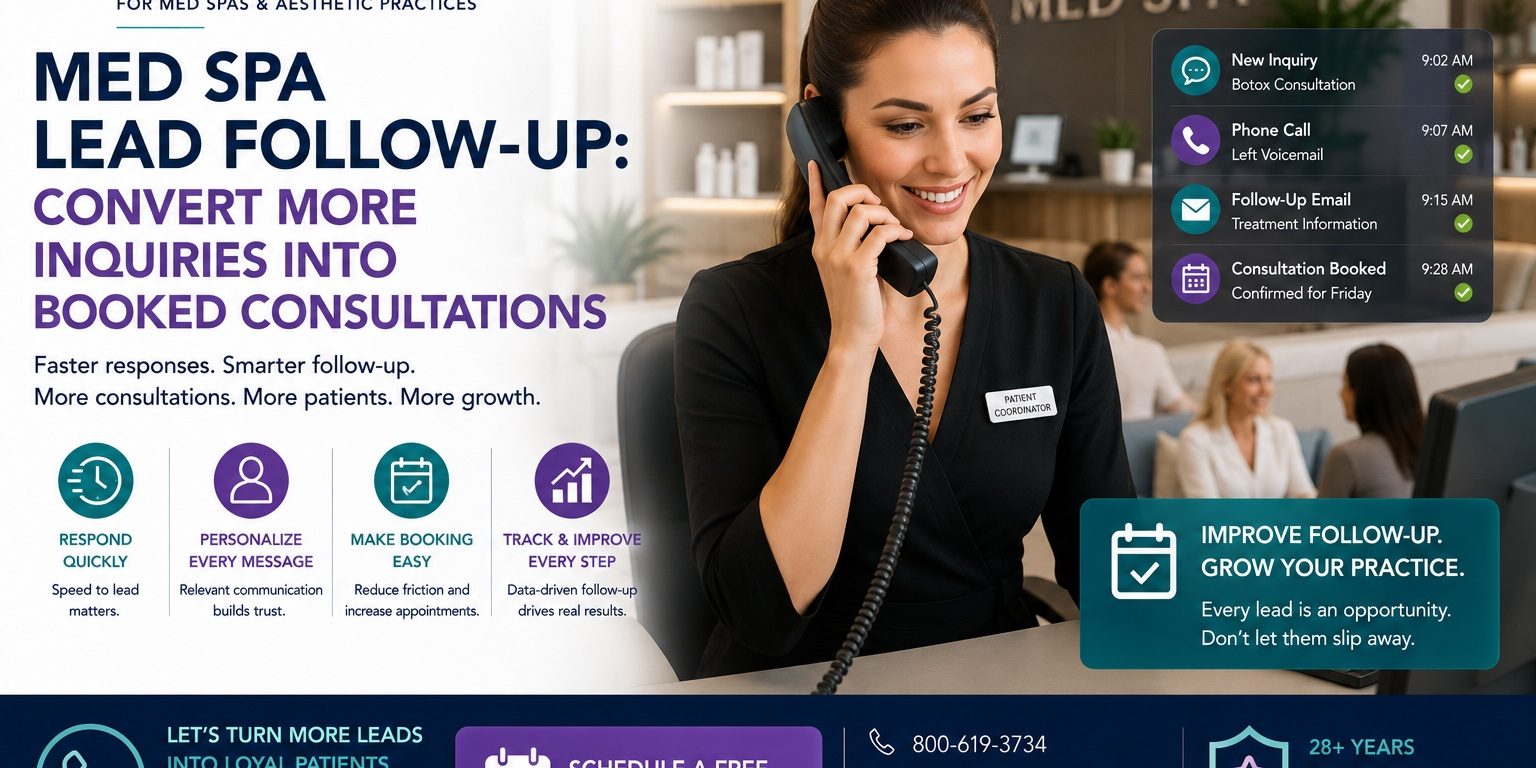
Generating more med spa leads does not automatically produce more patients. A practice can invest heavily in SEO, paid advertising, social media, content, referrals, and other marketing channels while still losing substantial revenue after prospective patients make contact. The problem is often not lead generation itself. It is what happens immediately afterward.
Med spa lead follow-up is the process of responding to inquiries, establishing contact, answering initial questions, overcoming appropriate barriers, and moving qualified prospects toward a consultation or appointment. When that process is inconsistent, slow, or difficult for patients, marketing performance can appear weaker than it actually is.
For med spas already investing in med spa marketing, improving lead follow-up can be one of the most important ways to increase the return from traffic and inquiries the practice is already generating.
Why Med Spa Leads Get Lost
Prospective aesthetic patients rarely exist in a vacuum.
Someone considering Botox, fillers, laser treatments, body contouring, skin rejuvenation, or another aesthetic service may research several providers before making a decision. They can visit multiple websites, compare reviews, look through social media accounts, examine before-and-after photographs, and contact more than one clinic.
Submitting an inquiry does not mean the clinic has won the patient.
It means the clinic has earned an opportunity to continue the conversation.
Several problems can cause that opportunity to disappear:
- slow response times
- missed phone calls
- unanswered forms
- inconsistent text or email follow-up
- confusing scheduling procedures
- poor communication
- lack of personalization
- inadequate treatment knowledge
- excessive sales pressure
- failure to follow up after the first attempt
These are conversion problems rather than traffic problems.
If management does not distinguish between the two, it may respond by spending even more money to generate leads that continue leaking out of the same process.
Understand the Med Spa Lead Journey
A useful way to evaluate lead management is to break the process into stages.
A typical journey may look like:
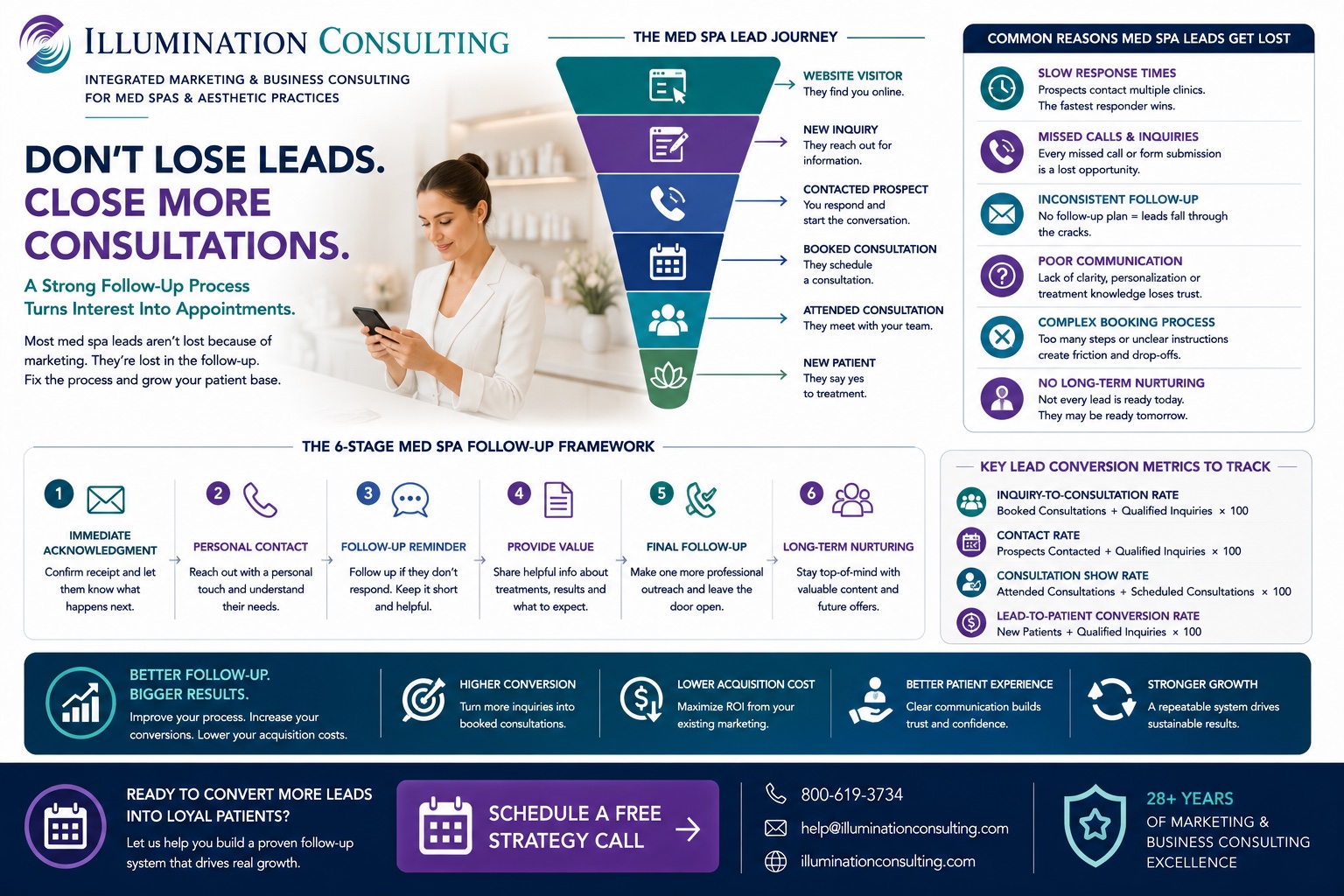
Website visitor → inquiry → contacted prospect → booked consultation → attended consultation → treatment → returning patient
Each transition can be measured.
If 100 qualified inquiries arrive but only 20 consultations are booked, management should investigate the inquiry-to-consultation stage.
If 60 consultations are booked but only 30 patients attend, the scheduling and confirmation process may need attention.
If consultations are occurring but relatively few become treatments, the constraint may exist within the consultation, pricing, patient expectations, financing, provider communication, or treatment recommendation process.
The objective is to identify where qualified prospects are being lost.
Respond Quickly to New Inquiries
Response time matters because prospective patients can continue researching after submitting a form or making a call.
A person who contacts three aesthetic practices may naturally continue the conversation with the clinic that responds professionally while the original interest is still active.
That does not mean every inquiry requires an immediate sales pitch.
It means the practice should acknowledge the patient’s interest and create a clear next step.
Clinics should establish internal expectations for:
- website form responses
- missed calls
- text messages
- social media inquiries
- online booking requests
- after-hours inquiries
Management should also measure actual response performance rather than assuming the process works because a policy exists.
Make the First Response Personal
Automation can improve speed and consistency, but med spa communication should not feel mechanical.
A generic message such as “Thank you for contacting us. Someone will get back to you” confirms receipt but does little to advance the patient relationship.
When appropriate, the first meaningful response should acknowledge what the prospective patient asked about.
For example, someone requesting information about laser resurfacing should receive a response relevant to laser resurfacing rather than a generic description of the entire clinic.
Personalization communicates that the inquiry was actually reviewed.
It also gives staff an opportunity to move the conversation toward the correct next step.
Give Prospective Patients a Clear Next Step
Every lead interaction should make it easy for the prospective patient to understand what happens next.
Depending on the practice and treatment, that might be:
Schedule a consultation.
Speak with a patient coordinator.
Complete an intake form.
Select an appointment time.
Receive additional treatment information.
Uncertainty creates friction.
If a prospect submits a form and receives a long email containing several different phone numbers, links, offers, and instructions, the response may make taking action harder rather than easier.
The goal is to reduce unnecessary effort between interest and consultation.
Use Multiple Communication Channels Appropriately
Patients have different communication preferences.
Some prefer phone calls.
Others respond more readily to text messages or email.
A lead follow-up system can therefore use multiple channels rather than relying on one communication method.
For example, a practice may combine:
- phone calls
- SMS
- online scheduling
- appropriate automated reminders
The precise mix should reflect patient consent, applicable privacy requirements, clinic policies, and the nature of the communication.
The strategic principle is straightforward: do not make prospective patients repeatedly work to reach the practice.
Do Not Give Up After One Follow-Up Attempt
One unanswered phone call does not necessarily indicate that a prospect has lost interest.
People work.
They attend meetings.
They care for children.
They travel.
They screen unfamiliar calls.
They forget to respond.
A structured follow-up process allows the clinic to remain professionally persistent without becoming intrusive.
A sequence might include several contact attempts across an appropriate period using the communication channels available to the clinic.
The purpose is not aggressive selling.
It is giving an interested prospect reasonable opportunities to continue a conversation they initiated.
Build a Defined Lead Follow-Up Sequence
Rather than leaving follow-up entirely to individual staff members, clinics should establish a repeatable process.
The exact timing should be tested against the clinic’s patient behavior, staffing, communication systems, and applicable requirements.
A practical framework could include:
Stage 1: Immediate Acknowledgment
Confirm that the inquiry has been received and communicate what happens next.
Where appropriate, provide a direct scheduling option.
Stage 2: Personal Contact
A qualified staff member follows up regarding the specific treatment or question.
The objective is to understand the patient’s interest and determine the appropriate next step.
Stage 3: Follow-Up Reminder
If the prospect does not respond, follow up again with a concise message that makes re-engagement easy.
Stage 4: Helpful Information
When appropriate, provide useful information related to the treatment rather than repeatedly asking whether the person wants to book.
Stage 5: Final Active Follow-Up
Make another professional attempt and leave the communication channel open.
Stage 6: Longer-Term Nurturing
Prospects who are not ready today may still become patients later.
With appropriate permission and communication practices, they can remain connected through educational content, email marketing, treatment information, and future clinic communication.
This transforms lead follow-up from a handful of random calls into a system.
Separate Immediate Follow-Up From Lead Nurturing
Not every inquiry is ready to book immediately.
This is especially relevant for higher-consideration aesthetic procedures.
A prospective patient may be researching treatment months before making a decision.
They may need time to:
- understand the procedure
- evaluate providers
- consider costs
- plan recovery
- discuss the decision with someone
- determine timing
- become comfortable with the clinic
A “not now” lead is therefore not necessarily a bad lead.
This is where lead nurturing becomes important.
Educational content, treatment information, email communication, social media, and other touchpoints can maintain familiarity until the patient is ready to take the next step.
Illumination Consulting’s content marketing services can support this longer decision journey by helping practices create useful information around treatments and patient questions rather than relying exclusively on promotional messages.
Use Treatment-Specific Follow-Up
A prospective injectable patient and someone considering a major laser procedure may have very different concerns.
Follow-up should reflect those differences.
Questions may involve:
- expected outcomes
- treatment frequency
- recovery
- candidacy
- preparation
- provider experience
- consultation requirements
- cost
- financing or payment options
- appointment availability
Staff should have accurate information and understand when a question needs to be escalated to an appropriate clinical professional.
Marketing and administrative communication should never cross into providing medical advice that requires a qualified healthcare provider.
Improve the Consultation Booking Experience
A lead can be highly interested and still abandon the process if scheduling is difficult.
Common friction points include:
- limited ways to book
- long telephone hold times
- unclear availability
- repeated transfers
- cumbersome forms
- unnecessary steps
- poor mobile experiences
- delayed confirmation
The booking process should be reviewed from the patient’s perspective.
How many steps are required between deciding to schedule and having a confirmed appointment?
Every unnecessary step creates another opportunity for abandonment.
Reduce Consultation No-Shows
Lead conversion does not end when a consultation is scheduled.
A booked appointment that never occurs does not create the same business value as an attended consultation.
Clinics should therefore track show rate separately.
Depending on the practice, appointment confirmation systems can include:
- confirmation messages
- calendar details
- reminders
- preparation instructions
- rescheduling options
- clear location information
- deposit policies where appropriate
Communication should reduce uncertainty while making it easy for patients to update the clinic if plans change.
Track Inquiry-to-Consultation Conversion Rate
A core metric is the percentage of qualified inquiries that become booked consultations.
The calculation is:
Inquiry-to-Consultation Rate = Booked Consultations ÷ Qualified Inquiries × 100
If a med spa receives 80 qualified inquiries and books 32 consultations:
32 ÷ 80 × 100 = 40%
This example is illustrative, not an industry benchmark.
The value of the metric is that it creates a baseline.
If the practice improves its follow-up process and the conversion rate rises over time, management has evidence that more value is being extracted from existing marketing activity.
Track Contact Rate
Before analyzing booking performance, determine whether staff are actually reaching prospective patients.
Contact Rate = Prospects Successfully Contacted ÷ Qualified Inquiries × 100
A low contact rate can indicate:
- poor lead information
- delayed responses
- inadequate contact attempts
- wrong communication channels
- after-hours problems
- technical issues with forms or phone systems
Without this metric, management may mistakenly conclude that leads are poor quality when many prospects were never successfully reached.
Track Consultation Show Rate
The next useful measurement is:
Consultation Show Rate = Attended Consultations ÷ Scheduled Consultations × 100
This helps distinguish scheduling performance from appointment attendance.
If booking rates are strong but show rates are weak, generating more leads may not be the highest-priority solution.
The practice should first investigate why scheduled prospects fail to attend.
Track Lead-to-Patient Conversion
Ultimately, the practice needs to know how many inquiries become paying patients.
A simplified calculation is:
Lead-to-Patient Conversion Rate = New Patients ÷ Qualified Inquiries × 100
This provides a broader view of the entire conversion system.
However, management should still examine each stage individually because the overall number does not explain where conversion is being lost.
Connect Follow-Up With Patient Acquisition Cost
Improving lead conversion can materially change marketing economics without increasing advertising spending.
Consider two hypothetical practices.
Both spend $10,000 and generate 100 qualified inquiries.
Practice A converts 10 inquiries into new patients.
Its simplified acquisition cost is:
$10,000 ÷ 10 = $1,000 per patient
Practice B converts 25 of the same 100 inquiries.
Its simplified acquisition cost becomes:
$10,000 ÷ 25 = $400 per patient
Nothing about the marketing expenditure changed.
The difference came from conversion.
This is why the med spa marketing metrics that occur after lead generation deserve as much management attention as traffic, advertising clicks, and search rankings.
Use a CRM or Lead Management System
Once lead volume increases, spreadsheets, inboxes, handwritten notes, and staff memory become increasingly unreliable.
A customer relationship management or lead-management system can help clinics organize:
- lead source
- contact information
- treatment interest
- inquiry date
- contact attempts
- appointment status
- follow-up tasks
- consultation outcome
- acquisition source
- patient conversion
The purpose of the system is not simply storing information.
It should help ensure that qualified opportunities do not disappear because someone forgot to follow up.
Use Automation Without Removing the Human Experience
Automation can support med spa lead management through:
- inquiry acknowledgments
- staff notifications
- follow-up tasks
- appointment confirmations
- reminders
- email sequences
- lead-status updates
- reporting
However, automation should support human communication rather than replace it indiscriminately.
Aesthetic medicine is personal.
Prospective patients may have concerns about appearance, outcomes, safety, recovery, costs, or privacy.
The best system combines operational consistency with appropriate personal attention.
Train Front-Desk and Patient Coordination Staff
Marketing performance depends partly on the people handling the leads.
Staff should understand:
How the clinic is positioned
They need to communicate what distinguishes the practice.
Priority treatments
They should understand basic non-clinical treatment information and the appropriate next steps.
Lead qualification
They need a consistent method for collecting useful information.
Communication standards
Tone, response expectations, and follow-up responsibilities should be clear.
Escalation
Staff should know which questions require clinical expertise.
CRM usage
Every relevant interaction should be documented consistently.
A sophisticated advertising campaign can be undermined by an unstructured front-desk process.
Review Recorded Outcomes, Not Staff Impressions
When asked about lead quality, staff may say:
“The leads aren’t very good.”
That assessment may be correct.
But it should be verified with data.
Review:
- lead sources
- treatment interests
- contact rates
- response times
- booking rates
- show rates
- treatment conversion
- reasons prospects did not book
Patterns are more useful than anecdotes.
Perhaps one advertising channel genuinely generates poor prospects.
Or perhaps leads from that channel arrive after hours and receive slower responses.
Those situations require very different solutions.
Evaluate Lead Quality by Marketing Source
Not all channels produce the same type of patient.
A med spa may receive inquiries from:
- organic Google searches
- Google Maps
- paid search
- Meta advertising
- referrals
- partnerships
- direct website visits
Track each source through the conversion process.
A channel with a high cost per lead may produce excellent patients.
Another channel may generate inexpensive leads that rarely answer, schedule, or purchase.
The relevant question is not:
Which channel produces the cheapest leads?
It is:
Which channels acquire economically valuable patients?
Build a Weekly Lead Conversion Review
Med spa management does not need to wait until the end of each quarter to discover that leads are being lost.
A simple weekly review can examine:
- qualified inquiries received
- percentage successfully contacted
- consultations booked
- consultations attended
- new patients acquired
- lead sources
- average response time
- unresolved leads
This creates operational accountability.
It also allows problems to be corrected before weeks or months of marketing investment are wasted.
Diagnose the Constraint Before Buying More Traffic
When new-patient growth slows, increasing marketing is an understandable reaction.
Sometimes it is the correct response.
But first determine which constraint actually exists.
Not enough qualified traffic?
Increase visibility and acquisition.
Traffic but few inquiries?
Improve website conversion, messaging, offers, and calls to action.
Strong inquiries but weak contact rates?
Improve response and follow-up.
Strong contact but few bookings?
Evaluate communication, qualification, positioning, and scheduling.
Strong bookings but weak show rates?
Improve confirmation and appointment management.
Strong consultations but weak treatment conversion?
Investigate the consultation and patient decision process.
This approach treats marketing as a measurable patient-acquisition system rather than a collection of disconnected campaigns.
Better Lead Follow-Up Can Increase the Value of Existing Marketing
Med spas often look outward when searching for growth.
More advertising.
More traffic.
More social media.
More content.
More leads.
Those activities can be necessary, but practices should also examine the opportunities already entering the business.
Every qualified inquiry represents marketing effort that has already succeeded in generating interest.
The next objective is converting that interest efficiently and professionally.
A strong med spa lead follow-up system combines fast response, appropriate personalization, clear next steps, consistent communication, convenient scheduling, automation, staff training, and measurement.
When these elements improve, the practice may generate more consultations and patients without requiring an equivalent increase in lead volume.
Illumination Consulting helps aesthetic practices integrate marketing services with website conversion, patient acquisition, analytics, and growth strategy. Rather than measuring success exclusively through traffic or lead counts, practices can identify where prospects are being lost and build a stronger system for converting marketing investment into booked consultations and long-term patients.
Frequently Asked Questions
How should a med spa follow up with new leads?
A med spa should acknowledge inquiries promptly, attempt personal contact, provide a clear next step, follow up consistently when prospects do not initially respond, and document interactions within a structured lead-management system. Communication should remain professional and appropriate to the patient’s inquiry.
How many times should a med spa follow up with a lead?
There is no universal number appropriate for every clinic or prospect. Practices should establish and test a structured sequence using appropriate communication channels while respecting patient preferences, consent, privacy requirements, and requests to discontinue communication.
What is a med spa lead conversion rate?
Lead conversion can refer to several stages. Clinics can measure inquiry-to-consultation rate, consultation show rate, consultation-to-treatment conversion, and the overall percentage of qualified inquiries that eventually become new patients.
Why are med spa leads not booking consultations?
Potential causes include slow responses, unsuccessful contact attempts, poor lead quality, unclear positioning, scheduling friction, weak communication, pricing concerns, lack of trust, inadequate follow-up, or a mismatch between the patient’s needs and the practice.
Can automation improve med spa lead follow-up?
Yes. Automation can support acknowledgments, staff notifications, reminders, follow-up tasks, email communication, and reporting. However, it should complement rather than indiscriminately replace personal communication, particularly when prospective patients have treatment-specific questions.