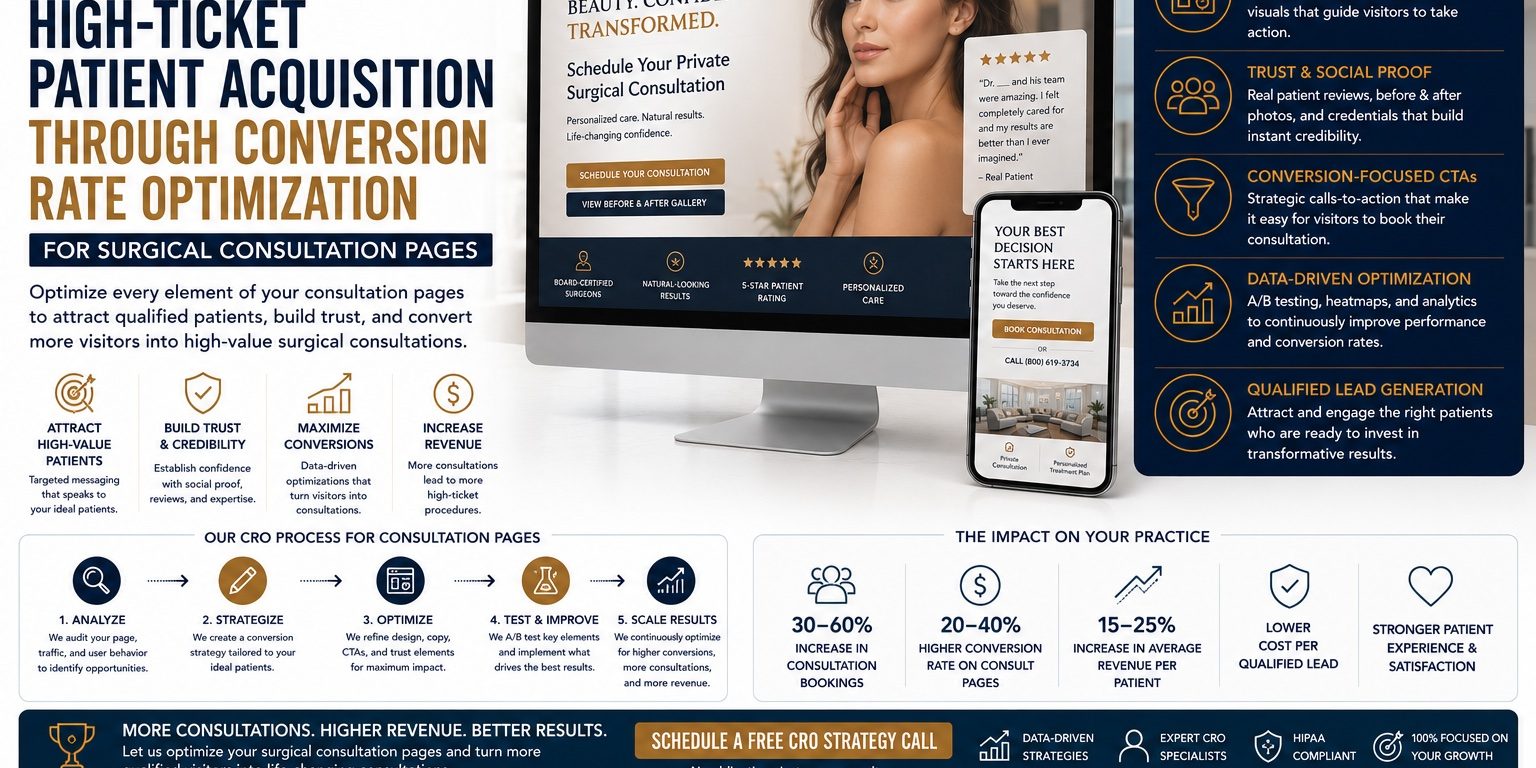
Acquiring patients for high-ticket medical procedures such as rhinoplasty, facelifts, breast augmentation, and body contouring requires a specialized approach to conversion rate optimization (CRO). Unlike standard ecommerce transactions, these $5,000–$25,000 surgeries trigger unique psychological barriers including fear, cost concerns, recovery downtime, and the critical need to establish surgeon trust. This article presents a comprehensive and authoritative framework designed specifically to enhance plastic surgery consultation conversion rates and elevate patient acquisition for surgeons. By focusing on an aesthetic clinic CRO mindset, surgical consultation booking funnels can be transformed into effective, patient-centric conversion engines.
Executive Summary & The High-Ticket Paradigm
Standard ecommerce CRO strategies, often geared toward impulse buys or low-involvement decisions, fall short when applied to high-ticket medical procedures. The purchase journey for surgical consultations involves substantial psychological hurdles: fear of complications, apprehension about recovery, significant financial investment, and an intense need to trust the surgeon. Potential patients are not merely clicking “Add to Cart” — they are entrusting their health, appearance, and wellbeing to a surgeon. Therefore, conversion rate optimization in this realm demands a sophisticated, multi-layered strategy sensitive to these factors.
To address this, patient acquisition for surgeons must go beyond simple website tweaks and instead embrace a deep understanding of behavioral psychology, trust-building mechanisms, and regulatory compliance such as HIPAA for secure consultation forms. The goal is to create a smooth and reassuring journey that guides prospects from curiosity to committed consultation bookings, thereby boosting the high-ticket medical procedure conversion rate effectively.
The 5-Pillar Surgical Consultation Conversion Framework
To optimize plastic surgery consultation conversion effectively, medical practices should implement the following five pillars, each addressing critical aspects of patient engagement and funnel performance:
Pillar 1: Frictionless, Multi-Step Qualification Forms
Long, intimidating single-page forms often deter potential patients early in the process. Instead, implementing multi-step qualification forms streamlines lead qualifying and reduces drop-off rates. These forms can segment prospects based on procedure interest, budget, medical history, and readiness level while remaining HIPAA-compliant to ensure data privacy and security. Incorporating deposit and scheduling micro-conversions within these forms — such as prompting for partial commitments or preferred consultation times — further encourages patient engagement without overwhelming the user.
Pillar 2: High-Trust Visual Proof Architecture
Visual proof is paramount in aesthetic clinic CRO. Before-and-after gallery optimization involves categorizing images by procedure type, body type, age group, and surgeon to ensure relevance and relatability. Well-organized galleries that highlight transformative results not only showcase surgeon expertise but also provide social proof, reducing patient anxiety and establishing credibility. These galleries should be easily navigable and integrated into the surgical consultation booking funnel to reinforce decision-making.
Pillar 3: Authoritative Surgeon Persona & Board Certification E-E-A-T Signals
Establishing surgeon authority through E-E-A-T (Experience, Expertise, Authoritativeness, and Trustworthiness) signals is indispensable. Displaying verifiable credentials such as board certifications, hospital affiliations, peer-reviewed publications, and professional memberships reassures potential patients of the surgeon’s qualifications. Detailed surgeon bios that include educational background, case experience, and patient testimonials further cultivate trust. This authoritative persona builds confidence critical for high-ticket medical procedure conversion rate improvements.
Pillar 4: Interactive Procedure Pricing & Financing Calculators
Price transparency mitigates sticker shock, a common barrier in surgical consultations. Integrating interactive pricing and financing calculators on consultation pages allows patients to explore estimated costs and flexible payment options, including partnerships with providers like CareCredit and Alphaeon. This empowers patients to make informed decisions and reduces abandonment rates by addressing financial concerns upfront within the surgical consultation booking funnel.
Pillar 5: Post-Submission Automated Concierge Nurturing
The patient journey doesn’t end at form submission. Implementing automated nurturing through SMS confirmations, personalized video greetings from the surgeon, and pre-consultation medical guides significantly decreases no-show rates and improves engagement. This high-touch approach fosters a sense of personalized care and keeps potential patients connected, effectively steering them toward confirmed appointments.
Detailed CRO Audit Checklist for Surgical Landing Pages
Step-by-Step Implementation Guide for Practice Managers & Web Teams
- Assess Current Funnel: Audit existing surgical consultation pages against the CRO checklist to identify gaps.
- Build Multi-Step Qualification Forms: Use HIPAA-compliant form builders that allow staged information collection with micro-conversions.
- Develop Visual Proof Content: Organize and optimize before-and-after galleries with categorization filters and high-quality imagery.
- Enhance Surgeon Profiles: Collect and publish detailed E-E-A-T signal content including certifications and publications.
- Integrate Pricing Tools: Work with finance partners to embed calculators showcasing realistic cost and payment solutions.
- Set Up Automated Nurturing: Implement SMS and email workflows to provide confirmations, reminders, and pre-consultation resources.
- Test and Refine: Conduct A/B testing of form lengths, CTAs, visual layouts, and messaging to continuously improve conversion rates.
- Monitor KPIs: Track high-ticket medical procedure conversion rate, lead quality, appointment attendance, and patient acquisition costs.
Structured FAQ Section
What is plastic surgery consultation conversion?
It refers to the percentage of visitors to a plastic surgery consultation page who complete desired actions such as booking an appointment, indicating their interest, or submitting qualification forms within the surgical consultation booking funnel.
How can I improve patient acquisition for surgeons?
Improvement involves optimizing website design and content with a focus on trust-building E-E-A-T signals, implementing frictionless multi-step forms, enhancing before-and-after galleries, integrating transparent pricing tools, and automating patient nurturing communications post-visit.
What is aesthetic clinic CRO?
Aesthetic clinic CRO involves using conversion optimization techniques tailored specifically to cosmetic medical practices, addressing the unique needs and concerns of patients seeking elective procedures.
Why are deposit and scheduling micro-conversions important?
They break down the conversion funnel into smaller, manageable steps that encourage commitment incrementally, reducing abandonment and increasing overall booking rates.
How do HIPAA-compliant consultation forms affect patient acquisition?
They protect patient privacy and build trust by ensuring personal health information is handled securely, which is crucial for compliance and for patients’ peace of mind.
Authoritative Conclusion
Optimization of surgical consultation pages for high-ticket medical procedures demands a bespoke, multi-faceted approach that addresses psychological barriers, establishes surgeon authority, simplifies qualification, and supports patients through transparent pricing and personalized communication. Implementation of the 5-Pillar Surgical Consultation Conversion Framework enables medical practices to elevate patient acquisition for surgeons significantly while reducing no-show rates and enhancing lead quality. Practice managers and web teams should adopt an iterative CRO mindset, continuously testing and refining each component of the patient journey. Expertly executed, this strategy transforms surgical consultation booking funnels into powerful engines for sustained growth and profitability.
Ready to transform your surgical practice’s patient acquisition?
Implement these proven CRO strategies with our expert guidance to maximize your high-ticket medical procedure conversion rate.
About Illumination Consulting
Illumination Consulting is a business consulting, digital marketing, and SEO firm specializing in med spa and aesthetic clinic growth. Since 1998, the firm has partnered with plastic surgeons, dermatologists, and aesthetic practices nationwide to strengthen patient acquisition, improve conversion performance, and build scalable, results-driven growth systems.