Many plastic surgery practices invest heavily in marketing to generate consultation requests. They focus on SEO, paid advertising, social media, referrals, and reputation management to attract prospective patients. However, generating consultations is only part of the growth equation.
A common challenge facing many practices is converting consultations into booked procedures. While consultation volume may appear healthy, low conversion rates can significantly limit revenue growth and profitability. Consequently, practices often spend more money generating leads when the larger opportunity may lie within improving conversion performance.
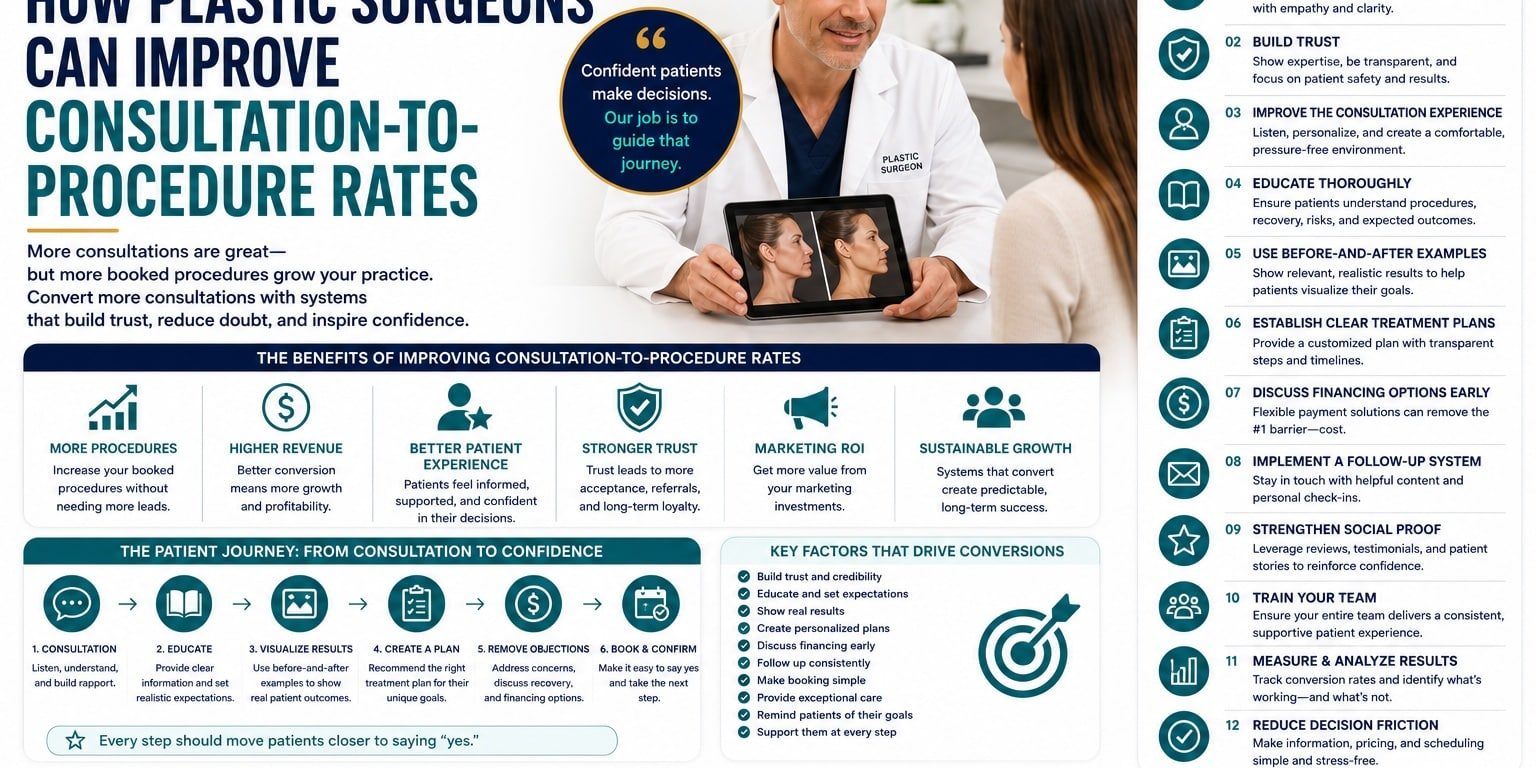
The most successful plastic surgery practices understand that every consultation represents a valuable opportunity. Rather than viewing consultations as isolated appointments, they treat them as a critical stage within the patient journey. Furthermore, these practices implement systems designed to educate, build trust, reduce uncertainty, and help patients make confident decisions.
Understanding how plastic surgeons can improve consultation-to-procedure rates allows practices to maximize marketing investments, improve patient experiences, and increase revenue without necessarily increasing lead generation expenses.
Whether you specialize in facial procedures, body contouring, breast surgery, reconstructive procedures, or comprehensive cosmetic services, improving consultation conversion rates can significantly impact long-term growth.
Understand Why Patients Hesitate
Before improving conversions, practices must understand why patients delay or avoid scheduling procedures.
Common concerns include:
- Cost
- Recovery time
- Fear of complications
- Uncertainty about results
- Lack of trust
- Family influence
- Timing concerns
- Multiple provider comparisons
Additionally, many patients enter consultations with emotional concerns that are not immediately obvious.
Therefore, successful surgeons take time to understand motivations and objections.
When concerns are addressed appropriately, conversion rates often improve.
Focus on Building Trust
Trust remains one of the most important factors influencing procedure decisions.
Patients are not simply purchasing a service.
They are placing their appearance, confidence, and well-being in the hands of a provider.
Trust is influenced by:
- Professional credentials
- Experience
- Reputation
- Communication
- Patient outcomes
- Transparency
Furthermore, trust-building begins before patients arrive for consultations.
Websites, reviews, educational content, and social proof all contribute to patient confidence.
As a result, strong trust-building systems often improve consultation-to-procedure rates.
Improve the Consultation Experience
Many practices underestimate the impact of the consultation experience itself.
Successful consultations focus on:
- Listening
- Education
- Personalization
- Transparency
- Relationship building
Patients want to feel understood.
Therefore, consultations should focus on patient goals rather than immediately presenting treatment recommendations.
Additionally, surgeons who actively listen often create stronger patient relationships.
Consequently, patients feel more comfortable moving forward.
Educate Patients Thoroughly
Education reduces uncertainty.
Many prospective patients spend weeks or months researching procedures before making decisions.
Effective consultation education includes:
- Procedure details
- Expected outcomes
- Recovery timelines
- Risks and benefits
- Alternative treatment options
- Long-term expectations
Furthermore, educated patients often feel more confident in their decisions.
As a result, procedure acceptance rates frequently improve.
Use Before-and-After Examples Strategically
Visual proof remains one of the most powerful conversion tools available.
Patients want realistic expectations.
Therefore, before-and-after examples should demonstrate:
- Relevant procedures
- Similar patient characteristics
- Realistic outcomes
- Consistent results
Additionally, visual examples help bridge the gap between education and confidence.
When patients can envision potential outcomes, decision-making becomes easier.
Establish Clear Treatment Plans
Patients often feel overwhelmed when presented with too many options.
Successful practices provide structured recommendations.
Effective treatment planning includes:
- Clear objectives
- Procedure recommendations
- Recovery expectations
- Timeline guidance
- Financial considerations
Furthermore, organized recommendations reduce confusion.
Consequently, patients often feel more comfortable proceeding.
Discuss Financing Options Early
Cost remains one of the most common barriers to elective procedures.
However, many practices avoid discussing financial solutions proactively.
Important strategies include:
- Financing education
- Payment plan options
- Transparent pricing
- Package explanations
- Value-focused discussions
Additionally, patients often appreciate knowing their options early in the process.
As a result, financial concerns become easier to address.
Create a Structured Follow-Up System
Many consultations do not convert immediately.
Patients often need additional time to evaluate decisions.
Therefore, follow-up systems are critical.
Effective follow-up may include:
- Consultation summaries
- Educational resources
- Procedure information
- Patient testimonials
- Personal check-ins
- Financing reminders
Furthermore, follow-up demonstrates professionalism and genuine interest.
Consequently, many patients who initially delay eventually move forward.
Strengthen Social Proof
Patients frequently seek validation before making major decisions.
Strong social proof includes:
- Reviews
- Testimonials
- Video success stories
- Before-and-after galleries
- Patient case studies
Additionally, social proof helps reinforce confidence after consultations.
When patients see positive outcomes from others, concerns often diminish.
Improve Staff Training
Consultation conversion is not solely the surgeon’s responsibility.
The entire team influences patient experiences.
Important training areas include:
- Customer service
- Communication
- Scheduling
- Follow-up
- Financial discussions
- Patient support
Furthermore, every interaction contributes to trust.
As a result, well-trained teams often improve conversion performance.
Measure Consultation Conversion Rates
Many practices fail to track consultation performance consistently.
Important metrics include:
- Consultation volume
- Procedure conversion rates
- Revenue per consultation
- Lead source performance
- Follow-up effectiveness
- Financing utilization
Additionally, measurement helps identify improvement opportunities.
Consequently, practices can optimize systems more effectively.
Reduce Decision-Making Friction
Many patients postpone procedures due to uncertainty rather than opposition.
Successful practices reduce friction by providing:
- Clear information
- Simple next steps
- Transparent pricing
- Easy scheduling
- Accessible financing
- Consistent communication
Furthermore, reducing complexity often accelerates decision-making.
As a result, conversion rates frequently improve.
Why Consultation Conversion Matters
Understanding how plastic surgeons can improve consultation-to-procedure rates is important because consultations represent significant investments.
Practices spend substantial resources generating consultations through:
- SEO
- Advertising
- Referrals
- Social media
- Reputation management
When conversion rates improve, the value of every marketing dollar increases.
Consequently, profitability often grows without increasing lead generation spending.
Long-Term Benefits of Higher Conversion Rates
Practices that improve consultation conversion often experience:
- Increased procedure volume
- Higher revenue
- Better marketing efficiency
- Improved patient experiences
- Greater profitability
- Stronger growth
Furthermore, conversion improvements compound over time.
As a result, practices create sustainable competitive advantages.
Ultimately, understanding how plastic surgeons can improve consultation-to-procedure rates helps practices maximize opportunities, strengthen patient relationships, and achieve more predictable growth.
Key Takeaways
Key takeaways include:
- Understanding patient concerns improves conversions
- Trust remains critical to decision-making
- Education reduces uncertainty
- Before-and-after examples build confidence
- Treatment plans provide clarity
- Financing options remove barriers
- Follow-up systems improve results
- Social proof strengthens credibility
- Team training supports conversions
- Measurement drives improvement
- Reduced friction accelerates decisions
- Conversion optimization improves profitability
These strategies help plastic surgery practices improve procedure acceptance rates and maximize patient acquisition investments.
Q&A
| Question | Answer |
|---|---|
| Why do patients delay cosmetic procedures after consultations? | Common reasons include cost concerns, uncertainty about outcomes, recovery fears, and the need for additional information. |
| How important is trust during consultations? | Trust is one of the most influential factors affecting procedure decisions. |
| Do financing options improve conversion rates? | Yes. Flexible financing often removes a major barrier to treatment acceptance. |
| Why is follow-up important after consultations? | Many patients need time to evaluate decisions, making structured follow-up essential. |
| How can practices measure consultation performance? | By tracking consultation volume, conversion rates, revenue per consultation, and lead source effectiveness. |
How Illumination Consulting Helps Plastic Surgery Practices Grow
Illumination Consulting helps plastic surgery practices improve consultation conversion rates, strengthen patient acquisition systems, optimize websites, enhance online visibility, improve reputation management, and implement growth strategies that increase procedures and long-term profitability.