Plastic surgery is one of the most competitive specialties in healthcare marketing. Patients considering cosmetic procedures often spend weeks—or even months—researching surgeons, comparing practices, reviewing before-and-after results, reading testimonials, and evaluating credentials before scheduling a consultation. Throughout that journey, one factor consistently shapes their first impression: your website.
Long before a prospective patient visits your office, speaks with your staff, or meets your surgeons, they interact with your practice online. Within seconds of arriving on your website, visitors begin evaluating your professionalism, expertise, attention to detail, and the overall quality of care they expect to receive. A modern, polished website immediately establishes confidence, while an outdated or confusing experience can cause patients to leave and continue searching elsewhere.
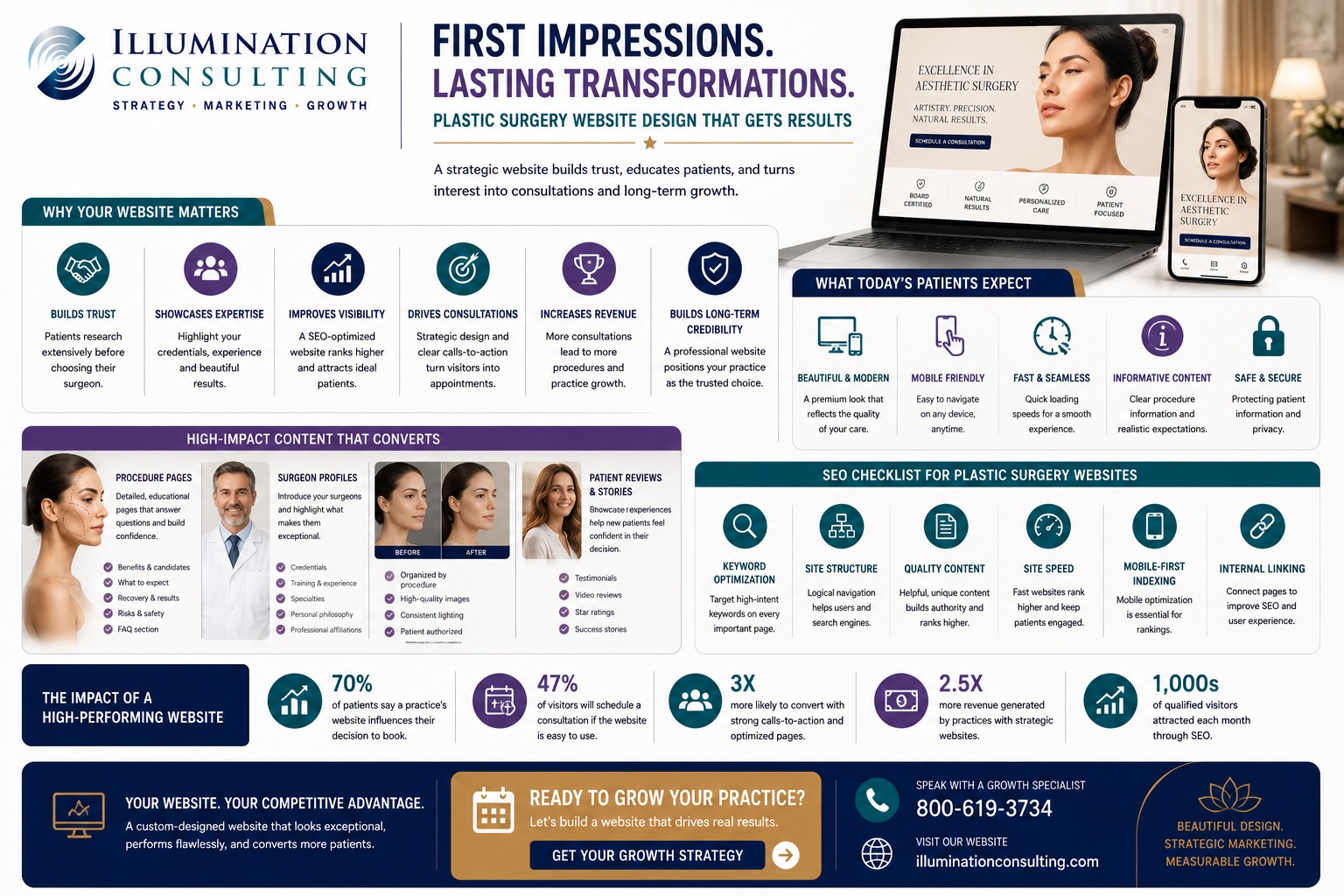
Today’s plastic surgery websites must accomplish much more than displaying procedure descriptions. They serve as sophisticated patient acquisition platforms designed to educate, build trust, demonstrate surgical expertise, and guide visitors toward requesting consultations. Every page should support the patient’s decision-making process while communicating the experience, precision, and professionalism that distinguish your practice.
Website design also directly influences search engine optimization. Google rewards websites that provide exceptional user experiences through fast loading speeds, mobile responsiveness, intuitive navigation, secure browsing, and high-quality educational content. A visually attractive website that neglects these technical elements may struggle to rank for valuable search terms, limiting its ability to attract qualified patients organically.
The rise of artificial intelligence, online consultation tools, virtual patient experiences, interactive treatment planning, and personalized content has further transformed patient expectations. Cosmetic surgery patients now expect websites that provide immediate answers, seamless navigation, transparent information, and convenient communication options from any device.
Whether your practice specializes in facial rejuvenation, breast procedures, body contouring, rhinoplasty, mommy makeovers, reconstructive surgery, or a comprehensive range of cosmetic procedures, your website should function as your most valuable marketing asset. Every visitor represents an opportunity to educate, inspire confidence, and convert interest into a consultation.
In this comprehensive guide, you’ll learn the essential principles of successful plastic surgery website design, discover the features that consistently increase consultation requests, and explore the strategies that help cosmetic surgery practices achieve sustainable long-term growth.
Why Website Design Matters for Plastic Surgery Practices
Plastic surgery patients make highly personal and often life-changing decisions. Trust, credibility, and emotional confidence play an even greater role than in many other medical specialties.
Your website serves as the digital extension of your practice, influencing patient perceptions before the first consultation is ever scheduled.
A professionally designed website should immediately communicate:
- Surgical expertise
- Professionalism
- Patient safety
- Attention to detail
- Compassion
- Exceptional results
- Premium patient experience
- Long-term credibility
These qualities establish confidence while encouraging prospective patients to continue exploring your services.
Patients Perform Extensive Online Research
Unlike many healthcare specialties, cosmetic surgery patients typically invest significant time researching providers before making contact.
They compare:
- Surgeon credentials
- Before-and-after galleries
- Procedure information
- Reviews and testimonials
- Recovery timelines
- Safety information
- Office locations
- Consultation process
- Financing options
Your website should answer these questions comprehensively while positioning your practice as the obvious choice.
Website Design Supports SEO
Website design and SEO work together to improve visibility and patient acquisition.
Google evaluates factors including:
- Mobile responsiveness
- Website speed
- User experience
- Technical SEO
- Internal linking
- Secure browsing
- Content quality
- Accessibility
A strong technical foundation allows your educational content to perform more effectively in organic search results.
Better Websites Generate More Consultations
The ultimate objective isn’t simply attracting website visitors—it’s converting qualified prospects into consultations.
High-performing plastic surgery websites accomplish this by:
- Building trust immediately
- Showcasing outstanding results
- Providing educational resources
- Simplifying navigation
- Displaying surgeon credentials
- Offering convenient consultation requests
- Including clear calls-to-action
Small improvements in website conversion rates often lead to substantial increases in consultation requests without increasing advertising costs.

Understanding the Modern Plastic Surgery Patient
Today’s plastic surgery patient is more informed, selective, and digitally connected than ever before. Before committing to a consultation, prospective patients invest significant time researching procedures, comparing surgeons, reviewing outcomes, and evaluating whether a practice aligns with their expectations.
Your website should support every stage of this decision-making process by providing valuable information while reinforcing confidence in your expertise.
Patients Want Education Before They Schedule
Most visitors don’t arrive ready to book surgery immediately.
Instead, they’re searching for answers to questions like:
- Am I a good candidate for this procedure?
- What results can I realistically expect?
- How long is recovery?
- What are the risks?
- How much experience does this surgeon have?
- Can I see before-and-after results?
- What financing options are available?
- What happens during the consultation?
Providing clear, educational content positions your practice as a trusted authority while reducing uncertainty.
Trust Is Everything
Plastic surgery involves deeply personal decisions.
Patients are looking for far more than technical skill—they’re looking for a surgeon they trust.
Your website should reinforce credibility through:
- Board certification
- Surgeon biographies
- Years of surgical experience
- Before-and-after galleries
- Patient testimonials
- Hospital affiliations
- Awards and recognitions
- Professional memberships
- Published articles
- Educational videos
Every trust signal helps reduce anxiety while encouraging visitors to schedule consultations.
Patients Expect a Premium Experience
Patients considering elective cosmetic procedures often associate the quality of your website with the quality of your practice.
Premium websites feature:
- Elegant design
- Professional photography
- Simple navigation
- Fast loading pages
- High-end branding
- Mobile optimization
- Personalized messaging
Your digital experience should reflect the level of care patients will receive throughout their surgical journey.
Essential Features Every Plastic Surgery Website Needs
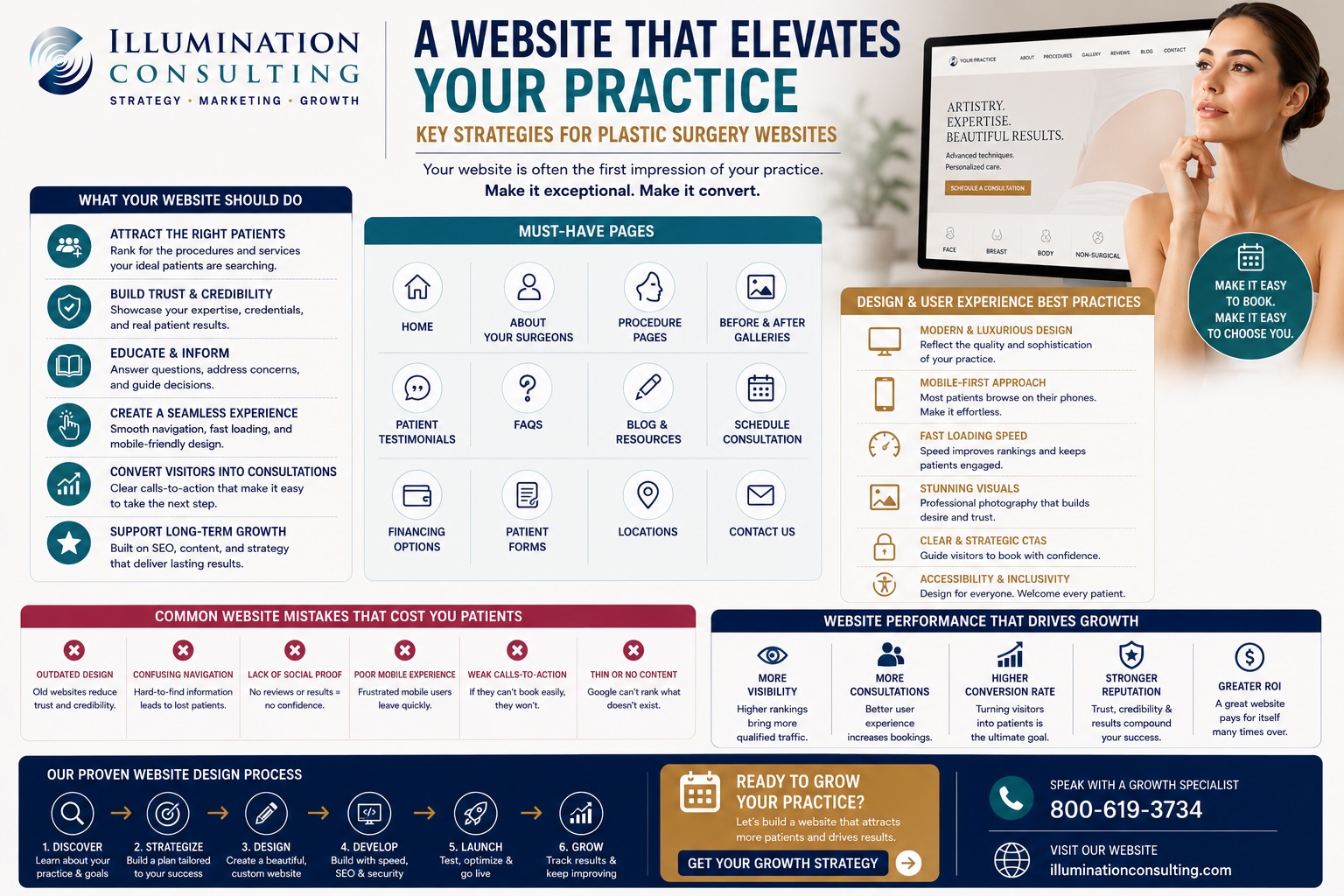
A successful plastic surgery website combines exceptional aesthetics with strategic functionality.
Every feature should support one or more objectives:
- Build trust
- Educate patients
- Improve SEO
- Increase consultations
- Simplify communication
Professional Branding
Luxury healthcare requires premium branding.
Your website should present:
- Elegant typography
- Consistent color palette
- Premium imagery
- Modern layouts
- High-quality graphics
- Professional logo placement
Every visual element should reinforce your reputation and attention to detail.
Clear Navigation
Patients should easily locate important information.
Primary navigation should include:
- Home
- Meet Our Surgeons
- Face Procedures
- Breast Procedures
- Body Procedures
- Non-Surgical Treatments
- Before & After Gallery
- Patient Resources
- Blog
- FAQs
- Contact
- Schedule Consultation
Well-structured navigation improves usability while strengthening SEO.
Strong Calls-to-Action
Every important page should naturally guide visitors toward scheduling consultations.
Examples include:
- Schedule Your Consultation
- Request a Personalized Consultation
- Meet with Our Surgeon
- Contact Our Practice
- Begin Your Transformation
Calls-to-action should remain visible throughout the website without interrupting the user experience.
Homepage Best Practices
Your homepage serves as the introduction to your practice.
Visitors should quickly understand:
- Who you are
- What procedures you specialize in
- Why patients choose your practice
Every section should reinforce these messages.
Create a Premium Hero Section
Your hero section should include:
- Professional practice photography
- Clear value proposition
- Brief supporting message
- Consultation CTA
- Elegant visual design
Rather than overwhelming visitors with excessive text, communicate confidence through clarity and simplicity.
Highlight Core Procedures
Feature your highest-demand services prominently.
Examples include:
- Facelift
- Rhinoplasty
- Breast Augmentation
- Breast Lift
- Liposuction
- Tummy Tuck
- Mommy Makeover
- Eyelid Surgery
- Neck Lift
- Body Contouring
Each procedure should link to its own comprehensive service page.
Introduce Your Surgeons
Patients want confidence in the individual performing their procedure.
Each surgeon profile should include:
- Professional headshot
- Credentials
- Board certification
- Surgical specialties
- Years of experience
- Personal philosophy
- Professional memberships
Humanizing your practice strengthens emotional connections while building trust.
Showcase Patient Success Stories
Authentic patient experiences provide powerful social proof.
Feature:
- Testimonials
- Google Reviews
- Video testimonials
- Patient stories
- Awards
- Media features
Real experiences help prospective patients visualize their own journey while increasing confidence in your practice.
Procedure Pages That Convert Visitors into Consultations
Procedure pages consistently generate some of the highest-value organic traffic because they target patients actively researching cosmetic surgery.
Each procedure deserves its own comprehensive page.
Every page should include:
- Procedure overview
- Ideal candidates
- Benefits
- Surgical process
- Recovery timeline
- Risks and considerations
- Frequently asked questions
- Before-and-after gallery
- Consultation CTA
Comprehensive pages improve SEO while answering the questions patients need addressed before scheduling.
Before-and-After Galleries Are Essential
For plastic surgery practices, before-and-after photography is one of the most influential elements of the entire website.
Patients want realistic expectations and visual proof of surgical expertise.
Best practices include:
- Organize galleries by procedure.
- Maintain consistent lighting and angles.
- Use professional photography.
- Optimize images for website speed.
- Include descriptive captions where appropriate.
- Obtain proper patient authorization.
Well-organized galleries significantly increase engagement while reinforcing confidence in your surgical outcomes.
Surgeon Biography Pages Build Patient Confidence
Patients aren’t simply choosing a plastic surgery practice—they’re choosing a surgeon. Because cosmetic surgery is highly personal and often elective, prospective patients want to feel completely confident in the individual performing their procedure.
A comprehensive surgeon biography should go beyond listing credentials. It should tell your story, communicate your philosophy of care, and demonstrate why patients can trust your expertise.
An effective biography page should include:
- Professional headshot
- Board certifications
- Medical education
- Residency and fellowship training
- Areas of surgical specialization
- Years of experience
- Professional memberships
- Awards and recognitions
- Published research
- Hospital affiliations
- Community involvement
- Personal philosophy of patient care
Adding a short welcome video can further strengthen trust by allowing visitors to meet the surgeon before their consultation.
Showcase Specialized Expertise
Many patients search specifically for surgeons with extensive experience performing particular procedures.
Highlight expertise in areas such as:
- Facelift surgery
- Rhinoplasty
- Breast augmentation
- Breast lift
- Breast reduction
- Mommy makeover
- Liposuction
- Tummy tuck
- Eyelid surgery
- Neck lift
- Body contouring
- Facial fat grafting
- Reconstructive procedures
Clearly communicating your areas of specialization helps patients quickly determine whether your practice is the right fit.
Patient Reviews and Social Proof
Plastic surgery patients invest significant time researching reviews before requesting consultations.
Positive patient experiences provide reassurance while reducing uncertainty about both surgical outcomes and the overall experience.
Your website should integrate reviews naturally throughout the patient journey.
Display Testimonials Throughout the Website
Rather than limiting testimonials to one page, place them strategically across the website.
Ideal locations include:
- Homepage
- Procedure pages
- Surgeon biographies
- Before-and-after galleries
- Consultation pages
This reinforces trust at every stage of the decision-making process.
Additional Trust Signals
Beyond reviews, include indicators that reinforce your credibility:
- Board certification logos
- Professional associations
- Hospital affiliations
- Years in practice
- National awards
- Media interviews
- Conference presentations
- Published articles
- Patient satisfaction awards
These elements help differentiate your practice while strengthening both patient confidence and search engine authority.
Mobile-First Website Design
Today’s cosmetic surgery patients research providers from smartphones, tablets, and laptops throughout the day.
Whether browsing before-and-after galleries, reading reviews, or comparing surgeons, patients expect a seamless experience regardless of the device they’re using.
Google also uses mobile-first indexing, making mobile optimization essential for both user experience and SEO.
Responsive Design
Every page should automatically adapt to different screen sizes while maintaining excellent usability.
Patients should easily be able to:
- Browse procedures
- View before-and-after galleries
- Read educational articles
- Request consultations
- Contact your office
- Complete patient forms
Responsive design improves engagement while supporting higher search rankings.
Mobile User Experience
A premium mobile experience should prioritize:
- Fast loading pages
- Large tap-friendly buttons
- Click-to-call functionality
- Mobile consultation requests
- Simple navigation
- Readable typography
- Optimized images
Reducing friction on mobile devices consistently increases consultation requests.
Website Speed and Technical SEO
An attractive website loses value if it loads slowly or performs poorly.
Patients expect immediate access to information, and Google rewards websites that provide fast, stable experiences.
Optimize Core Web Vitals
Google measures website performance using Core Web Vitals, which evaluate:
- Loading performance
- Visual stability
- User interaction responsiveness
Strong Core Web Vitals contribute to better rankings while creating a smoother browsing experience.
Improve Website Performance
Plastic surgery websites often contain high-resolution photography and extensive visual content.
Optimize performance through:
- Image compression
- Modern image formats
- Browser caching
- Content Delivery Networks (CDNs)
- Lazy loading
- Optimized hosting
- Minified CSS and JavaScript
These improvements maintain visual quality while significantly improving page speed.
Create an SEO-Friendly Website Structure
Website architecture should help both patients and search engines navigate your content.
A logical structure might include:
Home
About
- Meet Our Surgeons
- Our Practice
- Testimonials
Face Procedures
- Facelift
- Rhinoplasty
- Eyelid Surgery
- Neck Lift
Breast Procedures
- Breast Augmentation
- Breast Lift
- Breast Reduction
- Breast Revision
Body Procedures
- Liposuction
- Tummy Tuck
- Mommy Makeover
- Body Lift
Non-Surgical Treatments
- Botox
- Dermal Fillers
- Laser Treatments
- Skin Rejuvenation
Resources
- Blog
- FAQs
- Financing
- Patient Forms
Contact
This hierarchy improves crawlability while making it easier for prospective patients to find the information they’re seeking.
AI Features for Modern Plastic Surgery Websites
Artificial intelligence is rapidly changing how cosmetic surgery practices engage with prospective patients.
Modern websites increasingly incorporate AI-powered tools that improve both patient experience and operational efficiency.
Examples include:
- AI chat assistants
- Consultation scheduling
- Procedure recommendation tools
- Personalized content delivery
- Automated lead nurturing
- Interactive FAQs
- Marketing automation
- Follow-up workflows
- Predictive analytics
These technologies help practices respond faster to inquiries while creating more personalized digital experiences.
HIPAA, Security, and Patient Privacy
Trust begins with protecting patient information.
Every plastic surgery website should clearly demonstrate its commitment to privacy and security.
Essential features include:
- HTTPS encryption
- SSL certificates
- Secure hosting
- HIPAA-conscious contact forms
- Protected consultation requests
- Secure patient portals
- Privacy Policy
- Cookie Policy
- Accessibility Statement
Patients are significantly more likely to complete consultation requests when they feel confident their personal information is protected.
Common Plastic Surgery Website Mistakes
Many otherwise successful practices unknowingly reduce consultation requests because of avoidable website issues.
Common mistakes include:
- Outdated website design
- Slow page loading
- Poor mobile optimization
- Weak calls-to-action
- Generic stock photography
- Limited before-and-after galleries
- Thin procedure pages
- Missing surgeon biographies
- Poor internal linking
- Weak local SEO
- Outdated educational content
- Inconsistent branding
Correcting these issues often produces noticeable improvements in patient engagement, search visibility, and consultation conversions without increasing advertising spend.