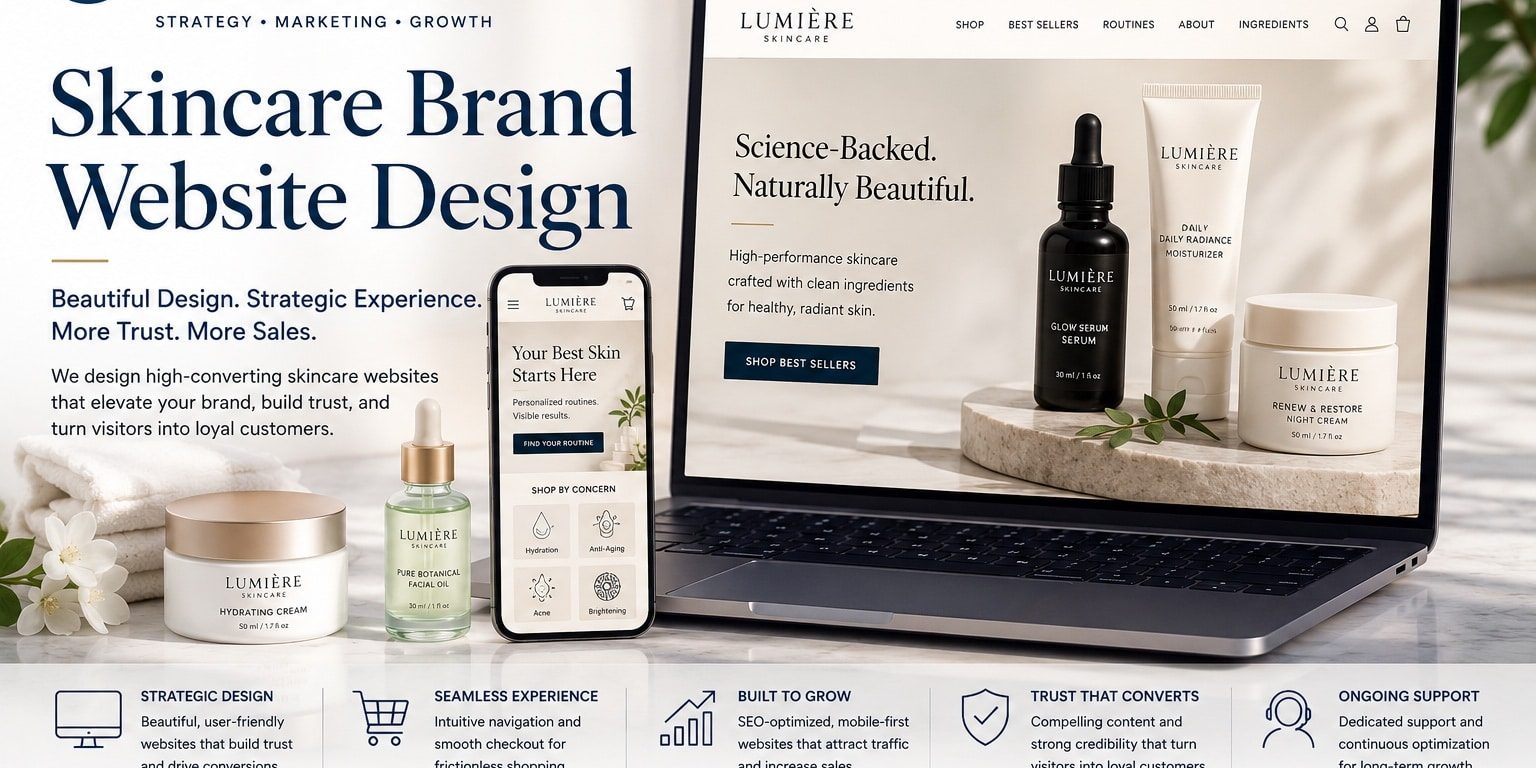
A skincare brand’s website is far more than an online store—it’s the foundation of your brand experience and one of your most valuable sales assets. Long before customers purchase their first cleanser, moisturizer, serum, or sunscreen, they evaluate your brand online. Every image, product page, headline, and design element influences whether they trust your company enough to make a purchase.
Today’s consumers have countless skincare brands to choose from. They compare ingredients, read product reviews, research company values, evaluate packaging, browse educational content, and often visit multiple websites before deciding where to buy. In this highly competitive environment, an outdated or poorly designed website can cost your brand thousands of dollars in lost sales every month.
Modern skincare websites must do much more than display products. They should educate shoppers, communicate your brand story, build credibility, simplify the buying process, and create an enjoyable shopping experience across every device. Every page should move visitors closer to making a purchase while reinforcing the quality and professionalism of your brand.
Website design also plays an essential role in search engine optimization (SEO). Search engines reward websites that provide exceptional user experiences through fast loading speeds, mobile responsiveness, intuitive navigation, secure checkout experiences, and valuable content. A beautifully designed website that ignores these technical factors will struggle to attract organic traffic, making customer acquisition significantly more expensive.
Today’s successful skincare brands also integrate artificial intelligence, personalized shopping experiences, automated product recommendations, subscription programs, loyalty rewards, and educational content into their websites. These technologies improve customer engagement while increasing average order value, repeat purchases, and long-term customer loyalty.
Whether you’re launching a new skincare startup, managing an established direct-to-consumer brand, selling through Shopify, WooCommerce, or another eCommerce platform, your website should function as your most effective salesperson. It should educate visitors, answer product questions, build trust, and convert first-time visitors into loyal, repeat customers.
In this comprehensive guide, you’ll learn the principles of high-performing skincare brand website design, discover the features that consistently increase online sales, and understand how strategic website design supports long-term brand growth.
Why Website Design Matters for Skincare Brands
Consumers make purchasing decisions remarkably quickly.
Within just a few seconds of arriving on your website, visitors begin evaluating your brand’s professionalism, credibility, product quality, and overall trustworthiness.
An attractive website captures attention, but successful skincare websites go much further by combining exceptional design with strategic eCommerce principles that encourage visitors to explore products and complete purchases.
Your Website Creates the First Impression
Your website often serves as the digital equivalent of walking into a luxury skincare boutique.
Every design element influences perception, including:
- Brand identity
- Product photography
- Typography
- Color palette
- Navigation
- Website speed
- Mobile experience
- Content quality
- Checkout experience
Premium skincare products deserve a premium online experience. A polished website immediately communicates quality while increasing customer confidence.
Consumers Research Before Purchasing
Unlike many impulse purchases, skincare products often require careful consideration.
Shoppers frequently research:
- Active ingredients
- Product benefits
- Skin type compatibility
- Clinical studies
- Customer reviews
- Before-and-after results
- Product routines
- Brand philosophy
- Sustainability practices
- Return policies
Your website should answer these questions while naturally guiding visitors toward completing their purchase.
Website Design Supports SEO
Website design and SEO work together to increase visibility and online sales.
Search engines evaluate factors including:
- Mobile responsiveness
- Website speed
- User experience
- Navigation structure
- Internal linking
- Technical performance
- Product page quality
- Secure browsing
A properly designed eCommerce website creates the technical foundation necessary for achieving strong search rankings while providing an exceptional shopping experience.
Better Design Increases Online Sales
Traffic alone doesn’t build a successful skincare brand.
The true objective is converting visitors into customers.
High-performing skincare websites accomplish this by:
- Building trust immediately
- Highlighting product benefits
- Simplifying navigation
- Creating premium shopping experiences
- Offering personalized recommendations
- Providing frictionless checkout
- Displaying authentic customer reviews
Every improvement in the customer journey contributes to higher conversion rates, larger average order values, and stronger customer retention.
Understanding Today’s Skincare Consumer
The skincare industry has evolved dramatically over the past decade. Modern consumers are more educated, more selective, and more brand-conscious than ever before. Before purchasing a product, shoppers often spend considerable time researching ingredients, comparing brands, reading reviews, watching product demonstrations, and evaluating whether a company’s values align with their own.
Understanding this buying journey is essential when designing a website that consistently converts visitors into customers.
Consumers Want Education Before They Buy
Unlike commodity products, skincare products often require consumers to understand how ingredients work and which formulations best address their concerns.
Common questions include:
- Which products are best for sensitive skin?
- What ingredients help reduce fine lines?
- Is vitamin C better than niacinamide?
- How should I build a skincare routine?
- Which products work together?
- Are your products dermatologist tested?
- Are ingredients clinically proven?
- How long before I see results?
Your website should answer these questions naturally while helping shoppers feel confident about their purchasing decisions.
Trust Drives Purchasing Decisions
Trust is one of the most valuable assets a skincare brand can build.
Consumers want reassurance that your products are safe, effective, and worth the investment.
Your website should reinforce credibility through:
- Ingredient transparency
- Clinical research
- Customer reviews
- Before-and-after photography
- Dermatologist recommendations
- Third-party certifications
- Brand story
- Sustainability initiatives
- Product guarantees
- Media recognition
These trust signals reduce purchase hesitation while strengthening long-term customer loyalty.
Customers Expect a Premium Shopping Experience
Today’s online shoppers compare your website not only to other skincare brands but also to leading eCommerce companies.
They expect:
- Fast page loading
- Beautiful product photography
- Mobile-friendly browsing
- Easy navigation
- Personalized recommendations
- Secure checkout
- Multiple payment options
- Simple returns
- Responsive customer support
Every interaction should make purchasing feel effortless.
Essential Features Every Skincare Brand Website Needs
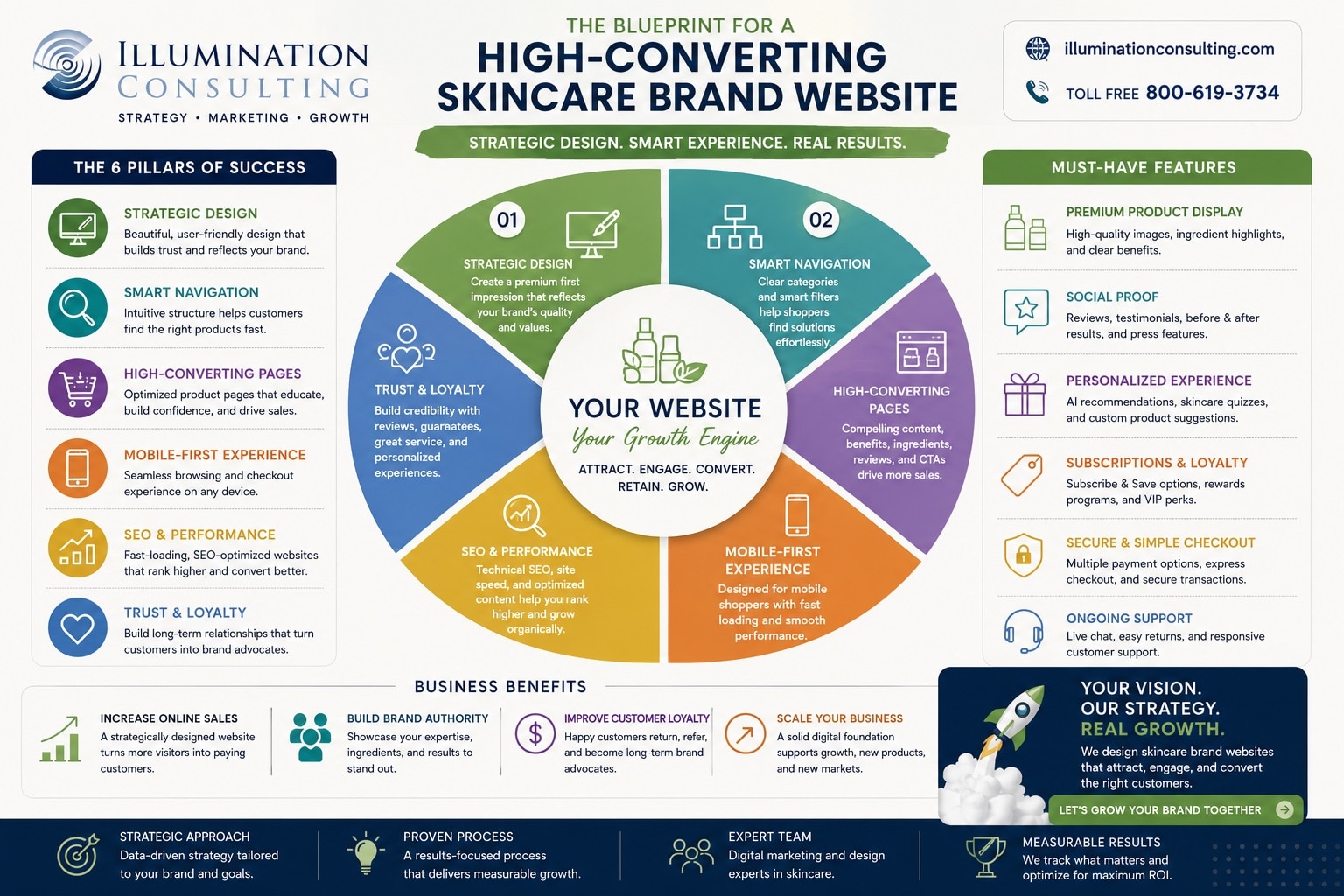
Successful skincare websites combine premium design with strategic eCommerce functionality.
Every feature should contribute toward one or more goals:
- Build trust
- Educate shoppers
- Increase sales
- Improve SEO
- Encourage repeat purchases
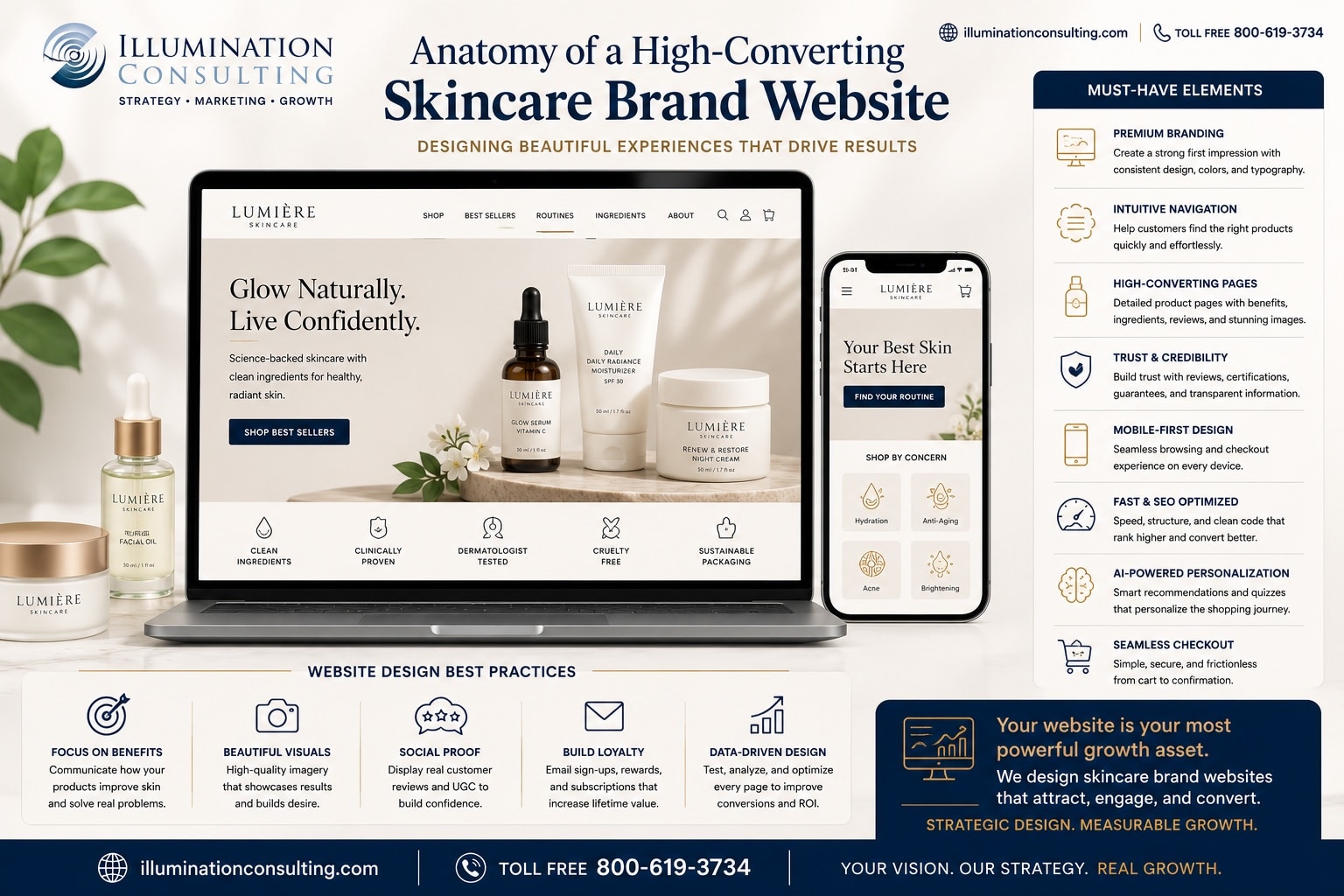
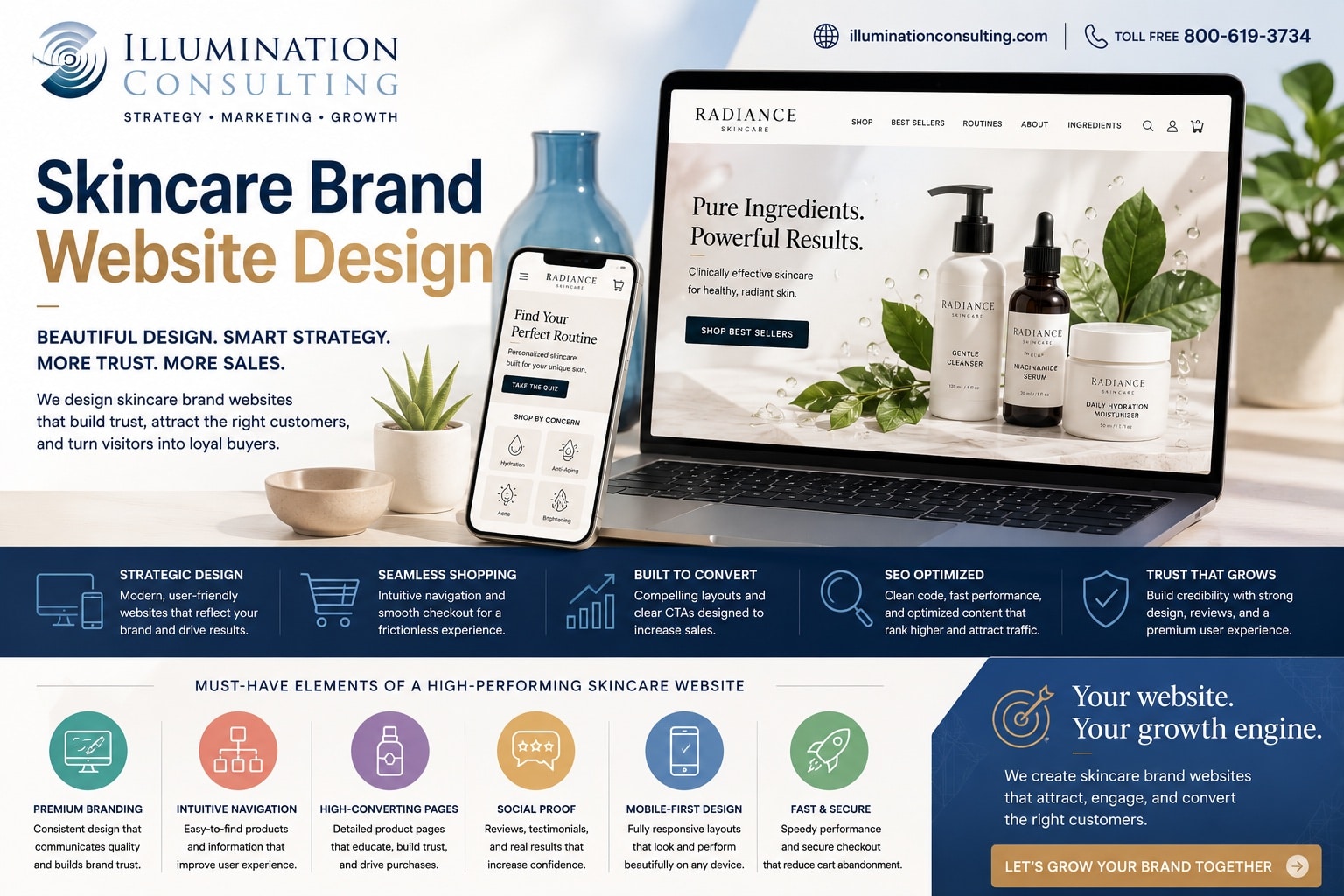
Premium Branding
Your website should immediately communicate the quality and positioning of your brand.
Strong branding includes:
- Professional logo placement
- Cohesive color palette
- Premium typography
- Luxury product photography
- Consistent visual identity
- High-quality graphics
Whether your brand is positioned as luxury, clinical, clean beauty, or natural skincare, your design should reinforce that identity throughout every page.
Clear Navigation
Visitors should find products quickly without feeling overwhelmed.
A well-structured navigation menu might include:
- Shop All Products
- Cleansers
- Serums
- Moisturizers
- Sunscreens
- Eye Care
- Skincare Sets
- Best Sellers
- New Arrivals
- Skin Concerns
- Ingredients
- Blog
- About Us
- Contact
Organizing products by both category and skin concern improves usability while helping customers discover relevant solutions.
Powerful Calls-to-Action
Every important page should encourage customers to take the next step.
Examples include:
- Shop Now
- Add to Cart
- Build Your Routine
- Find Your Perfect Skincare Routine
- Subscribe & Save
- Discover Best Sellers
- Shop the Collection
Strategically placed calls-to-action guide shoppers naturally through the buying process.
Build Trust Throughout the Website
Consumers purchasing skincare products often need reassurance before completing their order.
Important trust-building elements include:
- Verified customer reviews
- Before-and-after results
- Dermatologist recommendations
- Clinical testing
- Money-back guarantee
- Secure checkout badges
- Fast shipping information
- Return policy
- Ingredient transparency
Displaying these elements throughout the website helps reduce abandoned carts while increasing customer confidence.
Homepage Best Practices
Your homepage serves as the digital storefront of your skincare brand.
Within just a few seconds, visitors should understand:
- Who you are.
- What makes your products unique.
- Why they should trust your brand.
- What action to take next.
Everything above the fold should support these objectives.
Create a Compelling Hero Section
The hero section should include:
- High-quality lifestyle photography
- Strong brand message
- Brief value proposition
- Primary call-to-action
- Featured product or collection
Keep messaging concise while focusing on benefits rather than features alone.
Highlight Best-Selling Products
Many customers appreciate guidance when visiting a new brand for the first time.
Feature products such as:
- Best Sellers
- Staff Favorites
- Award-Winning Products
- New Arrivals
- Limited Edition Collections
- Complete Skincare Systems
Each featured product should link directly to a detailed product page.
Tell Your Brand Story
Consumers increasingly support brands whose values align with their own.
Share your story by highlighting:
- Brand mission
- Founder story
- Product philosophy
- Ingredient sourcing
- Sustainability commitments
- Manufacturing standards
Authentic storytelling creates emotional connections that strengthen brand loyalty.
Showcase Social Proof
Nothing builds confidence like seeing other customers achieve positive results.
Feature:
- Verified product reviews
- Customer testimonials
- User-generated content
- Before-and-after photography
- Influencer collaborations
- Awards
- Press mentions
These trust signals encourage first-time buyers to move forward with confidence.
Product Pages That Increase Sales
Product pages are among the most important pages on your website because they directly influence purchasing decisions.
Every product page should answer the questions customers ask before buying.
Include:
- Product overview
- Key benefits
- Ingredient list
- How to use
- Skin types
- Clinical results
- Frequently asked questions
- Customer reviews
- Product recommendations
- Subscription options
- Shipping information
- Return policy
Well-designed product pages improve conversion rates while supporting SEO by providing comprehensive, valuable content that search engines can understand and index effectively.
Optimizing the Shopping Experience
A beautiful website may attract visitors, but the shopping experience determines whether they complete a purchase. Every unnecessary click, confusing page, or complicated checkout process increases the likelihood that shoppers abandon their carts before placing an order.
The highest-converting skincare websites are designed to remove friction while making every step of the buying journey feel simple and intuitive.
Simplify Product Discovery
Customers should never struggle to find products that match their skincare needs.
Helpful navigation features include:
- Shop by skin concern
- Shop by ingredient
- Shop by product category
- Shop by collection
- Shop by routine
- Best Sellers
- New Arrivals
- Staff Picks
Offering multiple ways to browse helps shoppers quickly discover products that fit their goals.
Personalized Product Recommendations
Artificial intelligence has transformed online shopping by providing personalized recommendations based on customer behavior and preferences.
Examples include:
- Products frequently purchased together
- Complete skincare routines
- Recommended upgrades
- Complementary products
- Recently viewed items
- Personalized product suggestions
- Subscription recommendations
These features improve the shopping experience while increasing average order value.
Streamline the Checkout Process
A complicated checkout process is one of the leading causes of abandoned shopping carts.
Your checkout experience should emphasize:
- Guest checkout options
- Express payment methods
- Multiple payment choices
- Secure transactions
- Minimal form fields
- Clear shipping costs
- Order summaries
- Mobile-friendly checkout
Reducing checkout friction can significantly increase completed purchases.
Mobile-First Website Design
More than half of all skincare purchases now begin on a mobile device. Consumers browse products while commuting, relaxing at home, watching television, or scrolling through social media. If your website doesn’t perform flawlessly on smartphones and tablets, you’re likely losing valuable sales opportunities.
Google also uses mobile-first indexing, making mobile optimization essential for both search visibility and customer experience.
Responsive Website Design
Your website should automatically adapt to every screen size.
Customers should be able to:
- Browse collections
- Read product descriptions
- View ingredient lists
- Watch videos
- Read reviews
- Add products to cart
- Complete purchases
without frustration.
Mobile Shopping Experience
A mobile-friendly website should prioritize:
- Fast loading speeds
- Large product images
- Easy navigation
- Touch-friendly buttons
- Click-to-search functionality
- Mobile checkout
- Simplified menus
- Readable typography
Providing an exceptional mobile experience directly contributes to higher conversion rates.
Website Speed and Technical SEO
Website performance has a direct impact on customer satisfaction, search engine rankings, and online revenue.
Slow-loading websites frustrate shoppers, increase bounce rates, and reduce sales.
Improve Core Web Vitals
Google evaluates website quality using Core Web Vitals, including:
- Loading performance
- Responsiveness
- Visual stability
Improving these metrics benefits both SEO and the overall shopping experience.
Optimize Website Performance
Skincare websites often contain numerous high-resolution product images.
Improve performance by:
- Compressing images
- Using modern image formats
- Browser caching
- Content Delivery Networks (CDNs)
- Optimized hosting
- Lazy loading
- Clean website code
- Removing unnecessary scripts
These improvements create a faster website while maintaining premium visual quality.
SEO-Friendly Website Architecture
Website architecture plays a significant role in both user experience and search engine optimization.
A logical structure helps customers discover products while allowing search engines to understand your content more effectively.
Organize Product Categories
A well-organized navigation structure might include:
Shop
- Cleansers
- Toners
- Serums
- Moisturizers
- Eye Care
- Sunscreens
- Masks
- Treatments
- Gift Sets
Shop by Concern
- Acne
- Dry Skin
- Sensitive Skin
- Aging Skin
- Hyperpigmentation
- Rosacea
Learn
- Blog
- Ingredients
- Skincare Routines
- FAQs
About
- Our Story
- Sustainability
- Reviews
Contact
This structure supports both SEO and user navigation.
Optimize Internal Linking
Internal links help customers explore your catalog while strengthening SEO.
For example:
A Vitamin C Serum page might naturally link to:
- Vitamin C Cleanser
- Daily Moisturizer
- Sunscreen
- Complete Brightening Routine
- Blog articles about antioxidants
These connections increase page authority while encouraging additional purchases.
AI Features for Modern Skincare Brands
Artificial intelligence is transforming eCommerce by creating personalized shopping experiences that improve both customer satisfaction and revenue.
Leading skincare brands now incorporate AI-powered features such as:
- AI skincare quizzes
- Personalized routine builders
- Product recommendation engines
- Intelligent search
- Chat assistants
- Automated customer support
- Email personalization
- Predictive product recommendations
- Inventory forecasting
These tools improve customer engagement while helping brands increase average order value and repeat purchases.
Building Long-Term Customer Loyalty
Acquiring a new customer is only the beginning of the relationship.
The most successful skincare brands focus just as much on customer retention as they do on customer acquisition.
A thoughtfully designed website supports long-term loyalty by making it easy for customers to return, reorder, and continue engaging with your brand.
Effective retention strategies include:
- Loyalty rewards programs
- Subscribe-and-save options
- Personalized product recommendations
- Birthday offers
- VIP memberships
- Product replenishment reminders
- Exclusive product launches
- Educational email content
Customers who feel connected to your brand are significantly more likely to become repeat purchasers and recommend your products to others, increasing customer lifetime value while reducing overall acquisition costs.
Common Skincare Website Design Mistakes
Even well-established skincare brands often make website design mistakes that reduce conversions, increase shopping cart abandonment, and limit long-term growth. Identifying and correcting these issues can significantly improve customer experience while increasing online sales.
Generic Product Pages
Many skincare brands invest heavily in product development but provide only minimal information on their product pages.
Every product page should answer the questions customers ask before purchasing.
Avoid pages that only include:
- A short description
- One product image
- A price
- An Add to Cart button
Instead, provide comprehensive information including:
- Key benefits
- Active ingredients
- Full ingredient list
- How to use
- Skin types
- Clinical results
- Frequently asked questions
- Customer reviews
- Before-and-after photography
- Recommended companion products
The more informed customers feel, the more likely they are to complete a purchase.
Weak Brand Storytelling
Consumers increasingly purchase from brands they trust and connect with emotionally.
Don’t assume visitors already know who you are.
Share:
- Why your company was founded
- Your skincare philosophy
- Ingredient sourcing
- Product development process
- Sustainability initiatives
- Manufacturing standards
- Company values
A compelling brand story differentiates your company from countless competitors selling similar products.
Overcomplicated Navigation
Too many product categories or confusing menus overwhelm shoppers.
Navigation should remain simple, intuitive, and focused on helping customers quickly find solutions.
Organize products by:
- Category
- Skin concern
- Ingredient
- Collection
- Routine
Making discovery effortless improves both customer satisfaction and sales.
Slow Website Performance
High-resolution product photography is essential for skincare brands, but oversized images frequently slow websites.
Regular performance optimization should include:
- Image compression
- Modern image formats
- Browser caching
- Fast hosting
- Content Delivery Networks (CDNs)
- Script optimization
Fast websites improve user experience, search rankings, and conversion rates.
Poor Mobile Experience
Many brands still design websites primarily for desktop users.
Considering that mobile shopping continues to grow rapidly, every page should be optimized for smartphones first.
Common mobile issues include:
- Tiny buttons
- Difficult navigation
- Slow loading
- Long checkout forms
- Small product images
Improving mobile usability often delivers immediate increases in conversion rates.
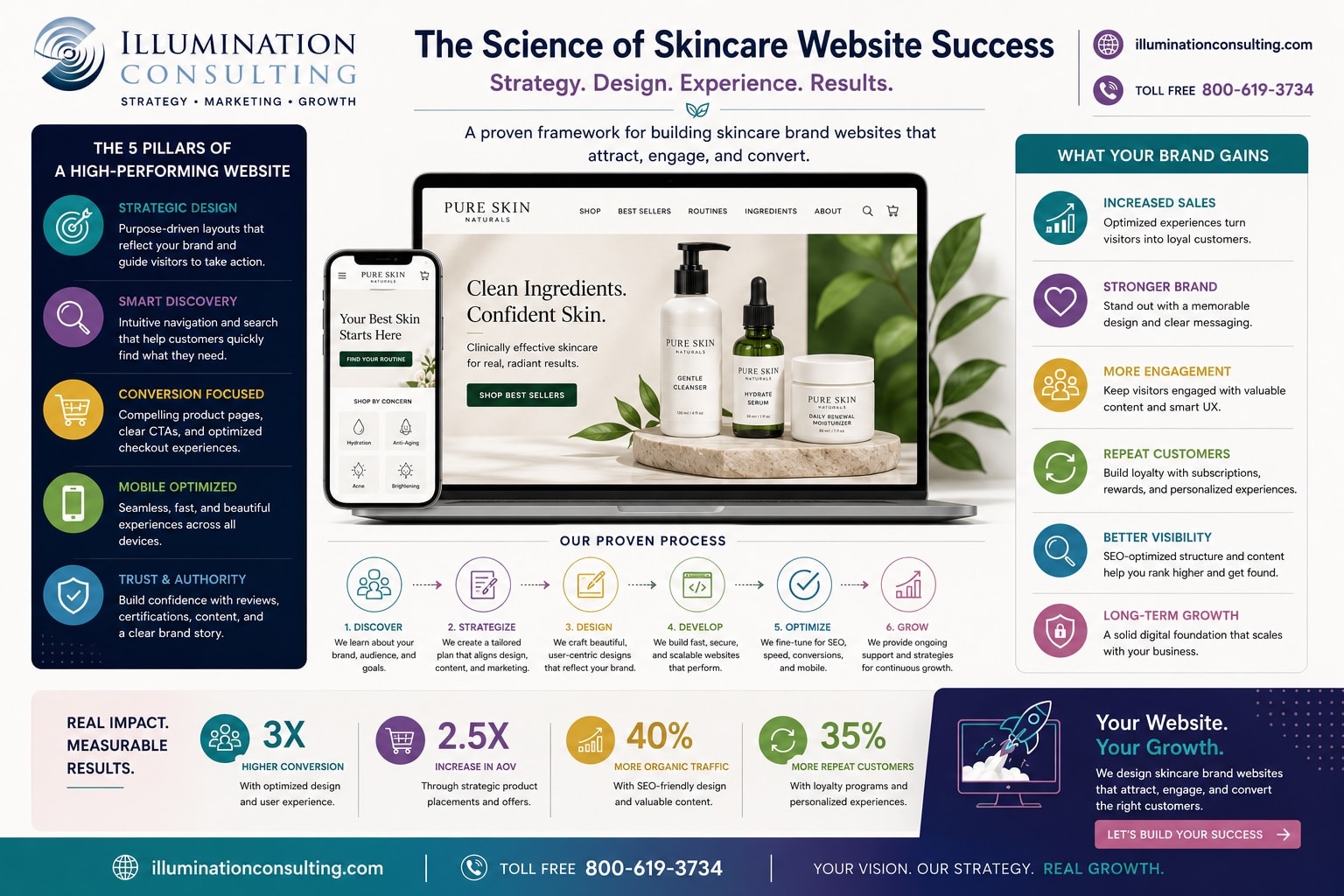
Measuring Website Success
Launching a beautiful website is only the beginning.
Successful skincare brands continuously analyze performance to understand how customers interact with their website and identify opportunities for improvement.
Rather than focusing only on traffic, evaluate metrics that directly contribute to revenue growth.
Important Performance Metrics
Monitor key indicators such as:
- Organic website traffic
- Conversion rate
- Average order value (AOV)
- Shopping cart abandonment rate
- Revenue per visitor
- Returning customer rate
- Customer lifetime value (LTV)
- Product page engagement
- Checkout completion rate
- Email subscriber growth
Together, these metrics provide a comprehensive picture of website performance and customer behavior.
Continuous Optimization
Your website should evolve alongside your business.
Regularly review:
- Product pages
- Homepage performance
- Navigation
- Calls-to-action
- Search rankings
- Customer feedback
- Checkout experience
- Product photography
- Internal linking
- Mobile usability
Small improvements made consistently often produce substantial long-term revenue growth.
Integrating Your Website with Your Digital Marketing Strategy
Your website should serve as the central hub for every marketing initiative.
Whether customers discover your brand through Google, Instagram, TikTok, Pinterest, YouTube, email marketing, influencers, or paid advertising, nearly every customer journey ultimately leads back to your website.
Each marketing channel should work together to create a seamless shopping experience.
Search Engine Optimization
SEO helps potential customers discover your products through organic search.
An optimized website supports SEO by providing:
- Comprehensive product pages
- Educational blog content
- Fast loading speeds
- Mobile responsiveness
- Internal linking
- Technical optimization
- Optimized collection pages
- Structured product data
These elements improve search visibility while attracting highly qualified shoppers.
Content Marketing
Educational content builds authority while helping customers make informed purchasing decisions.
Examples include:
- Ingredient guides
- Skincare routines
- Product comparisons
- Seasonal skincare advice
- Anti-aging education
- Acne treatment resources
- Sunscreen education
- Sensitive skin guides
Each article creates another opportunity to rank in search engines while introducing new customers to your products.
Social Media Marketing
Social media should consistently direct followers back to valuable resources on your website.
Examples include:
- Product launches
- Educational blog articles
- Customer success stories
- Before-and-after results
- Routine demonstrations
- Ingredient education
- Video tutorials
- Limited-time promotions
Driving traffic to your website increases both customer engagement and sales opportunities.
Email Marketing
Email remains one of the highest-performing marketing channels for skincare brands.
Your website should encourage visitors to join your email list through:
- Welcome discounts
- Free skincare guides
- Product launch notifications
- VIP memberships
- Loyalty rewards
- Early access offers
A growing email list creates an owned marketing channel that supports repeat purchases and long-term customer relationships.
Frequently Asked Questions
What platform is best for a skincare brand website?
Shopify is one of the most popular platforms due to its ease of use, scalability, security, and extensive app ecosystem. WooCommerce, BigCommerce, and Adobe Commerce can also be excellent options depending on your business requirements and growth goals.
Does website design affect SEO?
Yes. Google evaluates page speed, mobile responsiveness, website architecture, user experience, technical SEO, and content quality when determining search rankings. A professionally designed website provides the foundation for long-term organic growth.
Why are product pages so important?
Product pages directly influence purchasing decisions. Comprehensive pages with detailed descriptions, ingredient information, customer reviews, FAQs, high-quality images, and related product recommendations typically generate higher conversion rates.
How can AI improve a skincare website?
AI can personalize product recommendations, power skincare quizzes, automate customer support, optimize search functionality, improve email marketing, and deliver tailored shopping experiences that increase customer satisfaction and revenue.
How often should a skincare website be updated?
Your website should be continuously optimized. Product pages, blog content, SEO, photography, promotions, and technical performance should be reviewed regularly, while a full redesign is typically recommended every three to five years.
Designing a High-Converting Skincare Website for Growth
Your website is much more than an online storefront—it’s the foundation of your brand, your most valuable sales representative, and one of your strongest long-term marketing assets. Every page should educate shoppers, communicate your brand values, build trust, and guide visitors naturally toward making a purchase.
A successful skincare website combines premium design, intuitive navigation, search engine optimization, mobile responsiveness, persuasive product pages, AI-powered personalization, and a seamless shopping experience. When these elements work together, your website becomes a scalable growth engine that consistently attracts new customers, increases average order value, and builds long-term brand loyalty.
At Illumination Consulting, we design high-performing skincare brand websites that combine premium branding, eCommerce strategy, SEO, AI-powered marketing, and conversion optimization to help skincare companies grow online. Whether you’re launching a new skincare startup, redesigning an existing eCommerce store, or expanding into new markets, our team develops customized digital solutions that generate measurable results.
Get Your Growth Strategy today or Speak with a Growth Specialist to discover how a professionally designed skincare website can elevate your brand, increase online sales, and position your business for sustainable long-term growth.