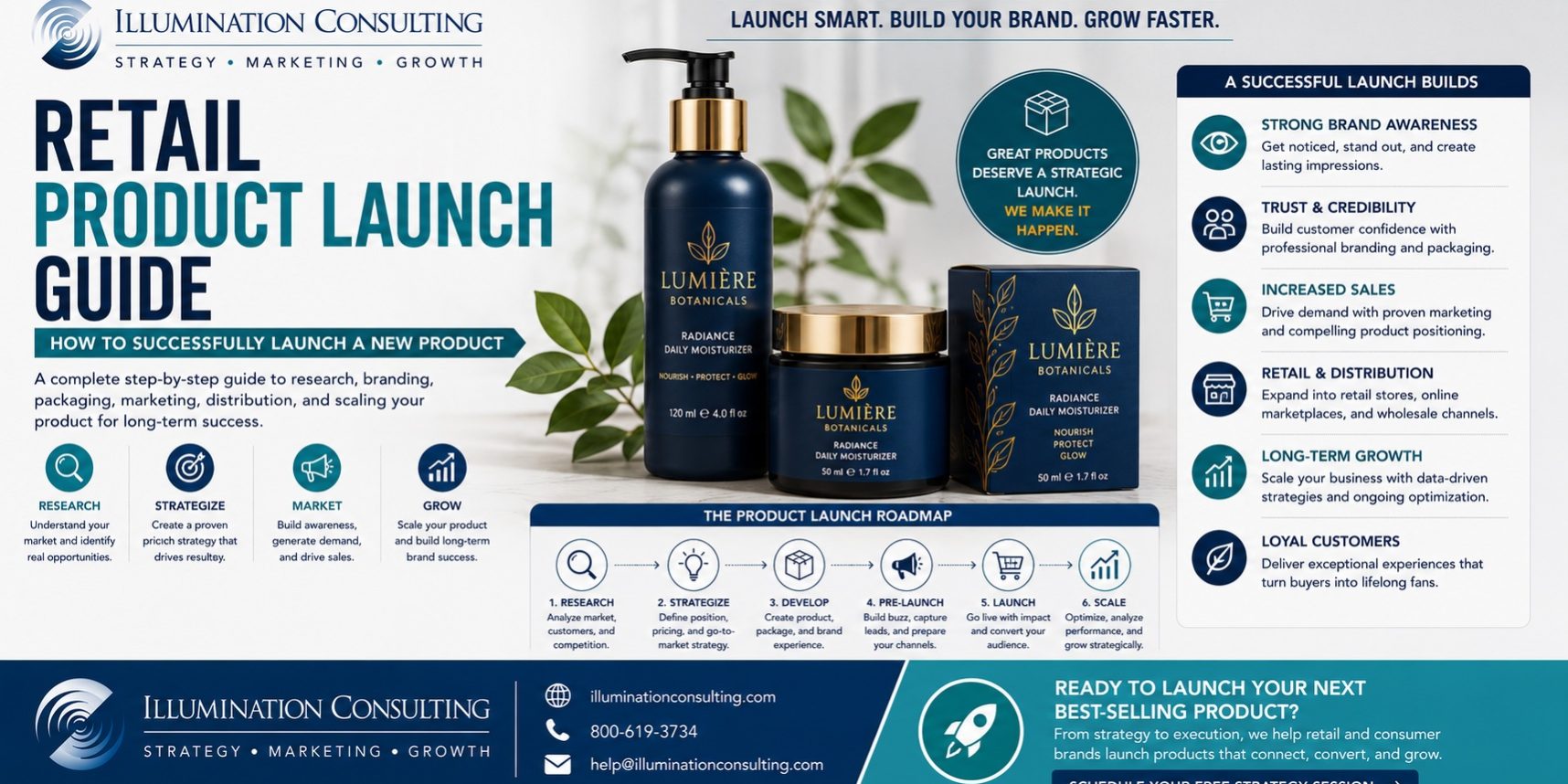
Bringing a new product to market is one of the most exciting milestones for any business. Whether you’re launching a skincare line, consumer packaged good, wellness product, or retail brand, a successful product launch requires far more than simply manufacturing inventory and hoping customers discover it.
Many promising products fail—not because they lack quality—but because they enter the market without a clear strategy. Poor positioning, ineffective branding, limited visibility, weak marketing, and inadequate planning can all prevent an otherwise outstanding product from gaining traction.
A successful retail product launch combines research, branding, packaging, ecommerce, marketing, distribution, and customer engagement into one coordinated strategy. Every stage should support the next, creating momentum that drives awareness, generates sales, and builds long-term customer loyalty.
This guide explores the essential steps involved in launching a retail product successfully while avoiding common mistakes that often limit growth.
Why Product Launches Matter
The first few weeks after introducing a new product often determine its long-term trajectory.
A well-executed launch creates excitement, generates early sales, attracts customer reviews, and provides valuable market feedback that helps businesses improve future marketing efforts.
More importantly, a successful launch establishes credibility and gives retailers, distributors, and consumers confidence in your brand.
An effective launch can help businesses:
- Build immediate brand awareness
- Generate early revenue
- Validate product demand
- Increase customer confidence
- Collect valuable customer feedback
- Create marketing momentum
- Support retail expansion
- Strengthen long-term brand recognition
Rather than viewing product launches as a single event, businesses should approach them as the beginning of an ongoing growth strategy.
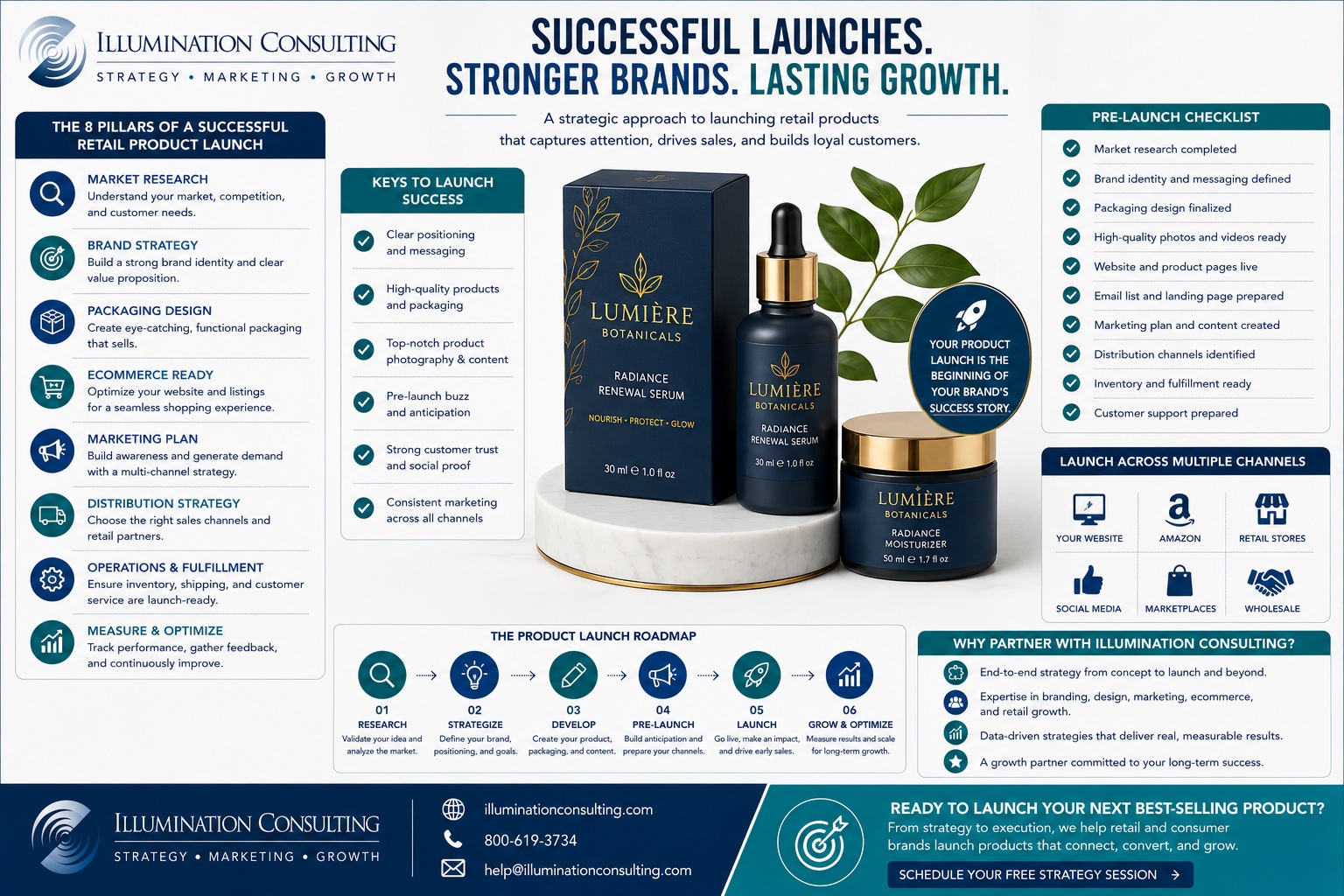
Start with Market Research
Every successful product launch begins with understanding the market.
Before investing in manufacturing, packaging, or advertising, evaluate whether genuine demand exists and identify opportunities to differentiate your product from competitors.
Market research should examine:
- Customer demand
- Target demographics
- Buying behavior
- Competitor products
- Pricing trends
- Distribution channels
- Market size
- Industry growth
- Consumer preferences
Thorough research reduces uncertainty while helping businesses make better decisions throughout the launch process.
Define Your Ideal Customer
Trying to sell to everyone often results in marketing that resonates with no one.
Instead, clearly define your ideal customer by considering:
- Age
- Lifestyle
- Income
- Shopping habits
- Interests
- Purchasing motivations
- Pain points
- Preferred buying channels
The more precisely you understand your audience, the easier it becomes to develop messaging that connects with potential buyers.
Build a Strong Brand Before You Launch
Customers rarely purchase products based solely on features.
They buy brands they trust.
Before introducing your product, invest in developing a professional brand identity that communicates quality, credibility, and consistency.
A strong brand should include:
- Professional logo
- Brand positioning
- Consistent color palette
- Typography
- Brand messaging
- Product packaging
- Photography style
- Website design
- Social media presence
Launching with a cohesive brand creates a stronger first impression while helping customers remember your products long after their initial purchase.
Develop Your Unique Value Proposition
One of the most important questions every launch must answer is:
Why should customers choose your product instead of the alternatives?
Your value proposition should clearly communicate what makes your product different.
This may include:
- Superior quality
- Innovative features
- Better ingredients
- Sustainable materials
- Luxury positioning
- Exceptional performance
- Better customer experience
- Competitive pricing
Every marketing message should reinforce this value proposition consistently across every customer touchpoint.
Design Packaging That Sells
Packaging is often the first physical interaction customers have with your product.
Professional packaging not only protects the product but also communicates quality, reinforces your brand, and influences purchasing decisions.
Effective packaging should:
- Capture attention
- Reflect your brand identity
- Communicate product benefits
- Include clear product information
- Photograph well for ecommerce
- Perform well on retail shelves
- Create a memorable unboxing experience
Packaging should work equally well whether customers discover your products in retail stores, on your website, or through marketplaces such as Amazon.
Prepare Your Ecommerce Presence
Before your launch begins, customers should have an easy way to learn about your brand and purchase your products.
Your ecommerce website often becomes the central hub for product information, customer education, and online sales.
An effective ecommerce website should include:
- Professional product photography
- Detailed product descriptions
- Fast page loading
- Mobile-friendly design
- Secure checkout
- Customer reviews
- Frequently asked questions
- Contact information
- Clear calls to action
A well-designed website builds confidence while supporting every marketing campaign that follows.
Develop a Comprehensive Marketing Strategy
A successful product launch depends on more than simply introducing a new product. Customers need multiple opportunities to discover your brand before they decide to make a purchase.
Your marketing efforts should begin well before launch day and continue long after your product becomes available.
An integrated marketing strategy creates awareness, generates anticipation, and encourages early sales while building momentum for long-term growth.
A comprehensive launch strategy may include:
- Search engine optimization (SEO)
- Content marketing
- Social media marketing
- Email marketing
- Video marketing
- Paid advertising
- Influencer partnerships
- Public relations
- Product demonstrations
- Referral campaigns
Using multiple channels together allows your messaging to reach customers throughout every stage of the buying journey.
Create Pre-Launch Excitement
Generating anticipation before your official launch can significantly increase early sales.
Rather than announcing your product only when it becomes available, begin introducing your brand weeks in advance through educational content, behind-the-scenes updates, and product previews.
Popular pre-launch tactics include:
- Countdown campaigns
- Email waitlists
- Product teasers
- Sneak peeks
- Behind-the-scenes videos
- Early access promotions
- Social media countdowns
- Landing pages with email signup forms
Building anticipation helps create demand before inventory is officially released.
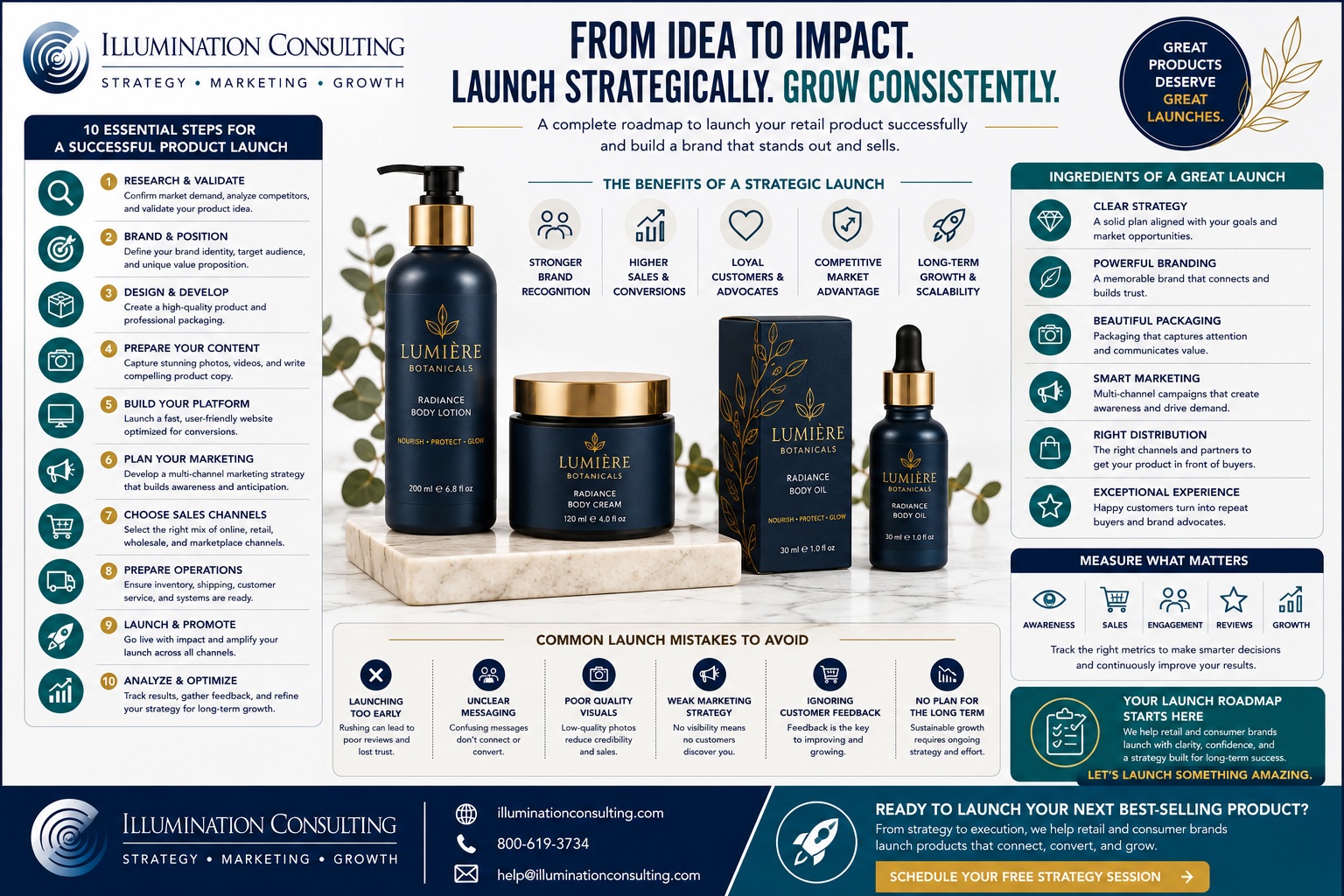
Prepare High-Quality Product Content
Your product content should answer every question customers might have before making a purchase.
Professional content improves customer confidence while reducing hesitation during the buying process.
Every product should include:
- Professional photography
- Lifestyle images
- Product videos
- Detailed descriptions
- Feature highlights
- Benefit-focused messaging
- Specifications
- Frequently asked questions
High-quality content supports ecommerce websites, Amazon listings, retail sales materials, and digital advertising.
Invest in Professional Product Photography
Product photography often determines whether customers continue exploring your product or move on to a competitor.
Strong photography should include:
- Clean product images
- Multiple viewing angles
- Lifestyle photography
- Close-up detail shots
- Scale comparisons
- Packaging photography
- Infographic-style feature graphics
Consistent photography strengthens your brand while improving conversions across every sales channel.
Choose the Right Sales Channels
Modern retail businesses rarely depend on a single sales channel.
Instead, successful product launches typically combine multiple distribution methods that work together to maximize visibility.
Depending on your business goals, consider launching through:
- Your ecommerce website
- Amazon
- Retail stores
- Specialty retailers
- Wholesale distributors
- Boutique shops
- Online marketplaces
- Social commerce
- Pop-up events
- Trade shows
Diversifying your sales channels creates additional opportunities for customers to discover and purchase your products.
Develop a Retail Distribution Strategy
For businesses pursuing retail placement, preparation is essential.
Retail buyers evaluate much more than the quality of a product. They also consider branding, packaging, pricing, merchandising potential, and overall market demand.
Before approaching retailers, prepare:
- Sales sheets
- Product catalogs
- Wholesale pricing
- Suggested retail pricing (MSRP)
- Product photography
- Marketing materials
- Brand story
- Sales data, if available
Professional presentation significantly improves your credibility with retail buyers.
Prepare Your Inventory and Operations
Marketing campaigns are only effective if customers can actually purchase your product.
Launching without sufficient inventory or reliable fulfillment can damage customer trust while creating unnecessary operational challenges.
Before launch, confirm that your business is prepared to manage:
- Inventory levels
- Manufacturing timelines
- Order fulfillment
- Shipping processes
- Customer service
- Returns
- Payment processing
- Warehouse operations
Operational readiness is just as important as marketing readiness.
Build Customer Trust from Day One
Customers purchasing from a new brand often need additional reassurance before making a buying decision.
Building trust should be incorporated into every aspect of your launch strategy.
Focus on providing:
- Professional branding
- Transparent product information
- Customer testimonials
- Product guarantees
- Secure checkout
- Responsive customer service
- Clear return policies
- Educational content
Reducing uncertainty helps increase conversion rates while encouraging repeat purchases.
Use Customer Feedback to Improve
Your launch is only the beginning.
Early customer feedback provides valuable insights that can improve your product, packaging, messaging, and marketing campaigns.
Pay close attention to:
- Product reviews
- Customer questions
- Return reasons
- Support requests
- Social media comments
- Survey responses
- Retailer feedback
Businesses that continually refine their products based on customer insights are often better positioned for long-term success than those that remain static.
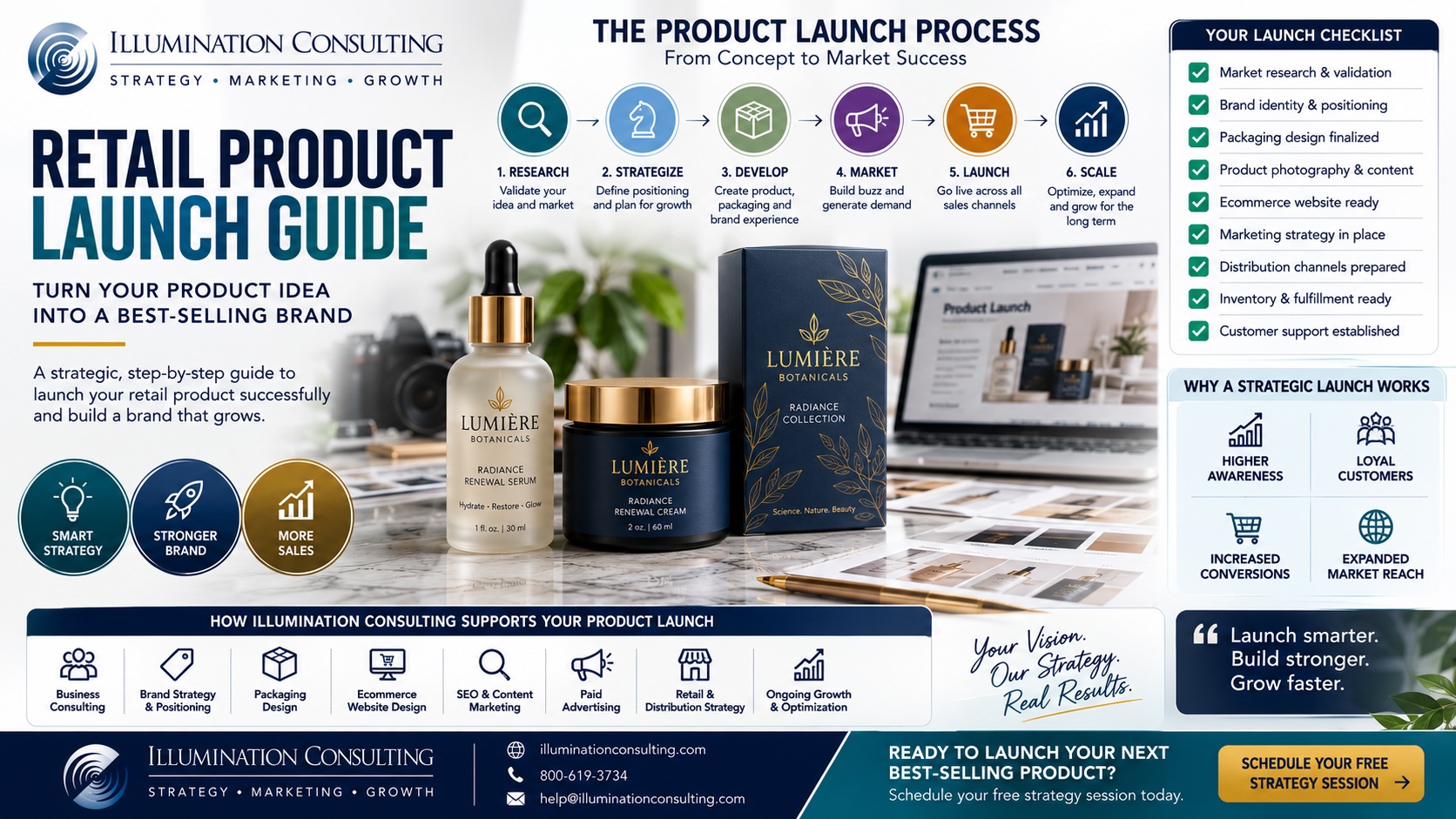
Common Product Launch Mistakes to Avoid
Even exceptional products can struggle if the launch strategy is poorly executed. Many businesses focus heavily on product development but invest too little time preparing for the market.
Recognizing these common mistakes can help improve your chances of a successful launch while protecting your investment.
Launching Too Early
Rushing to market before your product, branding, or operations are fully prepared can create negative first impressions that are difficult to overcome.
Before launching, ensure that your:
- Product has been thoroughly tested
- Packaging is production-ready
- Website is complete
- Inventory is available
- Marketing materials are finished
- Customer support is prepared
A delayed launch is often preferable to one that disappoints customers.
Ignoring Customer Feedback
Your first customers provide some of the most valuable insights your business will ever receive.
Listen carefully to their feedback regarding:
- Product quality
- Packaging
- Pricing
- User experience
- Product instructions
- Shipping
- Customer service
Small improvements made early can significantly strengthen your product and marketing over time.
Focusing Only on the Launch Day
Many companies treat launch day as the finish line rather than the starting point.
In reality, sustained marketing after launch is what creates lasting growth.
Continue investing in:
- Content marketing
- Search engine optimization
- Social media
- Email campaigns
- Paid advertising
- Public relations
- Customer engagement
- Product education
The most successful products continue gaining visibility long after their official launch.
Measuring Product Launch Success
Every product launch should be evaluated using meaningful business metrics rather than assumptions.
Tracking performance allows businesses to identify strengths, uncover opportunities, and improve future launches.
Important metrics include:
- Sales revenue
- Conversion rate
- Website traffic
- Average order value
- Customer acquisition cost
- Return on advertising spend (ROAS)
- Email subscriber growth
- Customer reviews
- Social media engagement
- Repeat purchase rate
- Inventory turnover
- Customer lifetime value
Regularly reviewing these metrics provides valuable insights that support long-term business growth.
Scaling After a Successful Launch
Once your product gains traction, your focus should shift from launching to scaling.
Growth requires continuously strengthening your operations, expanding your marketing efforts, and creating additional opportunities for customers to engage with your brand.
Successful retail businesses often scale by:
- Expanding product lines
- Introducing complementary products
- Entering new retail markets
- Launching internationally
- Increasing advertising investment
- Growing wholesale relationships
- Improving customer retention
- Strengthening ecommerce operations
- Optimizing Amazon listings
- Developing loyalty programs
Scaling should be intentional and supported by reliable systems that allow your business to grow without compromising quality or customer experience.
Product Launch Trends Shaping the Future
Consumer expectations and retail technologies continue to evolve, changing how businesses introduce new products to the market.
Brands that embrace innovation while maintaining a customer-first approach are better positioned to build momentum and sustain long-term growth.
Artificial Intelligence
Artificial intelligence is transforming nearly every aspect of product launches.
Businesses now use AI to:
- Analyze customer behavior
- Forecast product demand
- Generate marketing content
- Personalize email campaigns
- Optimize advertising
- Improve customer support
- Monitor performance metrics
- Identify market opportunities
When combined with strategic planning, AI helps businesses launch products more efficiently while making better data-driven decisions.
Creator and Influencer Partnerships
Consumers increasingly discover products through trusted creators rather than traditional advertising alone.
Collaborating with influencers, industry experts, and content creators can help brands:
- Build credibility
- Reach targeted audiences
- Generate authentic product demonstrations
- Increase brand awareness
- Drive online conversations
- Encourage social proof
Selecting creators who genuinely align with your brand is often more effective than simply choosing those with the largest audiences.
Omnichannel Launch Strategies
Today’s customers move seamlessly between online and offline shopping experiences.
Successful launches create consistent messaging across every channel, including:
- Ecommerce websites
- Retail stores
- Amazon
- Social media
- Email marketing
- Search engines
- Online marketplaces
- Video platforms
Providing a unified customer experience strengthens brand recognition while increasing purchasing opportunities.
Frequently Asked Questions
How long should I prepare before launching a retail product?
Preparation timelines vary depending on the complexity of the product, but most successful launches begin planning several months in advance. This allows sufficient time for market research, branding, packaging, website development, marketing preparation, inventory planning, and operational testing.
Should I launch online before approaching retailers?
In many cases, yes. Launching through your ecommerce website or marketplaces like Amazon allows you to gather customer feedback, generate sales data, and refine your marketing before expanding into wholesale and retail distribution.
What is the most important part of a product launch?
A successful launch depends on several interconnected elements, including market research, branding, product positioning, packaging, marketing, ecommerce, and customer experience. Rather than relying on one tactic, businesses should develop an integrated strategy that supports every stage of the customer journey.
How do I know if my product launch was successful?
Success should be measured using key performance indicators such as sales revenue, conversion rate, customer reviews, repeat purchases, website traffic, advertising performance, and customer acquisition costs. Monitoring these metrics helps identify opportunities for continuous improvement.
Can small businesses successfully launch retail products?
Absolutely. Many successful consumer brands began with a single product and a focused launch strategy. By combining professional branding, thoughtful marketing, high-quality products, and a clear understanding of their target audience, small businesses can compete effectively with much larger companies.
Launch Your Next Product with Confidence
Launching a new retail product requires much more than introducing inventory to the marketplace. It demands careful planning, strategic branding, compelling packaging, professional marketing, operational readiness, and a long-term commitment to continuous improvement.
At Illumination Consulting, we help startups, consumer product companies, skincare brands, and retail businesses successfully bring new products to market. From business consulting and brand strategy to packaging design, ecommerce website development, SEO, digital marketing, content creation, and retail growth planning, we provide the expertise needed to launch products with confidence and build brands that thrive.
Whether you’re preparing to introduce your first product or expanding an established product line, our team can help you create a launch strategy that generates awareness, drives sales, and supports sustainable long-term growth.