The skincare industry has become increasingly competitive as new brands enter the market and established companies continue expanding their digital presence. Consequently, customer acquisition costs have risen across many advertising platforms. While paid advertising can generate immediate visibility, many skincare brands are searching for sustainable ways to attract customers and increase sales without relying entirely on advertising budgets.
This is where search engine optimization becomes one of the most valuable growth strategies available. SEO helps skincare brands attract highly qualified visitors who are actively searching for solutions, products, ingredients, and skincare advice. Furthermore, organic search traffic often produces stronger conversion rates because consumers are already interested in solving a specific problem.
Many skincare companies focus heavily on social media and paid advertising while overlooking SEO. However, some of the fastest-growing skincare brands generate a significant portion of their revenue through organic search. As a result, they create a predictable source of traffic that continues producing results month after month.
Whether you operate a skincare startup, an established skincare company, a medical skincare brand, or a private-label skincare business, implementing a strategic SEO plan can increase visibility, strengthen authority, and support long-term revenue growth.
Why SEO Matters for Skincare Brands
Consumers rarely purchase skincare products without conducting research first. In most cases, buyers spend time learning about ingredients, comparing products, reading reviews, and evaluating potential solutions.
Common skincare searches include:
- Best skincare products for acne
- How to reduce wrinkles
- Vitamin C serum benefits
- How to treat hyperpigmentation
- Best moisturizer for dry skin
- Skincare routine for sensitive skin
- Retinol versus peptide products
- Anti-aging skincare recommendations
These searches represent opportunities for skincare brands to attract potential customers before purchasing decisions are made.
Additionally, organic search traffic often produces higher-quality visitors because users are actively looking for information or solutions. Consequently, SEO can generate both awareness and sales simultaneously.
Understand Search Intent Before Creating Content
One of the most common SEO mistakes skincare brands make is creating content without understanding search intent.
Search intent refers to the reason behind a user’s search.
Generally, skincare searches fall into four categories:
- Informational searches
- Commercial research searches
- Product comparison searches
- Purchase-focused searches
For example, someone searching “benefits of hyaluronic acid” is seeking information. Meanwhile, someone searching “best hyaluronic acid serum” is much closer to making a purchase.
Therefore, skincare brands should create content that addresses every stage of the buying journey.
When content aligns with search intent, rankings and conversions often improve significantly.
Build Keyword Clusters Instead of Individual Articles
Many skincare brands publish random blog posts that lack a cohesive strategy. As a result, search engines struggle to understand the brand’s expertise.
Instead, skincare companies should build topical authority through keyword clusters.
For example, an acne-focused skincare brand could create content around:
- Causes of acne
- Types of acne
- Acne treatment options
- Best ingredients for acne
- Acne skincare routines
- Acne prevention strategies
- Product recommendations
Together, these articles create a comprehensive resource hub.
Furthermore, search engines reward websites that demonstrate expertise across an entire topic. Consequently, topical authority can improve rankings across multiple keywords.
Optimize Product Pages for Search Engines
Many skincare brands focus exclusively on blog content while neglecting product page SEO.
However, product pages often represent the most valuable pages on the website.
Strong skincare product pages should include:
- Keyword-rich product titles
- Detailed product descriptions
- Ingredient information
- Usage instructions
- Benefits and outcomes
- Frequently asked questions
- Customer reviews
- Internal links
Additionally, product pages should address common customer concerns and objections.
When product pages provide comprehensive information, search engines can better understand the content while customers gain greater confidence.
As a result, rankings and conversion rates often improve.
Create Educational Content That Builds Trust
Consumers want to understand skincare before purchasing products. Therefore, educational content plays a critical role in SEO success.
High-performing skincare content often includes:
- Ingredient guides
- Product comparisons
- Skincare routines
- Seasonal skincare advice
- Expert recommendations
- Skin condition education
- Treatment explanations
- Frequently asked questions
Educational content helps attract visitors who may not be ready to purchase immediately.
However, it also creates opportunities to build trust and guide visitors toward products over time.
Consequently, educational content becomes a valuable long-term asset.
Use Internal Linking Strategically
Internal linking is frequently overlooked by skincare brands.
However, strong internal linking helps search engines understand website structure while guiding visitors toward important pages.
Effective internal linking should connect:
- Blog articles
- Product pages
- Category pages
- Educational resources
- Service pages
For example, an article about retinol benefits should link naturally to retinol products and related educational content.
As a result, visitors stay engaged longer while search engines gain additional context about the website.
Optimize Images for SEO
Skincare websites often rely heavily on visual content.
While high-quality images improve user experience, they can also support SEO efforts.
Image optimization should include:
- Descriptive file names
- Alt text descriptions
- Proper image sizing
- Fast-loading formats
- Relevant keywords where appropriate
Furthermore, optimized images can appear in image search results.
Consequently, image SEO provides an additional source of traffic and visibility.
Improve Website Speed and User Experience
Search engines prioritize websites that provide positive user experiences.
Unfortunately, many skincare websites suffer from performance issues caused by large images, excessive scripts, and poor mobile optimization.
Important technical SEO factors include:
- Fast loading speeds
- Mobile responsiveness
- Secure website connections
- Easy navigation
- Clean site architecture
- Optimized code
When websites load quickly and function smoothly, users engage more effectively.
As a result, bounce rates decrease and conversions often improve.
Build Authority Through Backlinks
Backlinks remain one of the strongest ranking factors in SEO.
A backlink occurs when another website links to your content.
Quality backlink opportunities for skincare brands include:
- Beauty publications
- Industry blogs
- Skincare experts
- Dermatology websites
- Med spa websites
- Product reviews
- Influencer collaborations
Additionally, creating valuable educational content naturally increases the likelihood of earning backlinks.
As authority grows, search rankings often improve across multiple pages.
Leverage User-Generated Content
User-generated content can support both SEO and conversion optimization.
Examples include:
- Customer reviews
- Product testimonials
- Before-and-after photos
- Customer videos
- Social media mentions
Search engines value fresh content, while consumers trust authentic customer experiences.
Therefore, user-generated content creates benefits for both visibility and sales.
Furthermore, customer-generated content often contains natural keyword variations that support search performance.
Use Local SEO for Medical and Professional Skincare Brands
Many skincare companies sell nationally. However, medical skincare brands often serve local markets as well.
Local SEO opportunities include:
- Google Business Profile optimization
- Local landing pages
- Location-specific content
- Review generation
- Local citations
- Community partnerships
For dermatologists, plastic surgeons, and med spas with skincare lines, local SEO can generate highly qualified traffic.
Consequently, local visibility becomes an important component of a broader SEO strategy.
Measure SEO Performance Consistently
SEO success requires ongoing measurement and optimization.
Important metrics include:
- Organic traffic
- Keyword rankings
- Conversion rates
- Revenue from organic search
- Backlink growth
- Time on page
- Bounce rate
- Customer acquisition cost
Additionally, regular analysis helps identify new opportunities and areas for improvement.
When performance data guides decision-making, SEO campaigns become significantly more effective.
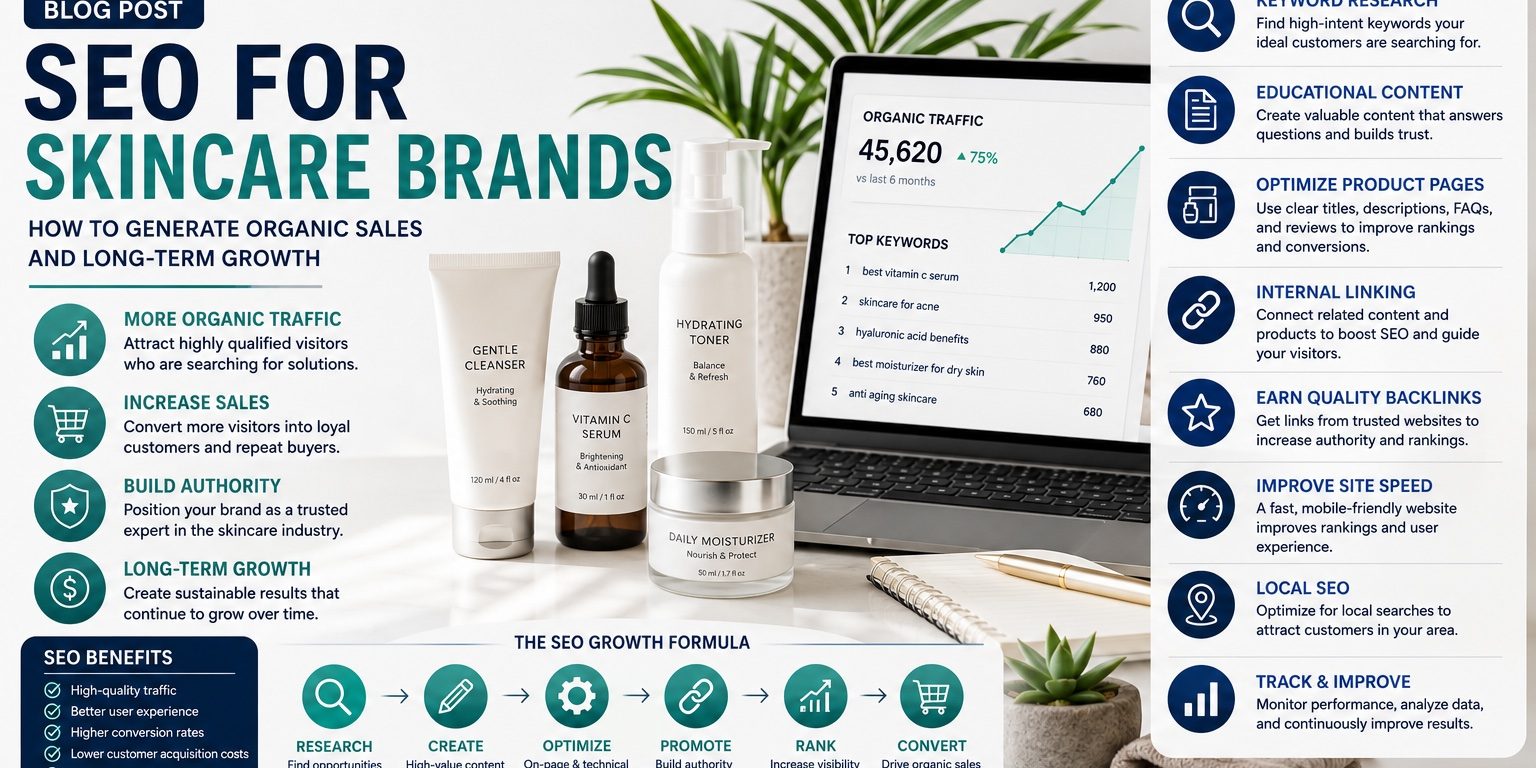
Build an SEO System for Sustainable Growth
SEO should not be treated as a one-time project. Instead, it should function as an ongoing business system.
Successful skincare SEO programs typically include:
- Keyword research
- Content creation
- Technical optimization
- Product page optimization
- Link building
- Performance analysis
- Continuous improvements
When these elements work together, organic visibility grows steadily over time.
As a result, skincare brands reduce dependence on advertising while increasing profitability.
Long-Term Benefits of SEO for Skincare Brands
SEO for skincare brands creates advantages that extend far beyond search rankings. Strong organic visibility increases brand awareness, improves credibility, and generates qualified traffic throughout the customer journey.
Furthermore, educational content continues producing value long after publication. As authority grows, rankings improve and customer acquisition becomes more efficient.
Unlike paid advertising, which stops generating traffic when spending ends, SEO assets continue working for the business. Consequently, skincare brands that invest in SEO often create a sustainable competitive advantage.
Over time, strong SEO programs help brands attract more customers, increase sales, and strengthen profitability.
Key Takeaways
Key takeaways include:
- SEO attracts highly qualified skincare consumers
- Search intent should guide content creation
- Keyword clusters improve topical authority
- Product pages require SEO optimization
- Educational content builds trust and rankings
- Internal linking supports visibility
- Technical SEO improves performance
- Backlinks strengthen authority
- User-generated content supports SEO
- SEO creates long-term traffic and sales growth
These strategies help skincare brands generate sustainable organic growth and reduce dependence on paid advertising.
Q&A
| Question | Answer |
|---|---|
| Why is SEO important for skincare brands? | SEO helps attract consumers actively searching for skincare products, ingredients, and solutions. |
| How long does SEO take to produce results? | Most skincare brands begin seeing meaningful improvements within several months, although results vary by competition and effort. |
| What content performs best for skincare SEO? | Ingredient guides, skincare routines, product comparisons, and educational articles often perform well. |
| Can SEO increase skincare product sales? | Yes. SEO attracts qualified visitors who are already researching skincare solutions and products. |
| Is SEO better than paid advertising? | Both can be valuable. However, SEO often provides more sustainable long-term results and lower acquisition costs over time. |
How Illumination Consulting Helps Skincare Brands Grow
Illumination Consulting helps skincare brands increase visibility, attract qualified customers, and generate sales through SEO, website optimization, content marketing, e-commerce growth strategies, and digital marketing solutions designed to support long-term profitability and brand authority.