The skincare industry continues to experience strong growth as consumers invest more heavily in products that improve skin health, reduce signs of aging, and address specific skincare concerns. At the same time, competition continues to intensify as new brands enter the market and established companies expand their product offerings. Consequently, skincare companies must develop effective growth strategies that extend beyond simply launching new products.
Many brands generate initial sales but struggle to maintain momentum. Others achieve moderate success yet find it difficult to scale profitably. Therefore, implementing proven skincare sales growth strategies for 2026 has become increasingly important for brands seeking sustainable success. The companies that thrive over the next several years will be those that combine strong branding, effective marketing systems, customer retention programs, and operational excellence.
Successful growth requires more than increasing website traffic. Instead, skincare companies must optimize every stage of the customer journey. Furthermore, brands must focus on attracting qualified prospects, converting visitors into customers, and turning customers into long-term advocates. When these elements work together, revenue growth becomes more predictable and sustainable.
Whether you operate a skincare startup, an established beauty company, a med spa product line, or a dermatologist-developed skincare brand, the following skincare sales growth strategies for 2026 can help improve visibility, increase conversions, and support long-term profitability.
Build a Strong Brand Position
One of the most important skincare sales growth strategies for 2026 involves creating a clear and compelling brand position.
Consumers are overwhelmed with choices. Therefore, brands must communicate exactly why they deserve attention.
A strong brand position should explain:
- Who the brand serves
- What skin concerns the products address
- What makes the products different
- Why customers should trust the company
- What results consumers can expect
Additionally, branding should remain consistent across websites, product packaging, social media, and marketing campaigns.
When consumers understand a brand quickly, purchasing decisions become easier.
As a result, conversion rates often improve while customer acquisition costs decrease.
Focus on Solving Customer Problems
Many skincare companies spend too much time discussing products and not enough time discussing outcomes.
Consumers purchase solutions rather than ingredients.
Common skincare concerns include:
- Fine lines and wrinkles
- Acne
- Hyperpigmentation
- Dry skin
- Sensitive skin
- Uneven texture
- Sun damage
- Skin aging
Therefore, marketing should focus on how products help customers achieve desired results.
Furthermore, educational content should demonstrate expertise and provide practical guidance.
When brands focus on solving problems, customers are more likely to engage and purchase.
Improve Website Conversion Rates
Traffic alone does not generate revenue.
Consequently, skincare brands should prioritize conversion optimization as part of their skincare sales growth strategies for 2026.
Important conversion factors include:
- Fast page loading speeds
- Mobile-friendly design
- Clear navigation
- Product education
- Strong calls to action
- Customer reviews
- Before-and-after results
- Trust signals
Additionally, skincare shoppers often have questions before making purchasing decisions.
Therefore, websites should provide detailed information that reduces uncertainty and increases confidence.
Even small improvements in conversion rates can significantly increase revenue.
Invest in Search Engine Optimization
SEO remains one of the most valuable long-term growth channels available to skincare brands.
Unlike paid advertising, SEO continues generating traffic long after content is published.
Important SEO opportunities include:
- Ingredient guides
- Product comparison articles
- Skincare routine content
- Educational blog posts
- FAQ resources
- Product page optimization
- Technical SEO improvements
Furthermore, consumers actively search for skincare solutions every day.
When brands appear in search results at the right moment, they attract highly qualified prospects.
As a result, SEO often produces strong returns while reducing dependence on advertising.
Create Educational Content That Builds Authority
Educational content remains one of the most effective ways to attract, engage, and convert skincare consumers.
Content marketing should include:
- Ingredient education
- Product usage guides
- Anti-aging advice
- Acne treatment recommendations
- Seasonal skincare routines
- Skin health resources
- Frequently asked questions
- Product comparisons
Moreover, educational content supports both SEO and customer trust.
Consumers frequently conduct extensive research before purchasing skincare products. Therefore, brands that provide valuable information often gain a competitive advantage.
Consequently, content marketing should remain a core component of skincare sales growth strategies for 2026.
Strengthen Email Marketing Systems
Email marketing continues to deliver some of the highest returns on investment in e-commerce.
However, many skincare brands still fail to utilize email effectively.
Important email campaigns include:
- Welcome sequences
- Product education campaigns
- Abandoned cart recovery
- Replenishment reminders
- Product launch announcements
- Customer retention programs
- Loyalty communications
Additionally, email marketing allows brands to build direct relationships with customers.
Unlike social media platforms, email lists remain fully owned business assets.
As a result, email marketing often becomes a major revenue contributor.
Increase Customer Retention
Customer retention represents one of the most overlooked skincare sales growth strategies for 2026.
Many businesses focus heavily on acquiring new customers while neglecting existing ones.
Effective retention strategies include:
- Subscription programs
- Loyalty rewards
- VIP memberships
- Personalized recommendations
- Product bundles
- Exclusive offers
- Educational content
Furthermore, repeat customers typically spend more and purchase more frequently.
Consequently, improving retention often produces stronger profitability than increasing acquisition alone.
Use Social Proof Throughout the Customer Journey
Trust plays a critical role in skincare purchasing decisions.
Consumers often seek reassurance before trying new products.
Effective forms of social proof include:
- Product reviews
- Customer testimonials
- Before-and-after photos
- User-generated content
- Expert endorsements
- Case studies
Additionally, social proof should appear on product pages, landing pages, emails, and social media content.
When consumers repeatedly encounter positive experiences from other customers, confidence increases.
As a result, conversion rates typically improve.
Leverage Influencer and Professional Partnerships
Strategic partnerships can accelerate brand growth significantly.
Potential partners include:
- Influencers
- Dermatologists
- Med spas
- Plastic surgeons
- Estheticians
- Beauty professionals
- Industry publications
The most effective partnerships create mutual value while strengthening credibility.
Furthermore, recommendations from trusted sources often outperform traditional advertising.
Consequently, partnerships remain among the most effective skincare sales growth strategies for 2026.
Expand Revenue Through Product Bundles
Many skincare brands underestimate the impact of increasing average order value.
Product bundles provide a simple and effective solution.
Popular bundle opportunities include:
- Morning skincare routines
- Evening skincare routines
- Anti-aging systems
- Acne treatment kits
- Hydration collections
- Seasonal skincare packages
Additionally, bundles improve customer convenience while increasing revenue per transaction.
As a result, brands can grow sales without significantly increasing traffic.
Optimize Mobile Shopping Experiences
Mobile traffic now accounts for a substantial portion of skincare e-commerce activity.
Therefore, mobile optimization should be a top priority.
Important areas include:
- Mobile navigation
- Page speed
- Product page layout
- Checkout processes
- Payment options
- Image optimization
Furthermore, mobile users often make quick purchasing decisions.
Reducing friction improves both conversion rates and customer satisfaction.
Consequently, mobile optimization remains an important component of skincare sales growth strategies for 2026.
Measure What Matters
Successful skincare brands rely on data rather than assumptions.
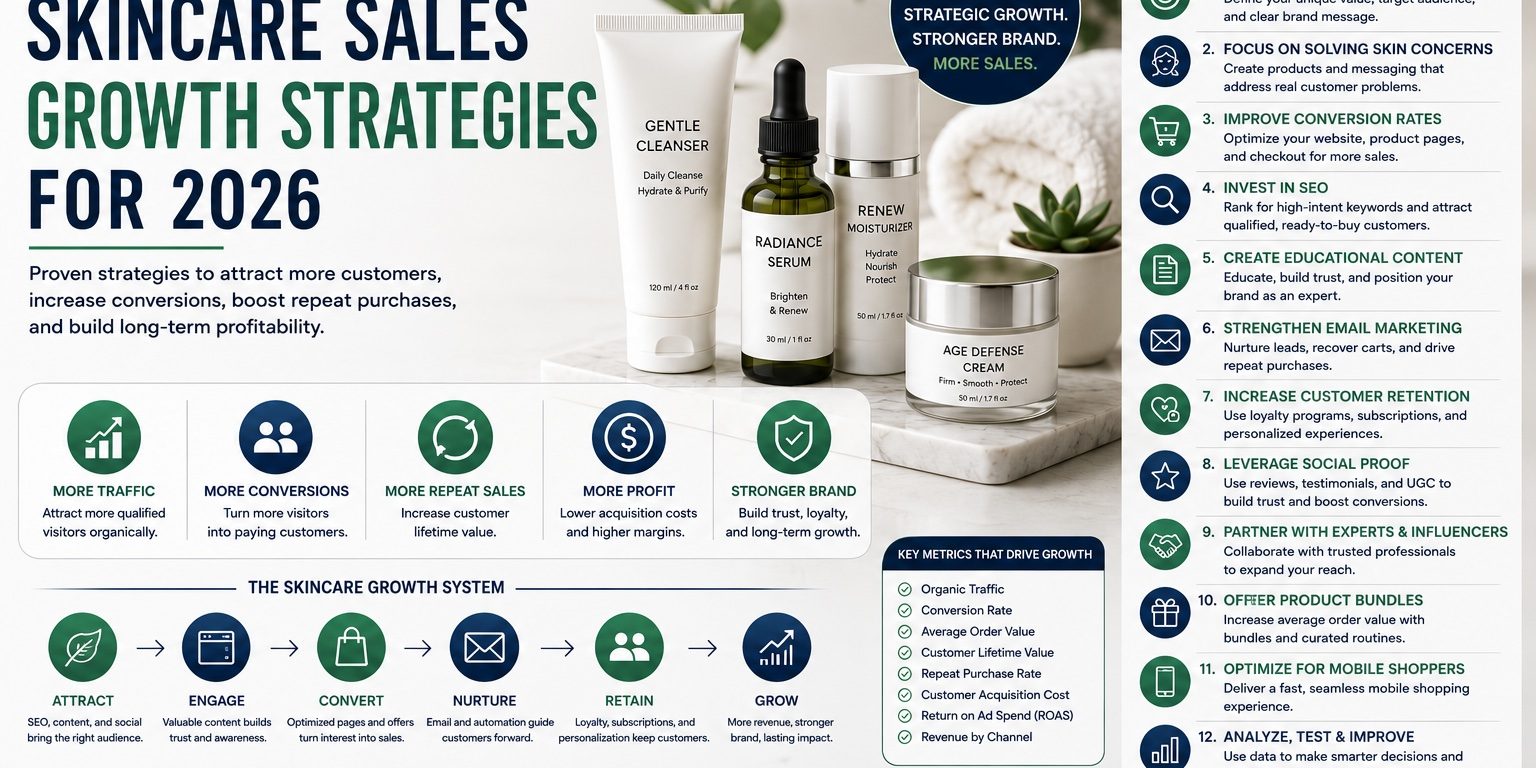
Important performance indicators include:
- Conversion rate
- Average order value
- Customer lifetime value
- Repeat purchase rate
- Organic traffic
- Return on ad spend
- Revenue by channel
- Customer acquisition cost
Regular analysis helps identify strengths and opportunities.
Additionally, data-driven decisions often improve efficiency and profitability.
As a result, businesses can scale more predictably.
Build an Integrated Growth System
The most successful skincare brands do not rely on isolated marketing tactics.
Instead, they create integrated systems that combine:
- SEO
- Content marketing
- Email marketing
- Customer retention
- Social media
- Conversion optimization
- Strategic partnerships
- Operational excellence
When these systems work together, each channel supports the others.
For example, SEO attracts visitors, content builds trust, email nurtures relationships, and retention programs increase customer lifetime value.
Consequently, growth becomes more sustainable and profitable.
Long-Term Benefits of Skincare Sales Growth Strategies for 2026
The most effective skincare sales growth strategies for 2026 focus on building assets and systems rather than chasing short-term results.
Brands that invest in SEO, content marketing, customer retention, conversion optimization, and operational efficiency often create lasting competitive advantages.
Furthermore, these strategies continue producing value long after implementation.
As authority grows and customer relationships strengthen, acquiring new customers becomes easier and more cost-effective.
Ultimately, skincare sales growth strategies for 2026 are about creating a business that can scale predictably while delivering exceptional customer experiences.
Strategic Imperatives for Sustainable Skincare Business Growth
Key takeaways include:
- Build a strong brand position
- Focus on customer outcomes
- Improve website conversion rates
- Invest in SEO
- Create educational content
- Strengthen email marketing
- Increase customer retention
- Leverage social proof
- Build strategic partnerships
- Optimize mobile experiences
- Measure performance consistently
- Develop integrated growth systems
These strategies help skincare brands increase visibility, improve profitability, and support long-term growth.
Q&A
| Question | Answer |
|---|---|
| What are the most effective skincare sales growth strategies for 2026? | SEO, content marketing, customer retention, conversion optimization, and email marketing remain among the most effective strategies. |
| Why is customer retention important for skincare brands? | Repeat customers typically spend more, purchase more frequently, and improve overall profitability. |
| Does SEO still work for skincare companies? | Yes. SEO remains one of the most effective long-term channels for generating qualified traffic and sales. |
| How can skincare brands increase average order value? | Product bundles, subscriptions, and personalized recommendations can increase transaction values. |
| What role does content marketing play in skincare growth? | Educational content builds trust, improves SEO performance, and supports conversion rates. |
How Illumination Consulting Helps Skincare Brands Grow
Illumination Consulting helps skincare brands increase visibility, improve conversions, strengthen customer retention, and generate long-term growth through SEO, website optimization, content marketing, branding, e-commerce consulting, automation, and digital marketing strategies designed to support sustainable profitability.