The skincare industry continues to evolve rapidly as consumer expectations, technology, and competition reshape the marketplace. While demand for skincare products remains strong, building a successful brand requires far more than launching quality products. Today, the most successful skincare companies combine strong branding, effective marketing systems, customer retention strategies, and operational excellence to drive sustainable growth.
Many skincare brands generate initial sales but struggle to scale beyond the startup phase. In most cases, the problem is not product quality. Instead, businesses often lack the systems necessary to consistently attract customers, convert visitors, and increase repeat purchases. Consequently, growth becomes unpredictable and difficult to sustain.
The skincare brands that thrive in 2026 will focus on building complete business ecosystems rather than relying on individual marketing tactics. Furthermore, successful companies will integrate SEO, content marketing, social media, e-commerce optimization, email marketing, and customer retention into a unified growth strategy.
Whether you are launching a new skincare company, growing an established brand, expanding a med spa skincare line, or developing dermatologist-backed products, this framework can help create a roadmap for long-term success.
Establish a Clear Brand Position
Every successful skincare brand begins with strong positioning.
Consumers should immediately understand:
- Who the brand serves
- What problems the products solve
- What makes the products unique
- Why customers should trust the brand
- What results customers can expect
Without clear positioning, marketing efforts become less effective.
For example, luxury skincare brands require different messaging than acne-focused product lines. Similarly, medical-grade skincare companies should communicate differently than clean beauty brands.
Strong positioning helps consumers quickly identify whether the brand aligns with their needs. As a result, customer acquisition becomes more efficient.
Build Products Around Customer Problems
Consumers purchase skincare products because they want solutions.
Therefore, successful skincare brands focus on addressing specific concerns such as:
- Acne
- Wrinkles
- Hyperpigmentation
- Dry skin
- Sensitive skin
- Uneven texture
- Skin aging
- Sun damage
Additionally, product messaging should focus on outcomes rather than ingredients alone.
While ingredients matter, most customers care more about the results they can achieve. Consequently, brands should communicate benefits clearly and consistently.
Develop a High-Converting E-Commerce Website
A website serves as the foundation of the digital customer journey.
Many skincare brands invest heavily in marketing while overlooking website performance. However, traffic alone does not generate revenue.
A high-performing skincare website should include:
- Professional product photography
- Mobile-friendly design
- Fast loading speeds
- Detailed product information
- Customer reviews
- Ingredient transparency
- Frequently asked questions
- Clear calls to action
Furthermore, product pages should answer common customer concerns before they become objections.
When visitors feel informed and confident, conversion rates typically improve.
Create an SEO System for Long-Term Growth
SEO remains one of the most valuable growth channels for skincare brands.
Unlike advertising, SEO continues producing traffic long after content is published.
Important skincare SEO opportunities include:
- Ingredient guides
- Product comparison articles
- Skincare routine content
- Educational blog posts
- FAQ resources
- Product page optimization
- Technical SEO improvements
Additionally, SEO helps skincare brands build authority while attracting qualified visitors.
Consumers frequently search for skincare solutions before making purchases. Therefore, educational content creates opportunities to engage potential customers early in the buying journey.
As a result, SEO often becomes a significant driver of long-term revenue.
Use Content Marketing to Build Authority
Content marketing helps skincare brands educate consumers and establish credibility.
Effective content topics include:
- Ingredient benefits
- Product usage guides
- Anti-aging recommendations
- Acne treatment advice
- Seasonal skincare tips
- Skincare routines
- Product comparisons
- Expert insights
Furthermore, educational content supports SEO while improving customer trust.
Consumers often spend considerable time researching skincare before making purchasing decisions. Consequently, brands that provide helpful information frequently gain a competitive advantage.
Build a Social Media Ecosystem
Social media should support broader business objectives rather than simply generating engagement.
Successful skincare brands use social media to:
- Educate consumers
- Build trust
- Showcase products
- Highlight customer results
- Increase brand awareness
- Support customer retention
High-performing content formats include:
- Product demonstrations
- Before-and-after results
- Customer testimonials
- Educational videos
- Founder stories
- User-generated content
Video content remains particularly effective because skincare products are highly visual.
As a result, social media continues to play an important role in customer acquisition and brand development.
Implement Email Marketing Automation
Email marketing remains one of the highest-return marketing channels available.
Unfortunately, many skincare brands underutilize email.
Essential campaigns include:
- Welcome sequences
- Educational campaigns
- Product launch announcements
- Replenishment reminders
- Abandoned cart recovery
- Customer retention programs
- Loyalty communications
Email marketing allows brands to maintain relationships beyond the initial website visit.
Additionally, automated campaigns help nurture prospects and encourage repeat purchases.
Consequently, email marketing often becomes a major contributor to customer lifetime value.
Prioritize Customer Retention
Customer retention is one of the most important drivers of profitability.
While acquiring new customers is essential, retaining existing customers often produces stronger returns.
Effective retention strategies include:
- Subscription programs
- Loyalty rewards
- VIP memberships
- Product bundles
- Personalized recommendations
- Exclusive promotions
Furthermore, repeat customers frequently spend more over time and generate referrals.
As a result, retention programs improve both revenue and profitability.
Leverage Reviews and Social Proof
Trust plays a major role in skincare purchasing decisions.
Consumers want evidence that products deliver results.
Important forms of social proof include:
- Customer reviews
- Testimonials
- Before-and-after photos
- User-generated content
- Expert endorsements
- Case studies
Additionally, social proof should appear throughout the customer journey.
When customers consistently encounter positive feedback, confidence increases.
Consequently, conversion rates often improve significantly.
Expand Distribution Channels
Many skincare brands begin with direct-to-consumer sales. However, additional distribution channels can accelerate growth.
Potential opportunities include:
- Amazon
- Med spas
- Dermatology clinics
- Plastic surgery practices
- Beauty retailers
- Boutique stores
- Wellness centers
Diversification reduces dependence on any single revenue source.
Furthermore, multiple channels increase visibility and brand awareness.
As a result, businesses often discover new growth opportunities.
Use Data to Guide Growth
Successful skincare companies rely on data rather than assumptions.
Important performance indicators include:
- Organic traffic
- Conversion rate
- Customer acquisition cost
- Customer lifetime value
- Average order value
- Repeat purchase rate
- Return on ad spend
- Revenue by channel
Regular analysis helps identify opportunities and challenges.
Additionally, data-driven decision-making improves efficiency and reduces risk.
Consequently, growth becomes more predictable.
Develop Scalable Operations
Operational excellence becomes increasingly important as revenue grows.
Important operational systems include:
- Inventory management
- Fulfillment processes
- Customer service workflows
- Marketing automation
- Reporting systems
- Financial management
Without strong systems, growth can create operational bottlenecks.
Therefore, successful skincare brands invest in infrastructure before problems arise.
As a result, they are better prepared for future expansion.
Build Strategic Partnerships
Partnerships can accelerate growth while expanding credibility.
Potential partnership opportunities include:
- Influencers
- Dermatologists
- Med spas
- Plastic surgeons
- Beauty professionals
- Industry publications
- Affiliate marketers
The most effective partnerships create value for all parties involved.
Furthermore, trusted recommendations often outperform traditional advertising.
Consequently, partnerships can become powerful growth drivers.
Create a Complete Growth System
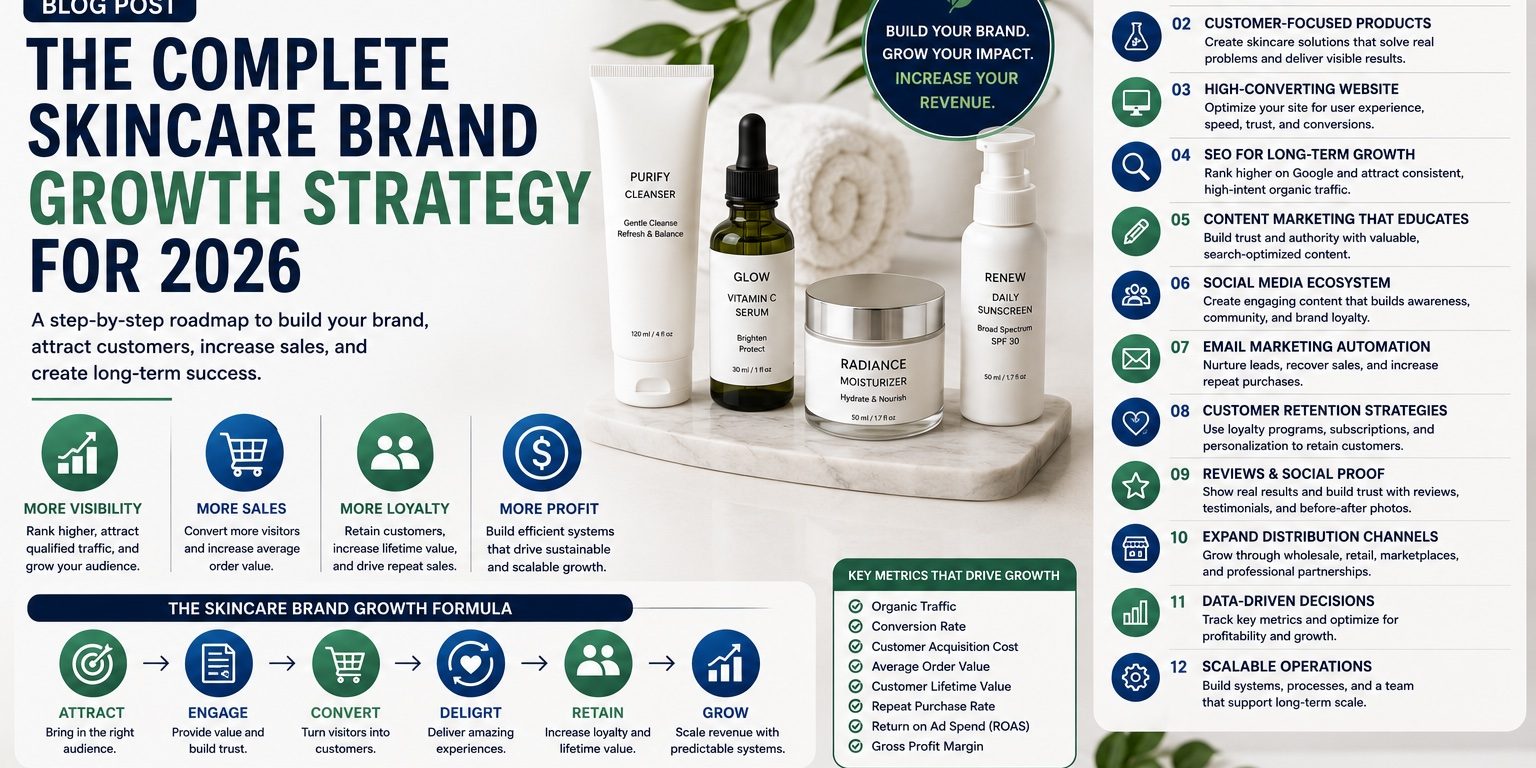
The complete skincare brand growth strategy for 2026 depends on creating integrated systems rather than relying on isolated tactics.
Successful brands combine:
- SEO
- Content marketing
- Social media
- Email marketing
- Customer retention
- E-commerce optimization
- Strategic partnerships
- Operational excellence
When these systems work together, each channel strengthens the others.
For example, SEO generates traffic, content builds trust, email nurtures relationships, and retention programs increase lifetime value.
As a result, growth becomes more sustainable and predictable.
Long-Term Benefits of a Comprehensive Growth Strategy
The complete skincare brand growth strategy for 2026 provides advantages that extend far beyond short-term sales.
Brands that invest in long-term systems often achieve:
- Greater visibility
- Stronger customer loyalty
- Higher profitability
- Improved operational efficiency
- Increased brand authority
- Sustainable growth
Furthermore, integrated marketing and operational systems create compounding benefits over time.
Consequently, businesses become more resilient and better positioned for future opportunities.
Key Takeaways
Key takeaways include:
- Build a strong brand position
- Focus on solving customer problems
- Create a high-converting website
- Invest in SEO and content marketing
- Develop email marketing automation
- Prioritize customer retention
- Leverage social proof
- Expand distribution channels
- Use data to guide decisions
- Build scalable systems
These strategies help skincare brands increase visibility, improve profitability, and achieve long-term growth.
Strategic Growth Roadmap for Skincare Brands in 2026
| Question | Answer |
|---|---|
| What is the most important factor in skincare brand growth? | Strong systems that combine marketing, retention, operations, and customer experience often drive the greatest results. |
| Is SEO still important for skincare brands in 2026? | Yes. SEO remains one of the most effective long-term customer acquisition channels available. |
| How can skincare brands improve customer retention? | Loyalty programs, subscriptions, personalized recommendations, and email marketing can significantly increase retention. |
| Should skincare brands expand into wholesale channels? | Many brands benefit from wholesale partnerships with med spas, dermatologists, and retailers. |
| What separates successful skincare brands from struggling competitors? | Successful brands typically combine strong branding, effective marketing systems, operational excellence, and customer retention strategies. |
How Illumination Consulting Helps Skincare Brands Grow
Illumination Consulting helps skincare brands launch, market, and scale through branding, SEO, website optimization, content marketing, e-commerce growth strategies, automation, and digital marketing systems designed to increase visibility, generate sales, improve customer retention, and support long-term profitability.