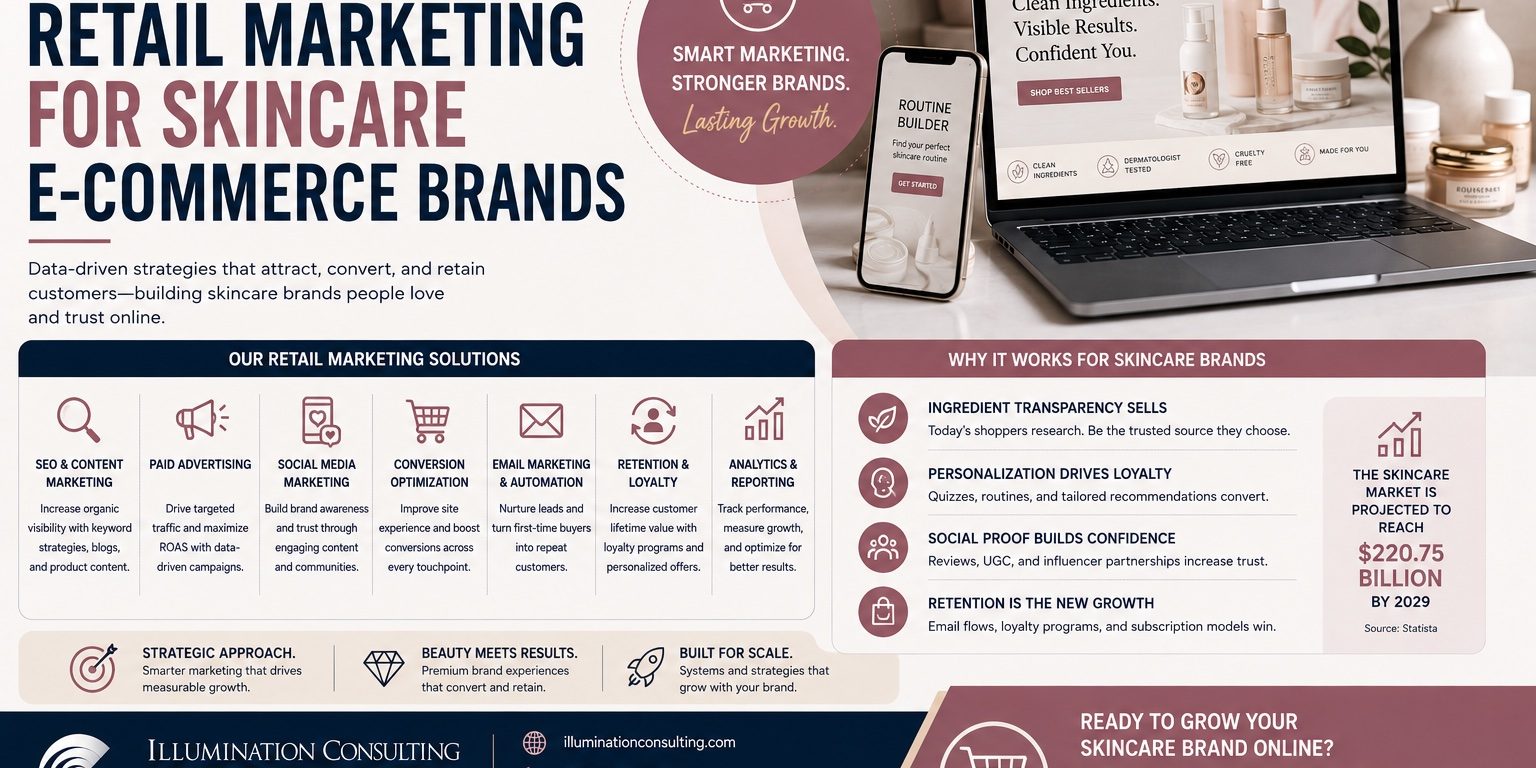
Retail Marketing for Skincare E-Commerce Brands
By Illumination Consulting Editorial Team · Updated 2026-07-29
Ingredient transparency, personalization, and social proof drive skincare e-commerce success, with the category projected to reach $220.75 billion by 2029. Brands must combine quizzes, routine builders, and influencer campaigns to convert research-driven consumers into loyal, repeat customers.
Effective retail marketing for skincare e-commerce brands combines SEO, content marketing, paid advertising, email campaigns, and conversion optimization into one coordinated system rather than isolated tactics. cite-1 With skincare projected to reach $220.75 billion by 2029, brands win through ingredient transparency, personalization tools like quizzes, and retention-focused email flows that turn first-time buyers into repeat customers.
Key Takeaways
- Skincare ecommerce market reaches $220.75 billion by 2029, driven by ingredient transparency and personalization strategies.
- Successful brands identify defining characteristics and lean into them consistently across all marketing efforts.
- Product descriptions require features, benefits, selling points, ingredient lists, and instructions for maximum conversion.
- Fastest-growing skincare brands prioritize marketing strategy execution over product formulation alone for competitive differentiation.
What Builds a Winning Skincare Retail Strategy?
A winning strategy fuses seven disciplines into one system: search engine optimization, content marketing, social media, paid advertising, conversion optimization, email marketing, and retention initiatives. Retail marketing for skincare brands fails when these functions operate in isolation. A brand running ads without a conversion-ready site wastes budget; a brand posting content without email retention loses repeat buyers. Coordination, not volume, separates brands that scale from brands that stall.
The category rewards this coordination. Skincare demand keeps climbing, with the market projected to reach $220.75 billion by 2029. That growth means more competitors chasing the same customer attention.
What does effective skincare retail marketing actually deliver?
Skincare retail marketing should produce qualified customer acquisition, stronger brand awareness, and measurable revenue growth, not vanity impressions. A results-oriented system tracks:
- Qualified customer inquiries and site traffic increases
- Conversion rate improvements across product pages
- Retention metrics tied to email and loyalty programs
How does this strategy support long-term growth?
Customized marketing systems should target three outcomes: acquisition, retention, and sustained growth. Short-term promotions rarely build lasting brand equity. Strategy built for the long haul turns first-time buyers into repeat customers, which matters more as the category grows more crowded each year.
How Can Skincare Brands Stand Out Online?
Differentiation, not demand, decides which skincare brands win online today. New product lines launch every week, and established players already dominate shelf space and search results. Standing out requires retail marketing for skincare that combines visibility strategy with genuine product storytelling, not louder advertising.
Local search plays a bigger role than most brands assume. Strengthening local search visibility through dedicated retail SEO gives smaller skincare labels a foothold against national competitors, especially when shoppers search for products available near them or ready to ship quickly.
Why does SEO matter more than paid ads for skincare brands?
Paid ads generate short-term traffic, but the cost climbs fast. Advanced skincare retail marketing work, paired with content development and technical site optimization, converts more organic search traffic into actual sales. That reduces dependency on paid ads alone. Builds a channel that keeps producing results long after a campaign budget runs dry.
What tools help shoppers choose the right product?
Interactive tools solve a real shopper problem: too many options, not enough clarity. Quiz-style product matchers cut down the research shoppers must do on their own, guiding them toward items suited to their specific skin concerns. Brands executing strong product launch marketing often pair these quizzes directly with new releases to shorten the path from discovery to purchase.
How Should Skincare Brands Launch New Products?
Successful launches start on social media, not on the product page. Shoppers form their first impression of a brand through Instagram, TikTok, or YouTube long before they ever land on a website or add an item to cart. A weak or inconsistent presence during launch week costs brands the trust needed to convert browsers into buyers.
Product launch marketing works best when built on a foundation of consistent, educational content rather than one-off promotional posts. Brands that publish regularly around a launch demonstrate expertise, show real results, and answer the questions shoppers have before they buy.
What channels drive the strongest skincare launch results?
High-performing brands lean on a specific mix of channels rather than scattering effort everywhere:
- Influencer partnerships that lend credibility and reach new audiences
- AI-driven personalization that matches product recommendations to shopper needs
- TikTok content formats built for discovery and shareability
- Paid advertising channels timed to launch-week visibility
Does content strategy matter more than the product itself?
Formulation quality alone rarely wins a launch. Skincare retail marketing succeeds when brands pair strong products with structured storytelling, education, and proof of results across every channel shoppers already trust.
Retail skincare e-commerce brands that prioritize strategic positioning, seamless digital experiences, and authentic customer engagement establish the foundation for sustainable competitive advantage. By integrating comprehensive marketing systems with conversion-focused design. Data-driven optimization, brands transform their online presence into a powerful growth engine. The path forward demands commitment to these integrated strategies—not as isolated tactics. As interconnected elements of a cohesive business system designed to drive measurable results and long-term market success.
FAQ
What are the key disciplines in a skincare retail marketing strategy?
A winning strategy fuses seven disciplines: SEO, content marketing, social media, paid advertising, conversion optimization, email marketing, and retention initiatives. These functions work as one coordinated system rather than isolated tactics, which prevents wasted ad budget and lost repeat buyers.
How big is the skincare e-commerce market expected to grow?
The skincare e-commerce category reaches $220.75 billion by 2029. This growth stems from ingredient transparency, personalization tools like quizzes and routine builders, and influencer campaigns that convert research-driven consumers into loyal customers.
How do smaller skincare brands compete against established players online?
Smaller labels strengthen local search visibility through dedicated retail SEO to gain a foothold against national competitors. This approach helps when shoppers search for products available nearby or ready to ship quickly.
Facts
- Illumination Consulting is located in Beverly Hills, CA, USA.