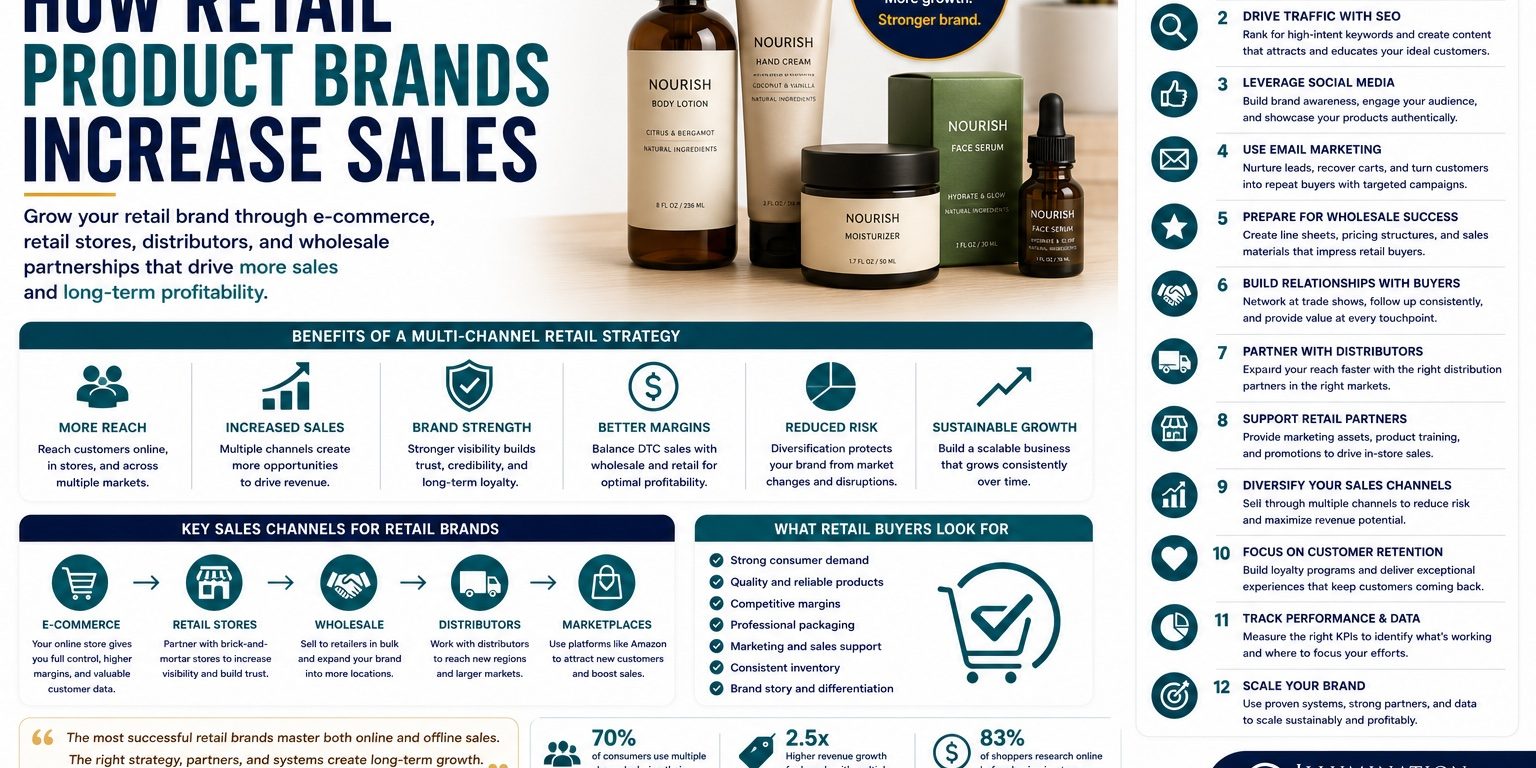
Many product-based businesses focus heavily on online sales when launching a new brand. While e-commerce remains an important growth channel, the most successful retail product companies rarely rely on a single sales channel. Instead, they build diversified revenue streams that include direct-to-consumer sales, wholesale accounts, distributors, retail buyers, and strategic partnerships.
Today’s consumers discover products through multiple touchpoints. They may first encounter a brand on social media, research it online, purchase through an e-commerce website, and later find the same product in a retail store. Consequently, successful brands create integrated sales and marketing systems that support both online and offline growth.
Many founders assume that great products automatically attract buyers. However, retailers, distributors, and consumers all evaluate products differently. As a result, brands must develop strategies that address each audience while maintaining consistent positioning and messaging.
Understanding how retail product brands increase sales through e-commerce, retail stores, and distribution can help companies expand market reach, improve revenue stability, and create long-term competitive advantages.
Whether you sell skincare products, wellness products, beauty products, consumer packaged goods, supplements, apparel, or specialty retail items, these strategies can help accelerate growth.
Why Diversification Matters
One of the biggest mistakes retail brands make is relying too heavily on a single sales channel.
Examples include:
- Only selling through Shopify
- Only selling through Amazon
- Only selling through distributors
- Only pursuing retail stores
While each channel offers opportunities, dependence on a single source creates risk.
Furthermore, consumer buying behavior continues to evolve.
As a result, diversification improves stability and growth potential.
Successful brands often combine:
- E-commerce
- Wholesale sales
- Retail partnerships
- Distribution networks
- Marketplace sales
- Strategic alliances
Consequently, revenue becomes more predictable and scalable.
Build a Strong Direct-to-Consumer Website
A direct-to-consumer website serves as the foundation of many modern retail brands.
Benefits include:
- Higher profit margins
- Greater customer control
- Better data collection
- Improved brand experiences
- Stronger customer relationships
Important website elements include:
- Mobile-friendly design
- Fast load speeds
- Professional branding
- Product education
- Customer reviews
- Subscription options
- Easy checkout processes
Additionally, direct sales provide valuable customer insights.
As a result, brands can improve products, marketing, and retention strategies.
Invest in Search Engine Optimization
SEO remains one of the most effective long-term customer acquisition channels.
Consumers frequently search for:
- Product solutions
- Product comparisons
- Buying guides
- Product reviews
- Industry information
Effective SEO strategies include:
- Product page optimization
- Educational blog content
- Technical SEO improvements
- Internal linking
- Keyword targeting
Furthermore, SEO attracts highly qualified consumers actively seeking solutions.
Consequently, organic traffic often generates strong conversion rates.
Develop a Content Marketing Strategy
Content marketing helps brands educate consumers while building authority.
Effective content may include:
- Buying guides
- Industry trends
- Product comparisons
- Educational resources
- How-to articles
- Customer success stories
Additionally, content supports SEO and customer trust simultaneously.
When consumers view a brand as an expert, purchasing confidence often increases.
Leverage Social Media for Brand Awareness
Social media helps brands reach consumers at various stages of the buying journey.
Popular platforms include:
- TikTok
- YouTube
Successful content often includes:
- Product demonstrations
- Educational content
- Customer stories
- Behind-the-scenes content
- Founder insights
Furthermore, social media supports brand familiarity and engagement.
Consequently, consumers are more likely to purchase when ready.
Use Email Marketing to Drive Repeat Sales
Email marketing remains one of the highest-performing channels for retail brands.
Important email campaigns include:
- Welcome sequences
- Product education
- New product launches
- Cart abandonment reminders
- Loyalty campaigns
- Replenishment reminders
Additionally, email provides direct access to customers without relying on social media algorithms.
As a result, retention often improves significantly.
Prepare for Wholesale Growth
Wholesale sales allow brands to expand beyond direct-to-consumer channels.
Potential wholesale partners include:
- Independent retailers
- Specialty stores
- Boutiques
- Regional chains
- Professional offices
Before approaching retailers, brands should develop:
- Wholesale pricing structures
- Product catalogs
- Line sheets
- Sales materials
- Brand presentations
Furthermore, professional preparation improves credibility with buyers.
Consequently, wholesale opportunities become easier to secure.
Understand What Retail Buyers Want
Retail buyers evaluate products differently than consumers.
They focus on:
- Product demand
- Margin opportunities
- Brand strength
- Packaging quality
- Marketing support
- Inventory reliability
Additionally, buyers want confidence that products will sell.
Successful brands often provide:
- Sales data
- Marketing support
- Consumer demand indicators
- Professional presentations
As a result, buyer confidence increases.
Build Relationships With Retail Buyers
Retail growth often depends on relationships.
Important strategies include:
- Industry trade shows
- Buyer outreach
- Product sampling
- Follow-up communication
- Professional presentations
Furthermore, retail buyers receive countless product pitches.
Therefore, persistence and professionalism matter significantly.
Consequently, relationship-building often becomes a competitive advantage.
Work With Distributors Strategically
Distributors can help brands scale more quickly.
Benefits may include:
- Expanded market access
- Retail relationships
- Sales support
- Logistics assistance
- Geographic expansion
However, not every product is ready for distribution.
Brands should evaluate:
- Margins
- Demand
- Production capacity
- Operational readiness
Additionally, distributor partnerships require careful planning.
As a result, successful relationships often begin after strong market validation.
Attend Industry Trade Shows
Trade shows remain valuable for retail growth.
Benefits include:
- Buyer meetings
- Distributor introductions
- Industry networking
- Brand visibility
- Market research
Furthermore, trade shows provide opportunities to build relationships face-to-face.
Consequently, many brands secure valuable partnerships through industry events.
Create Retail Marketing Support Programs
Retailers prefer brands that actively support sales.
Effective support programs include:
- Point-of-sale materials
- Product training
- Consumer promotions
- Social media support
- Educational resources
Additionally, retail support helps products perform more effectively in stores.
As a result, retailers are more likely to continue carrying the brand.
Focus on Customer Retention
Growth does not come solely from acquiring customers.
Successful retail brands prioritize retention through:
- Loyalty programs
- Subscription models
- Email marketing
- Community building
- Exceptional customer experiences
Furthermore, repeat customers often generate higher lifetime value.
Consequently, retention significantly improves profitability.
Use Data to Guide Expansion
Expansion decisions should be based on performance data.
Important metrics include:
- Customer acquisition costs
- Conversion rates
- Average order value
- Customer lifetime value
- Wholesale performance
- Retail sell-through rates
Additionally, data helps identify growth opportunities.
As a result, brands make more informed decisions.
Why Integrated Sales Channels Create Stronger Brands
The most successful retail product brands rarely depend on one source of revenue.
Instead, they combine:
- E-commerce sales
- Wholesale partnerships
- Retail accounts
- Distribution networks
- Marketplace exposure
- Strategic relationships
Furthermore, these channels support one another.
For example:
- Online marketing creates consumer demand
- Retail stores increase visibility
- Distributors expand reach
- Email marketing improves retention
Consequently, growth becomes more sustainable.
Long-Term Benefits of Multi-Channel Growth
Brands that successfully combine e-commerce, retail stores, and distribution often experience:
- Greater market reach
- Increased revenue
- Improved stability
- Better brand recognition
- Higher customer lifetime value
- Stronger profitability
Additionally, diversified sales channels reduce risk.
As a result, companies become more resilient during changing market conditions.
Ultimately, understanding how retail product brands increase sales through e-commerce, retail stores, and distribution helps businesses build stronger foundations, expand market presence, and achieve long-term growth.
Key Takeaways
Key takeaways include:
- Diversified sales channels reduce risk
- E-commerce provides direct customer access
- SEO drives qualified traffic
- Content marketing builds authority
- Social media increases visibility
- Email marketing improves retention
- Wholesale expands market reach
- Retail buyers evaluate products differently
- Distributor partnerships support scaling
- Trade shows create opportunities
- Retail support improves sell-through
- Data drives better decisions
These strategies help retail brands expand distribution, increase sales, and build sustainable long-term success.
Q&A
| Question | Answer |
|---|---|
| Should retail brands sell online and through retail stores? | Yes. Multi-channel sales strategies often provide greater growth and stability than relying on a single channel. |
| When should a brand approach retail buyers? | Typically after establishing demand, refining operations, and preparing professional wholesale materials. |
| Are distributors necessary for growth? | Not always. However, distributors can accelerate expansion once a brand is operationally ready. |
| Why is SEO important for retail brands? | SEO attracts consumers actively searching for products and solutions online. |
| What is the biggest mistake retail brands make? | Many rely too heavily on one sales channel rather than building diversified revenue streams. |
How Illumination Consulting Helps Retail Product Brands Grow
Illumination Consulting helps retail product brands increase visibility, improve e-commerce performance, attract retail buyers, strengthen wholesale strategies, optimize websites, implement SEO, develop marketing systems, and create growth strategies that support long-term expansion across online and retail sales channels.