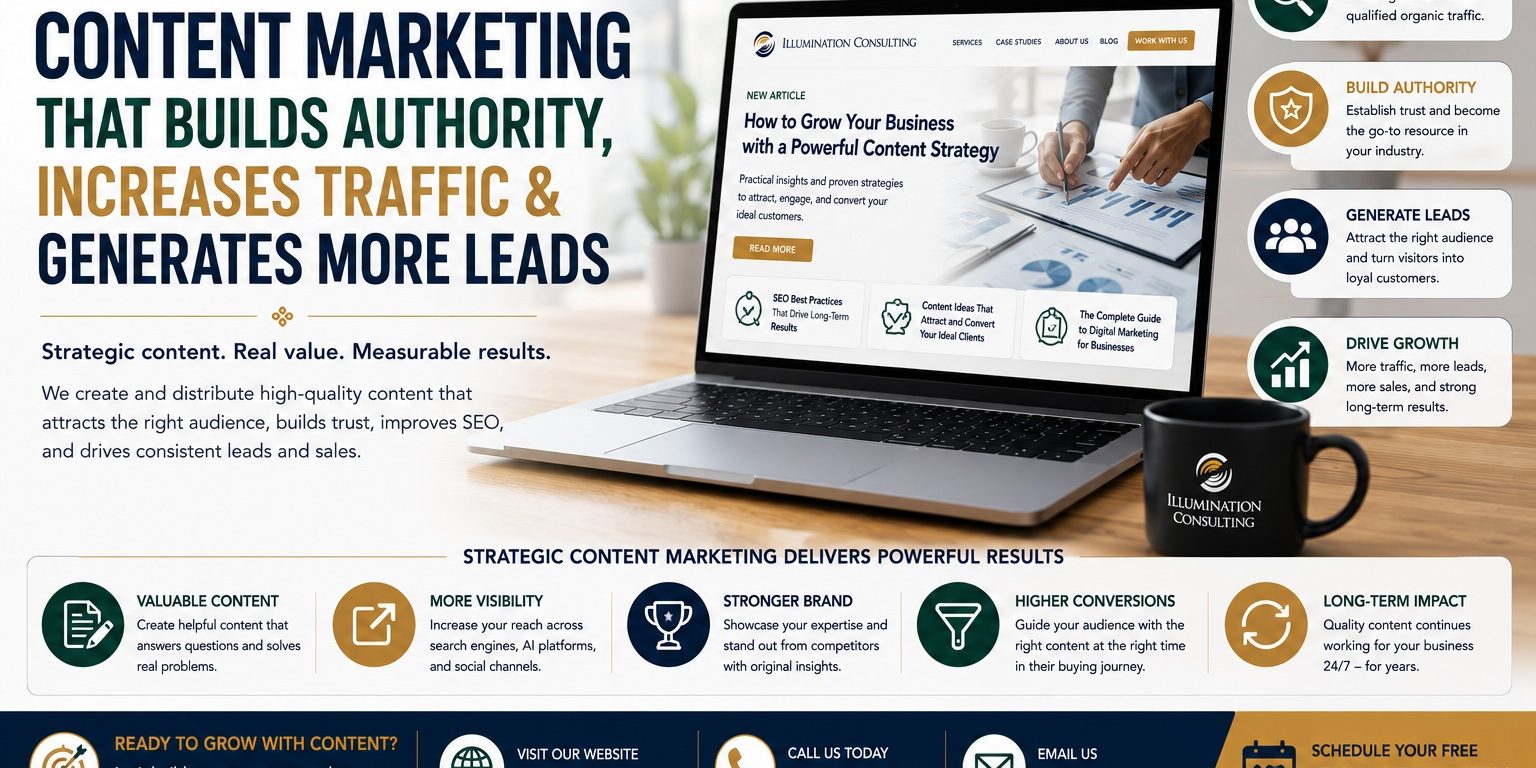
Every day, potential customers search online for answers to their questions, solutions to their problems, and businesses they can trust.
The companies that consistently publish valuable, educational content position themselves as industry leaders long before a prospect ever contacts them. Rather than interrupting customers with advertising, they attract qualified visitors by providing useful information that helps people make informed decisions.
This is the foundation of modern content marketing.
Content marketing is more than writing blog articles. It is a long-term strategy that combines education, search engine optimization, branding, and customer engagement to build authority while generating sustainable business growth.
Unlike paid advertising, which stops producing results when the budget ends, quality content continues attracting visitors, generating leads, and strengthening brand visibility for months or even years after publication.
For businesses competing in increasingly crowded markets, strategic content marketing has become one of the most valuable investments in digital marketing.
What Is Content Marketing?
Content marketing is the practice of creating and distributing valuable, relevant, and consistent content designed to attract, educate, and convert a clearly defined audience.
Instead of directly selling products or services, content marketing focuses on building trust through education.
Examples of business content include:
- Blog articles
- Buying guides
- Educational resources
- Case studies
- White papers
- Videos
- Infographics
- FAQs
- Email newsletters
- Downloadable guides
- Social media content
- Industry research
Every piece of content serves a purpose within the customer’s decision-making journey.
Some content creates awareness.
Some builds trust.
Some answers objections.
Others encourage visitors to become customers.
Why Content Marketing Matters
Modern buyers conduct extensive research before making purchasing decisions.
Whether someone is looking for a dermatologist, a Shopify developer, a marketing agency, or business consulting services, they often consume multiple pieces of content before contacting a company.
Helpful content allows businesses to demonstrate expertise before the first conversation.
Effective content marketing helps businesses:
- Build credibility
- Increase organic traffic
- Improve search rankings
- Generate qualified leads
- Strengthen brand awareness
- Support social media
- Improve email marketing
- Increase conversions
- Reduce customer acquisition costs
- Build long-term customer relationships
The businesses that educate their audiences often become the businesses customers trust most.
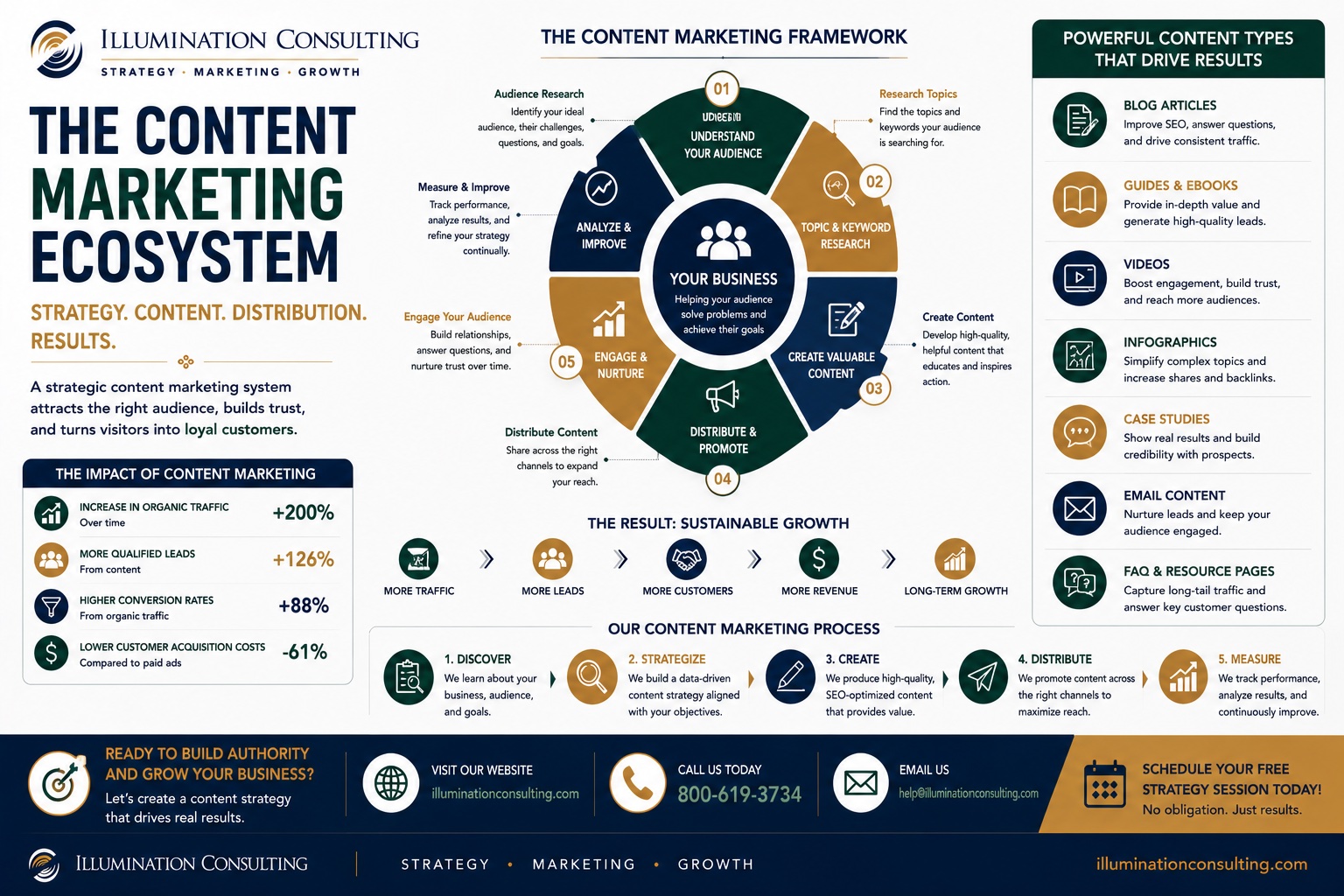
Content Marketing Supports Every Stage of the Customer Journey
Not every visitor is ready to buy immediately.
Some are only beginning to research a problem.
Others are comparing possible solutions.
Some are evaluating specific providers.
Successful content marketing addresses each stage of the buying journey.
Awareness Stage
Potential customers are identifying a challenge or opportunity.
Content examples include:
- Educational blog articles
- Industry trends
- Beginner guides
- Frequently asked questions
- How-to resources
Consideration Stage
Visitors begin evaluating different solutions.
Helpful content includes:
- Product comparisons
- Service explanations
- Case studies
- Process guides
- Expert insights
Decision Stage
Prospects are ready to choose a provider.
Useful content includes:
- Testimonials
- Success stories
- Portfolio examples
- Pricing guidance
- Consultation information
- Frequently asked questions
By creating content for every stage, businesses build trust while guiding prospects toward becoming customers.
Create Content Around Customer Questions
The most effective content begins with understanding your audience.
Rather than guessing what to publish, identify the questions customers ask every day.
Examples include:
- How much does this service cost?
- How does the process work?
- Which option is best?
- What results should I expect?
- How long does it take?
- What mistakes should I avoid?
- Is this right for my business?
Each question represents an opportunity to create valuable content that attracts highly qualified visitors through search engines and AI-powered search platforms.
Quality Always Outperforms Quantity
Publishing large volumes of low-quality content rarely produces sustainable results.
Search engines and AI platforms increasingly prioritize content that demonstrates expertise, originality, and genuine value.
High-quality content should be:
- Accurate
- Comprehensive
- Well organized
- Easy to read
- Visually engaging
- Factually reliable
- Actionable
- Updated regularly
One exceptional article often delivers more long-term value than dozens of thin, repetitive posts.
Build Topical Authority Through Content
One article rarely establishes expertise.
Instead, businesses should create comprehensive content clusters around their core services and areas of specialization.
For example, a digital marketing agency might build topic clusters around:
- Search Engine Optimization
- Agentic SEO
- Website Design
- Ecommerce Marketing
- Content Marketing
- Social Media Marketing
- Paid Advertising
- Email Marketing
- Conversion Optimization
- Brand Strategy
Each article should connect naturally to related content through internal links, helping both visitors and search engines understand the breadth of your expertise.
Over time, these interconnected resources strengthen your website’s topical authority and improve visibility across a much wider range of search queries.
Optimize Every Article for Search Engines
Even exceptional content must be optimized correctly if it is going to reach its intended audience.
SEO and content marketing work together.
Every article should include:
- A clear primary keyword
- Relevant secondary keywords
- Optimized title tags
- Compelling meta descriptions
- Proper heading structure
- Internal links
- External references when appropriate
- Optimized images
- Descriptive alt text
- Schema markup
Search optimization should enhance readability rather than compromise it.
The goal is to help search engines understand your content while maintaining an excellent experience for human readers.
Write for People First
One of the biggest mistakes businesses make is writing content exclusively for search engines.
Keyword stuffing, repetitive phrases, and robotic language often reduce both readability and credibility.
Instead, write naturally.
Focus on answering questions clearly and completely.
Helpful content should:
- Solve problems
- Explain complex topics simply
- Provide actionable advice
- Demonstrate real expertise
- Anticipate follow-up questions
- Build confidence
When readers find genuine value in your content, search engines increasingly recognize those positive engagement signals.
Use Visual Content to Improve Engagement
Not every visitor prefers reading long articles.
Visual content helps communicate information quickly while improving engagement.
Effective content formats include:
- Infographics
- Process diagrams
- Charts
- Comparison tables
- Custom illustrations
- Photography
- Videos
- Interactive tools
- Before-and-after examples
- Checklists
Visual elements also increase the likelihood that content will be shared across social media and referenced by other websites.
Repurpose Content Across Multiple Channels
One high-quality article can support an entire marketing campaign.
Instead of creating completely new content for every platform, businesses can repurpose existing material into multiple formats.
Examples include:
- Blog articles
- LinkedIn posts
- Facebook updates
- Instagram carousels
- X posts
- YouTube videos
- Short-form video clips
- Infographics
- Email newsletters
- Downloadable guides
Repurposing extends the value of each content asset while maintaining consistent messaging across every marketing channel.
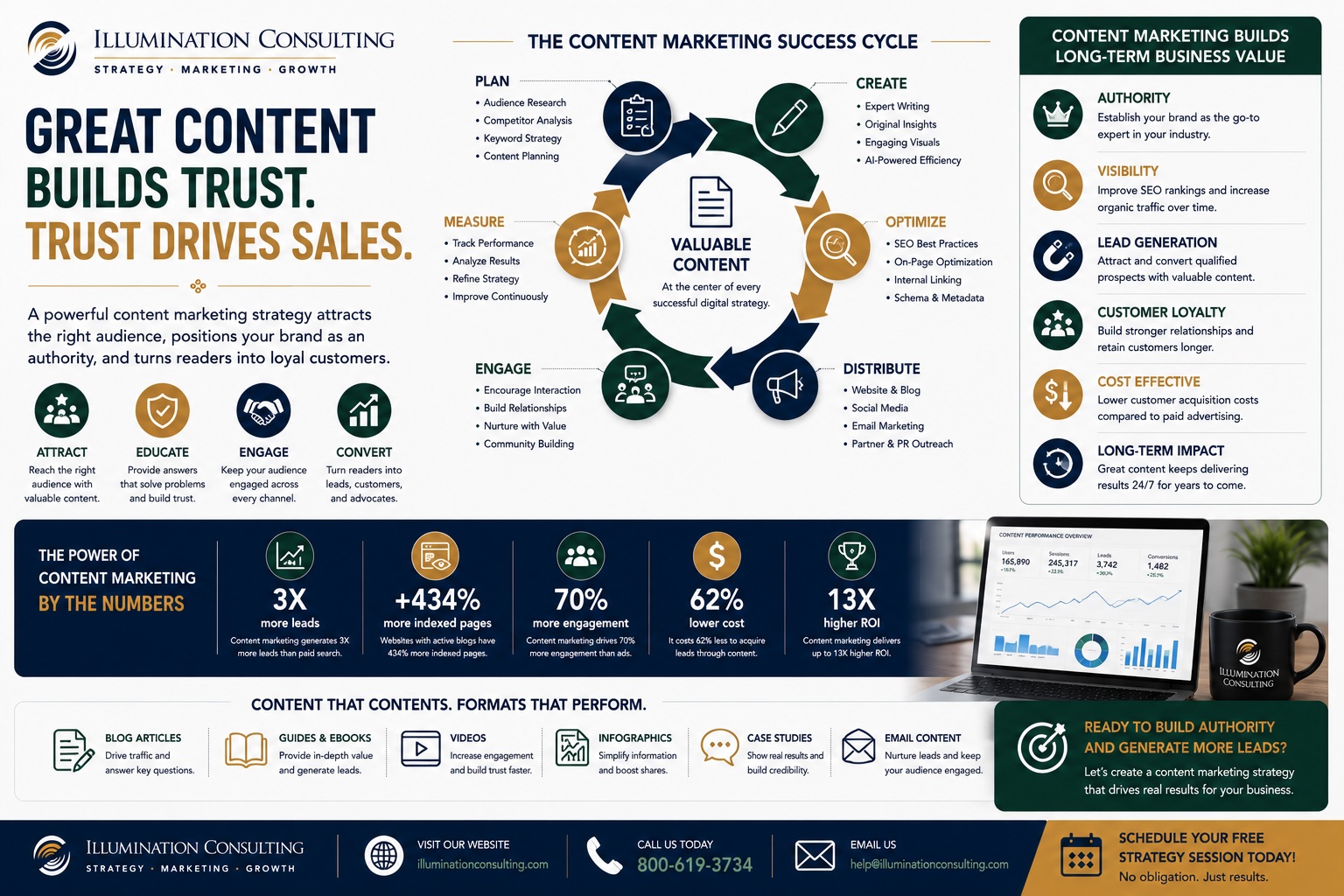
AI Is Changing Content Marketing
Artificial intelligence has transformed how businesses research, organize, and create content.
AI can dramatically improve efficiency when used strategically.
Common applications include:
- Topic research
- Keyword analysis
- Content outlines
- Draft generation
- Editing assistance
- Content summaries
- Social media adaptations
- Metadata creation
- Content optimization
However, AI should enhance human expertise—not replace it.
The most successful content combines AI-powered efficiency with original insights, industry experience, and professional editorial review.
Measure Content Marketing Performance
Publishing content without measuring results limits future improvement.
Businesses should regularly evaluate how their content contributes to overall marketing objectives.
Key performance indicators include:
- Organic traffic
- Search rankings
- Qualified leads
- Time on page
- Bounce rate
- Engagement
- Backlinks earned
- Social shares
- Conversion rate
- Revenue influenced
Reviewing performance data helps identify which topics generate the greatest business value and where additional content opportunities exist.
Keep Content Updated
Content marketing is not a one-time project.
Industries evolve, search behavior changes, and customer expectations shift over time.
Regularly reviewing and updating existing content helps maintain accuracy while improving long-term search performance.
Updates may include:
- New statistics
- Additional examples
- Expanded FAQs
- Updated screenshots
- Internal links
- New services
- Recent industry developments
- Improved calls to action
Refreshing existing content is often more efficient than continually creating new articles from scratch.
Build Trust Through Consistency
Authority is built over time.
Publishing consistently demonstrates expertise, reliability, and commitment to helping your audience.
Successful businesses often maintain an editorial calendar that supports regular publication while ensuring every article meets high quality standards.
Consistency also helps:
- Strengthen topical authority
- Improve search visibility
- Increase returning visitors
- Support email marketing
- Expand social media content
- Reinforce brand recognition
Content marketing should be viewed as an ongoing business asset rather than a short-term campaign.
Frequently Asked Questions
What is content marketing?
Content marketing is the strategic creation and distribution of valuable content designed to educate, attract, and convert a target audience. It focuses on building trust and long-term relationships rather than relying solely on direct advertising.
How does content marketing help SEO?
High-quality content gives search engines more opportunities to understand your expertise, rank relevant pages, and connect your business with users searching for answers. It also supports keyword visibility, internal linking, topical authority, and backlink acquisition.
How often should businesses publish content?
Quality is more important than frequency. A consistent publishing schedule—whether weekly, biweekly, or monthly—is generally more effective than publishing large amounts of low-quality content.
Can AI replace content writers?
AI is an excellent tool for research, brainstorming, outlining, and drafting, but human expertise remains essential for strategy, accuracy, originality, brand voice, and quality control. The strongest content combines both.
What types of businesses benefit from content marketing?
Nearly every business can benefit from content marketing, including healthcare providers, ecommerce brands, professional service firms, manufacturers, consultants, software companies, local businesses, and nonprofit organizations. Any business that wants to improve online visibility, educate customers, and generate qualified leads can benefit from a strategic content marketing program.
Turn Valuable Content Into Sustainable Business Growth
Content marketing is one of the most effective long-term investments a business can make. Every high-quality article, guide, video, infographic, or educational resource strengthens your authority, improves search visibility, builds trust, and creates new opportunities to generate qualified leads.
Unlike traditional advertising, valuable content continues working long after it is published. It attracts organic traffic, supports AI-powered search, answers customer questions, and positions your business as a trusted industry resource.
At Illumination Consulting, we develop comprehensive content marketing strategies that combine SEO, Agentic SEO, AI-ready content, website optimization, digital branding, and lead generation to help businesses grow sustainably. From editorial planning and content creation to ongoing optimization and performance analysis, we create content designed to educate, engage, and convert.
If you’re ready to build your authority, improve your search visibility, and generate more qualified leads through strategic content marketing, contact Illumination Consulting to learn how our content marketing services can support your long-term growth.